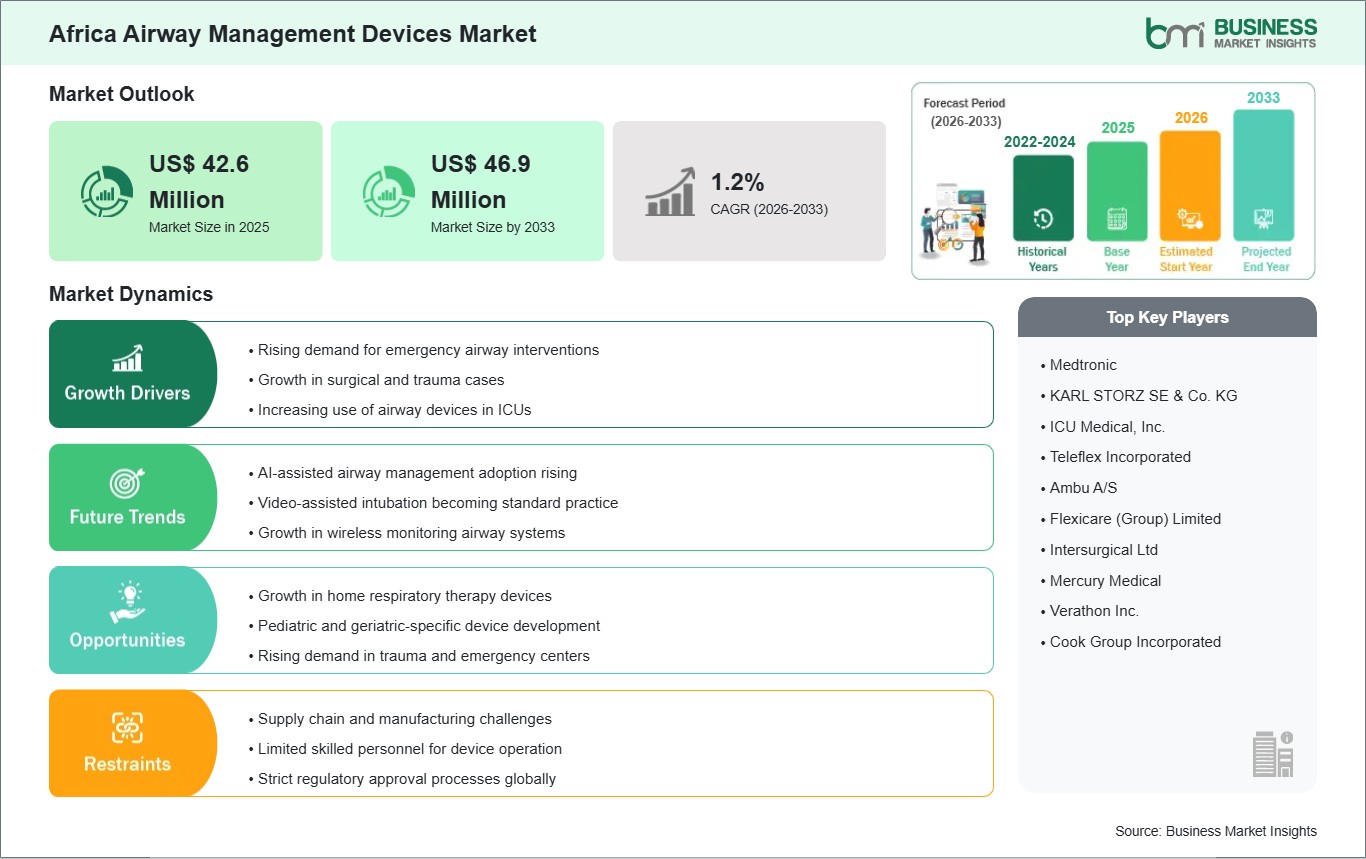
The Africa airway management devices market size is expected to reach US$ 46.9 million by 2033 from US$ 42.6 million in 2025. The market is estimated to record a CAGR of 1.2% from 2026 to 2033.
The airway management devices market in Africa has developed gradually, driven by the rising awareness of healthcare, innovations in surgical processes, and the development of hospital infrastructure in urban and semi-urban areas. There is high demand for airway management devices such as endotracheal tubes, laryngeal masks, and supraglottic airways due to the increasing prevalence of respiratory illnesses, trauma cases, and the growing need for emergency care. Another important market trend is the use of cost-effective and disposable airway management devices to reduce the risk of infections in the treatment process. Training programs are conducted for healthcare professionals to ensure proper usage of airway management devices.
Market growth is restrained because of disparities in healthcare infrastructure, lack of access to cutting-edge equipment in rural and underdeveloped regions, and exorbitant prices for modern technologies. Furthermore, the absence of an all-encompassing reimbursement strategy in some nations might hinder the deployment of sophisticated products. Nevertheless, the overall market in Africa is supported by growing investments in the healthcare sector, rising surgical volumes, and improved emergency response systems.

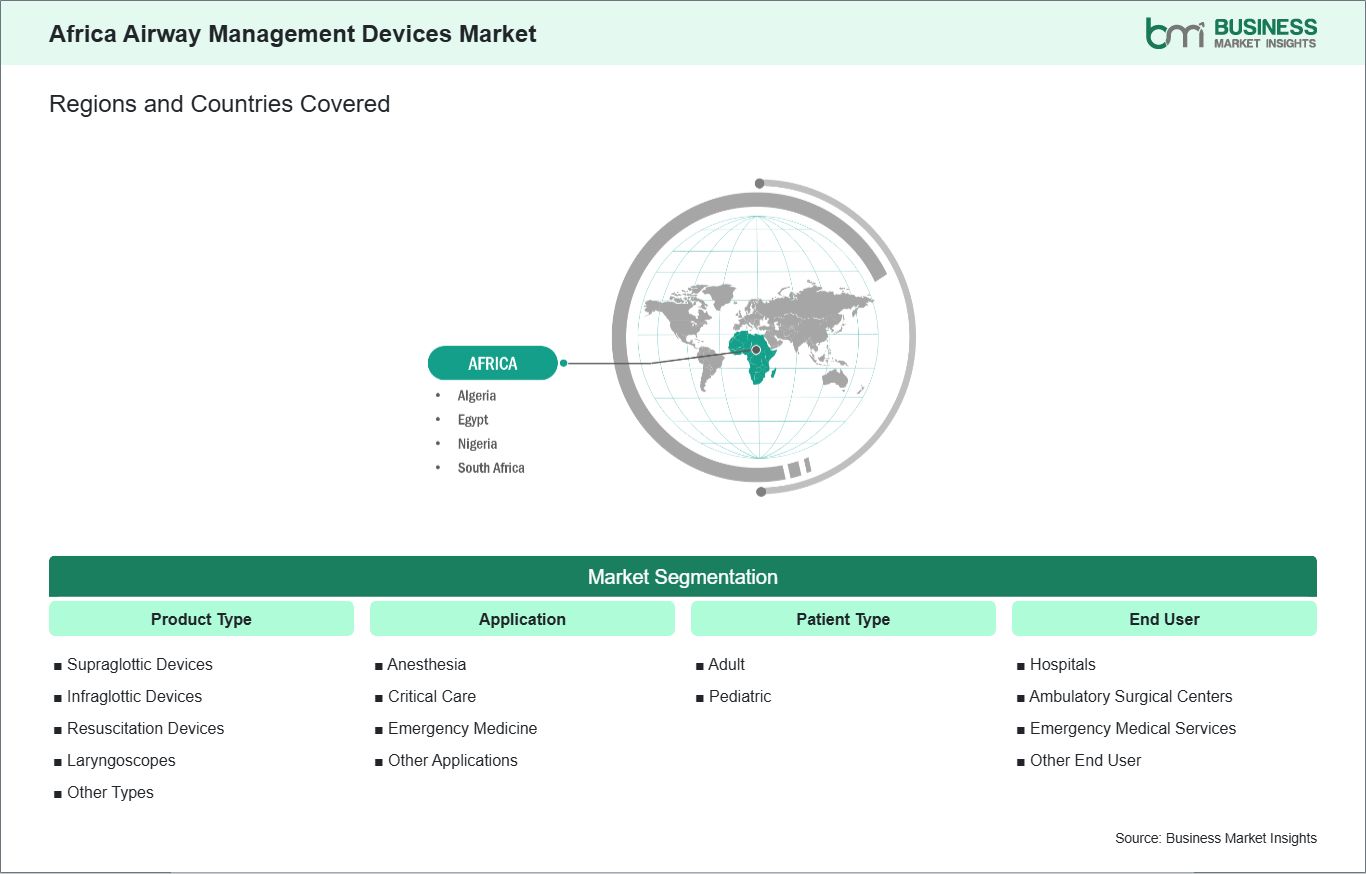
Key segments that contributed to the derivation of the Africa airway management devices market analysis are product type, patient type, and end user.
In Africa, emergency healthcare systems are increasingly encountering situations that require rapid airway intervention, which is driving demand for airway management devices. Major trauma referral centers in cities such as Lagos, Nairobi, and Johannesburg report that a significant portion of emergency admissions involve respiratory distress due to traffic accidents, occupational injuries, or acute infections. These cases often require prompt airway control to stabilize patients before definitive treatment, pushing hospitals to prioritize stocking essential devices such as laryngoscopes, resuscitation bags, and supraglottic airway tools.
Efforts to improve emergency medical services (EMS) in several African nations are also contributing to this rising demand. Governments and non‑governmental partners are investing in training paramedics and emergency clinicians in airway management techniques, recognizing that effective airway control is a foundational skill in trauma and critical care. Enhanced EMS training programs now regularly include hands‑on instruction in rapid sequence intubation and decision‑making around airway device selection, which creates greater clinical familiarity and demand for diverse airway tools.
In addition, regional hospitals are responding to broader public health challenges, such as seasonal respiratory outbreaks and increasing non‑communicable disease prevalence, by strengthening their emergency departments. This includes equipping triage areas and acute care units with devices suited for urgent airway management. As health systems continue to focus on reducing deaths and complications, emergency airway interventions are becoming a strategic priority, stimulating procurement of basic and advanced airway device portfolios across the continent.
Parallel to the growth in emergency care, there is an emerging trend toward home‑based respiratory therapy in Africa, driven by the rising prevalence of chronic respiratory conditions and patients' preference to receive care closer to home. In urban and peri‑urban areas of countries such as South Africa, Egypt, and Kenya, clinicians are increasingly prescribing portable airway support and respiratory therapy devices that patients can use outside hospital settings. These include compact airway clearance tools and noninvasive respiratory support systems designed to improve comfort and ease of use.
Home healthcare providers and private clinics are playing a key role in this shift by offering education and follow‑up support for patients using airway therapy devices at home. Several individuals with chronic conditions such as asthma or bronchiectasis prefer home‑based care as it reduces the need for frequent hospital visits and helps manage symptoms proactively. Portable airway management devices that are lightweight, user‑friendly, and adaptable to low‑resource home environments are therefore gaining traction among both patients and providers.
Community health initiatives are also helping to disseminate respiratory care technologies into more remote regions. Outreach programs led by health ministries and NGOs provide training on the use of home airway devices, particularly for elderly patients and those with mobility challenges. As awareness about the benefits of home respiratory therapy grows, demand for appropriate airway support technologies is expanding beyond traditional clinical settings and presenting a significant opportunity for market growth throughout Africa.

The Africa airway management devices market is experiencing steady growth, with market size and share analysis reflecting evolving treatment preferences and competitive dynamics among key players. The report evaluates important subsegments categorized within product type, application, patient type, and end user, highlighting their respective contributions to overall market performance.
By product type, the infraglottic devices subsegment dominated the market in 2025. In anesthesia practice, their use protects against aspiration and enables precise airway management, driving higher adoption in operating rooms and critical care settings compared with supraglottic devices.
On the basis of application, the anesthesia subsegment dominated the market in 2025 due to the need for definitive airway control across a wide range of surgical procedures, from routine elective surgeries to complex interventions. Because infraglottic devices are essential for intubation during anesthesia, this segment experiences consistent, high-volume usage, making it the largest segment compared with emergency or general critical care.
In terms of patient type, the adult subsegment dominated the market in 2025 due to the higher incidence of conditions requiring intubation in adults. This dominance is further reinforced by the fact that most procedural training, device designs, and usage guidelines are optimized for adult anatomy and clinical scenarios, supporting higher market volume.
Based on end user, the hospital subsegment dominated the market in 2025, as hospitals remain the central hub for airway management, handling scheduled surgeries, emergency admissions, ICU care, and trauma cases. Their larger budgets, need for extensive airway inventories, and availability of multidisciplinary professionals make them the largest purchasers compared with outpatient centers and EMS, where patient volume and purchasing power are comparatively lower.
| Report Attribute | Details |
|---|---|
| Market size in 2025 | US$ 42.6 Million |
| Market Size by 2033 | US$ 46.9 Million |
| CAGR (2026 - 2033) | 1.2% |
| Historical Data | 2022-2024 |
| Forecast period | 2026-2033 |
| Segments Covered | By Product Type
|
|
Regions and Countries Covered
| |
| Africa | Egypt, South Africa, Nigeria, Algeria |
| Market leaders and key company profiles |
|
The "Africa Airway Management Devices Market Size and Forecast (2022–2033)" report provides a detailed analysis of the market covering below areas:
The geographical scope of the Africa airway management devices market report is divided into: Nigeria, Egypt, South Africa, and Algeria. South Africa held the largest share in 2025.
South Africa dominates the use of airway management devices due to its relatively advanced healthcare infrastructure, particularly in urban areas, and the adoption of modern airway management technologies. The major cities in South Africa have been adopting various airway management devices such as video laryngoscopes, flexible endoscopes, and disposable supraglottic airway devices. South Africa has a well-developed private healthcare sector where new technological innovations are readily embraced in their practice, while the public health sector prioritizes the application of practical and economical approaches. Moreover, the country has invested heavily in clinical simulation training to enhance the skill level in emergency and surgical airway management procedures. Challenges include the high cost of sophisticated equipment, limited availability in remote areas, and supply chain issues for imported technologies. However, despite these constraints, South Africa remains a key driver of airway management device adoption due to its focus on patient safety and the modernization of hospitals.

The Africa airway management devices market is evaluated by gathering qualitative and quantitative data post primary and secondary research, which includes important corporate publications, association data, and databases. A few of the key developments in the Africa airway management devices market are:
The Africa Airway Management Devices Market is valued at US$ 42.6 Million in 2025, it is projected to reach US$ 46.9 Million by 2033.
As per our report Africa Airway Management Devices Market, the market size is valued at US$ 42.6 Million in 2025, projecting it to reach US$ 46.9 Million by 2033. This translates to a CAGR of approximately 1.2% during the forecast period.
The Africa Airway Management Devices Market report typically cover these key segments-
The historic period, base year, and forecast period can vary slightly depending on the specific market research report. However, for the Africa Airway Management Devices Market report:
The Africa Airway Management Devices Market is populated by several key players, each contributing to its growth and innovation. Some of the major players include:
The Africa Airway Management Devices Market report is valuable for diverse stakeholders, including:
Essentially, anyone involved in or considering involvement in the Africa Airway Management Devices Market value chain can benefit from the information contained in a comprehensive market report.
Please tell us your area of interest
(Market Segments/ Regions and Countries/ Companies)