Market Summary
Executive Summary and Global Market Analysis
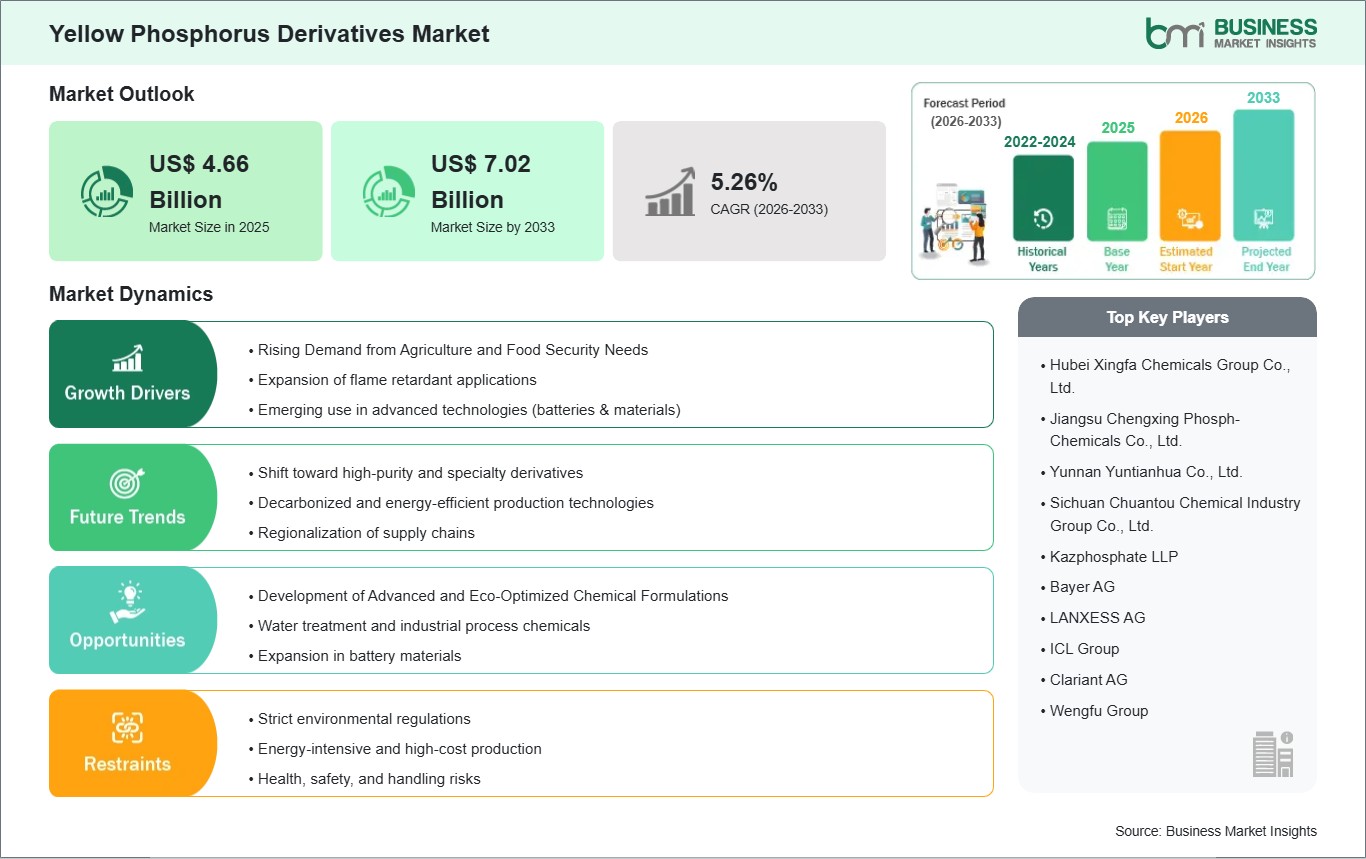
The global market for yellow phosphorus derivatives functions as a key backbone for a variety of high-performance industrial and agricultural value chains. The importance of the market does not lie in the elemental compound itself but rather in the dynamic nature of the derivatives that find applications in formulations for crop protection, industrial water treatment, flame resistance, and chemical synthesis. The market is fundamentally shaped by the need for reliable chemical intermediates that can deliver stability, reactivity control, and functional enhancement across end-use industries. One of the key growth factors is the increasing complexity of the industrial and agricultural needs that the product fulfills. The complexity of the needs of the agricultural sector, with the increasing complexity of the needs of the industrial sector, has led to greater importance for the derivatives of phosphorus rather than the product itself. At the same time, industries are gradually shifting toward more performance-oriented and application-specific chemical systems, which has expanded the scope of derivative innovation.
However, the market is constrained by the inherently hazardous nature of yellow phosphorus handling and the tightly controlled production environment required for its processing. Environmental pressures, safety regulations, and dependence on limited upstream production bases also contribute to structural challenges. However, the market remains a significant opportunity given its high penetration in vital industrial processes and limited substitutability in key applications.
Segment Analysis
Yellow Phosphorus Derivatives Market Segmentation
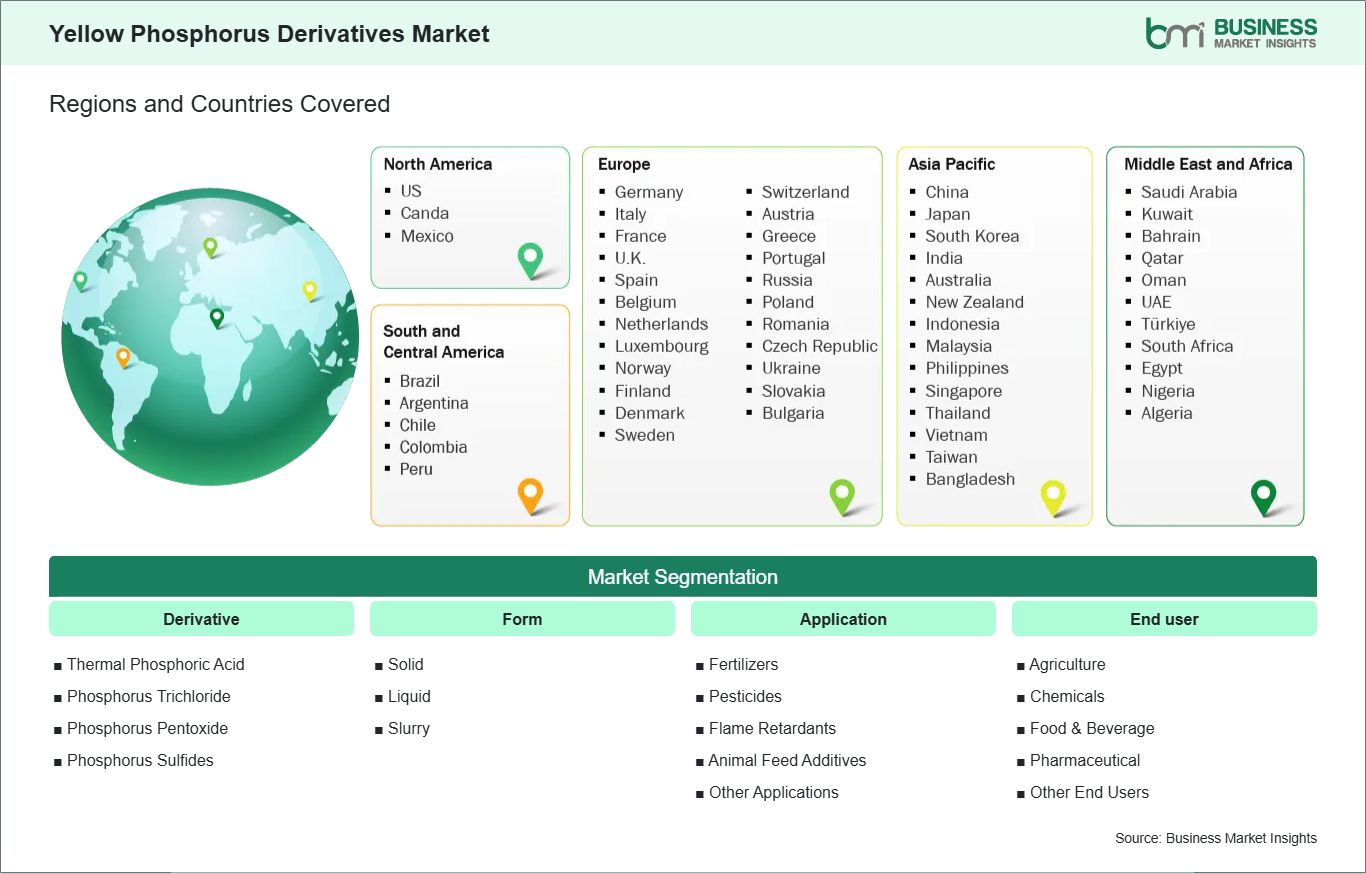
Key segments that contributed to the derivation of yellow phosphorus derivatives market analysis are derivative, form, application, and end use.
- By derivative, the yellow phosphorus derivatives market is segmented into thermal phosphoric acid, phosphorus trichloride, phosphorus pentoxide, and phosphorus sulfides. The thermal phosphoric acid segment dominated the market in 2025.
- By form, the yellow phosphorus derivatives market is segmented into solid, liquid, and slurry. The liquid segment dominated the market in 2025.
- By application, the yellow phosphorus derivatives market is segmented fertilizers, pesticides, flame retardants, animal feed additives, and others). The fertilizers segment dominated the market in 2025.
- By end use, the yellow phosphorus derivatives market is segmented agriculture, chemicals, food & beverage, pharmaceutical, others. The agriculture segment dominated the market in 2025.
Market Forces
Yellow Phosphorus Derivatives Market Drivers and Opportunities
Rising Demand from Agriculture and Food Security Needs
One of the most significant factors fueling the market for yellow phosphorus derivatives is the consistent demand from the agriculture industry, in which phosphorus compounds are considered to be extremely important for enhancing soil fertility and increasing crop productivity. The world`s food requirements are under increasing pressure from the growing global population, climate change, and diminishing arable land. In these circumstances, the need for efficient and effective crop nutrition and protection agents has increased. The yellow phosphorus derivatives are extensively employed in the manufacture of fertilizers and crop protection agents, making these compounds indispensable for modern farming practices.
On a larger scale, there are changes in farming practices towards more efficient input utilization, in which emphasis is given to nutrient optimization and yield enhancement rather than traditional methods. This change in farming practices has increased the dependence on phosphorus-based compounds, as these compounds are highly reactive and provide excellent versatility. In addition to these factors, modern farming practices such as integrated farming and precision farming are also increasing the significance of these compounds derived from yellow phosphorus.
Development of Advanced and Eco-Optimized Chemical Formulations
A key opportunity in the market comes in the form of advanced, environmentally optimized, and application-specific chemical formulations. In this respect, the global focus on the safety of chemicals, environmental protection, and the adoption of environmentally sound industrial practices has put pressure on manufacturers to redesign their chemical formulations based on phosphorus derivatives to have reduced toxicity profiles and improved environmental compatibility. This means improving their biodegradability, residual impact in soil and water, and improving their lifecycle efficiency in terms of their use in the form of derivatives. Yellow phosphorus derivatives are best suited to this transformation due to their high chemical versatility to be transformed into a variety of functional chemicals.
At the same time, the tightening of regulations in the major industrial regions of the world is also driving the move towards cleaner production technologies and safer alternatives for the chemicals involved in the process. This is forcing companies to invest more in the research and development of process optimization technologies, energy-efficient synthesis routes, and minimizing waste during the production process. This is not just about the end product's safety and performance but also about the environmental footprint that the company leaves during the entire process chain, from the extraction and processing of the phosphorus to the end product's performance.
Size and Share Analysis
Yellow Phosphorus Derivatives Market Size and Share Analysis
The global yellow phosphorus derivatives market is experiencing steady growth, with market size and share analysis reflecting evolving treatment preferences and competitive dynamics among key players. The report evaluates important subsegments categorized within derivative, form, application, and end use highlighting their respective contributions to overall market performance.
By derivative, the phosphoric acid subsegment dominated the market in 2025 due This leadership is driven by its central role as a foundational intermediate in converting yellow phosphorus into high-volume downstream products. It is widely used across fertilizer production, industrial-grade phosphates, and water treatment formulations, making it structurally embedded in large-scale commodity and utility applications.
By form, the liquid subsegment dominated the market in 2025 due to largely due to its higher usability in downstream processing and formulation flexibility. They also reduce handling complexity and improve reaction efficiency in continuous processing environments.
By application, the fertilizer subsegment dominated the market in 2025 due to strong demand for This is primarily due to the critical role of phosphorus-based compounds in maintaining soil fertility and improving agricultural yield efficiency. Fertilizer demand is deeply linked to global food security requirements, making it a structurally stable and non-cyclical consumption driver.
By end use, the agriculture subsegment dominated the market in 2025 due to its dual dependency on fertilizers and crop protection chemicals derived from phosphorus chemistry
Report Coverage
Yellow Phosphorus Derivatives Market Report Coverage and Deliverables
The "Yellow Phosphorus Derivatives Market Size and Forecast (2022 - 2033)" report provides a detailed analysis of the market covering below areas:
- Yellow phosphorus derivatives market size and forecast at the regional and country levels for segments covered under the scope
- Yellow phosphorus derivatives market trends, as well as drivers, restraints, and opportunities
- Yellow phosphorus derivatives market analysis covering key trends, regional framework, major players, regulations, and recent developments
- Industry landscape and competition analysis covering market concentration, heat map analysis, prominent players, and recent developments for the yellow phosphorus derivatives market
- Detailed company profiles, including SWOT analysis
Geographic Insights
Yellow Phosphorus Derivatives Market Geographic Insights
The geographical scope of the yellow phosphorus derivatives report is divided into: North America, Asia Pacific, Europe, Middle East & Africa, and South & Central America. North America held the largest share in 2025.
North America is at the forefront in the world picture, and this is because of its well-developed chemical processing infrastructure and consequent downstream industrial integration. The demand for phosphorus derivatives is highly diversified in North America, as seen in its usage in agricultural practices, industrial water treatment, flame retardants, and specialty chemicals for advanced industrial processes. One major reason for the dominance of North America is the well-developed industries in the region, which are highly performance- and safety-conscious, and hence compliant with regulations. As such, there has been sustained usage of phosphorus derivatives, especially in industries where performance is crucial. Additionally, there is highly developed expertise and formulation capabilities, allowing manufacturers to develop derivatives to meet highly specific industrial needs rather than relying on generic product offerings. At the same time, North America`s market structure is impacted by limited primary production of yellow phosphorus, which makes it reliant on external sourcing.
However, North America`s stability is assured by efficient supply chain integration and contractual procurement. Similarly, government regulations play a two-fold role: on one hand, they increase complexity in terms of compliance; on the other hand, they promote innovation in terms of cleaner and more efficient derivative use. Overall, North American dominance rests on its technological maturity, diversified use, and alignment of chemical innovation to user needs.
Industry Activity
Recent Developments
The yellow phosphorus derivatives market is evaluated by gathering qualitative and quantitative data post primary and secondary research, which includes important corporate publications, association data, and databases. A few of the key developments in the yellow phosphorus derivatives market are:
- In November 2024, Clariant introduced Exolit AP 422 A, a next-generation phosphorus-based flame retardant designed without melamine content to improve regulatory compliance and fire performance. The product was developed to address stricter chemical safety classifications and evolve regulatory restrictions on certain additives.
- In December 2024, ICL Group announced the launch of VeriQuel R100, a reactive phosphorus-based flame retardant designed for polyurethane insulation systems. The product introduces a more sustainable approach by chemically bonding within polymer structures, reducing migration and improving long-term performance.
- In April 2025, Clariant announced the development and commercialization of melamine-free Exolit AP phosphorus-based flame retardants, designed to meet stricter global chemical safety regulations while maintaining high-performance fire protection in coatings, insulation, and construction materials.
Trust & Transparency
Research Methodology
The market analysis combines proprietary research with secondary data from government agencies, company disclosures, regulatory filings, industry databases and expert interviews. Market estimates are validated through data triangulation, cross-market benchmarking and analyst
review.
View Full Research Methodology
Key Sources Referred:
World Health Organization (WHO) Organisation for Economic Cooperation and Development (OECD) The World Bank Group Worldometer The Lancet International Bar Association International Trade Administration