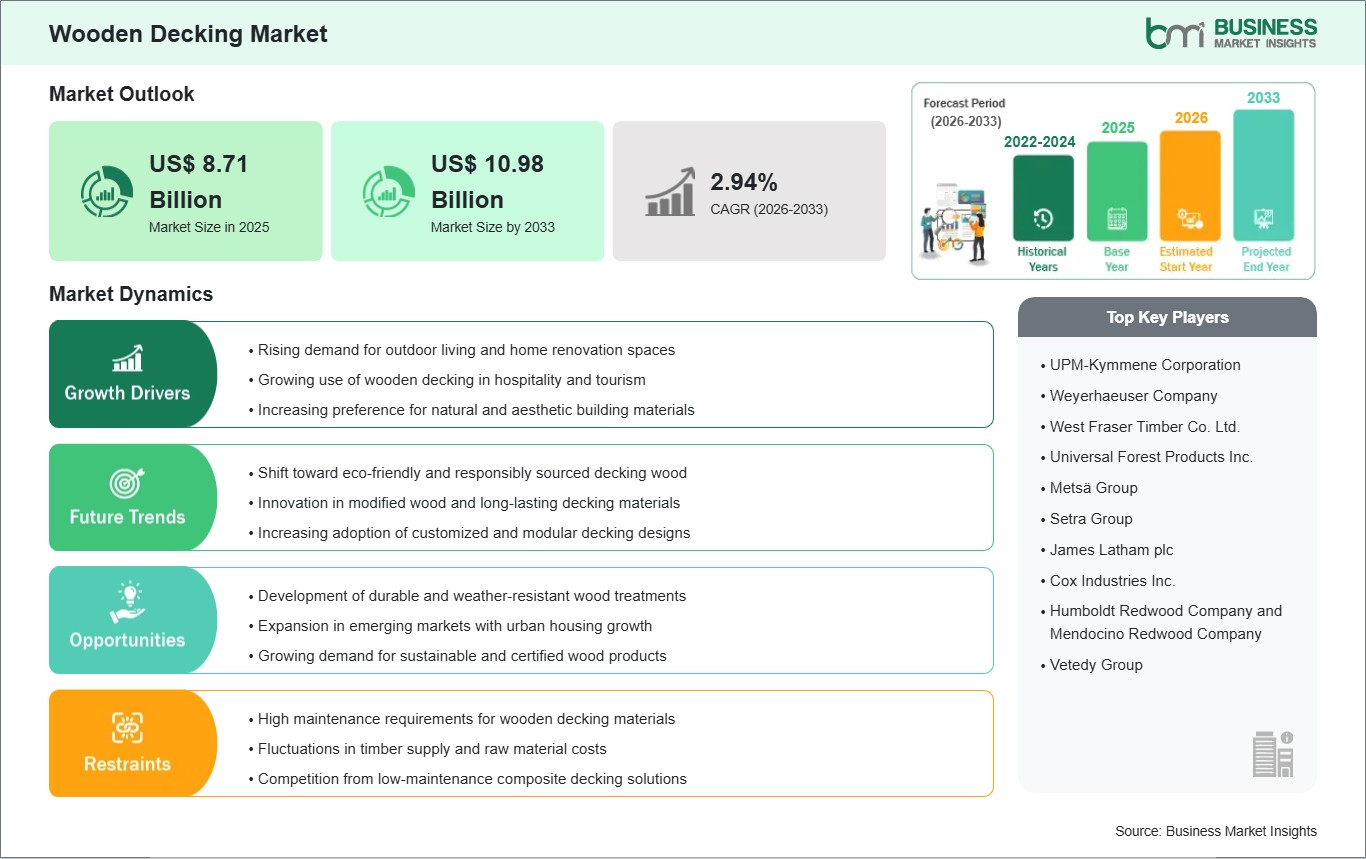
The Wooden Decking Market size is expected to reach US$ 10.98 billion by 2033 from US$ 8.71 billion in 2025. The market is estimated to record a CAGR of 2.94% from 2026 to 2033.
Executive Summary and Global Market Analysis:
The global wooden decking market represents a vital segment within the broader construction and outdoor living industry, which focuses on natural wood materials that create exterior flooring for residential decks and patios, walkways and commercial outdoor spaces. Wooden decking is valued for its aesthetic appeal, natural texture and versatility, which makes it a preferred choice in landscaping and architectural design. The industry commonly uses pressure-treated softwoods and hardwoods as wood types, but now uses thermally modified wood because it provides better durability and environmental protection.
The market experiences growth because homeowners want more outdoor space, which they add to their residential properties through construction work and home improvement projects. Homeowners across developed and emerging economies are investing in outdoor extensions such as decks and patios to enhance property value and lifestyle appeal. This trend is supported by changing consumer preferences, which favor open-air environments and multifunctional outdoor areas and nature-integrated designs. Wood decking finds extensive use in commercial environments because it creates visually attractive outdoor spaces which provide comfort to customers in hospitality areas, resorts, restaurants and recreational areas.
The market experiences environmental changes because people prefer to buy timber products that contain sustainable material and wood items that have received environmental certification. Industries guide their operations toward sustainable timber harvesting methods, which allow them to track wood products and use safe environmental solutions in order to satisfy customer needs and government requirements. The development of wood treatment technologies today provides superior protection against moisture, decay and insect damage, which extends the life and functional capacity of wood decking products. The market experiences multiple restrictions that limit its potential. The maintenance process of wooden decking requires multiple tasks, which include weatherproofing, sealing and staining, thereby making the material more expensive to maintain throughout its entire lifespan when compared to composite decking. The industry faces two challenges: social issues and the market situation, which create difficulties because of how raw materials are obtained and because people worry about deforestation and its ecological effects. Consumers today prefer decking options that require less upkeep, which creates a competitive challenge for companies offering wooden decking.
The wooden decking market maintains its strength because of its inherent beauty and ability to adapt to multiple uses and a strong connection to outdoor activities. The wood treatment industry will develop through ongoing research, which will create new sustainable methods and design options that will drive global demand while developing new usage possibilities.
Wooden Decking Market - Strategic Insights:
Get more information on this report
Wooden Decking Market Segmentation Analysis:
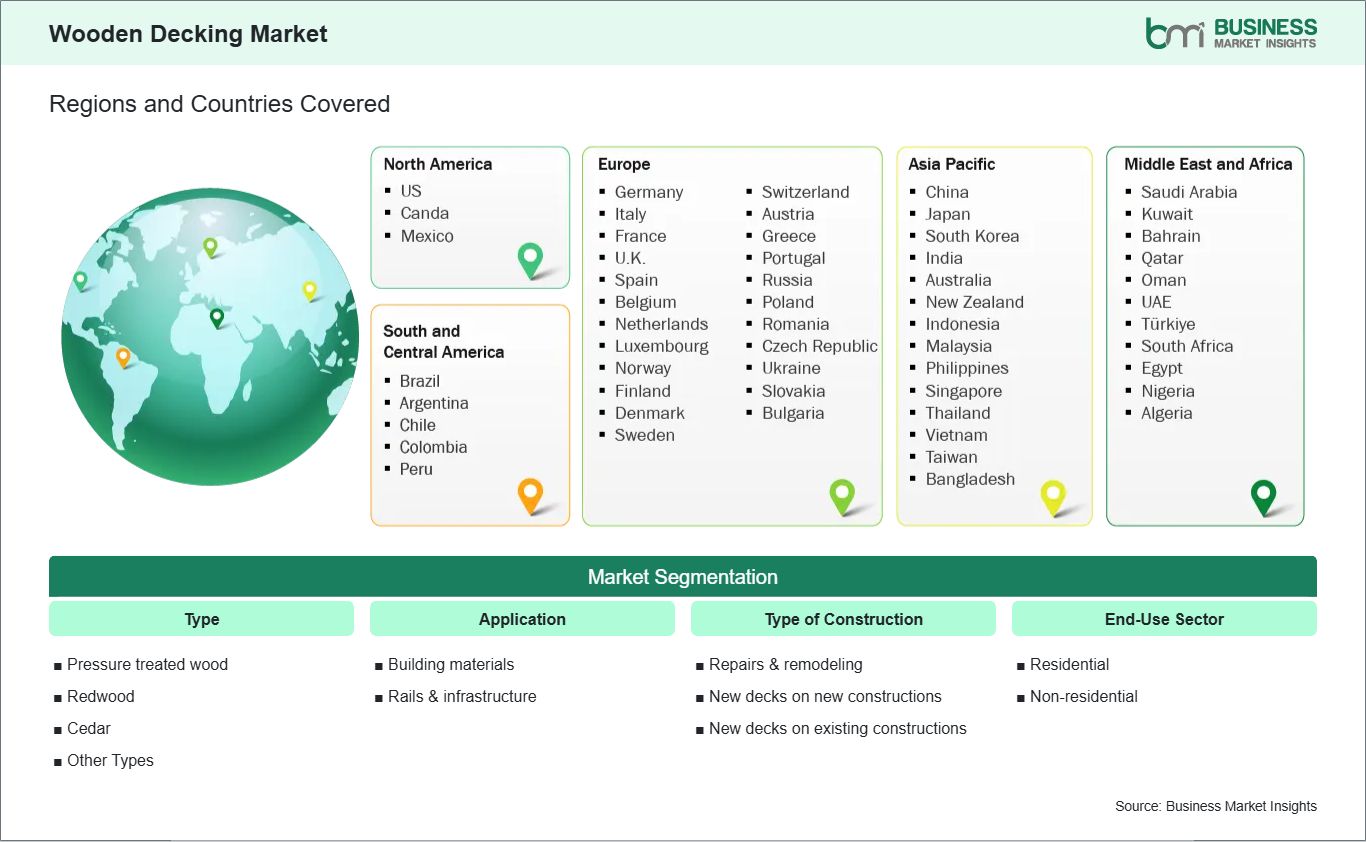
Key segments that contributed to the derivation of the wooden decking market analysis are type, application, type of construction and end-use sector.
By type, the wooden decking market is segmented into pressure treated wood, redwood, cedar, other types. The pressure treated wood segment dominated the market in 2025.
Based on application, the wooden decking market is categorized into building materials, rails & infrastructure. The building materials segment dominated the market in 2025.
On the basis of type of construction, the wooden decking market is categorized into repairs & remodeling, new decks on new constructions, new decks on existing constructions. The repairs & remodeling segment dominated the market in 2025.
In terms of end-use sector, the wooden decking market is categorized into residential, non-residential. The residential segment dominated the market in 2025.
Wooden Decking Market Drivers and Opportunities:
Rising demand for outdoor living and home renovation spaces
The global wooden decking market experiences substantial market growth because consumers increasingly demand outdoor living spaces and home renovation areas, which create functional and visually attractive exterior spaces. Wooden decking functions as a common material that builders use to create outdoor areas that extend their indoor spaces through building design, which provides areas for entertaining, dining and relaxing. North American homes typically include decks, which builders design to complement backyards while homeowners use them to increase their property value and improve their outdoor living spaces.
Wooden decking usage has increased throughout European cities because people now choose to construct balconies, rooftop terraces and small garden areas. Homeowners and developers aim to create outdoor spaces that maximize their available area by using wood decking, which produces natural outdoor spaces that match contemporary architectural designs. The region's hospitality industry relies on decking materials to create outdoor dining spaces and recreational areas, which drives up demand for these products.
Rising disposable income and changing housing designs have created an interest in outdoor lifestyles in both the Asia Pacific and South America. Building designs for residential complexes, resorts and recreational spaces now use wooden decking to enhance visual appeal and functional performance. The global trend that promotes outdoor living spaces creates an increasing requirement for decking products that combine long-lasting performance with attractive design across various weather conditions and use scenarios.
Development of durable and weather-resistant wood treatments
The development of durable and weather-resistant wood treatments presents a key opportunity in the global wooden decking market, addressing one of the primary concerns associated with natural wood materials. Advanced treatment technologies enhance resistance to moisture, UV radiation, fungal decay, and insect damage, significantly improving the longevity and performance of wooden decks. In North America, pressure-treated wood and thermally modified timber are widely adopted to withstand seasonal weather variations and extend service life.
Europe is at the forefront of innovation in environmentally responsible wood treatments, focusing on low-emission preservatives and sustainable modification processes. Countries such as Germany and the Nordic region emphasize high-performance decking materials that combine durability with compliance to strict environmental standards. These advancements enable wood to compete more effectively with alternative materials such as composites.
In Asia Pacific and the Middle East, where climatic conditions can be extreme, weather-resistant treatments are essential for maintaining deck integrity and appearance. Manufacturers are developing solutions tailored to high humidity, temperature fluctuations, and intense sunlight exposure. As treatment technologies continue to evolve, they expand the applicability of wooden decking globally, enhancing its competitiveness and supporting long-term market growth.
Wooden Decking Market Size and Share Analysis:
The wooden decking market demonstrates steady growth, with size and share analysis highlighting evolving trends and competitive dynamics among key players. The report examines subsegments categorized within type, application, type of construction and end-use sector, offering insights into their contribution to overall market performance.
By type, the pressure treated wood subsegment dominated the market in 2025, driven by its cost-effectiveness, durability, and resistance to moisture, decay, and insects.
Based on application, the building materials subsegment dominated the market in 2025, driven by widespread use of wooden decking in structural and construction applications.
In terms of type of construction, the repairs & remodeling subsegment dominated the market in 2025, driven by increasing renovation activities and replacement demand for existing decks.
In terms of end-use sector, the residential subsegment dominated the market in 2025, driven by rising demand for outdoor living spaces and home improvement projects.
Australia, China, India, Japan, South Korea, Indonesia, Malaysia, Philippines, Singapore, Thailand, Vietnam, Bangladesh, New Zealand, Taiwan
South and Central America
Brazil, Argentina, Peru, Chile, Colombia
Middle East and Africa
Bahrain, Kuwait, Oman, Qatar, Saudi Arabia, United Arab Emirates, Turkiye, South Africa, Egypt, Algeria, Nigeria
Market leaders and key company profiles
UPM-Kymmene Corporation
Weyerhaeuser Company
West Fraser Timber Co. Ltd.
Universal Forest Products Inc.
Metsä Group
Setra Group
James Latham plc
Cox Industries Inc.
Humboldt Redwood Company and Mendocino Redwood Company
Vetedy Group
Get more information on this report
Wooden Decking Market Report Coverage and Deliverables:
The "Wooden Decking Market Size and Forecast (2022 - 2033)" report provides a detailed analysis of the market covering below areas:
Wooden Decking Market size and forecast at global, regional, and country levels for all the key market segments covered under the scope
Wooden Decking Market trends, as well as drivers, restraints, and opportunities
Wooden Decking Market analysis covering key trends, global and regional framework, major players, regulations, and recent developments
Industry landscape and competition analysis covering market concentration, heat map analysis, prominent players, and recent developments for the Wooden Decking Market
Detailed company profiles, including SWOT analysis
Wooden Decking Market Geographic Insights:
The geographical scope of the Wooden Decking Market report is divided into North America, Asia Pacific, Europe, Middle East & Africa, and South & Central America. North America held the largest share in 2025.
North America maintains its position as the leading region for worldwide wooden decking markets because people in this area highly value outdoor activities, and homeowners frequently renovate their properties and deck installations have become a typical component of home building practices. Homeowners in the United States and Canada demonstrate a stable demand for wooden decks, which they install in their suburban residences, vacation homes and hospitality venues that feature outdoor areas designed for social gatherings and relaxation. The market penetration receives support from contractors and retailers who possess established networks through which they distribute pressure-treated lumber, premium hardwoods and thermally modified wood products.
Europe represents a developed market that prioritizes sustainability through its focus on certified timber and eco-friendly sourcing and high-quality finishes, which dominate the markets of Germany, the United Kingdom and Nordic countries. European cities use wooden decking to create urban terraces, garden landscaping and hospitality spaces with a preference for durable hardwoods and treated softwoods that comply with environmental regulations. Countries including China, India, Japan and Australia currently experience increased demand for modern housing designs, which results from their rapid urbanization and growing disposable income. The region sees rising popularity of wooden decking in residential complexes, commercial outdoor spaces and resorts, although cost sensitivity and climate conditions affect material selection and treatment requirements.
The Middle East and Africa market is starting to grow because the region's tourism, luxury real estate and infrastructure projects in the UAE, Saudi Arabia and South Africa create new business opportunities. High-end resorts, poolside areas and outdoor hospitality spaces use wooden decking, which needs special treatments to survive extreme heat and dry conditions.
The construction industry in South and Central America, which includes Brazil, Mexico and Argentina, uses wooden decking for residential buildings, eco-tourism facilities and outdoor recreational areas, thanks to the region's abundant timber resources. People choose cost-effective solutions that use wood sourced from local areas as their preferred option. North America leads in product development, while consumer acceptance and market development have reached their highest point, yet all other regions show different patterns of expansion, which result from urbanization, climate change impacts and sustainability practices and changing consumer behavior, that together create the worldwide wooden decking market.
Get more information on this report
Wooden Decking Market Research Report Guidance:
The report includes qualitative and quantitative data in the Wooden Decking Market across type, application, type of construction, end-use sector and geography.
The report starts with the key takeaways (chapter 2), highlighting key trends and outlook of the Wooden Decking Market.
Chapter 3 focuses on the research methodology of the study.
Chapter 4 includes ecosystem analysis.
Chapter 5 highlights the major industry dynamics in the Wooden Decking Market, including factors that are driving the market, prevailing deterrents, potential opportunities, as well as future trends. Impact analysis of these drivers and restraints is also covered in this section.
Chapter 6 discusses the Wooden Decking Market scenario, in terms of historical market revenues, and forecast till the year 2033.
Chapters 7 to 11 cover Wooden Decking Market segments by type, application, type of construction, end-use sector and geography across North America, Asia Pacific, Europe, Middle East & Africa, and South & Central America. They cover the market revenue forecast and factors driving the market.
Chapter 12 describes the competitive analysis along with the heat map analysis for the key players operating in the market.
Chapter 13 describes the industry landscape analysis. It provides detailed descriptions of business activities such as market initiatives, new developments, mergers, and joint ventures globally, along with a competitive landscape.
Chapter 14 provides detailed profiles of the major companies operating in the Wooden Decking Market. Companies have been profiled on the basis of their key facts, business descriptions, products, financial overview, SWOT analysis, and key developments.
Chapter 15, i.e., the appendix, is inclusive of a brief overview of the company, a list of abbreviations, and a disclaimer.
Wooden Decking Market News and Key Development:
The Wooden Decking Market is evaluated by gathering qualitative and quantitative data post primary and secondary research, which includes important corporate publications, association data, and databases. A few of the key developments in the wooden decking market are:
In August 2024, Trex Company, Inc. announced that it celebrated the steel topping out of its new state‑of‑the‑art decking and railing manufacturing facility in Little Rock, Arkansas, marking the completion of the structural framework for this major production campus designed to expand capacity, strengthen supply chains, and support future growth in sustainable outdoor living products.
In June 2025, The AZEK Company announced that it highlighted the superior fire resistance of TimberTech Advanced PVC decking through a new controlled‑environment comparison video, demonstrating its high performance for safety‑conscious outdoor applications and reinforcing product differentiation in the global decking space.
Key Sources Referred:
World Health Organization (WHO)
Organisation for Economic Cooperation and Development (OECD)
The World Bank Group
Worldometer
The Lancet
International Bar Association
International Trade Administration
The List of Companies - Wooden Decking Market
UPM-Kymmene Corporation
Weyerhaeuser Company
West Fraser Timber Co. Ltd.
Universal Forest Products Inc.
Metsä Group
Setra Group
James Latham plc
Cox Industries Inc.
Humboldt Redwood Company and Mendocino Redwood Company
Vetedy Group
Frequently Asked Questions
How big is the Wooden Decking Market?
The Wooden Decking Market is valued at US$ 8.71 Billion in 2025, it is projected to reach US$ 10.98 Billion by 2033.
What is the CAGR for Wooden Decking Market by (2026 - 2033)?
As per our report Wooden Decking Market, the market size is valued at US$ 8.71 Billion in 2025, projecting it to reach US$ 10.98 Billion by 2033. This translates to a CAGR of approximately 2.94% during the forecast period.
What segments are covered in this report?
The Wooden Decking Market report typically cover these key segments-
Type (Pressure treated wood, Redwood, Cedar, Other Types)
Type of Construction (Repairs & remodeling, New decks on new constructions, New decks on existing constructions)
End-Use Sector (Residential, Non-residential)
What is the historic period, base year, and forecast period taken for Wooden Decking Market?
The historic period, base year, and forecast period can vary slightly depending on the specific market research report. However, for the Wooden Decking Market report:
Historic Period : 2022-2024
Base Year : 2025
Forecast Period : 2026-2033
Who are the major players in Wooden Decking Market?
The Wooden Decking Market is populated by several key players, each contributing to its growth and innovation. Some of the major players include:
UPM-Kymmene Corporation
Weyerhaeuser Company
West Fraser Timber Co. Ltd.
Universal Forest Products Inc.
Metsä Group
Setra Group
James Latham plc
Cox Industries Inc.
Humboldt Redwood Company and Mendocino Redwood Company
Vetedy Group
Who should buy this report?
The Wooden Decking Market report is valuable for diverse stakeholders, including:
Investors: Provides insights for investment decisions pertaining to market growth, companies, or industry insights. Helps assess market attractiveness and potential returns.
Industry Players: Offers competitive intelligence, market sizing, and trend analysis to inform strategic planning, product development, and sales strategies.
Suppliers and Manufacturers: Helps understand market demand for components, materials, and services related to concerned industry.
Researchers and Consultants: Provides data and analysis for academic research, consulting projects, and market studies.
Financial Institutions: Helps assess risks and opportunities associated with financing or investing in the concerned market.
Essentially, anyone involved in or considering involvement in the Wooden Decking Market value chain can benefit from the information contained in a comprehensive market report.




 Get Free Sample For Wooden Decking Market