
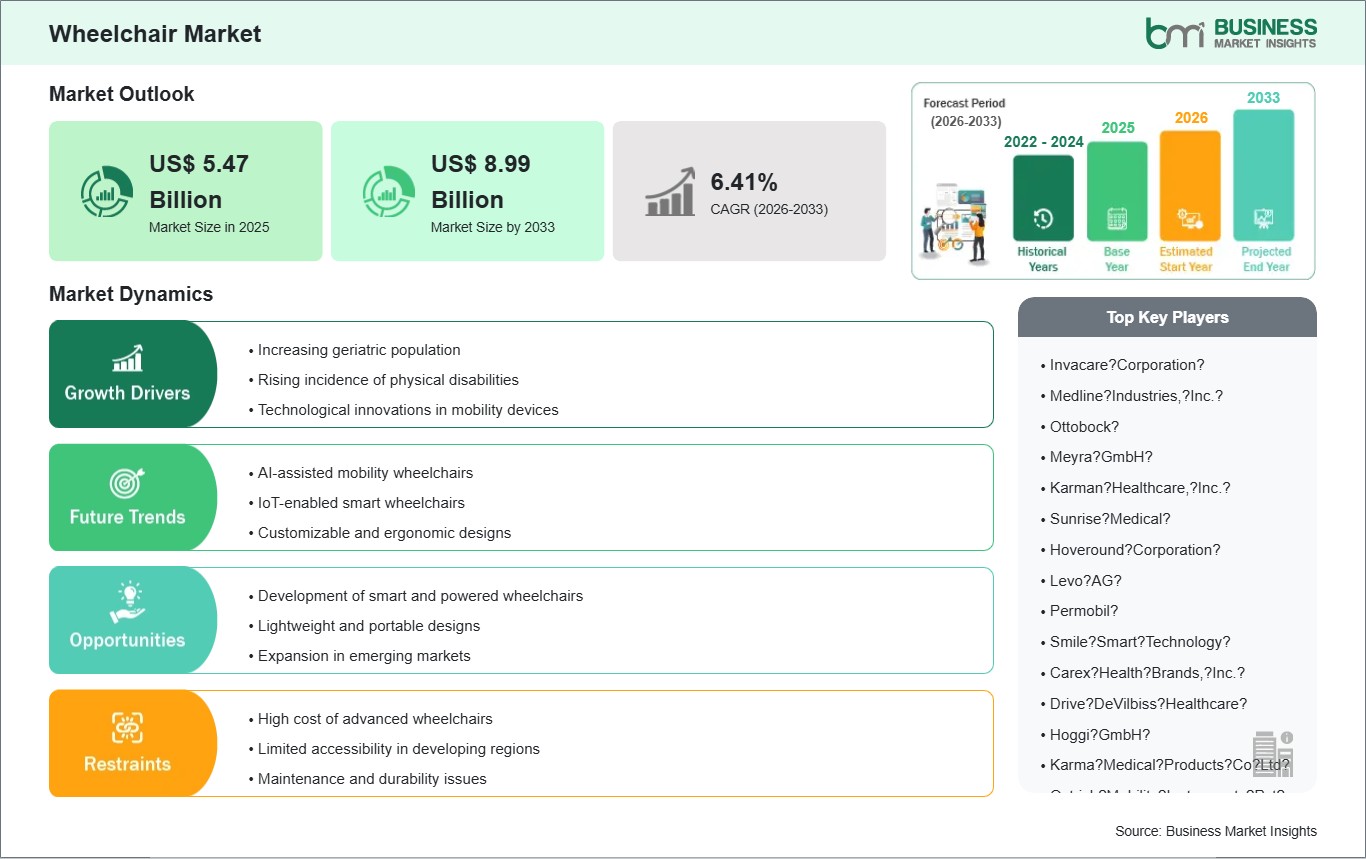
The Wheelchair market size is expected to reach US$ 8.99 billion by 2033 from US$ 5.47 billion in 2025. The market is estimated to record a CAGR of 6.41% from 2026 to 2033.
The global provision of mobility solutions is unthinkable without wheelchairs that provide a good deal of independence and better quality of life for people with mobility problems. They are irreplaceable in hospitals, rehabilitation centers, home care settings, and outpatient surgery facilities. Besides this, the use of wheelchairs also brings a number of benefits like the possibility of moving around more, having an ergonomically designed chair and getting access to the different tasks of daily living. The continuously increasing prevalence of disabilities, aging population and chronic conditions such as arthritis, spinal injuries and neurological disorders are among the key market drivers. Furthermore, the research and development of manual and electric wheelchairs, the use of ultra-light materials and the integration of smart mobility features are adding to their usability, comfort, and safety.
On the other hand, there are certain challenges that can limit the growth of the market, including but not limited to the high price of powered and advanced wheelchairs, limited insurance coverage in some areas, and inconsistencies in regulations from one country to another. The industry is very much dependent on economic conditions that are likely to affect healthcare spending and consumer affordability. Still, the market has great opportunities thanks to the rising demand for homecare solutions, the increasing adoption of high-tech mobility devices and the development of healthcare infrastructure in emerging markets. Furthermore, the manufacturers' investments in the development of connected and smart wheelchairs, personalized designs, and the use of light, durable materials will create new opportunities for the market expansion, as manufacturers will be able to meet the varying needs of patients while at the same time promoting mobility and independence in the world

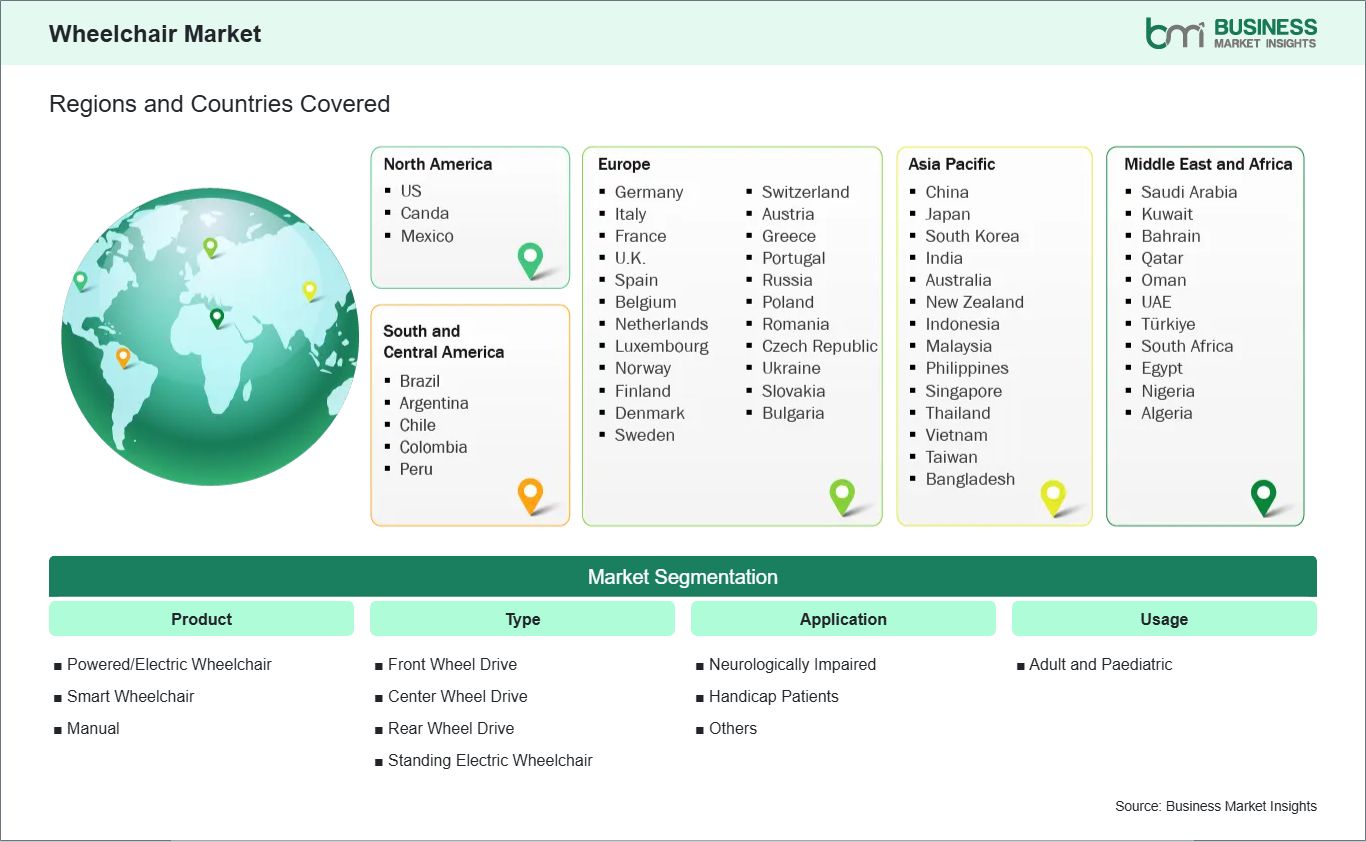
Key segments that contributed to the derivation of the Wheelchair market analysis are Product, Type, Application, Usage, End User, Distribution Channel.
The extraordinary demographic transition towards an aging populace is the main factor motivating the global wheelchair market. The World Health Organization (WHO) projects that by the year 2050, the number of people aged 60 and above will be 2.1 billion, i.e., it will have doubled. This "silver tsunami" can be said to be a direct cause of the increased mobility impairments as a result of aging. The elderly population is the main group affected by chronic diseases, such as osteoarthritis, osteoporosis, arthritis, and also by neurological disorders like Parkinson's disease or stroke, etc., which all lead to increased aging-related mobility impairments.
Age-related factors cause a gradual reduction of physical strength, balance, and flexibility in joints, hence making walking alone impossible or unsafe. Thus, wheelchairs have evolved from being medical devices only to being assistive devices for daily living that, through which elder people are able to keep them independent, engaged socially, and having a good quality of life. The market is also larger in developed areas such as North America and Europe where there are already existing healthcare reimbursement systems and insurance coverage that provide access to advanced mobility solutions. At the same time, in the case of a country like China or India, the increasing life expectancy and the betterment of healthcare infrastructure are opening a large new market for the businesses. Therefore, manufacturers are more and more engaged in producing ergonomically designed, lightweight, and easy-to-use products specifically aimed at the physiological requirements of elderly people, thus keeping the market growth of the elderly care industry assured for the near future.
The global wheelchair market is showing the potential of a massive opportunity which is mainly driven by the increasing demand for advanced mobility solutions, which are able to increase the independence and quality of life for the people with disabilities and the elderly with mobility difficulties. The populations in the North America, Europe, and Asia regions are rapidly getting older, and the number of such people suffering from mobility-related health issues is also increasing. The World Health Organization predicts that by 2030, one-sixth (1/6) of the world's population will be over 60 years of age, and this will create a huge demand for assistive devices—wheelchairs being one of them. This demographic trend is pushing the demand for the development of the products that would be able to do more than just manual wheelchairs of the past.
The opportunity is seen in the creation of modern, electric, and user-modified wheelchairs that have technology embedded into them for giving customer support. The use of materials that are super light, human-centered designed, electric powered, IoT-linked monitoring and AI-assisted navigation are all performing the function of converting the typical wheelchair into a high-tech mobility platform. All these new things not only make it easier and more pleasant to use but also allow the users to depend more on themselves in their home and community. Moreover, the government and healthcare policies that are in favor of making the society more accessible and including the people with disabilities are a great help in making the adoption faster, especially in developing countries where the quality of awareness and the support facilities for the disabled are also improving.
Companies that produce high-quality but low-cost products will be the ones to take most of the market share. The wheelchair market on the whole is an attractive place to be for those businesses that are ready to come up with new and improved solutions to mobility challenges for the ever-growing global population by focusing on the patients' comfort, portability, and digital integration needs that are still unmet.
By Product, the Wheelchair market is segmented into Powered/Electric Wheelchair, Smart Wheelchair, and Manual. The Manual segment dominated the market in 2025. The manual wheelchair segment dominated is driven by affordability, ease of use, wide availability, and suitability for both homecare and healthcare settings, meeting the mobility needs of diverse users.
By Type, the Wheelchair market is segmented into Front Wheel Drive, Center Wheel Drive, Rear Wheel Drive, and Standing Electric Wheelchair. The Center Wheel Drive segment dominated the market in 2025. The center wheel drive segment dominated due to superior maneuverability, stability, and compact design, making it ideal for indoor navigation and varied healthcare and rehabilitation applications.
By Application, the Wheelchair market is segmented into Neurologically Impaired, Handicap Patients, and Others. The Neurologically Impaired segment dominated the market in 2025. The neurologically impaired segment dominated by growing prevalence of neurological disorders, increased rehabilitation demand, and preference for specialized wheelchairs that enhance mobility and patient independence.
By Usage, the Wheelchair market is bifurcated into Adult and Paediatric. The Adult segment dominated the market in 2025. The adult segment dominated by reflecting higher incidence of mobility impairments among adults, greater demand in healthcare and homecare settings, and increased adoption of both manual and powered wheelchairs.
By End User, the Wheelchair market is segmented into Homecare, Hospitals and Clinics, Rehabilitation Centers, and Ambulatory Surgical Centers. The Rehabilitation Centers segment dominated the market in 2025. The rehabilitation centers segment dominated by high utilization of wheelchairs for patient recovery, physiotherapy, and mobility training, emphasizing advanced designs and durable construction
By Distribution Channel, the Wheelchair market is bifurcated into Retail and E-Commerce. The Retail segment dominated the market in 2025. The retail segment dominated due to widespread availability, direct consumer access, competitive pricing, and ability to provide guidance and support for selecting suitable wheelchair models
| Report Attribute | Details |
|---|---|
| Market size in 2025 | US$ 5.47 Billion |
| Market Size by 2033 | US$ 8.99 Billion |
| Global CAGR (2026 - 2033) | 6.41% |
| Historical Data | 2022 - 2024 |
| Forecast period | 2026-2033 |
| Segments Covered | By Product
|
|
Regions and Countries Covered
| |
| North America | US, Canada, Mexico |
| Europe | Belgium, Austria, Finland, Denmark, Greece, Poland, Romania, Russia, Ukraine, Czech Republic, Slovakia, Bulgaria, Italy, Luxembourg, Germany, Switzerland, France, Netherlands, Norway, Portugal, Spain, Sweden, United Kingdom |
| Asia-Pacific | Australia, China, India, Japan, South Korea, Indonesia, Malaysia, Philippines, Singapore, Thailand, Vietnam, Bangladesh, New Zealand, Taiwan |
| South and Central America | Brazil, Argentina, Peru, Chile, Colombia |
| Middle East and Africa | Bahrain, Kuwait, Oman, Qatar, Saudi Arabia, United Arab Emirates, Turkiye, South Africa, Egypt, Algeria, Nigeria |
| Market leaders and key company profiles |
|
The "Wheelchair Market Size and Forecast (2022–2033)" report provides a detailed analysis of the market covering below areas:
The region is also witnessing increased adoption of advanced wheelchair technologies, including powered wheelchairs, smart wheelchairs, and lightweight manual designs—particularly relevant for adults and neurologically impaired patients. Expansion of rehabilitation centers, hospitals, and homecare services is enhancing accessibility and user convenience. Additionally, rising urbanization, healthcare expenditure, and increasing focus on independent living, coupled with growing availability of retail and e-commerce channels, is positioning Asia-Pacific as a key hub in the global wheelchair ecosystem. Supportive policies, infrastructure development, and investments in medical device manufacturing further solidify the region’s dominant market position

The Wheelchair market is evaluated by gathering qualitative and quantitative data post primary and secondary research, which includes important corporate publications, association data, and databases. A few of the key developments in the Wheelchair market are:
The Wheelchair Market is valued at US$ 5.47 Billion in 2025, it is projected to reach US$ 8.99 Billion by 2033.
As per our report Wheelchair Market, the market size is valued at US$ 5.47 Billion in 2025, projecting it to reach US$ 8.99 Billion by 2033. This translates to a CAGR of approximately 6.41% during the forecast period.
The Wheelchair Market report typically cover these key segments-
The historic period, base year, and forecast period can vary slightly depending on the specific market research report. However, for the Wheelchair Market report:
The Wheelchair Market is populated by several key players, each contributing to its growth and innovation. Some of the major players include:
The Wheelchair Market report is valuable for diverse stakeholders, including:
Essentially, anyone involved in or considering involvement in the Wheelchair Market value chain can benefit from the information contained in a comprehensive market report.
Please tell us your area of interest
(Market Segments/ Regions and Countries/ Companies)