
Western Europe Resuscitation Devices Market Outlook ((2022-2033)

Historic Data: 2022-2024   |   Base Year: 2025   |   Forecast Period: 2026-2033
Report Content: Market Scope, Market Segmentation, Market Dynamics, and Competitive Analysis

Report Coverage:
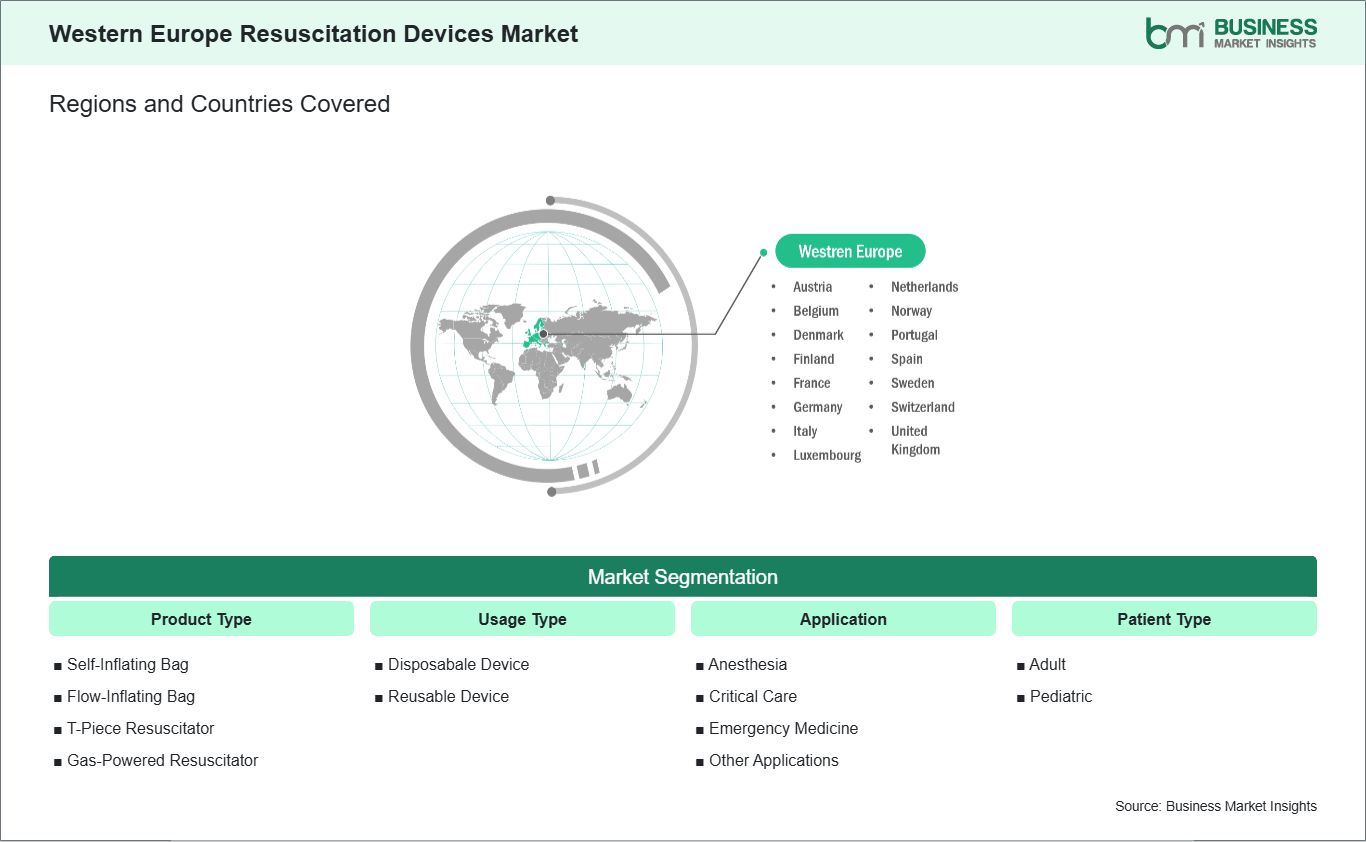
  • Product Type (Self-Inflating Bag, Flow-Inflating Bag, T-Piece Resuscitator, Gas-Powered Resuscitator)
  • Usage Type (Disposabale Device, Reusable Device)
  • Application (Anesthesia, Critical Care, Emergency Medicine, Other Applications)
  • Patient Type (Adult, Pediatric)

No. of Pages: 150
Report Code: BMIPUB00034937
Category: Life Sciences
Western Europe Resuscitation Devices Market

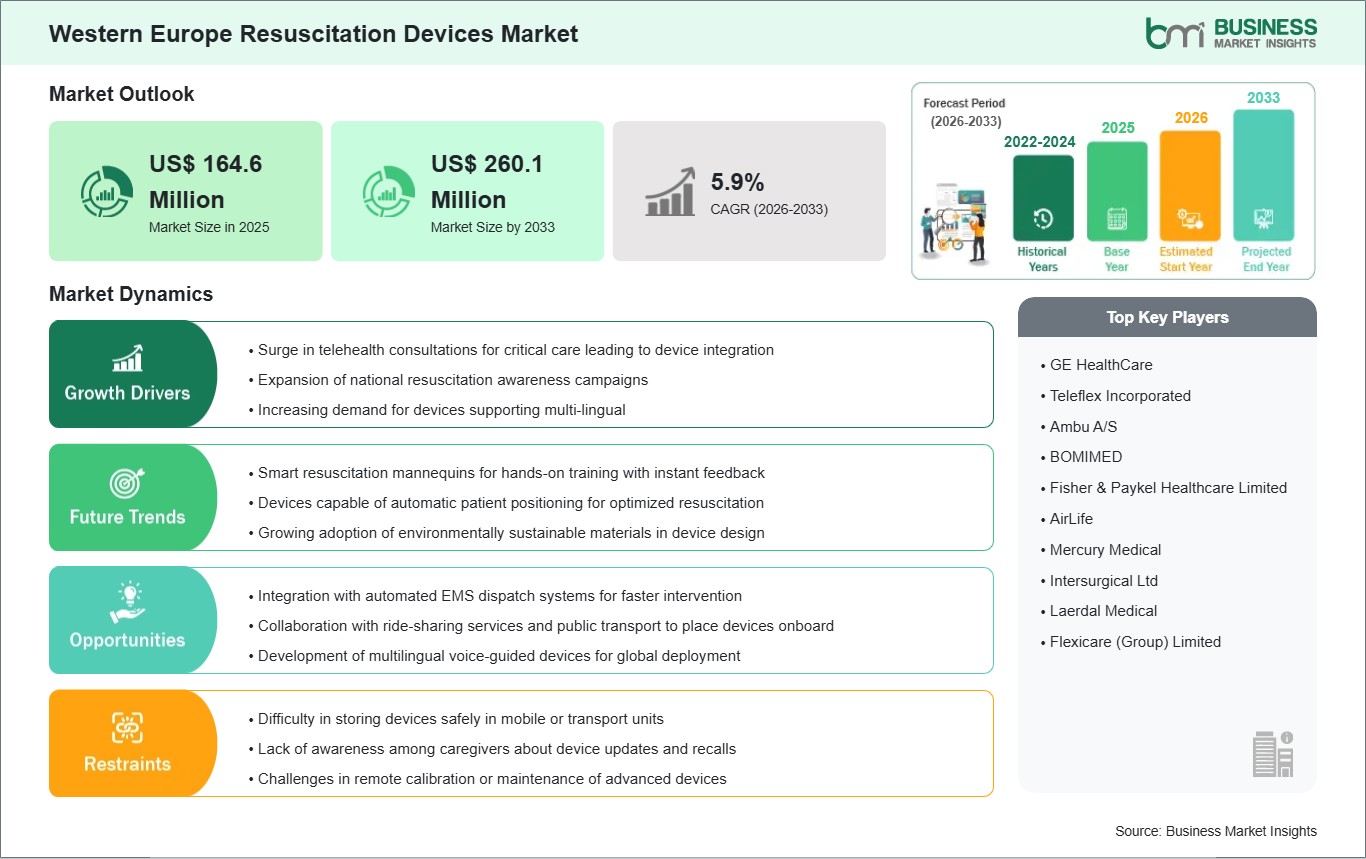
The Western Europe resuscitation devices market size is expected to reach US$ 260.1 million by 2033 from US$ 164.6 million in 2025. The market is estimated to register a CAGR of 5.9% from 2026 to 2033.

Executive Summary and Western Europe Resuscitation Devices Market Analysis:

The Western Europe resuscitation devices market is defined by highly mature healthcare systems, strong regulatory frameworks, and widespread adoption of advanced emergency care technologies. The region displays a developed ecosystem regarding intensive care and pre-hospital emergency response, characterized by an expansive network of hospitals, skilled medical practitioners, and adequate public knowledge on the importance of cardiac arrest treatment. The demand for resuscitation devices, including automated external defibrillators, advanced ventilators, manual resuscitators, and airway management systems, is determined by the aging population, prevalence of heart ailments, and consistent technological advancements in emergency medical facilities. Germany takes the lead in this area owing to the extensive nature of its healthcare industry, advanced engineering and medical equipment manufacturing sector, and effective incorporation of emergency medical technology across both urban and rural areas. The prominent growth factor in the market of Western Europe is a developed system of protocols for emergencies, involving the mandatory presence of resuscitation equipment in public places, workplaces, and healthcare centers. Another growth factor in Western Europe is the extensive knowledge of CPR among citizens, contributing to a more efficient process of early intervention during cardiovascular complications. Moreover, technological advances and the implementation of digital systems contribute to the efficiency and applicability of resuscitation devices. Restraints for Western Europe include high costs of advanced equipment, with slow incremental growth due to the developed healthcare industry. Nevertheless, Western Europe is one of the most advanced markets for resuscitation devices in the world.

Western Europe Resuscitation Devices Market - Strategic Insights:

global-market-strategic-framework
Get more information on this report

Western Europe Resuscitation Devices Market Segmentation Analysis:

Key segments that contributed to the derivation of the Nordic resuscitation devices market analysis are product type, usage type, application, patient type, and end user.

  • By product type, the resuscitation devices market is segmented into self-inflating bag, flow-inflating bag, t-piece resuscitator, and gas-powered resuscitator. The self-inflating bag segment dominated the market in 2025.
  • In terms of usage type, the resuscitation devices market is segmented into disposabale device and reusable device. The disposable devices segment dominated the market in 2025.
  • Based on application, the resuscitation devices market is classified into anesthesia, critical care, emergency medicine, and other applications. The anesthesia segment dominated the market in 2025.
  • By patient type, the resuscitation devices market is segmented into adult and pediatric. The adult segment dominated the market in 2025.
  • By end user, the resuscitation devices market is categorized into hospitals, ambulatory surgical centers, emergency medical services, and other end user. The hospitals segment dominated the market in 2025.
Western Europe Resuscitation Devices Market Drivers and Opportunities:

Surge in Telehealth Consultations for Critical Care Leading to Device Integration

In western Europe, telehealth is becoming a vital tool for transforming how emergency services are provided in hospitals. Hospitals are using these devices as they incorporate remote physician assistance services to aid in providing advice on managing cases involving heart attacks, respiratory failures, and trauma stabilization. In the regions facing increasing demands on emergency departments as a result of an aging population with a higher prevalence of chronic diseases, telehealth has proven to be invaluable.

Modern EMS systems have begun collaborating with specialists at hospitals by leveraging technologies that transmit information about patients' vitals, electrocardiogram readings, and images to hospital specialists in real-time. Resuscitation can take place much sooner in such scenarios, even before hospital admission. In cases such as those of Denmark and the Netherlands, paramedics are capable of accessing a video link to emergency physicians while undertaking resuscitation of patients.

The trend also influences the development of resuscitation equipment that is being used. In modern defibrillators, ventilators, and CPR assistance devices in Western Europe, manufacturers integrate connectivity options. This means that the device usage and functioning can be monitored by the telehealth clinician in real-time. This trend is expected to drive the use of new generation resuscitation equipment in the future.

Integration with Automated EMS Dispatch Systems for Faster Intervention

There is also a trend toward the tight integration of CPR processes into automatic ambulance dispatch systems. Such solutions include the deployment of AI-based triage systems in dispatch centers that can prioritize CPR patients and launch ambulance units and responders. This is highly beneficial for the time factor that is crucial when trying to save patients who suffer from sudden cardiac arrest.

There are growing trends toward dispatch system integration with responder geolocation applications and public access defibrillator maps. In many countries in Western Europe, responders, including citizens who are certified, are automatically alerted when a case of cardiac arrest is detected near their location, thus arriving on scene before the ambulance arrives. It has been proven by research that integrated responder systems help tremendously increase the survival rate of patients.

The current development has an effect on how resuscitation equipment will be deployed. Public authorities have been setting up more and more AEDs in places of transport, sports venues, and cities’ centers that correspond with high-risk areas as identified by dispatchers. Resuscitation equipment is being included in hospital monitoring for ambulances through the Emergency Medical Services (EMS) dashboard. This way, dispatchers will always know what resuscitation equipment is available and ready for use.

Western Europe Resuscitation Devices Market Size and Share Analysis:

The Western Europe resuscitation devices market is experiencing steady growth, with market size and share analysis reflecting evolving treatment preferences and competitive dynamics among key players. The report evaluates important subsegments categorized within product type, usage type, application, patient type, and end user, highlighting their respective contributions to overall market performance.

By product type, the self-inflating bag subsegment dominated the market in 2025, because they are easy to use and do not require external gas or power sources, making them ideal for emergencies. They allow precise manual control of ventilation, which is crucial in critical care. Their portability makes them suitable for both hospital wards and transport situations.

Based on usage type, the disposable devices subsegment dominated the market in 2025 due to their ability to prevent cross-contamination and infection. They eliminate the need for complex sterilization processes, saving time and reducing operational costs. In high-volume hospital settings, disposables improve workflow efficiency. This makes them highly preferred in emergency rooms, ICUs, and surgical units.

In terms of application, the anesthesia subsegment dominated the market in 2025, as resuscitation devices are essential for safe ventilation during induction and recovery. They provide backup support if mechanical ventilators fail. Their precise control helps manage patients with varying lung compliances. Hospitals rely on these devices to prevent hypoxia and ensure patient safety during surgeries.

By patient type, the adult subsegment dominated the market in 2025, as they experience more surgical procedures and critical emergencies than pediatric populations. Their larger lung capacity requires devices designed for adult ventilation. High prevalence of cardiac and respiratory conditions in adults increases usage frequency.

Based on end user, the hospitals subsegment dominated the market in 2025 due to constant emergency and surgical care needs. ICUs, operating rooms, and emergency departments require rapid access to resuscitation devices. High patient volume and stringent safety protocols make hospitals the key market driver. Their centralized procurement and standardized protocols ensure widespread device adoption.

Western Europe Resuscitation Devices Market Report Highlights:

Report Attribute Details
Market size in 2025 US$ 164.6 Million
Market Size by 2033 US$ 260.1 Million
CAGR (2026 - 2033)5.9%
Historical Data 2022-2024
Forecast period 2026-2033
Segments Covered By Product Type
  • Self-Inflating Bag
  • Flow-Inflating Bag
  • T-Piece Resuscitator
  • Gas-Powered Resuscitator
By Usage Type
  • Disposabale Device
  • Reusable Device
By Application
  • Anesthesia
  • Critical Care
  • Emergency Medicine
  • Other Applications
By Patient Type
  • Adult
  • Pediatric
Regions and Countries Covered
Western Europe Belgium, Netherlands, Luxembourg, Germany, France, Italy, Spain, Switzerland, Sweden, Austria, United Kingdom, Denmark, Portugal, Norway, Finland
Market leaders and key company profiles
  • GE HealthCare
  • Teleflex Incorporated
  • Ambu A/S
  • BOMIMED
  • Fisher & Paykel Healthcare Limited
  • AirLife
  • Mercury Medical
  • Intersurgical Ltd
  • Laerdal Medical
  • Flexicare (Group) Limited
Get more information on this report

Western Europe Resuscitation Devices Market Report Coverage and Deliverables:

The "Western Europe Resuscitation Devices Market Size and Forecast (2022–2033)" report provides a detailed analysis of the market covering below areas:

  • Western Europe Resuscitation devices market size and forecast at the regional and country levels for segments covered under the scope
  • Western Europe Resuscitation devices market trends, as well as drivers, restraints, and opportunities
  • Western Europe Resuscitation devices market analysis covering key trends, regional framework, major players, regulations, and recent developments
  • Industry landscape and competition analysis covering market concentration, heat map analysis, prominent players, and recent developments for the Western Europe Resuscitation devices market
  • Detailed company profiles, including SWOT analysis

Western Europe Resuscitation Devices Market Geographic Insights:

The geographical scope of the Western Europe resuscitation devices market report is divided into: Belgium, the Netherlands, Luxembourg, Germany, France, Italy, Spain, Switzerland, Sweden, Austria, the UK, Denmark, Portugal, Norway, and Finland. Germany held the largest share in 2025.

Germany dominates the Western Europe resuscitation devices market due to its highly developed healthcare infrastructure, strong industrial base in medical technology, and comprehensive emergency care system. The country possesses an efficient system of hospitals, trauma centers, and emergency medical services that enables quick action in case of heart and breathing failure. Hospitals in Germany are always furnished with the latest resuscitation technology, which includes powerful defibrillators, advanced ventilators, and airway devices. Emergency equipment is widely available in Berlin, Munich, and Hamburg, as well as in small towns. One of the characteristics of the market in Germany is that of strict regulation of the quality of medical devices and their standardization through engineering expertise. The nation is also well-equipped with extensive emergency medical technician and healthcare personnel training, which ensures optimal use of resuscitation devices during emergencies. Defibrillators are available at transport terminals, corporate offices, and sports venues, enhancing the capabilities of the nation in providing rapid response. Some of the disadvantages in the market include costly maintenance and procurement procedures due to the high cost of advanced medical systems. Nonetheless, Germany's advanced technological capabilities, organized healthcare sector, and ongoing research on innovative solutions make it the market leader within Western Europe.

global-market-geography
Get more information on this report

Western Europe Resuscitation Devices Market Research Report Guidance:

  • The report includes qualitative and quantitative data in the Western Europe Resuscitation devices market across product type, usage type, application, patient type, end user, and geography.
  • The report starts with the key takeaways (chapter 2), highlighting the key trends and outlook of the Western Europe Resuscitation devices market.
  • Chapter 3 focuses on the research methodology of the study.
  • Chapter 4 includes ecosystem analysis.
  • Chapter 5 highlights the major industry dynamics in the Western Europe Resuscitation devices market, including factors that are driving the market, prevailing deterrents, potential opportunities, as well as future trends. Impact analysis of these drivers and restraints is also covered in this section.
  • Chapter 6 discusses the Western Europe Resuscitation devices market scenario, in terms of historical market revenues, and forecast till the year 2033.
  • Chapters 7 to 12 cover the Western Europe resuscitation devices market segments by product type, usage type, application, patient type, end user, and geography across Belgium, the Netherlands, Luxembourg, Germany, France, Italy, Spain, Switzerland, Sweden, Austria, the UK, Denmark, Portugal, Norway, and Finland. They cover the market revenue, forecast, and factors driving the market.
  • Chapter 13 describes the competitive analysis along with the heat map analysis for the key players operating in the market.
  • Chapter 14 describes the industry landscape analysis. It provides detailed descriptions of business activities such as market initiatives, new developments, mergers, and joint ventures globally, along with a competitive landscape.
  • Chapter 15 provides detailed profiles of the major companies operating in the Western Europe Resuscitation devices market. Companies have been profiled on the basis of their key facts, business descriptions, products, financial overview, SWOT analysis, and key developments.
  • Chapter 16, i.e., the appendix, is inclusive of a brief overview of the company, list of abbreviations, and disclaimer.

Western Europe Resuscitation Devices Market News and Key Development:

The Western Europe resuscitation devices market is evaluated by gathering qualitative and quantitative data post primary and secondary research, which includes important corporate publications, association data, and databases. A few of the key developments in the Western Europe resuscitation devices market are:

  • In January 2025, Koninklijke Philips N.V. announced the sale of its Emergency Care business, including its defibrillator and resuscitation device portfolio, to Bridgefield Capital, marking a strategic shift to streamline its healthcare focus while continuing to support existing installed AED systems across Western Europe.
  • In June 2024, Stryker Corporation announced the expansion of its public access defibrillation programs across key Western European markets, including Germany, France, and the UK, increasing the placement of LIFEPAK AED systems in airports, railway stations, and large public venues to strengthen emergency cardiac response infrastructure.

Key Sources Referred:

  • The World Bank
  • World Health Organization (WHO)
  • Center for Disease Control and Prevention (CDC)
  • European Database on Medical Devices (EUDAMED)
  • European Society of Cardiology
  • American College of Cardiology
  • American Heart Association
  • Company Websites
  • Company Annual Reports
  • Company Investor Presentations
The List of Companies - Western Europe Resuscitation Devices Market
  • GE HealthCare
  • Teleflex Incorporated
  • Ambu A/S
  • BOMIMED
  • Fisher & Paykel Healthcare Limited
  • AirLife
  • Mercury Medical
  • Intersurgical Ltd
  • Laerdal Medical
  • Flexicare (Group) Limited
Frequently Asked Questions
How big is the Western Europe Resuscitation Devices Market?

The Western Europe Resuscitation Devices Market is valued at US$ 164.6 Million in 2025, it is projected to reach US$ 260.1 Million by 2033.

What is the CAGR for Western Europe Resuscitation Devices Market by (2026 - 2033)?

As per our report Western Europe Resuscitation Devices Market, the market size is valued at US$ 164.6 Million in 2025, projecting it to reach US$ 260.1 Million by 2033. This translates to a CAGR of approximately 5.9% during the forecast period.

What segments are covered in this report?

The Western Europe Resuscitation Devices Market report typically cover these key segments-

  • Product Type (Self-Inflating Bag, Flow-Inflating Bag, T-Piece Resuscitator, Gas-Powered Resuscitator)
  • Usage Type (Disposabale Device, Reusable Device)
  • Application (Anesthesia, Critical Care, Emergency Medicine, Other Applications)
  • Patient Type (Adult, Pediatric)

What is the historic period, base year, and forecast period taken for Western Europe Resuscitation Devices Market?

The historic period, base year, and forecast period can vary slightly depending on the specific market research report. However, for the Western Europe Resuscitation Devices Market report:

  • Historic Period : 2022-2024
  • Base Year : 2025
  • Forecast Period : 2026-2033
  • Who are the major players in Western Europe Resuscitation Devices Market?

    The Western Europe Resuscitation Devices Market is populated by several key players, each contributing to its growth and innovation. Some of the major players include:

  • GE HealthCare
  • Teleflex Incorporated
  • Ambu A/S
  • BOMIMED
  • Fisher & Paykel Healthcare Limited
  • AirLife
  • Mercury Medical
  • Intersurgical Ltd
  • Laerdal Medical
  • Flexicare (Group) Limited
  • Who should buy this report?

    The Western Europe Resuscitation Devices Market report is valuable for diverse stakeholders, including:

    • Investors: Provides insights for investment decisions pertaining to market growth, companies, or industry insights. Helps assess market attractiveness and potential returns.
    • Industry Players: Offers competitive intelligence, market sizing, and trend analysis to inform strategic planning, product development, and sales strategies.
    • Suppliers and Manufacturers: Helps understand market demand for components, materials, and services related to concerned industry.
    • Researchers and Consultants: Provides data and analysis for academic research, consulting projects, and market studies.
    • Financial Institutions: Helps assess risks and opportunities associated with financing or investing in the concerned market.

    Essentially, anyone involved in or considering involvement in the Western Europe Resuscitation Devices Market value chain can benefit from the information contained in a comprehensive market report.

    Available Report Formats

    pdf-format excel-format pptx-format
    Buy Now
    Sales Assistance
    +1 646 791 7070 (US & UK)
    Customization Form

    Please tell us your area of interest
    (Market Segments/ Regions and Countries/ Companies)