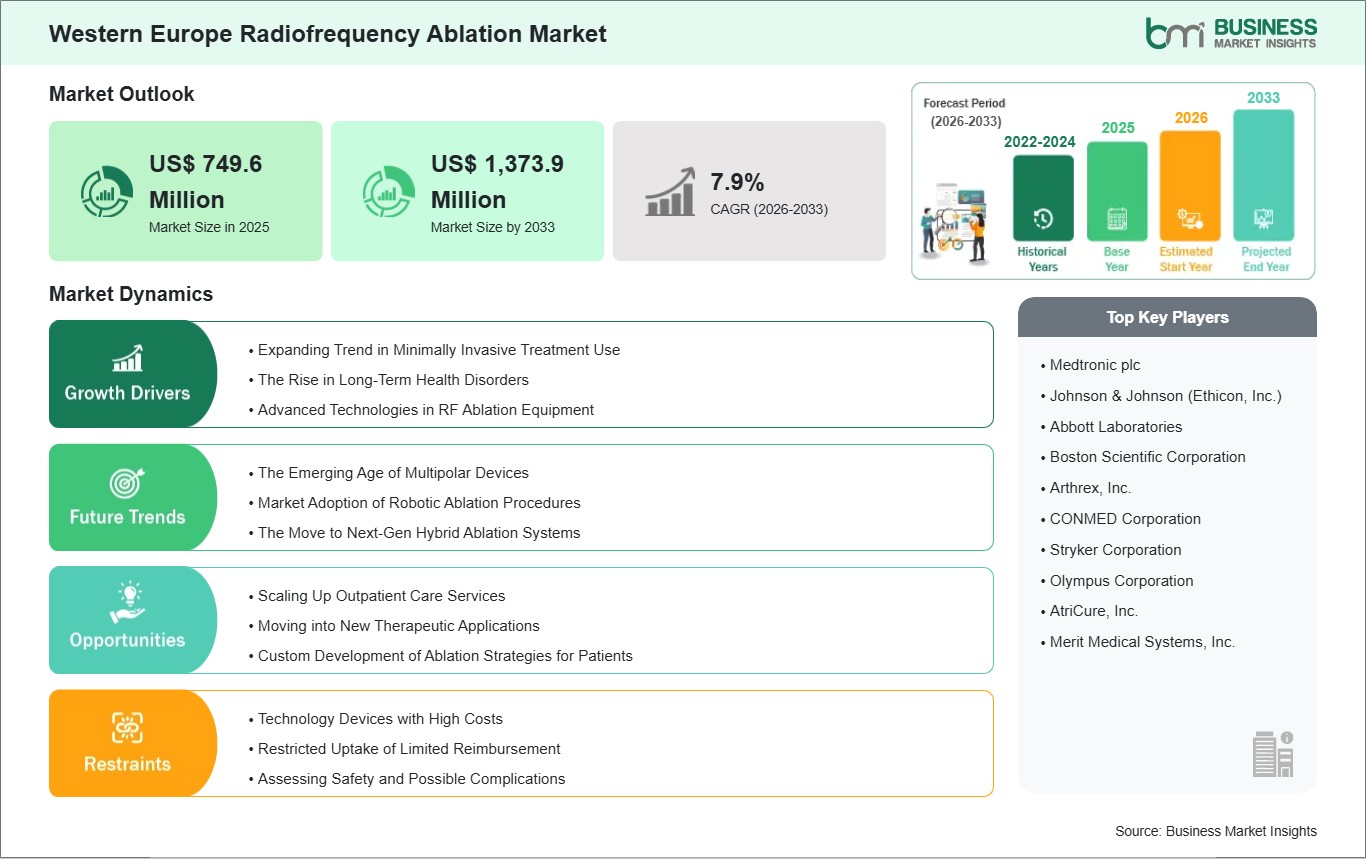
The Western Europe radiofrequency ablation market size is expected to reach US$ 1,373.9 million by 2033 from US$ 749.6 million in 2025. The market is estimated to record a CAGR of 7.9% from 2026 to 2033.
The Western Europe radiofrequency ablation (RFA) market has experienced robust development as healthcare systems in the region embrace minimally invasive procedures. RFA is utilized for cardiac conditions, oncology applications, and chronic pain management due to its precision, reduced recovery times, and lower procedural risks compared to conventional surgery. The market benefits from well-established healthcare infrastructure, advanced medical technologies, and a high degree of clinical expertise, which facilitate adoption across hospitals and specialized centers.
Key growth drivers include strong patient demand for less invasive therapies, continuous technological innovation in ablation devices, and comprehensive training programs that strengthen clinical confidence. Policymakers support modern treatment modalities and integrated care pathways encourage uptake. However, challenges persist, including the high cost of advanced RFA systems, variations in reimbursement policies across countries, and the concentration of trained interventional specialists in certain urban regions. These factors limit access in some areas, particularly for smaller clinics. The Western European RFA market reflects a sophisticated healthcare environment where minimally invasive solutions are becoming standard practice, with a continued emphasis on improving patient outcomes and procedural efficiency.

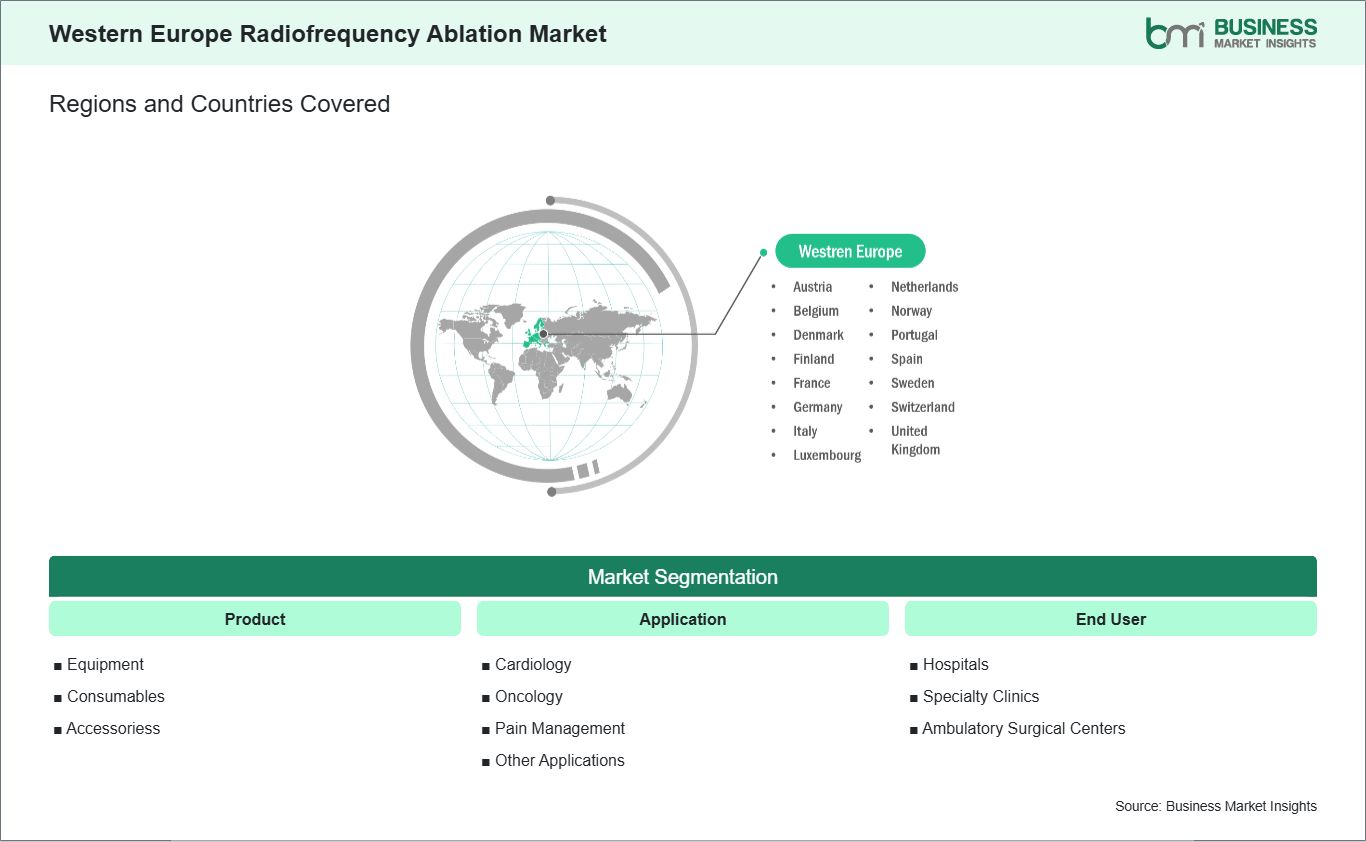
Key segments that contributed to the derivation of the Western Europe radiofrequency ablation market analysis are product type, application, and end user.
Western Europe is witnessing a growing trend toward minimally invasive medical treatments, with radiofrequency ablation (RFA) adopted in cardiology, oncology, and chronic pain management. Healthcare providers are prioritizing interventions that reduce surgical trauma, lower complication risks, and shorten hospital stays. This focus aligns with the region’s emphasis on patient-centered care, evidence-based clinical guidelines, and the efficient utilization of hospital resources.
Major hospitals and specialized clinics across Western Europe are investing in advanced imaging systems and catheter-based technologies to enable precise RFA procedures. Clinician training programs, along with collaborative research initiatives, enhance expertise and confidence in minimally invasive techniques. RFA is incorporated into standard treatment protocols for arrhythmia, tumor ablation, and chronic pain, establishing its role as a key alternative to conventional surgery.
Patient expectations are also influencing growth. Individuals prefer procedures that allow faster recovery and minimal disruption to daily activities. High awareness of innovative therapies and strong public and private healthcare infrastructure are contributing to widespread adoption of RFA, supporting sustained growth in the minimally invasive treatment segment across the region.
The expansion of outpatient and day-care services is creating opportunities for RFA adoption in Western Europe. Healthcare providers are shifting suitable procedures to ambulatory settings to optimize hospital bed use, improve efficiency, and enhance patient convenience. RFA’s minimally invasive profile and short recovery period make it particularly suitable for outpatient delivery, enabling higher patient throughput while maintaining clinical quality.
Private clinics and public hospitals are integrating RFA into outpatient care pathways for cardiac arrhythmia, chronic pain, and selected oncology procedures. Reimbursement policies and healthcare financing frameworks that support same-day interventions provide strong incentives for expanding outpatient capabilities. This shift is consistent with regional strategies to reduce healthcare costs while improving patient access and service quality.
Despite advanced infrastructure, challenges remain in providing uniform access to outpatient RFA services across rural and less populated areas. Investments in specialist training, procedural standardization, and upgrading day-care units are helping bridge these gaps. As outpatient care capacity grows, RFA adoption is expected to expand steadily, strengthening the Western Europe radiofrequency ablation market.

The Western Europe radiofrequency ablation market demonstrates consistent growth, with market size and share analysis reflecting evolving treatment preferences and competitive dynamics among leading players. The report evaluates important subsegments categorized within product type, application type, and end user, highlighting their respective contributions to market performance.
By product type, the consumables subsegment dominated the market in 2025, owing to the recurring need for disposable catheters, electrodes, and other consumable components during RFA procedures, making them a key revenue driver for manufacturers and ensuring consistent demand in clinical settings.
In terms of application, the cardiology subsegment dominated the market in 2025. The leadership of cardiology applications is attributed to the rising prevalence of arrhythmias and other cardiac conditions, growing adoption of minimally invasive ablation procedures, and increasing awareness among healthcare providers about the effectiveness of RFA in managing heart rhythm disorders.
Based on end user, the hospitals subsegment dominated the market in 2025. Hospitals maintain a stronghold due to their well-established surgical and electrophysiology departments, access to advanced RFA equipment, trained cardiologists and staff, and the capability to manage complex procedures with comprehensive patient care.
| Report Attribute | Details |
|---|---|
| Market size in 2025 | US$ 749.6 Million |
| Market Size by 2033 | US$ 1,373.9 Million |
| CAGR (2026 - 2033) | 7.9% |
| Historical Data | 2022-2024 |
| Forecast period | 2026-2033 |
| Segments Covered | By Product
|
|
Regions and Countries Covered
| |
| Western Europe | Belgium, Netherlands, Luxembourg, Germany, France, Italy, Spain, Switzerland, Sweden, Austria, United Kingdom, Denmark, Portugal, Norway, Finland |
| Market leaders and key company profiles |
|
The "Western Europe Radiofrequency Ablation Market Size and Forecast (2022–2033)" report provides a detailed analysis of the market covering below areas:
The geographical scope of the Western Europe radiofrequency ablation market report is divided into: Belgium, the Netherlands, Luxembourg, Germany, France, Italy, Spain, Switzerland, Sweden, Austria, the UK, Denmark, Portugal, Norway, and Finland. Germany held the largest share in 2025.
Germany is the leading market for RFA in Western Europe, driven by its advanced healthcare infrastructure, early adoption of innovative medical technologies, and strong focus on minimally invasive therapies. Hospitals and specialty centers across the country have incorporated RFA into clinical pathways for cardiac arrhythmias, targeted tumor ablation, and chronic pain management. Clinicians leverage RFA’s precision and reliability to optimize procedural outcomes and minimize patient recovery time. The country benefits from a structured framework for training interventional specialists, which enhances procedural quality and supports broader adoption across both public and private healthcare facilities. German healthcare providers also prioritize technological innovation, integrating advanced imaging and catheter-based techniques to improve procedural accuracy. Challenges remain in ensuring equitable access and managing the high costs associated with state-of-the-art RFA systems. Nevertheless, Germany maintains a leadership role in the Western European RFA market, reflecting a healthcare system aligned with innovation, patient-centered care, and the increasing prevalence of minimally invasive procedural solutions.

The Western Europe Radiofrequency Ablation market is evaluated by gathering qualitative and quantitative data post primary and secondary research, which includes important corporate publications, association data, and databases. A few of the key developments in the Western Europe Radiofrequency Ablation market are:
The Western Europe Radiofrequency Ablation Market is valued at US$ 749.6 Million in 2025, it is projected to reach US$ 1,373.9 Million by 2033.
As per our report Western Europe Radiofrequency Ablation Market, the market size is valued at US$ 749.6 Million in 2025, projecting it to reach US$ 1,373.9 Million by 2033. This translates to a CAGR of approximately 7.9% during the forecast period.
The Western Europe Radiofrequency Ablation Market report typically cover these key segments-
The historic period, base year, and forecast period can vary slightly depending on the specific market research report. However, for the Western Europe Radiofrequency Ablation Market report:
The Western Europe Radiofrequency Ablation Market is populated by several key players, each contributing to its growth and innovation. Some of the major players include:
The Western Europe Radiofrequency Ablation Market report is valuable for diverse stakeholders, including:
Essentially, anyone involved in or considering involvement in the Western Europe Radiofrequency Ablation Market value chain can benefit from the information contained in a comprehensive market report.
Please tell us your area of interest
(Market Segments/ Regions and Countries/ Companies)