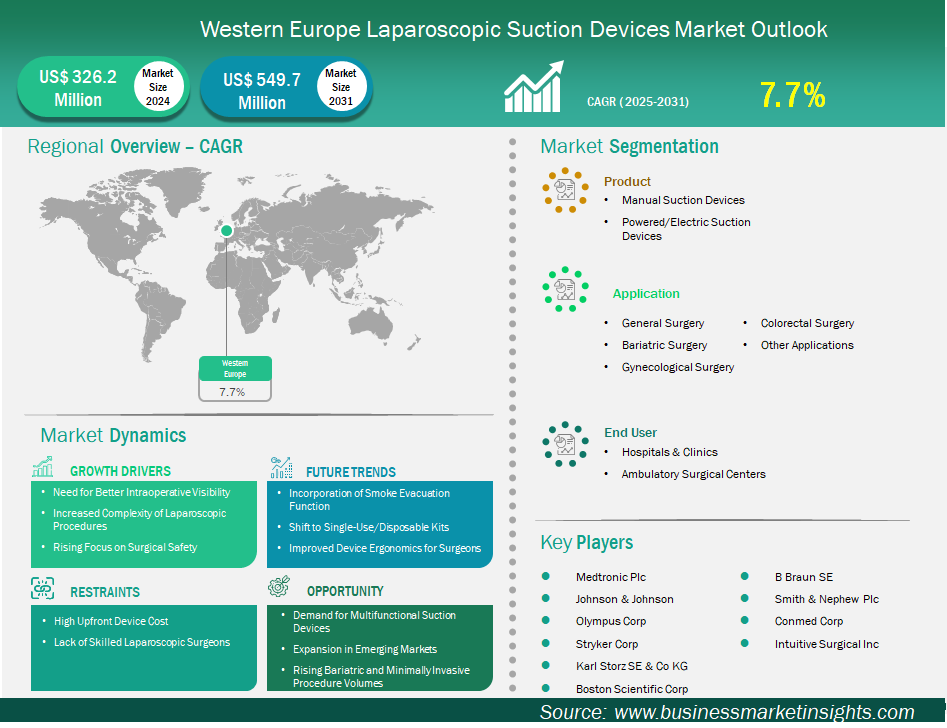
The Western Europe laparoscopic suction devices market size is expected to reach US$ 549.7 million by 2031 from US$ 326.2 million in 2024. The market is estimated to record a CAGR of 7.7% from 2025 to 2031.
Executive Summary and Western Europe Laparoscopic Suction Devices Market Analysis:
The laparoscopic suction devices market in Western Europe is experiencing significant growth driven by the need for better intraoperative visibility, increased complexity of laparoscopic procedures, and rising focus on surgical safety. The market for laparoscopic suction devices in Western Europe is composed of a fiercely competitive environment and strict regulatory harmonization, especially with regard to single-use versus reusable devices. One of the key features of the dynamics is the extensive pressure on prices caused by leading public healthcare systems that operate in countries like the UK, the NHS and France and Germany, which are inducing the need for cost-benefit analysis and group purchasing organizations. This environment is beneficial to the big global players in the market, such as Medtronic and Johnson & Johnson (Ethicon), who have the capacity to cope with such price limitations, thus they can benefit from their strong portfolio of both high-voltage electric pumps and disposable tubing sets for infection control. Technological innovation is mainly concerned with the optimization of the device's ergonomic features and the incorporation of next-generation features, such as anti-clogging technology and smart fluid management systems to not only enable surgical visualization but also help the surgeon perform better in high-stakes operations, e.g. colorectal and bariatric surgery.
Western Europe Laparoscopic Suction Devices Market Segmentation Analysis:
Key segments that contributed to the derivation of the laparoscopic suction devices market analysis are product, application, and end user.
- By product, the laparoscopic suction devices market is segmented into manual suction devices and powered/electric suction devices. The powered/electric suction devices segment dominated the market in 2024. This is the largest segment due to the requirement for consistent, high-volume suction power and reliability, which are essential for maintaining a clear surgical field in complex, high-volume operating room procedures.
- In terms of application, the market is segmented into general surgery, bariatric surgery, gynecological surgery, colorectal surgery, and other applications. The general surgery segment held the largest market share in 2024. This is the largest segment due to the high volume and frequency of common laparoscopic procedures (e.g., cholecystectomy, appendectomy, hernia repair) where fluid management is critical.
- By end user, the market is segmented into hospitals and clinics, and ambulatory surgical centers. The hospitals and clinics segment held the largest market share in 2024. This is the largest segment due to the concentration of advanced surgical infrastructure, high patient throughput, and the mandated need for reliable suction equipment in all operating theatres and critical care units.
Western Europe Laparoscopic Suction Devices Market Outlook
The market shows a slow expansion over time, which is mainly attributed to the continuous incorporation of laparoscopic technologies alongside the sophisticated robotic surgical systems. The next generation of suction devices will always find ways to be compatible with such complex systems by not only providing custom-modified suction instruments but also interface adapters that can communicate effortlessly with robotic arms that are source of suction-irrigation during complicated, multi-quadrant surgical procedures with more than one robotic arm in the operating theatre. The biggest factor to this positive development is the ongoing epidemiological transition, characterized by the rising cases of obesity and gastrointestinal diseases. Consequently, this is followed by the increased rate of laparoscopic bariatric surgeries (for example, sleeve gastrectomy) where the demand for high-performance aspiration systems that can manage large amounts of fluid and soft tissue is very high. Meanwhile, the relocation to outpatient settings will facilitate the need for smaller, portable, battery-operated suction devices that can be used in the workflow of an Ambulatory Surgical Center (ASC). Therefore, future product innovation in this area of the product category will most probably revolve around miniaturization and the integration of smart sensors that will provide real-time suction pressure and fluid volume feedback. This progression signifies a general transition from analog to digital and the use of data from surgical procedure guidelines and recommendations, which is happening in Europe, and is similar to the trend in other healthcare settings.
Western Europe Laparoscopic Suction Devices Market Country Insights
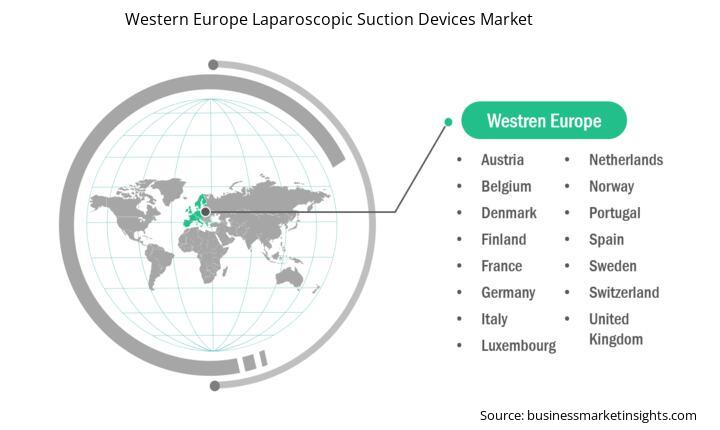
Based on country, the Western Europe laparoscopic suction devices market is segmented into Belgium, the Netherlands, Luxembourg, Germany, France, Italy, Spain, Switzerland, Sweden, Austria, the United Kingdom, Denmark, Portugal, Norway, and Finland. Germany held the largest share in 2024.
Procurement and purchasing practices for laparoscopic suction devices vary significantly across key Western European countries, reflecting the diverse healthcare financing and procurement frameworks. In Germany, there is a preference for clinically advanced and high-performing products, which stems from a fragmented hospital system where individual departments (usually under the control of chief clinicians) have significant autonomy in their choice of capital equipment. Procurement decisions are made based on expectations for durability, performance, and future capabilities, rather than cost. As a result, Germany is a positive market for innovation sales strategies. By contrast, the United Kingdom operates with a highly centralized procurement model through NHS procurement processes. Here, emphasis is placed on standardized contracts, volume-based purchasing, and the lowest provision unit cost. Consequently, disposable instruments or systems with a lower total lifetime cost have precedence. The key drivers for procurement outcomes are cost-effectiveness and procurement efficiency.
Western Europe Laparoscopic Suction Devices Market Company Profiles
Medtronic Plc; Johnson & Johnson; Olympus Corp; Stryker Corp; Karl Storz SE & Co KG, Boston Scientific Corp, B Braun SE, Smith & Nephew Plc, Conmed Corp, and Intuitive Surgical Inc., are among the key players operating in the market. These players adopt strategies such as expansion, product innovation, and mergers and acquisitions to stay competitive in the market and offer innovative products to their consumers.
Western Europe Laparoscopic Suction Devices Market Research Methodology:
The following methodology has been followed for the collection and analysis of data presented in this report:
Secondary Research
The research process begins with comprehensive secondary research, utilizing both internal and external sources to gather qualitative and quantitative data for each market. Commonly referenced secondary research sources include, but are not limited to:
- Company websites, annual reports, financial statements, broker analyses, and investor presentations
- Industry trade journals and other relevant publications
- Government documents, statistical databases, and market reports
- News articles, press releases, and webcasts specific to companies operating in the market
Note: All financial data included in the Company Profiles section has been standardized to US$. For companies reporting in other currencies, figures have been converted to US$ using the relevant exchange rates for the corresponding year.
Primary Research
Business Market Insights conducts a significant number of primary interviews each year with industry stakeholders and experts to validate and analyze the data and gain valuable insights. These research interviews are designed to:
- Refine findings from secondary research
- Enhance the expertise and market understanding of the analysis team
- Gain insights into market size, trends, growth patterns, competitive dynamics, and future prospects
Primary research is conducted via email interactions and telephone interviews with industry experts across various markets, categories, segments, and sub-segments in different regions. Participants typically include:
- Industry stakeholders: Vice Presidents, business development managers, market intelligence managers, and national sales managers
- External experts: Valuation specialists, research analysts, and key opinion leaders with industry-specific expertise
Key Sources Referred:
- World Health Organization (WHO)
- The World Bank Group
- Worldometer
- The Lancet
- BMC Medical Education
- Eurostat
Western Europe Laparoscopic Suction Devices Market Strategic Insights
Western Europe Laparoscopic Suction DevicesMarket Report Highlights
| Report Attribute | Details |
| Market size in 2024 | US$ 326.2 Million |
| Market Size by 2031 | US$ 549.7 Million |
| CAGR (2025 - 2031) | 7.7% |
| Historical Data | 2021-2023 |
| Forecast period | 2025-2031 |
| Segments Covered |
By Product
|
|
Regions and Countries Covered
|
|
| Western Europe | Belgium, Netherlands, Luxembourg, Germany, France, Italy, Spain, Switzerland, Sweden, Austria, United Kingdom, Denmark, Portugal, Norway, Finland |
| Market leaders and key company profiles |
|
Western Europe Laparoscopic Suction Devices Market Country and Regional Insights