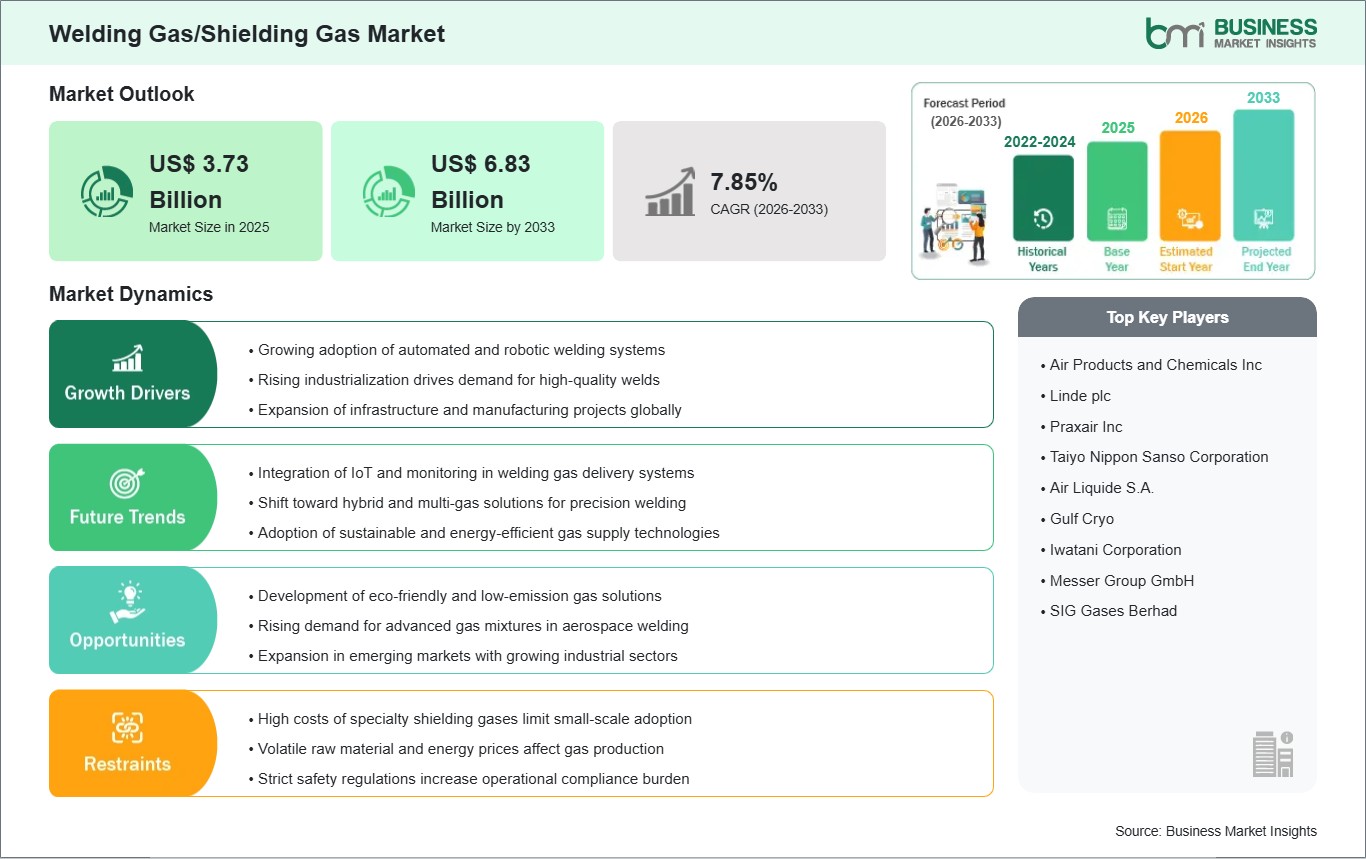
The Welding Gas/Shielding Gas Market size is expected to reach US$ 6.83 billion by 2033 from US$ 3.73 billion in 2025. The market is estimated to record a CAGR of 7.85% from 2026 to 2033.
The global welding gas and shielding gas market operates as a crucial component for both manufacturing and fabrication industries across various global markets. The process of shielding gases, which includes argon, carbon dioxide, helium and different gas mixtures, works as a fundamental material for welding because it shields molten weld pools from atmospheric contamination, which results in better weld quality, mechanical strength and structural stability. Welding gases serve as essential materials for industries like automotive, construction, shipbuilding, aerospace and energy because they support operations which include both basic metal joining and advanced manufacturing work. The global evolution of the market has developed through faster industrial growth, increased usage of automated welding systems and robotic welding systems, and higher requirements for product quality and operational efficiency.
The worldwide welding gas and shielding gas market maintains its growth through heavy industries and infrastructure development, which continues to expand across the globe. The demand for welding consumables, which include shielding gases, keeps increasing because countries spend money on building bridges and pipelines, residential and commercial skyscrapers and industrial facilities. Modern manufacturing facilities increasingly use advanced gas mixtures tailored to specific welding processes such as MIG/MAG and TIG welding to optimize penetration, reduce spatter, and achieve cleaner welds. The process optimization focus has resulted in manufacturers developing specialty blends that deliver performance improvements for specific applications that use stainless steel and high-strength alloys.
Another key driver is the adoption of automation and robotics in welding operations. Automated systems, especially in automotive and electronics manufacturing, require a precise and continuous gas supply to maintain consistent weld quality at high throughput. The need for constant supply has resulted in companies investing in gas delivery systems, storage solutions and logistics improvements. The implementation of cleaner gases and advanced gas delivery technologies, which reduce waste and protect operators from hazardous situations, has become more common due to workplace safety initiatives and emission reduction efforts. The global market experiences various challenges that have the potential to slow down its growth. The price of industrial gases and their availability for customers depend on three factors: energy price changes, raw material supply and production capacity restrictions. The gas handling, storage and transportation regulations require compliance work, which leads to higher costs for producers and end users in their operations. The global welding gas/shielding gas market undergoes industrial expansion and technological progress, and increasing demands for weld performance, but cost demands and regulatory requirements create continuous operational difficulties.

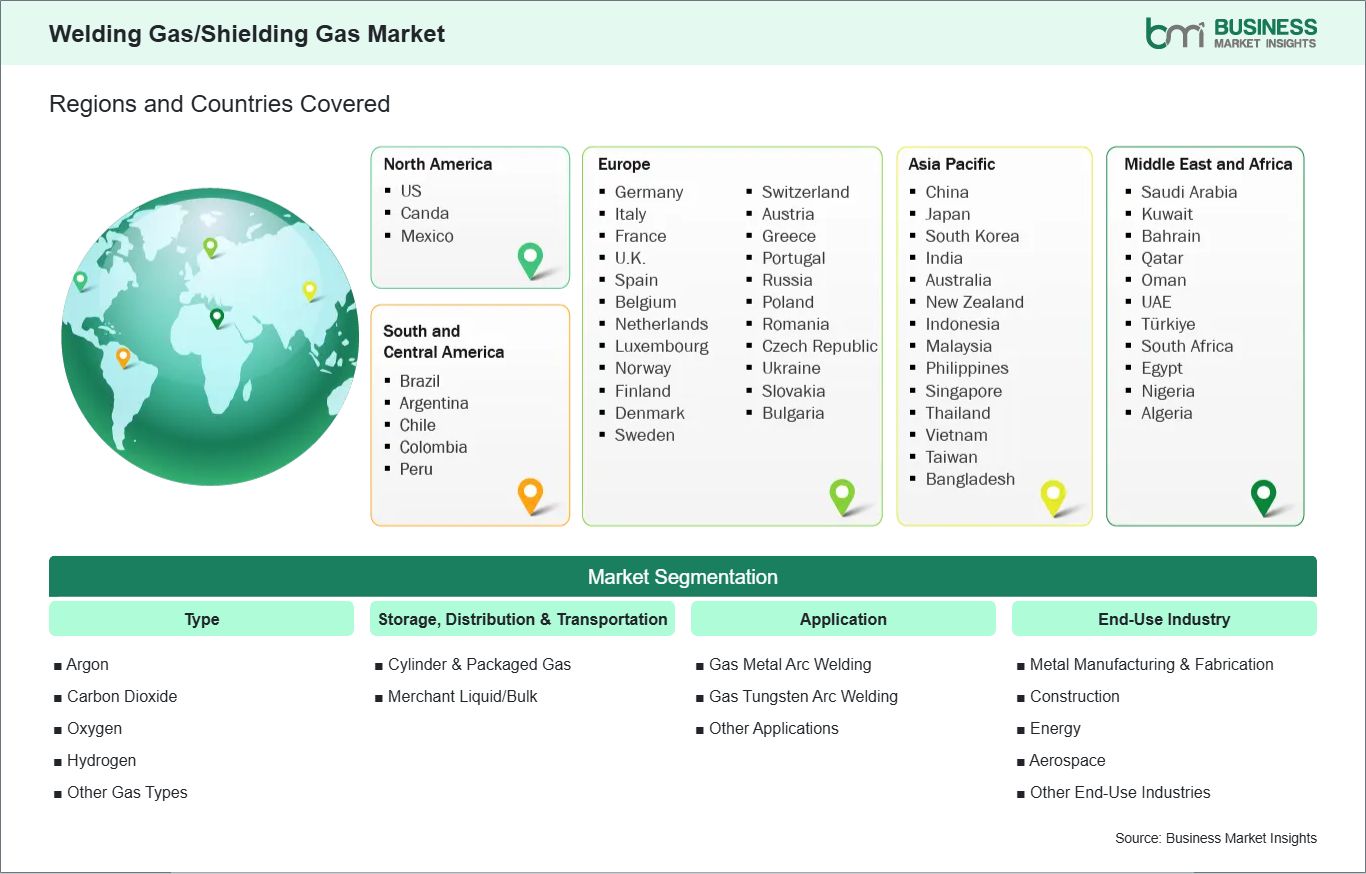
Key segments that contributed to the derivation of the welding gas/shielding gas market analysis are type; storage, distribution & transportation; application; and end-use industry.
The global welding gas and shielding gas market currently experiences growth due to industrial sectors adopting automated robotic welding systems. Manufacturing industries, which include automotive, aerospace and heavy machinery sectors, require precise and consistent weld quality, which manual processes cannot deliver. The operational efficiency of automated systems depends on their ability to deliver shielding gases, which include argon and carbon dioxide, and mixed gases for shielding purposes, which protect against contamination while maintaining consistent weld penetration.
Manufacturers achieve production expansion through robotics, which enables them to produce products at higher quality levels. North American and European regions depend on robotic welding cells for their automotive assembly lines and aerospace manufacturing plants, which need special gas delivery systems that their operators must monitor continuously to maintain workflow. The demand for shielding gases increases as Asia Pacific countries establish semi-automated welding systems to fulfill their rising requirements for infrastructure development and industrial production.
The increasing popularity of hybrid welding technologies, which combine laser and MIG/TIG techniques, has created a higher demand for specialized gas mixtures. These gas mixtures improve arc stability while reducing spatter, which results in stronger mechanical properties for welded joints. The welding market expands because industries need better productivity, accuracy and safety, which automated welding systems with dependable gas supplies deliver. This market growth creates chances for suppliers to develop their distribution systems while creating innovative delivery methods.
Environmental sustainability and regulatory compliance are increasingly influencing the global welding gas market. Industries are under pressure to reduce emissions, minimize greenhouse gas footprints, and adopt eco-friendly practices in production and operations. As a result, manufacturers are developing low-emission and energy-efficient gas solutions, such as recycled or blended shielding gases, which meet performance requirements while reducing environmental impact.
Regions like Europe and North America lead in adopting sustainable practices, with construction and automotive sectors implementing green standards. In Asia Pacific, growing awareness of industrial pollution and tightening regulations have prompted factories to replace conventional CO₂-rich mixtures with optimized low-emission alternatives, balancing efficiency and environmental compliance. These eco-friendly gases not only support sustainability goals but also enhance workplace safety by minimizing operator exposure to harmful fumes.
The market opportunity lies in the innovation and commercialization of these green gas solutions. Companies are investing in R&D to improve gas mixture formulations, storage systems, and delivery technologies to reduce waste, improve arc stability, and maintain weld quality. As industries worldwide prioritize sustainability without compromising performance, eco-friendly welding gases are expected to play a significant role in shaping future global demand.
The welding gas/shielding gas market demonstrates steady growth, with size and share analysis highlighting evolving trends and competitive dynamics among key players. The report examines subsegments categorized within type; storage, distribution & transportation; application; and end-use industry, offering insights into their contribution to overall market performance.
By type, the argon subsegment dominated the market in 2025, driven by its superior inert shielding properties and widespread use across high-quality welding applications.
Based on storage, distribution & transportation, the cylinder & packaged gas subsegment dominated the market in 2025, driven by its ease of transportation, flexibility in supply, and suitability for small to medium-scale operations.
On the basis of application, the gas metal arc welding subsegment dominated the market in 2025, driven by its high efficiency, versatility, and strong adoption in automated and industrial welding processes.
In terms of end-use industry, the metal manufacturing & fabrication subsegment dominated the market in 2025, driven by rising steel demand and extensive welding requirements across industrial production activities.
| Report Attribute | Details |
|---|---|
| Market size in 2025 | US$ 3.73 Billion |
| Market Size by 2033 | US$ 6.83 Billion |
| Global CAGR (2026 - 2033) | 7.85% |
| Historical Data | 2022-2024 |
| Forecast period | 2026-2033 |
| Segments Covered | By Type
|
|
Regions and Countries Covered
| |
| North America | US, Canada, Mexico |
| Europe | Belgium, Austria, Finland, Denmark, Greece, Poland, Romania, Russia, Ukraine, Czech Republic, Slovakia, Bulgaria, Italy, Luxembourg, Germany, Switzerland, France, Netherlands, Norway, Portugal, Spain, Sweden, United Kingdom |
| Asia-Pacific | Australia, China, India, Japan, South Korea, Indonesia, Malaysia, Philippines, Singapore, Thailand, Vietnam, Bangladesh, New Zealand, Taiwan |
| South and Central America | Brazil, Argentina, Peru, Chile, Colombia |
| Middle East and Africa | Bahrain, Kuwait, Oman, Qatar, Saudi Arabia, United Arab Emirates, Turkiye, South Africa, Egypt, Algeria, Nigeria |
| Market leaders and key company profiles |
|
The "Welding Gas/Shielding Gas Market Size and Forecast (2022 - 2033)" report provides a detailed analysis of the market covering below areas:
The geographical scope of the Welding Gas/Shielding Gas Market report is divided into North America, Asia Pacific, Europe, Middle East & Africa, and South & Central America. North America held the largest share in 2025.
North America becomes the main market for welding gases and shielding gases because its industrialized economy, manufacturing capacity and automated welding technology use reach advanced levels.
The United States and Canada depend on high-performance gas solutions for their aerospace, automotive, energy and heavy machinery sectors, which require precise welding work to maintain consistent results. The region maintains dependable specialty gas mixture access through its established supply chain and distribution network and technical support services, which deliver both manual and robotic welding gases.
Europe follows closely behind European countries because industrial automation and automotive production, shipbuilding and infrastructure development drive strong demand for these technologies. The requirements of stringent environmental regulations and workplace safety standards lead countries such as Germany, France and the United Kingdom to implement high-quality low-emission shielding gases, which create demand for advanced gas blends and delivery systems.
The Asia Pacific region stands as a major market that grows rapidly through urbanization, industrial development and infrastructure construction projects in China, India, Japan and South Korea. The combination of automated welding solution implementation and increased steel, automobile and electronics production has created a higher demand for dependable gas supply systems, which provide tailored mixtures that meet various metal and alloy needs. The energy, construction and heavy industrial markets drive the
Middle East and Africa market because Saudi Arabia and UAE and South Africa determine major industrial projects that require welding gases for pipelines and refineries and steel fabrication in extreme environmental conditions. The welding gas market in South and Central America is developing because Brazil, Mexico, and Argentina have started using welding gases for their automotive, shipbuilding and industrial manufacturing operations.
The region faces two main challenges because its supply chains do not function consistently and its regulations change unpredictably, yet the demand for goods continues because companies modernize their facilities and prioritize safety and efficiency improvements. The welding gas and shielding gas market worldwide develops through different drivers, which include European regulatory requirements and Asian industrial growth, Middle Eastern and African infrastructure needs and South American efficiency and modernization efforts, while North America leads in technology use and market development.

The Welding Gas/Shielding Gas Market is evaluated by gathering qualitative and quantitative data post primary and secondary research, which includes important corporate publications, association data, and databases. A few of the key developments in the welding gas/shielding gas market are:
The Welding Gas/Shielding Gas Market is valued at US$ 3.73 Billion in 2025, it is projected to reach US$ 6.83 Billion by 2033.
As per our report Welding Gas/Shielding Gas Market, the market size is valued at US$ 3.73 Billion in 2025, projecting it to reach US$ 6.83 Billion by 2033. This translates to a CAGR of approximately 7.85% during the forecast period.
The Welding Gas/Shielding Gas Market report typically cover these key segments-
The historic period, base year, and forecast period can vary slightly depending on the specific market research report. However, for the Welding Gas/Shielding Gas Market report:
The Welding Gas/Shielding Gas Market is populated by several key players, each contributing to its growth and innovation. Some of the major players include:
The Welding Gas/Shielding Gas Market report is valuable for diverse stakeholders, including:
Essentially, anyone involved in or considering involvement in the Welding Gas/Shielding Gas Market value chain can benefit from the information contained in a comprehensive market report.
Please tell us your area of interest
(Market Segments/ Regions and Countries/ Companies)