Market Summary
Executive Summary and Global Market Analysis
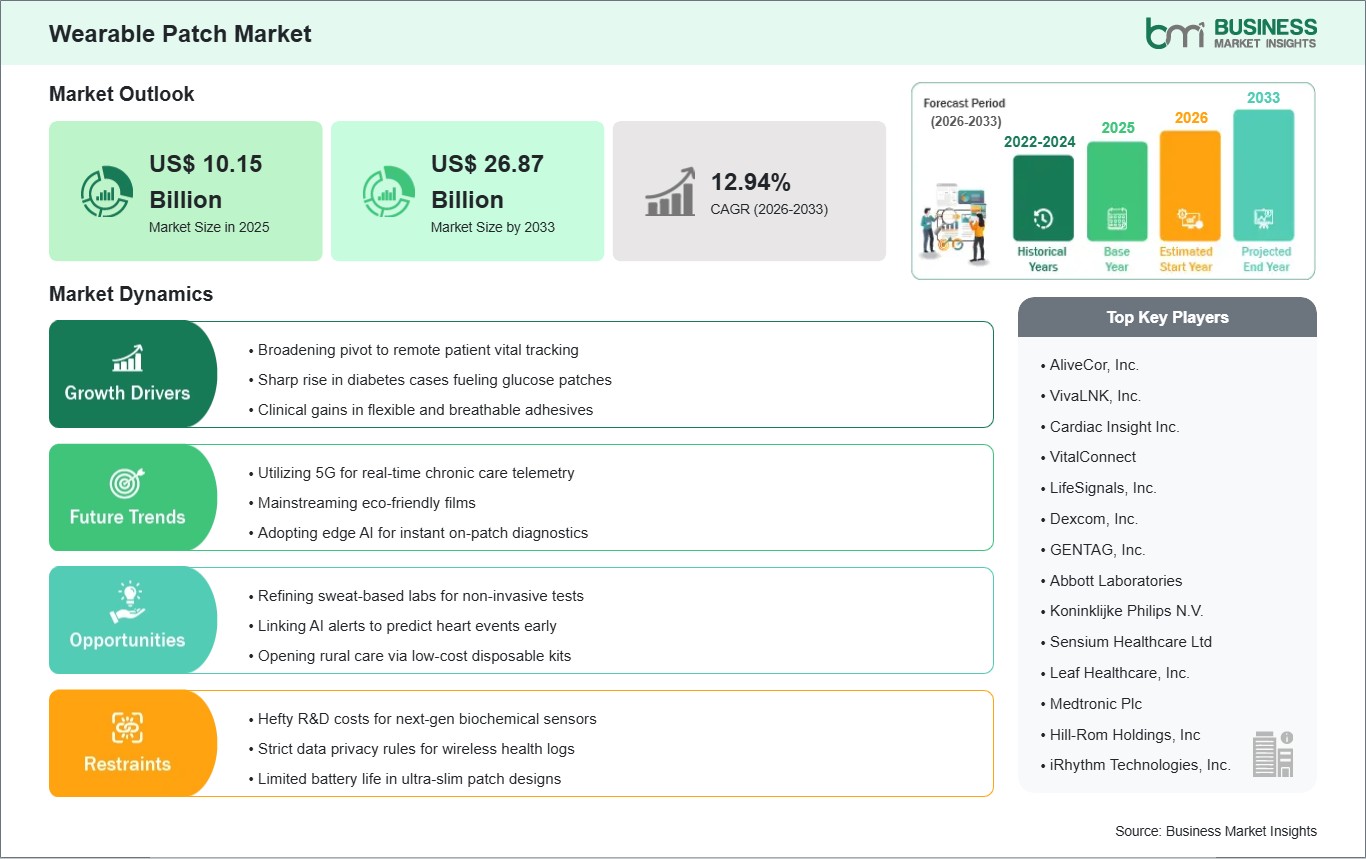
Wearable patches, also known as electronic skins or smart patches, are thin, flexible medical devices that adhere to the skin for continuous, non-invasive health monitoring or drug delivery. They use biosensors and wireless technology to track physiological parameters such as heart rate, glucose levels, and temperature, transmitting real-time data to smartphones or cloud platforms for healthcare providers. The wearable patch market supports decentralized, patient-centered care by offering both connected and standard patches for monitoring, diagnosis, and treatment. Key benefits include real-time health data tracking, improved patient adherence due to discreet design, and accurate transdermal medication delivery. Market growth is driven by rising rates of chronic diseases such as diabetes and cardiovascular conditions, increased adoption of remote patient monitoring, and advances in miniaturized, flexible electronics. The integration of artificial intelligence-powered analytics also enables early detection of health issues, supporting clinical decision-making and preventive care.
However, several challenges can restrain market growth: high R&D and manufacturing costs for advanced biosensors can be a barrier for mass-market adoption in emerging economies. Ongoing concerns about data privacy and cybersecurity in exchanging sensitive patient information remain significant industry challenges. Stringent FDA and CE approval processes, along with technical issues such as skin irritation from adhesives and limited battery life in high-bandwidth devices, also hinder progress. However, the market shows strong potential, driven by a focus on value-based healthcare and increased adoption of patches in decentralized clinical trials. Additional growth is expected through expansion into FemTech for hormone tracking and the development of energy-harvesting technologies to extend device longevity.
Segment Analysis
Wearable Patch Market Segmentation
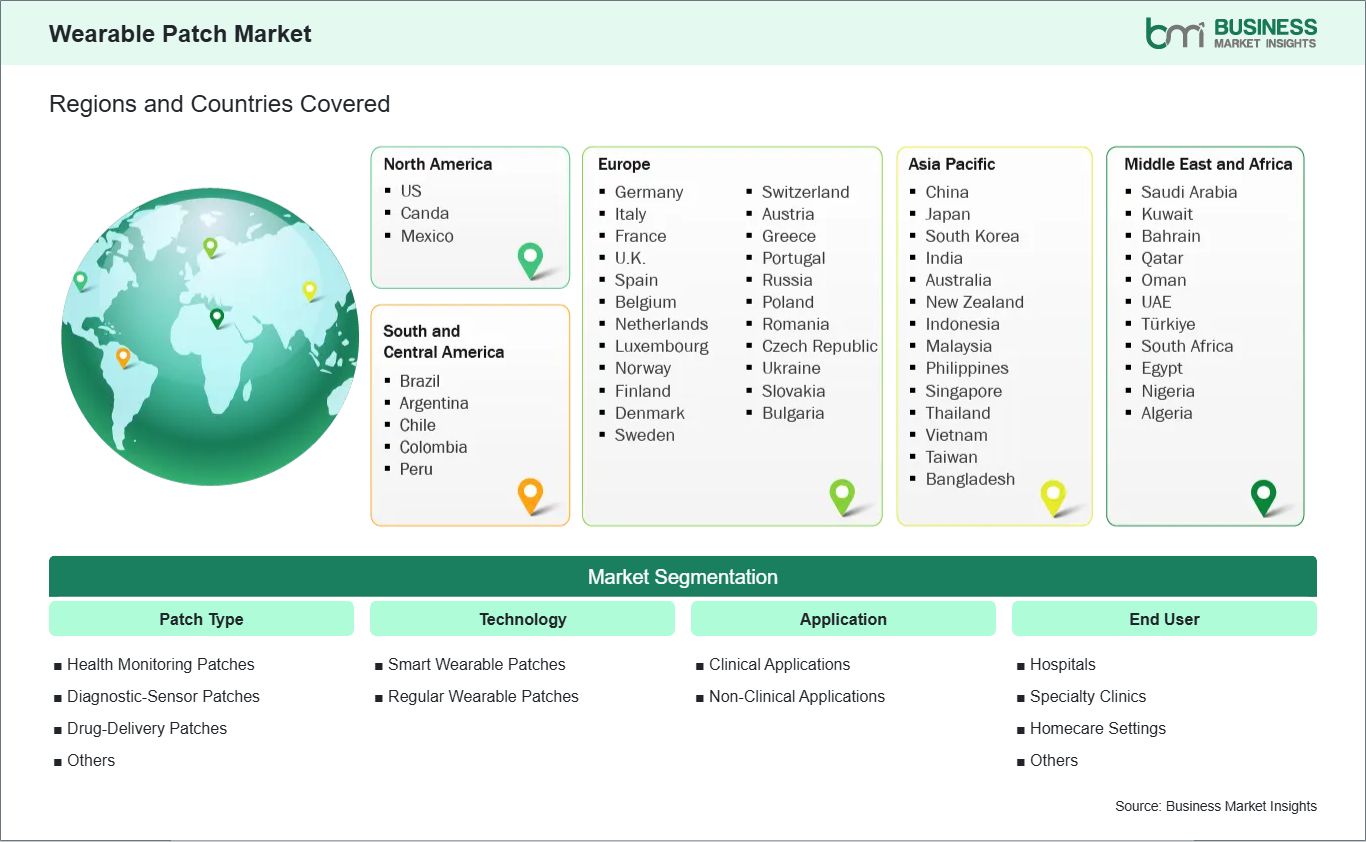
Key segments that contributed to the derivation of the Wearable Patch market analysis are patch type, technology, application, and end user.
- By Patch Type, the market is segmented into Health Monitoring Patches, Diagnostic-Sensor Patches, Drug-Delivery Patches, and Others.
- By Technology, the market is segmented into Smart Wearable Patches and Regular Wearable Patches.
- By Application, the market is segmented into Clinical Applications and Non-Clinical Applications.
- By End User, the market is segmented into Hospitals, Speciality Clinics, Homecare Settings, and Others.
Market Forces
Wearable Patch Market Drivers and Opportunities
Global Shift toward Remote Patient Monitoring
Adhesive medical patches are emerging as a superior alternative to traditional wrist-worn wearables because they maintain closer, more consistent contact with the skin. This allows them to capture continuous, medical-grade physiological data such as glucose levels, heart rate trends, respiration patterns, and even full ECG waveforms with far greater accuracy. Such precision is especially valuable for older adults, post-operative patients, and individuals managing chronic conditions, as it enables clinicians to monitor their health remotely without requiring frequent hospital visits or in-person checkups.
When integrated into modern telehealth platforms, these smart patches help in shifting healthcare from a reactive, treatment-focused model to a proactive, prevention-driven one. Real-time data streams allow physicians to detect subtle changes in a patient’s condition early, often before symptoms become severe, enabling timely interventions that can prevent complications, reduce emergency room visits, and lower overall healthcare costs. By combining continuous monitoring with virtual care, adhesive patches are transforming remote patient management into a more efficient, patient-friendly, and outcomes-focused system.
Advancements in Flexible Bioelectronics
A major high-value opportunity lies in the development of "electronic skin" and multifunctional patches that combine diagnostic sensing with automated drug delivery. Innovations in flexible, stretchable electronics and biocompatible materials are allowing for the creation of ultra-thin, "barely-there" patches that move naturally with the body, drastically improving patient compliance and comfort. Furthermore, there is a burgeoning market for "closed-loop" systems, such as smart insulin patches that not only monitor glucose levels but also administer precise doses via microneedle arrays.
As AI-driven analytics become more sophisticated, these patches can offer personalized health insights and predictive alerts, opening new revenue streams in the fitness and sports performance sectors for real-time hydration and electrolyte monitoring. Manufacturers who prioritize data security and interoperability with Electronic Health Records (EHR) are positioned to lead the next wave of integrated, mobile health solutions.
Size and Share Analysis
Wearable Patch Market Size and Share Analysis
The Wearable Patch market demonstrates steady growth, with size and share analysis revealing evolving trends and competitive positioning among key players. The report further examines subsegments categorized within patch type, technology, application, and end user, offering insights into their contribution to overall market performance.
For instance, the Health Monitoring Patches and Diagnostic-Sensor Patches segments are central to the market, frequently utilizing Smart Wearable Patches for real-time physiological tracking. These devices are widely used in Clinical Applications, particularly for cardiac and glucose monitoring. By leveraging wireless connectivity, these smart patches allow for continuous data streaming to cloud-based platforms, enabling healthcare providers in Hospitals to perform remote triage and early intervention without requiring the patient to remain stationary or tethered to bedside monitors.
Report Coverage
Wearable Patch Market Report Coverage and Deliverables
The "Wearable Patch Market Size and Forecast (2022–2033)" report provides a detailed analysis of the market covering below areas:
- Wearable Patch market size and forecast at global, regional, and country levels for all the key market segments covered under the scope
- Wearable Patch market trends, as well as market dynamics such as drivers, restraints, and key opportunities
- Wearable Patch market analysis covering key market trends, global and regional framework, major players, regulations, and recent market developments
- Industry landscape and competition analysis covering market concentration, heat map analysis, prominent players, and recent developments for the Wearable Patch market
- Detailed company profiles, including SWOT analysis
Geographic Insights
Wearable Patch Market Geographic Insights
The geographical scope of the Wearable Patch market report is divided into five regions: North America, Asia Pacific, Europe, Middle East & Africa, and South & Central America.
The Asia-Pacific Wearable Patch Market is segmented into China, Japan, South Korea, India, Australia, New Zealand, Indonesia, Malaysia, the Philippines, Singapore, Thailand, Vietnam, Taiwan, Bangladesh, and the Rest of Asia. The market is primarily driven by the region's massive aging population and the rising prevalence of chronic conditions like diabetes and atrial fibrillation.
Growth is further bolstered by the proliferation of connected wearable technology and the increasing demand for clinical-grade monitoring patches. The emergence of Femtech applications, such as hormone and fertility tracking, and the rising popularity of lifestyle and fitness patches among health-conscious consumers, solidify Asia-Pacific as the primary global hub for wearable patch innovation and manufacturing.
Industry Activity
Recent Developments
The Wearable Patch market is evaluated by gathering qualitative and quantitative data post primary and secondary research, which includes important corporate publications, association data, and databases. A few of the key developments in the Wearable Patch market are:
- In September 2025, Royal Philips, a global leader in health technology, announced that it had entered a national partnership in the USA with Optum Healthcare. The inclusion of Philips’ Mobile Cardiac Telemetry(MCOT) and Philips Extended Holter (ePatch) in the network is designed to enable earlier detection of cardiac conditions and timely clinical intervention. By expanding access to advanced cardiac ambulatory monitoring services for Optum members and streamlining the patient referral process, this collaboration supports proactive care and improved patient outcomes. Philips’ industry-leading solutions are now available to Optum Healthcare’s 3.4 million members in 22 US states.
- In June 2025, CeQur hits insulin patch milestone, highlights commercial expansion. CeQur announced that it reached the milestone of 10 million mealtime insulin injections replaced with its Simplicity insulin patch. CeQur introduced Simplicity to change that, as the discreet, wearable patch eliminates the need for MDI. It makes it easier to dose anytime, anywhere.
- In June 2024, Abbott announced to enter US consumer biowearables market with Lingo and Libre Rio. Abbott’s world-leading FreeStyle Libre portfolio of continuous glucose monitors has revolutionized the way roughly 6 million people worldwide manage their diabetes. Now the technology that powers the best-selling medical device in history will be available to US consumers with and without diabetes through two over-the-counter CGM systems cleared by the FDA.
Trust & Transparency
Research Methodology
The market analysis combines proprietary research with secondary data from government agencies, company disclosures, regulatory filings, industry databases and expert interviews. Market estimates are validated through data triangulation, cross-market benchmarking and analyst
review.
View Full Research Methodology
Key Sources Referred:
World Bank – Global Trade IndicatorsWorld Trade Organization (WTO)International Monetary Fund (IMF)International Trade Administration (ITA)Company WebsitesCompany Annual ReportsCompany Investor Presentations