Wearable Healthcare Devices Market Outlook (2022-2033)

Historic Data: 2022 - 2024   |   Base Year: 2025   |   Forecast Period: 2026-2033
Report Content: Market Scope, Market Segmentation, Market Dynamics, and Competitive Analysis

Report Coverage:
  • Product (Smartwatches, Trackers, Patches, Smart Clothing)
  • Type (Diagnostic & Monitoring Devices and Therapeutic Devices)
  • Grade (Consumer-Grade Wearable Healthcare Devices and Clinical-Grade Wearable Healthcare Devices)
  • Application (General Health & Fitness, Remote Patient Monitoring (RPM), Home Healthcare)

No. of Pages: 400
Report Code: BMIPUB00032637
Category: Life Sciences
Wearable Healthcare Devices Market
Buy Now

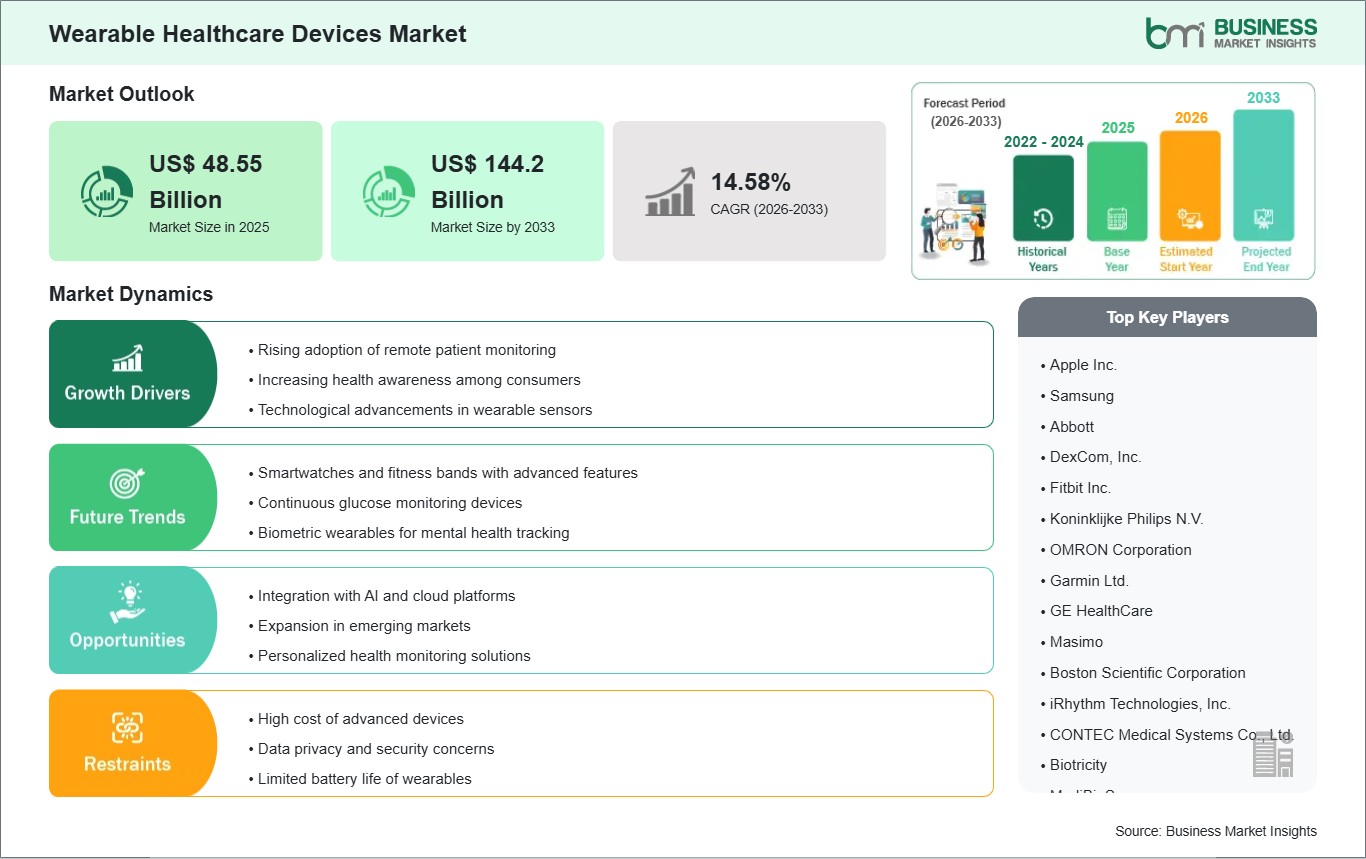
The Wearable Healthcare Devices market size is expected to reach US$ 144.2 billion by 2033 from US$ 48.55 billion in 2025. The market is estimated to record a CAGR of 14.58% from 2026 to 2033

Executive Summary and Global Market Analysis:

Wearable healthcare devices have become a significant part of today's healthcare system. They not only allow continuous monitoring of health but also help in detecting diseases at an early stage and involve the patients more. These devices are applied in various fields such as chronic disease management, fitness and wellness monitoring, telemedicine, and geriatric care. Among them, the most prominent are smartwatches, activity monitors, biosensors, adhesive patches, and smart apparel. Real-time capture of physiological data, higher precision in the monitoring of vital signs, user-friendliness for patients, and support for both preventive and customized healthcare have been some of the major benefits offered by these medical wearables. An increase in the number of people suffering from chronic diseases, increased awareness about health, and more digital health technologies being adopted are the primary factors fostering this market. Besides, the development of sensor technology, artificial intelligence, and wireless connectivity in general is making the devices better and the data more trustable.

Notwithstanding, some obstacles exist that might limit the growth of the market such as concerns over data privacy and the security of the data, complicated regulations and compliance, and inconsistencies in device accuracy and their integration with the healthcare systems. Furthermore, the high prices of pioneering clinical-grade devices and poor reimbursement policies in some geographical locations can also hinder the implementation of these devices on a large scale. Another factor that contributes to the restraint of the market is the lack of technology in the sense of short battery life and the requirement of continuous innovation to keep the users engaged. However, the market is still providing various avenues for growth because of the increased demand for remote and home-based healthcare, digital health infrastructure development in the case of emerging economies, and the preventive care approach getting more and more attention. There will be a considerable amount of investment in advanced analytics, AI-powered workloads, and other areas that are not particularly mentioned here among the other ones driven by the demand for technology in healthcare and the related industries

Wearable Healthcare Devices Market - Strategic Insights:

global-market-strategic-framework
Get more information on this report

Wearable Healthcare Devices Market Segmentation Analysis:

Key segments that contributed to the derivation of the Wearable Healthcare Devices market analysis are product, type, grade,  application, distribution channel.

  • By product, the Wearable Healthcare Devices market is segmented into smartwatches, trackers, patches, and smart clothing. The smartwatches segment dominated the market in 2025.
  • By type, the market is bifurcated into diagnostic & monitoring devices and therapeutic devices. The diagnostic & monitoring devices segment held the largest share of the market in 2025.
  • By grade, the market is bifurcated into consumer-grade wearable healthcare devices and clinical-grade wearable healthcare devices. The consumer-grade wearable healthcare devices segment held the largest share of the market in 2025.
  • By application, the market is segmented into general health & fitness, remote patient monitoring (RPM), home healthcare. The general health & fitness segment held the largest share of the market in 2025.
  • By distribution channel, the market is segmented into online channels, pharmacies, and hypermarkets. The online channels segment held the largest share of the market in 2025

Wearable Healthcare Devices Market Drivers and Opportunities:

Rising Demand for Remote Patient Monitoring and Preventive Healthcare

The remote patient monitoring and preventive healthcare demand has been the main reason for the growth of the Wearable Healthcare Devices market. As world healthcare systems move from the treatment of diseases that have already occurred to the prevention and timely screening of diseases, the use of wearable devices to monitor continuously the most important health parameters (e.g., heart rate, blood pressure, glucose level, oxygen saturation, sleep and activity) is becoming widespread. The early detection of health problems is made possible by these devices, along with the respective medical interventions, and better management of chronic diseases, thus, lowering the frequency of hospital visits.

Furthermore, the rise in the number of diabetes, cardiovascular disorders, and respiratory conditions is contributing positively to the sales of wearable healthcare gadgets. Real-time monitoring provides patients and doctors the opportunity to see how a disease is progressing and how effective the treatment is. At the same time, the global population of older people is driving the demand for at-home healthcare services that can help the elderly in living independently while being safe and healthy.

Market driver is also being reinforced by technological advancements. Sensor accuracy, wireless connectivity, cloud computing, and artificial intelligence improvements have all contributed to the devices' reliability and usability. The integration with smartphones and telehealth platforms enables healthcare professionals to remotely access patient data, thereby facilitating virtual consultations and personalized care plans. Moreover, the users' range is shifting from pure clinical use to more and more fitness and wellness tracking, as the health consciousness of consumers is one of the factors that contribute to this change. The further the government and the healthcare sector push the digital health and economical care delivery models, the more the demand for wearable health devices will be gradually increasing, thus making them a constant part of the future of connected health care and patient-centered care.

Growing Integration of Artificial Intelligence and Digital Health Ecosystems

The growing integration of artificial intelligence (AI) and digital health ecosystems presents a significant opportunity for the Wearable Healthcare Devices market. As healthcare increasingly embraces data-driven and personalized care models, wearable devices are evolving from basic monitoring tools into intelligent health management solutions. AI-powered analytics enable wearables to interpret large volumes of real-time health data, identify patterns, predict potential health risks, and deliver actionable insights to users and healthcare providers. This transformation enhances clinical decision-making, improves patient outcomes, and increases the overall value of wearable healthcare technologies.

The expansion of digital health ecosystems, including telemedicine platforms, electronic health records, and mobile health applications, further amplifies this opportunity. Seamless integration of wearable devices with these systems allows continuous data sharing and remote monitoring, supporting virtual care and long-term disease management. This is particularly beneficial for managing chronic conditions, post-operative recovery, and elderly care, where continuous oversight is essential. As healthcare providers seek to reduce costs and improve efficiency, AI-enabled wearables can help minimize hospital readmissions and optimize resource utilization.

Emerging markets also offer strong growth potential due to improving healthcare infrastructure, rising smartphone penetration, and increasing awareness of preventive healthcare. Manufacturers are increasingly focusing on developing affordable, user-friendly, and clinically validated wearable devices tailored to these regions. Additionally, advancements in battery technology, flexible electronics, and miniaturized sensors are expanding application areas and improving user comfort. As regulatory frameworks mature and reimbursement policies evolve, the adoption of intelligent, connected wearable healthcare devices is expected to accelerate, creating substantial opportunities for market expansion globally

Wearable Healthcare Devices Market Size and Share Analysis:

By product, the Wearable Healthcare Devices market is segmented into smartwatches, trackers, patches, and smart clothing. The smartwatches segment dominated the market in 2025. Smartwatches dominate due to multifunctional capabilities, real-time health tracking, strong consumer adoption, smartphone integration, and continuous innovation by leading technology brands worldwide.

By type, the market is bifurcated into diagnostic & monitoring devices and therapeutic devices. The diagnostic & monitoring devices segment held the largest share of the market in 2025. This segment leads as rising chronic diseases and preventive healthcare needs drive demand for continuous monitoring, early diagnosis, and real-time health data collection.

By grade, the market is bifurcated into consumer-grade wearable healthcare devices and clinical-grade wearable healthcare devices. The consumer-grade wearable healthcare devices segment held the largest share of the market in 2025. Dominance is driven by affordability, ease of use, widespread availability, wellness awareness, and growing adoption of fitness and health tracking among consumers.

By application, the market is segmented into general health & fitness, remote patient monitoring (RPM), home healthcare. The general health & fitness segment held the largest share of the market in 2025. This segment dominates due to increasing health consciousness, preventive care trends, and widespread use of wearables for daily activity, fitness, and lifestyle monitoring.

By distribution channel, the market is segmented into online channels, pharmacies, and hypermarkets. The online channels segment held the largest share of the market in 2025. Online channels lead due to convenience, wider product selection, competitive pricing, easy comparison, and growing consumer preference for digital and e-commerce-based purchases

Wearable Healthcare Devices Market Report Highlights:

Report Attribute Details
Market size in 2025 US$ 48.55 Billion
Market Size by 2033 US$ 144.2 Billion
Global CAGR (2026 - 2033)14.58%
Historical Data 2022 - 2024
Forecast period 2026-2033
Segments Covered By Product
  • Smartwatches
  • Trackers
  • Patches
  • Smart Clothing
By Type
  • Diagnostic & Monitoring Devices and Therapeutic Devices
By Grade
  • Consumer-Grade Wearable Healthcare Devices and Clinical-Grade Wearable Healthcare Devices
By Application
  • General Health & Fitness
  • Remote Patient Monitoring
  • Home Healthcare
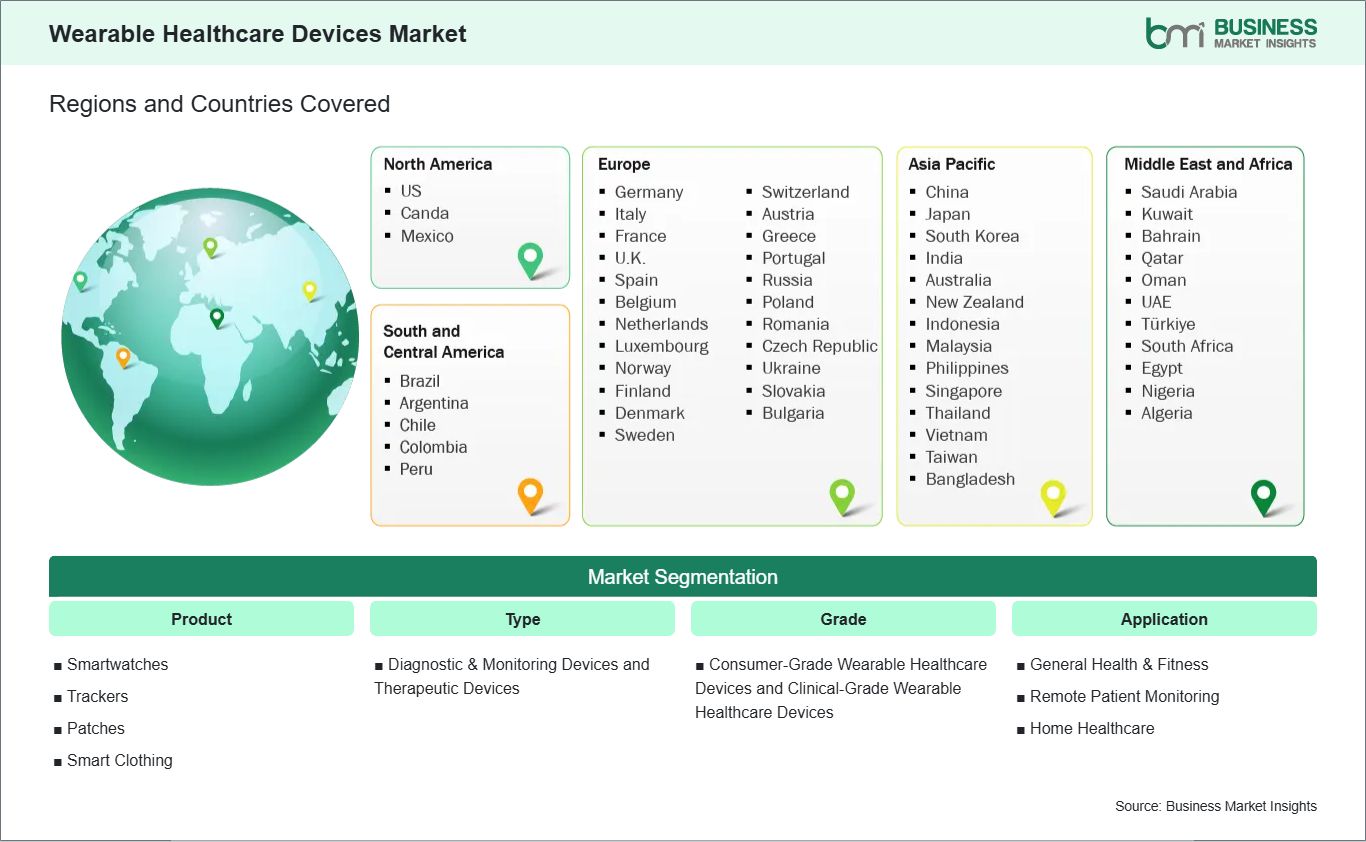
Regions and Countries Covered
North America US, Canada, Mexico
Europe Belgium, Austria, Finland, Denmark, Greece, Poland, Romania, Russia, Ukraine, Czech Republic, Slovakia, Bulgaria, Italy, Luxembourg, Germany, Switzerland, France, Netherlands, Norway, Portugal, Spain, Sweden, United Kingdom
Asia-Pacific Australia, China, India, Japan, South Korea, Indonesia, Malaysia, Philippines, Singapore, Thailand, Vietnam, Bangladesh, New Zealand, Taiwan
South and Central America Brazil, Argentina, Peru, Chile, Colombia
Middle East and Africa Bahrain, Kuwait, Oman, Qatar, Saudi Arabia, United Arab Emirates, Turkiye, South Africa, Egypt, Algeria, Nigeria
Market leaders and key company profiles
  • Apple Inc.
  • Samsung
  • Abbott
  • DexCom, Inc.
  • Fitbit Inc.
  • Koninklijke Philips N.V.
  • OMRON Corporation
  • Garmin Ltd.
  • GE HealthCare
  • Masimo
Get more information on this report

Wearable Healthcare Devices Market Report Coverage and Deliverables:

The "Wearable Healthcare Devices Market Size and Forecast (2022–2033)" report provides a detailed analysis of the market covering below areas:

  • Wearable Healthcare Devices market size and forecast at global, regional, and country levels for all the key market segments covered under the scope
  • Wearable Healthcare Devices market trends, as well as market dynamics such as drivers, restraints, and key opportunities
  • Wearable Healthcare Devices market analysis covering key market trends, global and regional framework, major players, regulations, and recent market developments
  • Industry landscape and competition analysis covering market concentration, heat map analysis, prominent players, and recent developments for the Wearable Healthcare Devices market
  • Detailed company profiles, including SWOT analysis

Wearable Healthcare Devices Market Geographic Insights:

The geographical scope of the Wearable Healthcare Devices market report is divided into five regions: North America, Asia Pacific, Europe, Middle East & Africa, and South & Central America. The Wearable Healthcare Devices market in Asia Pacific is expected to grow significantly during the forecast period.

The Asia-Pacific Wearable Healthcare Devices market is segmented into China, Japan, South Korea, India, Australia, New Zealand, Indonesia, Malaysia, the Philippines, Singapore, Thailand, Vietnam, Taiwan, Bangladesh, and the Rest of Asia. The Asia-Pacific wearable healthcare devices market is witnessing strong growth, driven by rising health awareness, increasing prevalence of chronic diseases, and rapid adoption of digital health technologies. Major economies such as China, Japan, and India are at the forefront, supported by large population bases, expanding middle-class income levels, and growing demand for preventive and remote healthcare solutions.

The region is also experiencing increased adoption of advanced wearable technologies, including AI-enabled health analytics, continuous glucose monitoring systems, and connected fitness and medical devices. Strong smartphone penetration and improving internet connectivity are enabling seamless integration of wearables with mobile health applications and telemedicine platforms. Additionally, government initiatives promoting digital health, along with investments in healthcare infrastructure and local manufacturing, are supporting market expansion. The growth of e-commerce platforms and online pharmacies further enhances product accessibility across urban and semi-urban areas. Together with rising innovation, expanding healthcare ecosystems, and favorable regulatory developments, Asia-Pacific is emerging as a key growth hub in the global wearable healthcare devices market

global-market-geography
Get more information on this report

Wearable Healthcare Devices Market Research Report Guidance:

  • The report includes qualitative and quantitative data in the Wearable Healthcare Devices market across Product, Type, Grade,  Application, Distribution Channel, and geography.
  • The report starts with the key takeaways (chapter 2), highlighting the key trends and outlook of the Wearable Healthcare Devices market.
  • Chapter 3 includes the research methodology of the study.
  • Chapter 4 further includes ecosystem analysis.
  • Chapter 5 highlights the major industry dynamics in the Wearable Healthcare Devices market, including factors that are driving the market, prevailing deterrents, potential opportunities, as well as future trends. Impact analysis of these drivers and restraints is also covered in this section.
  • Chapter 6 discusses the Wearable Healthcare Devices market scenario, in terms of historical market revenues, and forecast till the year 2033.
  • Chapters 7 to 10 cover Wearable Healthcare Devices market segments by Product, Type, Grade,  Application, Distribution Channel, and geography across North America, Europe, Asia Pacific, Middle East and Africa, and South and Central America. They cover the market volume revenue forecast and factors driving the market.
  • Chapter 11 describes the competitive analysis along with the heat map analysis for the key players operating in the market.
  • Chapter 12 describes the industry landscape analysis. It provides detailed descriptions of business activities such as market initiatives, new developments, mergers, and joint ventures globally, along with a competitive landscape.
  • Chapter 13 provides detailed profiles of the major companies operating in the Wearable Healthcare Devices market. Companies have been profiled on the basis of their key facts, business descriptions, products and services, financial overview, SWOT analysis, and key developments.
  • Chapter 14, i.e., the appendix is inclusive of a brief overview of the company, list of abbreviations, and disclaimer

Wearable Healthcare Devices Market News and Key Development:

The Wearable Healthcare Devices market is evaluated by gathering qualitative and quantitative data post primary and secondary research, which includes important corporate publications, association data, and databases. A few of the key developments in the Wearable Healthcare Devices market are:

  • In May 2025, Osteoboost Health Launched FDA-Cleared Prescription Wearable Device for Low Bone Density, Filling Critical Treatment Gap for 60M+ Americans.
  • In October 2025, Health monitoring platform Empatica announced it acquired PKG Health, a company offering movement disorder algorithms and digital endpoints for Parkinson’s disease. Empatica offers AI-enabled wearables, digital biomarkers and software for health monitoring and treatment, including its Empatica Health Monitoring Platform, a remote patient monitoring tool for clinical trials.
  • In January 2025, ActiGraph, the global leader in wearable digital health technology for clinical research and development, announced the acquisition of Biofourmis Connect, a division of Biofourmis that delivers an AI-driven, digital trial platform tailored for the life science industry. The combined solution will create a market-leading, unified software and data ecosystem for the modernization of clinical research throughout the drug-product lifecycle and across therapeutic areas.

Key Sources Referred:

  • World Bank – Global Trade Indicators
  • American Medical Association (AMA)
  • National Center for Biotechnology Information (NCBI)
  • National Library of Medicine (NLM)
  • Centers for Disease Control and Prevention (CDC)
  • Company website
  • National Institutes of Health (NIH)
  • International Hospital Federation (IHF)
  • Company annual reports
  • Company investor presentations
The List of Companies - Wearable Healthcare Devices Market
  • Apple Inc.
  • Samsung
  • Abbott
  • DexCom, Inc.
  • Fitbit Inc.
  • Koninklijke Philips N.V.
  • OMRON Corporation
  • Garmin Ltd.
  • GE HealthCare
  • Masimo
  • Boston Scientific Corporation
  • iRhythm Technologies, Inc.
  • CONTEC Medical Systems Co., Ltd.
  • Biotricity
  • MediBioSense
  • VitalConnect
  • Cyrcadia Health
  • ten3T Healthcare
  • MinttiHealth
  • Biobeat
  • iHealth Labs Inc.
  • VivaLNK, Inc.
  • GENTAG, Inc.
  • AiQ Smart Clothing
  • Nonin Medical
  • Oxitone Medical
Frequently Asked Questions
How big is the Wearable Healthcare Devices Market?

The Wearable Healthcare Devices Market is valued at US$ 48.55 Billion in 2025, it is projected to reach US$ 144.2 Billion by 2033.

What is the CAGR for Wearable Healthcare Devices Market by (2026 - 2033)?

As per our report Wearable Healthcare Devices Market, the market size is valued at US$ 48.55 Billion in 2025, projecting it to reach US$ 144.2 Billion by 2033. This translates to a CAGR of approximately 14.58% during the forecast period.

What segments are covered in this report?

The Wearable Healthcare Devices Market report typically cover these key segments-

  • Product (Smartwatches, Trackers, Patches, Smart Clothing)
  • Type (Diagnostic & Monitoring Devices and Therapeutic Devices)
  • Grade (Consumer-Grade Wearable Healthcare Devices and Clinical-Grade Wearable Healthcare Devices)
  • Application (General Health & Fitness, Remote Patient Monitoring (RPM), Home Healthcare)

What is the historic period, base year, and forecast period taken for Wearable Healthcare Devices Market?

The historic period, base year, and forecast period can vary slightly depending on the specific market research report. However, for the Wearable Healthcare Devices Market report:

  • Historic Period : 2022 - 2024
  • Base Year : 2025
  • Forecast Period : 2026-2033
  • Who are the major players in Wearable Healthcare Devices Market?

    The Wearable Healthcare Devices Market is populated by several key players, each contributing to its growth and innovation. Some of the major players include:

  • Apple Inc.
  • Samsung
  • Abbott
  • DexCom, Inc.
  • Fitbit Inc.
  • Koninklijke Philips N.V.
  • OMRON Corporation
  • Garmin Ltd.
  • GE HealthCare
  • Masimo
  • Boston Scientific Corporation
  • iRhythm Technologies, Inc.
  • CONTEC Medical Systems Co., Ltd.
  • Biotricity
  • MediBioSense
  • VitalConnect
  • Cyrcadia Health
  • ten3T Healthcare
  • MinttiHealth
  • Biobeat
  • iHealth Labs Inc.
  • VivaLNK, Inc.
  • GENTAG, Inc.
  • AiQ Smart Clothing
  • Nonin Medical
  • Oxitone Medical
  • Who should buy this report?

    The Wearable Healthcare Devices Market report is valuable for diverse stakeholders, including:

    • Investors: Provides insights for investment decisions pertaining to market growth, companies, or industry insights. Helps assess market attractiveness and potential returns.
    • Industry Players: Offers competitive intelligence, market sizing, and trend analysis to inform strategic planning, product development, and sales strategies.
    • Suppliers and Manufacturers: Helps understand market demand for components, materials, and services related to concerned industry.
    • Researchers and Consultants: Provides data and analysis for academic research, consulting projects, and market studies.
    • Financial Institutions: Helps assess risks and opportunities associated with financing or investing in the concerned market.

    Essentially, anyone involved in or considering involvement in the Wearable Healthcare Devices Market value chain can benefit from the information contained in a comprehensive market report.

    Available Report Formats

    pdf-format excel-format pptx-format
    Buy Now
    Customization Form

    Please tell us your area of interest
    (Market Segments/ Regions and Countries/ Companies)