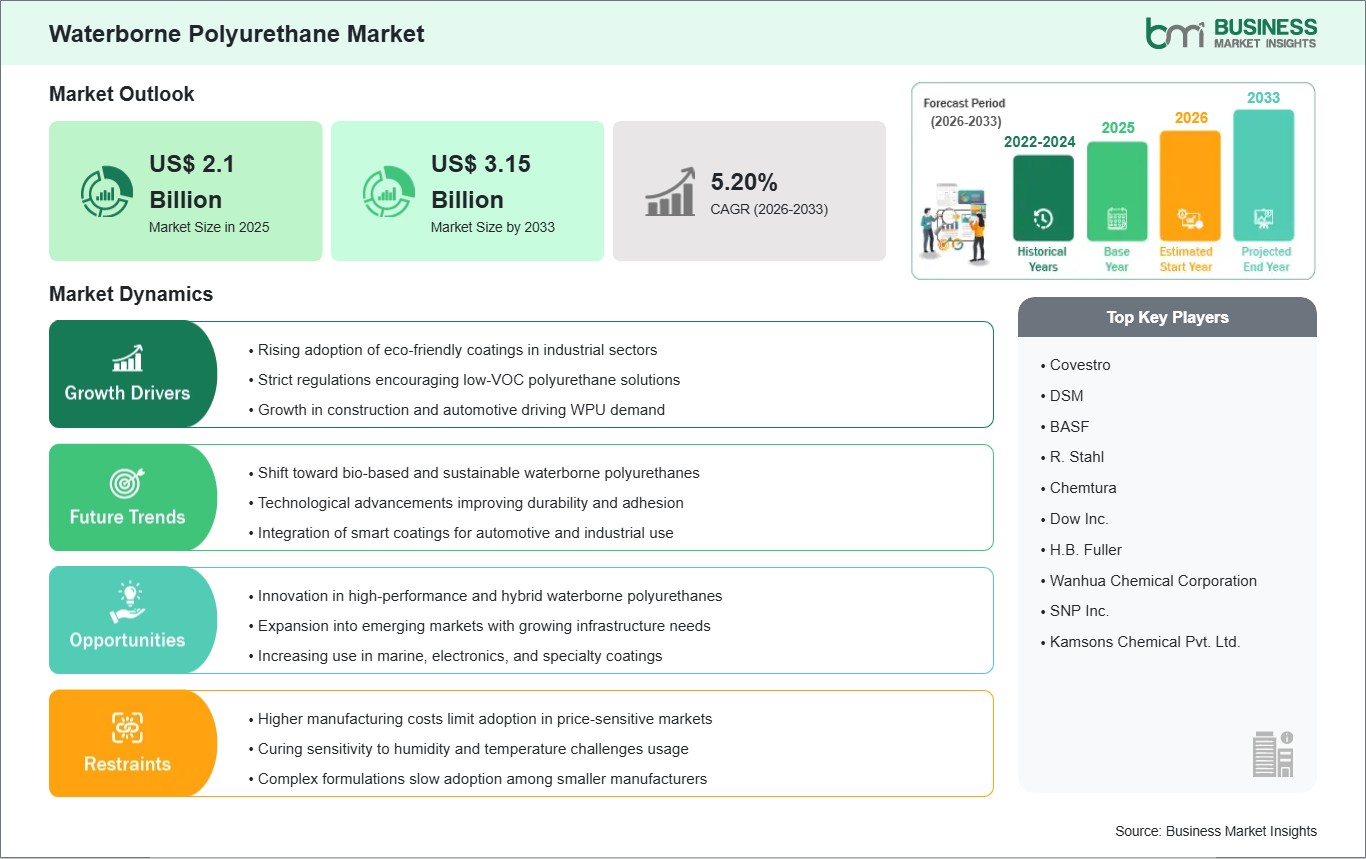
Market Summary
Executive Summary and Global Market Analysis
The global waterborne polyurethane market has emerged as a vital segment within sustainable coatings and polymer applications, driven by increasing environmental regulations, rapid industrial growth, and the desire for high‑performance alternatives to solvent‑borne systems. Waterborne polyurethane (WPU) formulations are valued for their low volatile organic compound (VOC) emissions, excellent durability, flexibility, and strong adhesion, making them suitable for a wide range of end‑use industries, including automotive, construction, packaging, textiles, and wood coatings.
The market sees increased adoption of waterborne polyurethanes because both manufacturers and end users now prefer eco‑friendly materials that meet performance standards and environmental regulations. Waterborne polyurethane (WPU) technology serves as a fundamental element in advanced surface coatings, adhesives, and specialty applications because of increasing global sustainability initiatives and regulatory requirements that target harmful emissions reduction. Market drivers include the increasing regulatory requirements that protect environmental resources and safeguard worker safety, which have led manufacturers to switch from traditional solvent-based products to waterborne solutions. Waterborne polyurethanes are used more frequently in architectural coatings, industrial maintenance systems and automotive finishes because
North America and Europe enforce stringent emissions standards. The demand from consumers for products that generate no smell and provide safe use in indoor spaces, like furniture and flooring, leads to waterborne polyurethane solutions gaining market traction. The development of new technologies makes it possible to solve past performance problems, which now allows materials to withstand both abrasion and UV radiation and chemical attacks, thus enabling their use in extreme working conditions. The market encounters multiple limitations despite these market-driving factors. The application of waterborne polyurethane systems requires precise environmental control because they show sensitivity to environmental factors, which include humidity and temperature, during the application process, which needs to happen to achieve proper curing and film development.
The production of certain complex formulations results in increased costs, which creates difficulties for price-sensitive market segments and markets that have less strict regulatory requirements. The performance requirements in specialized industries, which include aerospace and heavy industrial coatings, continue to prefer either solvent-borne systems or 100% solids systems until manufacturers develop better competitive products. The global waterborne polyurethane market will experience continuous growth and innovation because of the main trend, which supports environmentally friendly high-performance materials.
Segment Analysis
Waterborne Polyurethane Market Segmentation
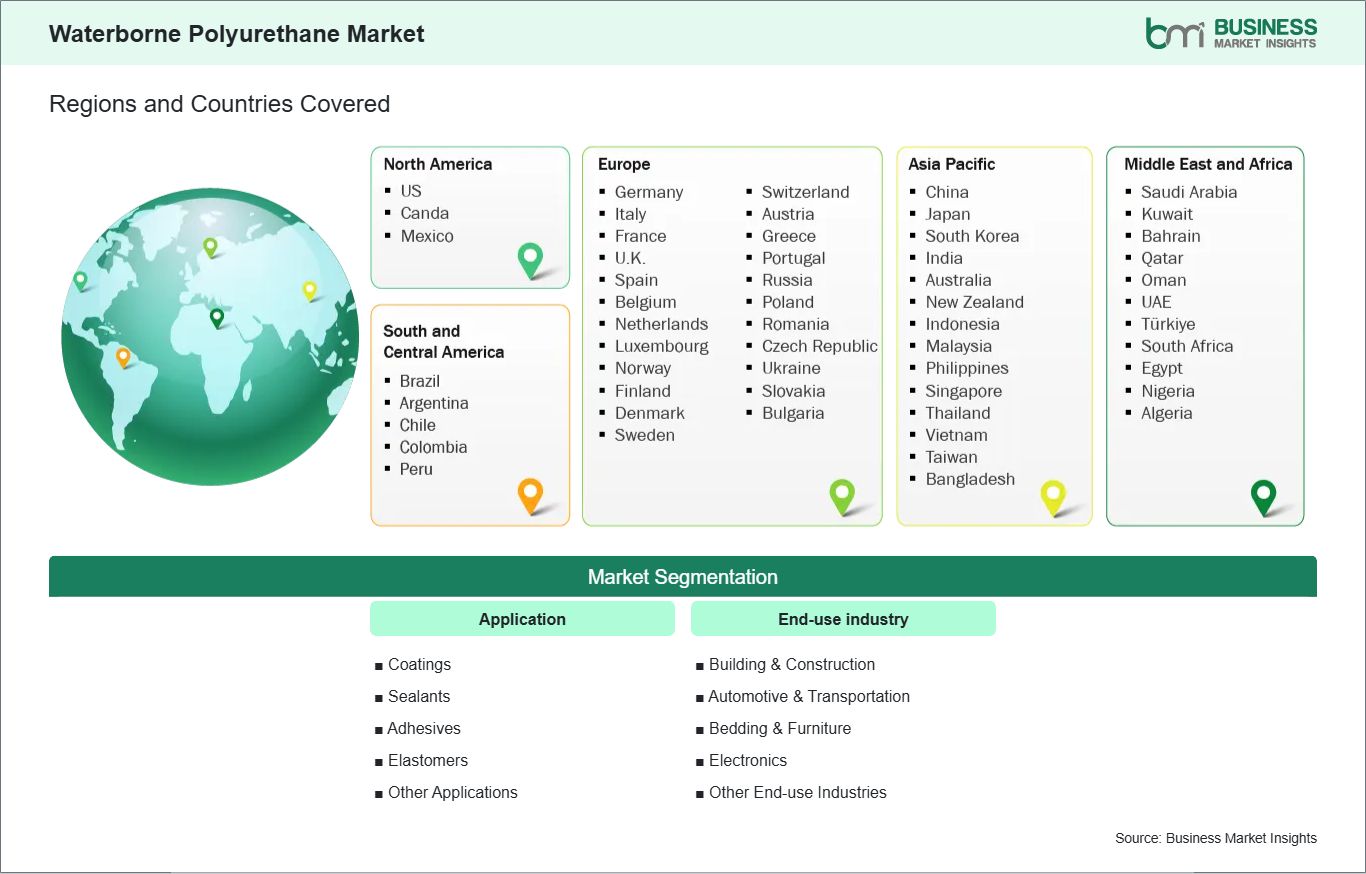
Key segments that contributed to the derivation of the waterborne polyurethane market analysis are application and end-use industry.
- By application, the waterborne polyurethane market is categorized into coatings, sealants, adhesives, elastomers, and other applications. The coatings segment dominated the market in 2025.
- In terms of end-use industry, the waterborne polyurethane market is categorized into building & construction, automotive & transportation, bedding & furniture, electronics, and other end-use industries. The building & construction segment dominated the market in 2025.
Market Forces
Waterborne Polyurethane Market Drivers and Opportunities
Rising adoption of eco-friendly coatings in industrial sectors
The worldwide waterborne polyurethane market experiences critical changes through increasing usage of environmentally friendly industrial coatings. Manufacturers and end users from developed and emerging markets now prefer waterborne polyurethane systems over traditional solvent‑borne coatings because they want to reduce environmental damage and satisfy stricter emissions regulations. The European and North American industrial sectors must now develop new protective coatings that comply with volatile organic compound (VOC) restrictions that regulatory agencies have established. The new system establishes environmental regulations that improve safety standards for operations that take place in industrial spaces that contain many people and face severe air quality challenges.
Sustainable coating solutions are increasingly needed throughout the Asia Pacific because of fast industrial growth and urban development projects. Waterborne polyurethane coatings are receiving growing adoption from automotive, electronics, and heavy manufacturing facilities because these coatings deliver both strong performance and environmental sustainability. Japanese and South Korean automotive OEMs use waterborne polyurethanes for their exterior finishes and interior components to meet national sustainability standards.
Multinational contractors and industrial firms now show increasing interest in standardizing low‑VOC materials through their global operations, which exist in Latin America and Middle East & Africa. The global shift toward eco‑friendly coatings operates as a main purchasing driver that affects product development methods for businesses throughout the world.
Innovation in high-performance and hybrid waterborne polyurethanes
Innovation in high‑performance and hybrid waterborne polyurethanes represents a key opportunity for market expansion across global industrial and commercial applications. Traditional waterborne systems have historically faced limitations in curing speed, moisture tolerance, and mechanical resilience compared with solvent‑based alternatives. In response, chemical manufacturers in North America and Europe are investing heavily in research to enhance formulation technologies, producing hybrid polyurethanes that combine waterborne environmental benefits with performance attributes previously achievable only with solvent systems. These innovations enable coatings with improved abrasion resistance, flexibility, and adhesion, making them suitable for demanding environments such as heavy machinery, coastal infrastructure, and industrial flooring.
In the Asia Pacific region, where manufacturing and construction activities continue at scale, improved waterborne polyurethane performance has encouraged broader adoption in sectors like automotive OEM coating lines and high‑end architectural finishes. Local producers in China and India are partnering with global technology suppliers to customize high‑performance formulations that meet regional climate conditions and regulatory expectations.
Emerging applications in electronics encapsulation and marine coatings further point to the versatility of advanced waterborne polyurethane technologies. As technological advancements continue, high‑performance and hybrid formulations are positioned to unlock new markets and reinforce waterborne polyurethanes as preferred solutions for environmentally conscious, performance‑driven users worldwide.
Size and Share Analysis
Waterborne Polyurethane Market Size and Share Analysis
The waterborne polyurethane market demonstrates steady growth, with size and share analysis highlighting evolving trends and competitive dynamics among key players. The report examines subsegments categorized within application and end-use industry, offering insights into their contribution to overall market performance.
Based on application, the coatings subsegment dominated the market in 2025, driven by increasing demand for eco-friendly, low-VOC coatings across industrial and architectural applications.
In terms of end-use industry, the building & construction subsegment dominated the market in 2025, driven by rapid infrastructure development and high adoption of protective and decorative coatings in residential and commercial projects.
Report Coverage
Waterborne Polyurethane Market Report Coverage and Deliverables
The "Waterborne Polyurethane Market Size and Forecast (2022 - 2033)" report provides a detailed analysis of the market covering below areas:
- Waterborne Polyurethane Market size and forecast at global, regional, and country levels for all the key market segments covered under the scope
- Waterborne Polyurethane Market trends, as well as drivers, restraints, and opportunities
- Waterborne Polyurethane Market analysis covering key trends, global and regional framework, major players, regulations, and recent developments
- Industry landscape and competition analysis covering market concentration, heat map analysis, prominent players, and recent developments for the Waterborne Polyurethane Market
- Detailed company profiles, including SWOT analysis
Geographic Insights
Waterborne Polyurethane Market Geographic Insights
The geographical scope of the Waterborne Polyurethane Market report is divided into North America, Asia Pacific, Europe, Middle East & Africa, and South & Central America. North America held the largest share in 2025.
The waterborne polyurethane market in North America is becoming the leading market worldwide because of strict environmental regulations, its robust industrial sector, and the common use of low-VOC sustainable coating solutions. The regulatory framework in the United States and Canada demands reduced volatile organic compound emissions, which leads major automotive original equipment manufacturers, architectural coatings producers and industrial formulators to choose waterborne polyurethane systems. The advanced research and development infrastructure in the region enables faster development of high-performance waterborne materials, which provide construction and automotive refinish and equipment manufacturing industries with better flexibility, chemical resistance and adhesion properties. Europe follows closely behind because environmental policies and green building standards in Germany, France and the U.K. create a market demand for eco-efficient polyurethanes, which are used in commercial construction, infrastructure coatings and specialty industrial applications. European manufacturers are increasingly focusing on product refinements to meet both performance expectations and sustainability directives, making waterborne systems a preferred choice for coatings and adhesives in regulated markets. The Asia Pacific region experiences waterborne polyurethane growth because its cities undergo rapid urban development and its automotive industry expands. In contrast, Chinese, Japanese, South Korean and Indian industries develop their industrial capacities. The economies of these countries are shifting from using traditional solvent-based coatings to adopting waterborne coatings because environmental regulations have become stricter, and sustainability awareness among customers has increased. The Middle East and Africa region shows early adoption of waterborne polyurethanes which are now used in large infrastructure projects and energy sector coatings and protective finishes for marine and industrial facilities to achieve performance standards while meeting regulatory requirements and ensuring worker safety. Waterborne polyurethane coatings are becoming more common in Brazil, Argentina and Mexico for residential and commercial construction and furniture finishes. Automotive refinish applications are becoming more stringent because environmental regulations are becoming more stringent, and manufacturers are developing more sustainable product ranges. The regional market dynamics continue to evolve because companies develop new coating formulations and businesses commit to sustainability, while multiple industries seek durable coating solutions that produce low emissions. North America maintains its dominant position because of its strict regulations, diverse industrial base and early acceptance of new technologies.
Industry Activity
Recent Developments
The Waterborne Polyurethane Market is evaluated by gathering qualitative and quantitative data post primary and secondary research, which includes important corporate publications, association data, and databases. A few of the key developments in the waterborne polyurethane market are:
- In June 2023, DIC Corporation announced that it released the HYDRAN™ GP series of environment‑friendly waterborne polyurethane resins, featuring higher solid content, no amines to reduce unpleasant odors, and performance comparable to solvent‑based products, aimed at applications such as artificial leather, coatings, and adhesives globally.
- In September 2024, Covestro announced that it introduced new high‑performance waterborne polyurethane adhesive solutions (Dispercoll® U and Dispercoll® U PLUS) for automotive interiors and footwear to enhance bonding performance, lower activation temperatures, and support energy efficiency and carbon reduction in manufacturing processes.
Trust & Transparency
Research Methodology
The market analysis combines proprietary research with secondary data from government agencies, company disclosures, regulatory filings, industry databases and expert interviews. Market estimates are validated through data triangulation, cross-market benchmarking and analyst
review.
View Full Research Methodology
Key Sources Referred:
World Health Organization (WHO) Organisation for Economic Cooperation and Development (OECD) The World Bank Group Worldometer The Lancet International Bar Association International Trade Administration