Market Summary
Executive Summary and Global Market Analysis
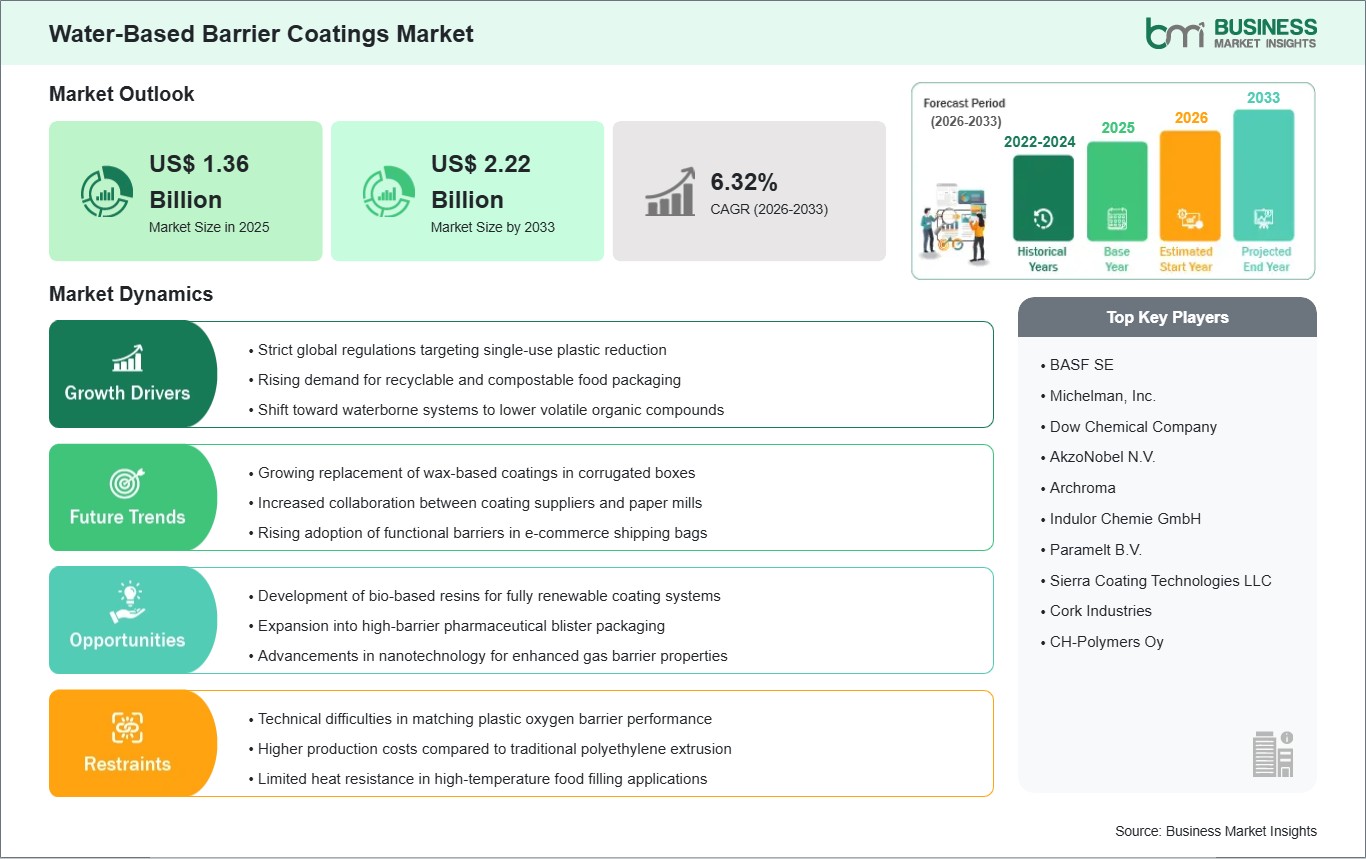
The water-based barrier coating market is exploding as the global packaging industry looks for feasible substitutes for standard plastic lamination. The increased pressure from regulators to reduce single-use plastic, as well as improve the recyclability of paper products, has made these coatings critical elements of today's food and beverage packaging. The functional properties of a water-based system will give it effective resistance to grease, moisture and oil while allowing the paper substrate to be re-pulped, unlike traditional film lamination. Proof of this transition can be seen in the food service industry with redesigning of cups and containers to meet changing environmental requirements.
Technological innovation remains the primary differentiator in the market, with a focus on improving barrier properties against oxygen and water vapor. While paper-based coatings currently lead the market, there is significant research into expanding these technologies to other substrates and end-use industries such as pharmaceuticals and chemicals. The industry is also seeing a shift toward bio-based components to further enhance the sustainability profile of the coatings. Despite challenges related to the cost of raw materials and technical performance in extreme conditions, the market is positioned for long-term growth as global brands commit to fully recyclable packaging portfolios and circular business models.
Segment Analysis
Water-Based Barrier Coatings Market Segmentation
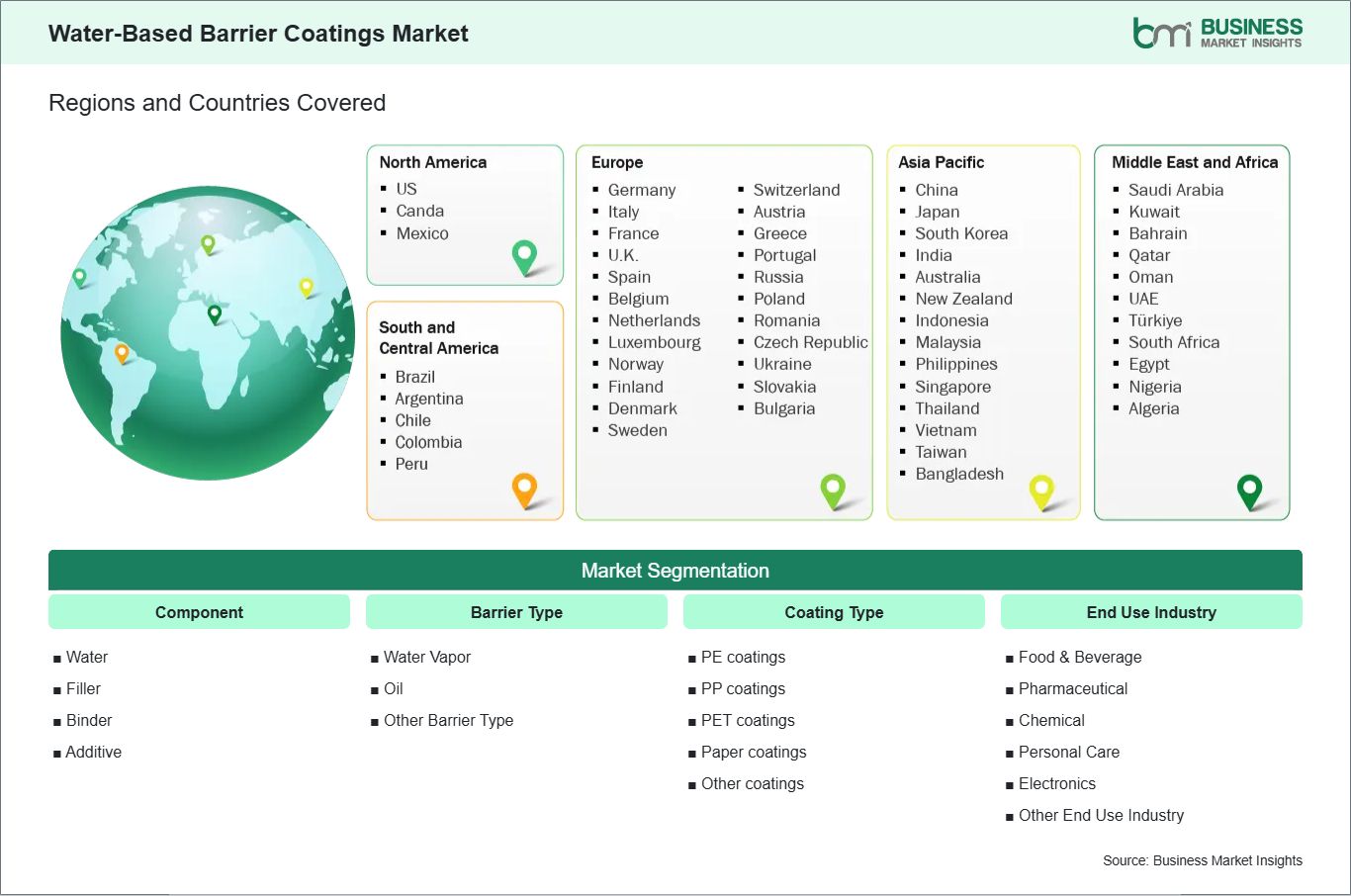
Key segments that contributed to the derivation of the Water-Based Barrier Coatings market analysis are component, barrier type, coating type, and end use industry.
- By component, the water-based barrier coatings market is segmented into Water, Filler, Binder, and Additive. The Binder segment dominated the market in 2025.
- By barrier type, the water-based barrier coatings market is segmented into Water Vapor, Oil, and Other barrier types. The Water Vapor segment dominated the market in 2025.
- By coating type, the water-based barrier coatings market is segmented into PE coatings, PP coatings, PET coatings, Paper coatings, and Others coatings. The Paper coatings segment dominated the market in 2025.
- By end use industry, the water-based barrier coatings market is segmented into Food & Beverage, Pharmaceutical, Chemical, Personal Care, Electronics, and Other end use industry. The Food & Beverage segment dominated the market in 2025.
Market Forces
Water-Based Barrier Coatings Market Drivers and Opportunities
Strict global regulations targeting single-use plastic reduction
The implementation of rigorous environmental policies worldwide is the most significant catalyst for the water-based barrier coatings market. Governments are increasingly banning or taxing traditional plastic-lined packaging because the thin plastic layers make the underlying paper nearly impossible to recycle in standard facilities. As a result, packaging converters are turning to water-based dispersions that can be applied using existing printing or coating equipment. These coatings provide the necessary resistance to liquids and oils while allowing the entire package to be easily repulped during the recycling process. This regulatory shift is forcing a total redesign of classic items like coffee cups, fast-food wrappers, and grocery bags, creating a permanent demand for high-performance water-based alternatives.
Beyond simple compliance, these regulations are driving a shift in consumer perception and brand strategy. Multinational food chains and retail giants are proactively adopting water-based barriers to meet their publicized sustainability goals. This movement is particularly strong in Europe and North America, where extended producer responsibility schemes hold companies financially accountable for the end-of-life management of their packaging. By switching to water-based functional coatings, companies can simplify their waste streams and avoid plastic-related levies. This alignment between government mandate and corporate responsibility ensures that water-based barrier technology remains a central pillar of the modern circular economy.
Development of bio-based resins for fully renewable coating systems
The emergence of bio-based and renewable materials represents a transformative opportunity for the water-based barrier coatings sector. While current waterborne coatings are already more sustainable than plastic films, many still rely on synthetic polymers derived from fossil fuels. The next generation of barriers is being developed using natural feedstocks such as starch, cellulose derivatives, and plant proteins. These bio-resins allow manufacturers to create a truly green package that is not only recyclable but also biodegradable and derived from carbon-neutral sources. This innovation is particularly attractive to the premium organic food and personal care sectors, where the packaging must reflect the natural ethos of the product inside.
Technological advancements in chemistry are now allowing these bio-based coatings to achieve performance levels that were previously only possible with synthetic materials. By cross-linking natural polymers with specialized additives, researchers are improving water resistance and shelf-life stability. This opens doors for use in more demanding applications, such as long-term storage for dry pharmaceuticals or moisture-sensitive electronics. As the scale of production for these bio-resins increases, the cost gap compared to synthetic alternatives is expected to narrow. Companies that invest early in bio-based barrier technology can capture a high-value market segment that prioritizes holistic sustainability over short-term material costs.
Size and Share Analysis
Water-Based Barrier Coatings Market Size and Share Analysis
The global Water-Based Barrier Coatings market is experiencing steady growth, with market size and share analysis reflecting evolving treatment preferences and competitive dynamics among key players. The report evaluates important subsegments categorized within component, barrier type, coating type, and end use industry, highlighting their respective contributions to overall market performance.
By component, the Binder subsegment dominated the market in 2025 due to its critical role in ensuring adhesion and forming a continuous film. High-performance binders are essential for holding fillers and additives in place while providing the necessary flexibility and resistance to external environmental factors.
By barrier type, the Water Vapor subsegment dominated the market in 2025 because moisture protection is the most fundamental requirement for shelf-life extension. Preventing moisture ingress is vital for maintaining the crispness of dry foods and the structural integrity of paper-based packaging in humid conditions.
By coating type, the Paper coatings subsegment dominated the market in 2025 due to the global movement toward plastic-free packaging. Brands are rapidly replacing traditional plastic laminates with water-based functional coatings on paper substrates to create recyclable and compostable alternatives for food service and retail.
By end use industry, the Food & Beverage subsegment dominated the market in 2025 because of the massive volume of single-use packaging required daily. The shift toward sustainable takeaway containers, cups, and flexible pouches has made food-grade water-based coatings the primary solution for grease and moisture resistance.
Report Coverage
Water-Based Barrier Coatings Market Report Coverage and Deliverables
The "Water-Based Barrier Coatings Market Size and Forecast (2022 - 2033)" report provides a detailed analysis of the market covering below areas:
- Water-Based Barrier Coatings market size and forecast at the regional and country levels for segments covered under the scope
- Water-Based Barrier Coatings market trends, as well as drivers, restraints, and opportunities
- Water-Based Barrier Coatings market analysis covering key trends, regional framework, major players, regulations, and recent developments
- Industry landscape and competition analysis covering market concentration, heat map analysis, prominent players, and recent developments for the Water-Based Barrier Coatings market
- Detailed company profiles, including SWOT analysis
Geographic Insights
Water-Based Barrier Coatings Market Geographic Insights
The geographical scope of the Water-Based Barrier Coatings market report is divided into: North America, Asia Pacific, Europe, Middle East & Africa, and South & Central America. North America held the largest share in 2025.
North America currently leads the water-based barrier coatings market, supported by a combination of sophisticated manufacturing capabilities and a strong corporate focus on sustainable packaging solutions. The United States and Canada have seen a surge in investment from major paper and board manufacturers who are integrating coating lines directly into their mills to produce ready-to-use barrier papers. This regional dominance is further strengthened by the presence of large global food and beverage corporations that are headquartered in the region and are leading the transition to plastic-free service ware. Additionally, the mature retail and e-commerce landscape in North America drives a high demand for specialty coatings that protect goods during long-distance shipping.
The regional market also benefits from a robust research and development ecosystem that is focused on overcoming the technical limitations of waterborne systems. Collaborations between chemical suppliers and academic institutions in the region are accelerating the commercialization of advanced binders and additives that improve the mechanical strength of the coatings. While federal regulations provide a baseline for environmental standards, individual state mandates are pushing the industry even further, creating localized pockets of high demand for innovative barrier technologies. North America's leadership in both supply chain integration and technological innovation ensures it remains the primary driver of value and volume in the global landscape.
Industry Activity
Recent Developments
The Water-Based Barrier Coatings market is evaluated by gathering qualitative and quantitative data post primary and secondary research, which includes important corporate publications, association data, and databases. A few of the key developments in the Water-Based Barrier Coatings market are:
- In October 2024, Michelman, announced at Pack Expo 2024 the introduction of its expanded portfolio of water-based barrier and functional coatings designed to replace polyethylene (PE) in paper and flexible packaging, enabling recyclable and fiber-based packaging solutions.
- In 2024, ACTEGA (part of Altana Group), announced the expansion of its ACTGreen® range of water-based barrier coatings for folding carton applications, offering oil, grease, and moisture resistance for sustainable packaging.
- In July 2023, Nippon Paper Industries Co., Ltd., announced the development of a new water-based barrier coating technology aimed at improving recyclability of paper-based packaging materials.
Trust & Transparency
Research Methodology
The market analysis combines proprietary research with secondary data from government agencies, company disclosures, regulatory filings, industry databases and expert interviews. Market estimates are validated through data triangulation, cross-market benchmarking and analyst
review.
View Full Research Methodology
Key Sources Referred:
World Coatings Council (WCC)American Coatings Association (ACA, USA)China National Coatings Industry Association (CNCIA)Japan Paint Manufacturers Association (JPMA)Indian Paint Association (IPA)Brazilian Paint Manufacturers Association (ABRAFATI)South African Paint Manufacturing Association (SAPMA)Company WebsitesCompany Annual ReportsCompany Investor Presentations