Market Summary
Executive Summary and Global Market Analysis
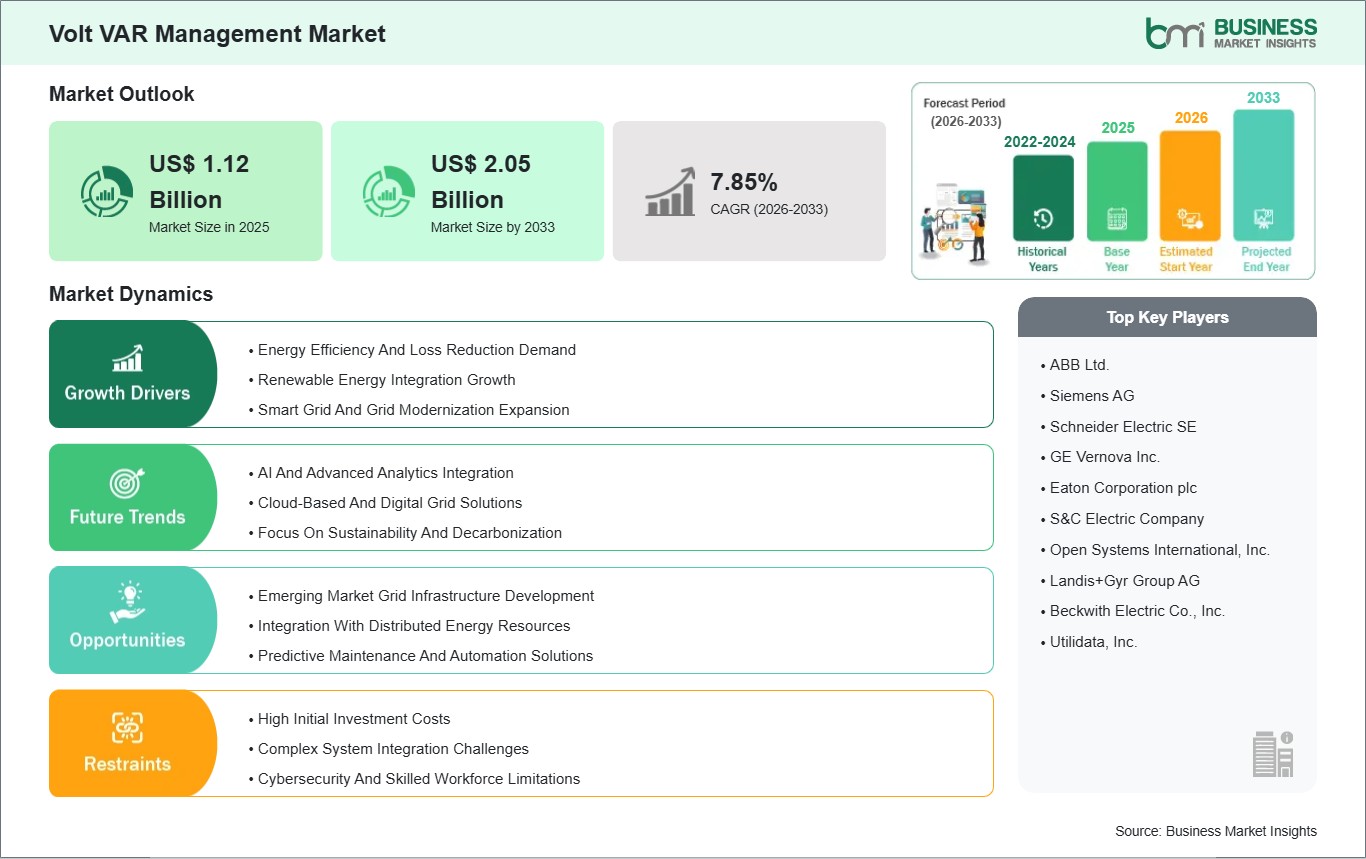
Volt VAR Management (VVM) is a sophisticated suite of power system engineering solutions designed to regulate voltage levels and reactive power (VARs) to optimize the efficiency of the electrical grid. These systems function by coordinating the operation of hardware components like capacitor banks, tap changers, and voltage regulators with advanced software algorithms. The primary objective is to maintain a stable voltage profile within a defined range while minimizing energy losses in transmission and distribution networks. Through techniques like Conservation Voltage Reduction (CVR), VVM systems enable utilities to reduce peak demand and lower overall energy consumption without impacting end-user performance, effectively "squeezing" more capacity out of existing infrastructure.
However, the market faces significant challenges, primarily the high capital expenditure required for upgrading legacy grid systems and the technical difficulty of ensuring interoperability between diverse hardware vendors. Additionally, the increasing complexity of bi-directional power flows—caused by the rapid adoption of distributed energy resources (DERs) like rooftop solar—can create volatile voltage fluctuations that traditional VVM systems are not equipped to handle, necessitating costly secondary investments in digital controllers and high-speed communication networks.
Despite these restraints, the market holds lucrative opportunities as the global push for "Smart Grids" intensifies. The integration of Artificial Intelligence (AI) and Machine Learning (ML) for predictive grid analytics allows for autonomous, real-time voltage optimization, presenting a major growth avenue. Furthermore, as countries strive for carbon neutrality by 2050, the demand for VVM as a prerequisite for stable renewable energy integration ensures a resilient, long-term expansion of the market through 2033.
Segment Analysis
Volt VAR Management Market Segmentation
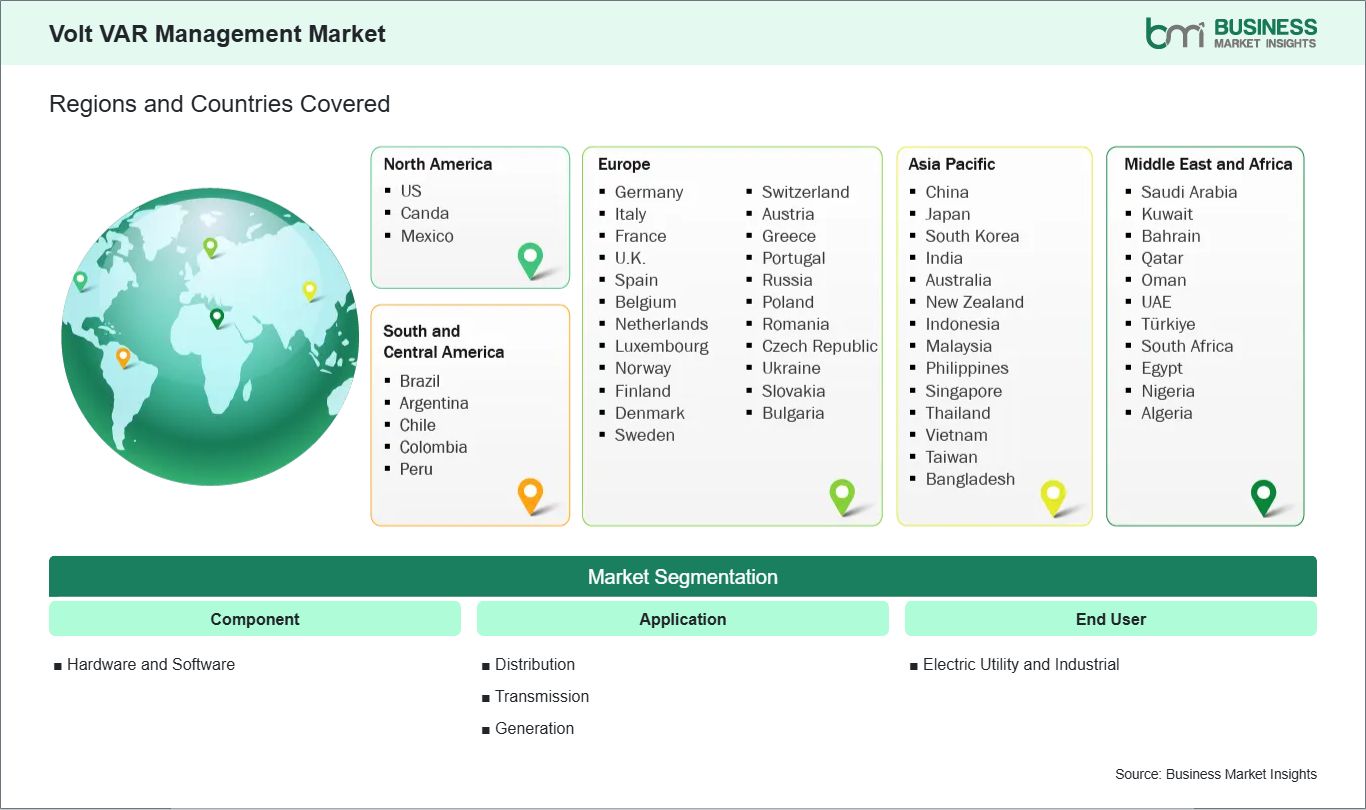
Key segments that contributed to the derivation of the Volt VAR Management market analysis are Component, Application, and End User.
- By Component, the market is segmented into Hardware and Software.
- By Application, the market is divided into Distribution, Transmission, and Generation.
- By End User, the market is categorized into Electric Utility and Industrial.
Market Forces
Volt VAR Management Market Drivers and Opportunities
Accelerating Decentralization and the Surge of Variable Generation
The fundamental shift from centralized, predictable power plants toward a decentralized network dominated by variable energy sources is the primary engine driving the market. As homeowners and commercial entities increasingly install rooftop solar arrays and local wind turbines, the traditional one-way flow of electricity is replaced by a complex, multi-directional exchange. This transition introduces significant technical volatility, as cloud cover or sudden wind shifts can cause rapid spikes and dips in local voltage levels. Legacy grid infrastructure, designed for steady and predictable demand, lacks the inherent flexibility to handle these high-frequency fluctuations. Consequently, utilities are compelled to deploy advanced management systems that can coordinate thousands of disparate generation points simultaneously. These solutions utilize intelligent hardware like smart inverters and automated tap changers to provide instantaneous reactive power compensation, ensuring that the local distribution network remains within safe operating limits.
By stabilizing these "active" distribution systems, management technologies enable the seamless integration of carbon-free energy without compromising the physical integrity of the grid or the delicate electronics used by consumers. This demand is further amplified by international efforts to modernize electrical architecture, transforming passive wires into a responsive and agile ecosystem capable of supporting the next generation of green energy.
Strategic Implementation of Artificial Intelligence for Predictive Optimization
A transformative opportunity within the sector lies in the integration of Artificial Intelligence and high-fidelity data analytics to shift grid operations from a reactive to a predictive posture. Historically, voltage control was governed by static rules and historical averages, often leading to inefficient power usage and delayed responses to unexpected events. Modern digital platforms, however, can now ingest massive streams of data from smart meters and environmental sensors to build a comprehensive digital twin of the entire utility network. By applying machine learning algorithms to this data, operators can forecast potential voltage violations and equipment stress long before they occur, allowing for autonomous adjustments to the system's state.
This proactive approach significantly enhances the effectiveness of programs like conservation voltage reduction, which lowers energy demand by minutely adjusting voltage without impacting the end-user's experience. Furthermore, predictive analytics offers a clear path toward optimized asset management; by identifying the subtle signatures of impending component failure, utilities can perform targeted maintenance, thereby extending the operational lifespan of expensive transformers and capacitor banks. As AI models become increasingly sophisticated, they offer a scalable way for utility providers to reduce operational expenditure while simultaneously improving the overall resilience and reliability of the global energy supply.
Size and Share Analysis
Volt VAR Management Market Size and Share Analysis
The Volt VAR Management market demonstrates steady growth, with size and share analysis revealing evolving trends and competitive positioning among key players. The report further examines subsegments categorized within Component, Application, and end user, offering insights into their contribution to overall market performance.
In the case of the component section, the Hardware sub-segment commands the largest share due to the essential nature of physical components like capacitor banks and voltage regulators in every grid upgrade.
Within applications, the Distribution sub-segment remains a primary contributor as utilities focus on "last-mile" reliability and the management of residential solar inputs.
From an end-user perspective, the Electric Utility sub-segment continues to represent the majority of the market, driven by large-scale grid modernization projects and regulatory mandates for energy efficiency.
Report Coverage
Volt VAR Management Market Report Coverage and Deliverables
The "Volt VAR Management Market Size and Forecast (2022 - 2033)" report provides a detailed analysis of the market covering below areas:
- Volt VAR Management market size and forecast at global, regional, and country levels for all the key market segments covered under the scope
- Volt VAR Management market trends, as well as market dynamics such as drivers, restraints, and key opportunities
- Volt VAR Management market analysis covering key market trends, global and regional framework, major players, regulations, and recent market developments
- Industry landscape and competition analysis covering market concentration, heat map analysis, prominent players, and recent developments for the Volt VAR Management market
- Detailed company profiles, including SWOT analysis
Geographic Insights
Volt VAR Management Market Geographic Insights
The geographical scope of the Volt VAR Management market report is divided into five regions: North America, Asia Pacific, Europe, the Middle East and Africa, and South and Central America.
In North America, the market is primarily propelled by the urgent need to modernize aging electrical infrastructure and the implementation of federal initiatives aimed at enhancing grid resiliency against extreme weather events.
The European market maintains a specialized focus on the integration of high-voltage transmission networks with cross-border renewable energy clusters, alongside stringent directives for decarbonizing the automotive and industrial sectors.
Within the Asia-Pacific region, rapid urbanization and the expansion of massive electronics manufacturing hubs serve as significant catalysts, as nations invest heavily in smart city frameworks and advanced wireless communication grids to manage escalating power demands.
The Middle East and Africa are witnessing a strategic shift toward the digital transformation of utility sectors, characterized by the development of large-scale solar energy parks that require sophisticated reactive power compensation to maintain stability in remote desert environments.
Meanwhile, South and Central America are experiencing steady development driven by the modernization of regional distribution networks to mitigate technical losses and improve the reliability of power delivery to burgeoning industrial centers. This multifaceted regional growth ensures a balanced global expansion as diverse economies synchronize their digital and electrical architectures to support a sustainable energy future.
Industry Activity
Recent Developments
The Volt VAR Management market is evaluated by gathering qualitative and quantitative data post primary and secondary research, which includes important corporate publications, association data, and databases. A few of the key developments in the Volt VAR Management market are:
- In October 2025, ABB announced that it had accelerated the development of gigawatt-scale next-generation data centers in collaboration with NVIDIA. The innovation focused on the development and deployment of cutting-edge power solutions required to create high-efficiency, scalable power delivery for future AI workloads. As part of this initiative, the companies integrated advanced Volt VAR Management capabilities into the power architecture to ensure voltage stability and reactive power compensation within high-density computing environments. These research and development projects supported NVIDIA's planned introduction of an 800 VDC power architecture for 1 megawatt server racks, optimizing energy throughput for intense processing demands.
- In February 2024, Siemens announced the launch of Gridscale X, a significant milestone that paved the way toward the vision of autonomous grid management. This launch was designed to accelerate the digital transformation for grid operators at speed and scale, providing the modularity needed to handle the increasing complexity of modern energy systems. By integrating advanced Volt VAR Management functionalities within this software suite, Siemens enabled utilities to optimize grid capacity and maintain voltage stability amidst the rapid rise of distributed energy resources. The platform, part of the Siemens Xcelerator portfolio, was engineered to help operators transition from traditional reactive methods to a more proactive, automated approach to grid stability.
Trust & Transparency
Research Methodology
The market analysis combines proprietary research with secondary data from government agencies, company disclosures, regulatory filings, industry databases and expert interviews. Market estimates are validated through data triangulation, cross-market benchmarking and analyst
review.
View Full Research Methodology
Key Sources Referred:
World Bank - Global Trade Indicators World Trade Organization (WTO) International Monetary Fund (IMF) International Trade Administration (ITA) Company website Company annual reports Company investor presentations