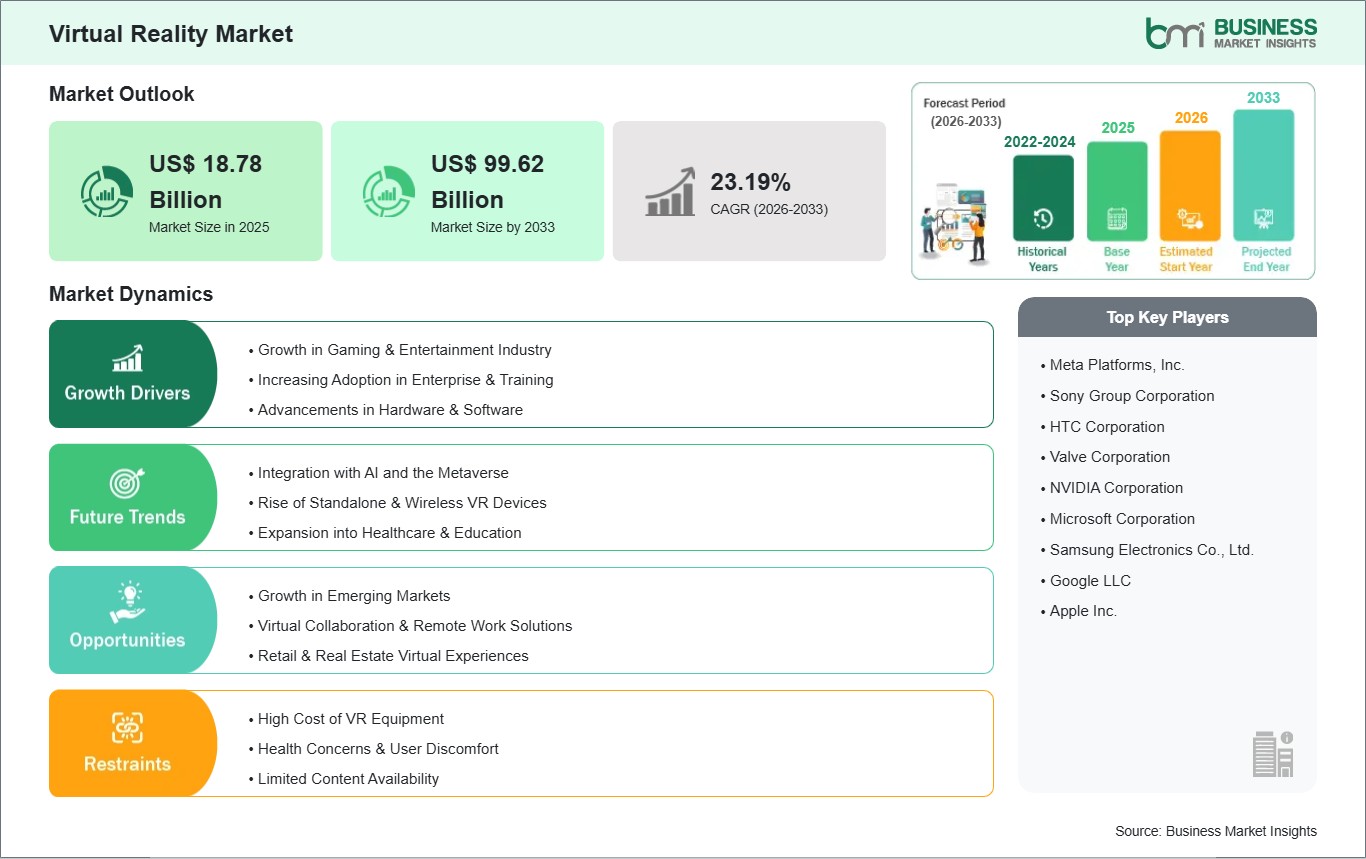
The Virtual Reality Market size is expected to reach US$ 99.62 billion by 2033 from US$ 18.78 billion in 2025. The market is estimated to record a CAGR of 23.19% from 2026 to 2033.
Virtual reality (VR) refers to the integrated application of high-resolution head-mounted displays (HMDs), advanced spatial sensors, and immersive software engineered to simulate a fully synthetic three-dimensional environment. By utilizing stereoscopic rendering, low-latency motion tracking, and spatial audio, these systems achieve presence, the psychological state where a user perceives themselves to be physically within the virtual space. This technology is fundamental to the transformation of the global gaming and entertainment landscape, as well as the modernization of high-stakes professional environments such as surgical theaters, flight simulators, and industrial design studios. Market expansion is being propelled by the rapid transition toward spatial computing, the rising institutional adoption of VR for remote workforce training, and a decisive shift toward untethered standalone headsets that offer high-performance processing without the need for external hardware.
However, several factors may restrain market progression. The high capital intensity associated with premium HMDs, particularly those featuring advanced Micro-OLED displays and specialized pancake optics, remains a significant hurdle for mass-market adoption among price-sensitive consumer segments. The industry also faces persistent technical and physiological challenges, with many users reporting some form of "VR sickness" or motion-induced discomfort during prolonged sessions. Additionally, a persistent content gap remains; while hardware capabilities have accelerated, the development of high-fidelity AAA software experiences remains prohibitively expensive for many studios, leading to a fragmented ecosystem with limited cross-platform interoperability. These hurdles, compounded by the rising complexity of data privacy and biometric sovereignty regulations regarding the collection of eye-tracking and movement data, increase the total cost of compliance and operational risk for platform providers.
Despite these hurdles, the market outlook remains favorable. Opportunities are emerging through the adoption of Mixed Reality (MR) pass-through capabilities, which allow users to blend virtual content with their physical surroundings, thereby reducing social isolation and expanding the utility of headsets to productivity and navigation tasks. The expansion of 5G and early-stage 6G networks is gaining traction, facilitating cloud-based VR that offloads complex rendering to the edge and allows for significantly lighter, more ergonomic device form factors. Furthermore, the growth of AI-driven Codec Avatars and photorealistic digital twins aligns with global goals for decentralized collaboration, making virtual meetings indistinguishable from physical presence. Collectively, these innovations position the virtual reality industry for sustained long-term development as it evolves from a niche gaming accessory into a primary interface for the future of digital work and social interaction.

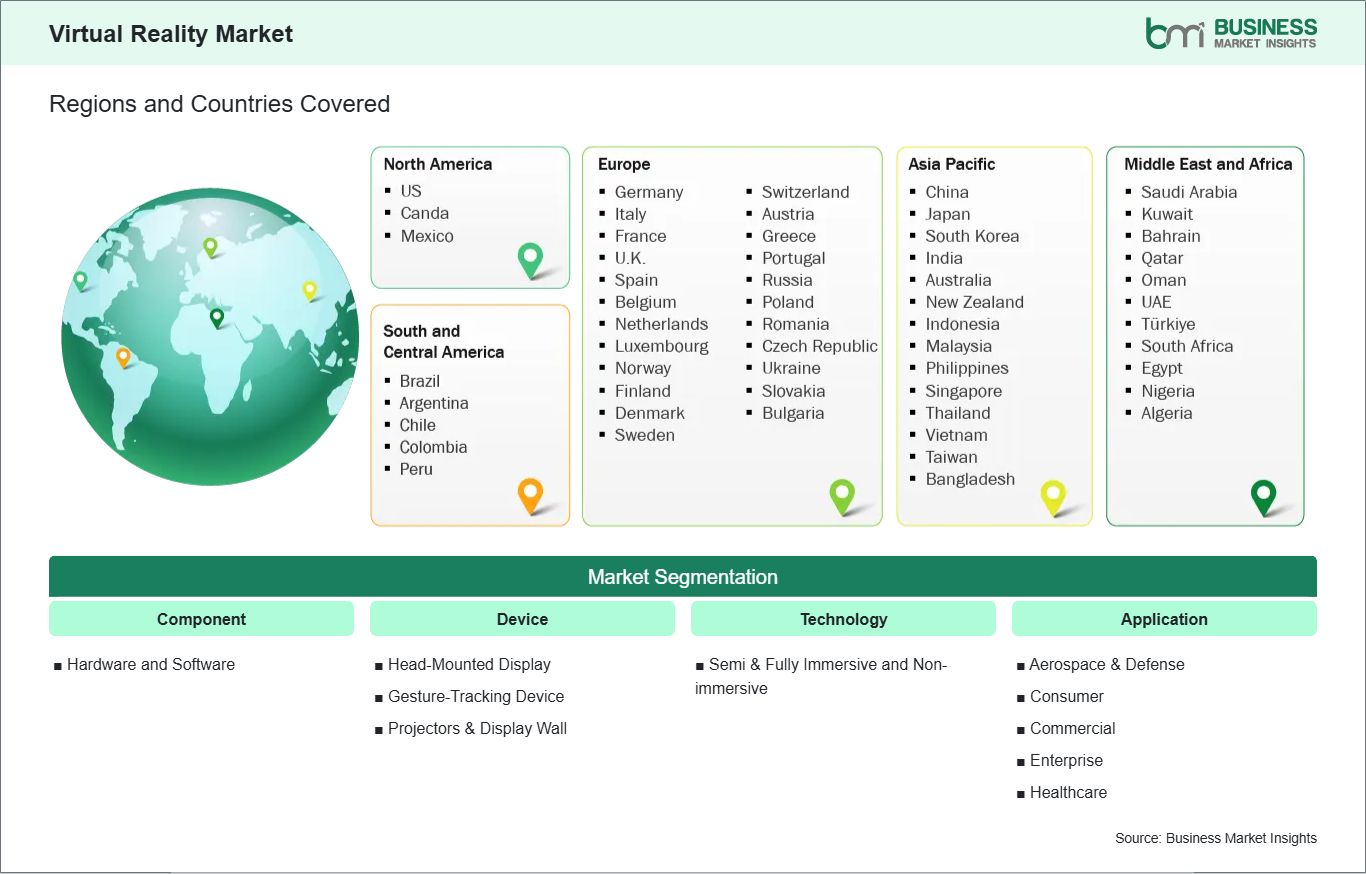
Key segments that contributed to the derivation of the Virtual Reality market analysis are component, device, technology, and application.
The virtual reality (VR) market is being driven by the growing demand for immersive experiences across entertainment, education, healthcare, and enterprise applications. In gaming and media, VR enhances user engagement by delivering lifelike environments, interactive storytelling, and social connectivity. The expansion of remote work and digital collaboration is amplifying adoption, as VR platforms enable virtual meetings, training, and simulations that improve productivity, reduce costs, and foster global teamwork. Healthcare is another major driver, with VR increasingly used for surgical training, patient rehabilitation, pain management, and mental health therapies, offering safe and effective alternatives to traditional methods.
Educational institutions are leveraging VR to create interactive learning environments, reinforcing demand in the academic sector and supporting skill development. Additionally, the rising popularity of the metaverse and social VR platforms is fueling consumer interest in immersive digital ecosystems. Regulatory and corporate emphasis on innovation, sustainability, and digital transformation is further propelling adoption. Collectively, entertainment, enterprise digitization, and healthcare innovation are driving sustained growth in the global VR market.
Opportunities in the VR market are expanding through the integration of artificial intelligence, IoT connectivity, and emerging applications in diverse industries. AI‑enabled VR systems can deliver adaptive experiences, tailoring content to user behavior and preferences, creating new pathways for personalized engagement. IoT‑connected devices are gaining traction, enabling VR platforms to interact with smart environments, wearables, and robotics. The growing emphasis on accessibility is opening lucrative opportunities, as VR can assist in training, remote collaboration, and rehabilitation for differently‑abled users. Emerging applications in real estate, tourism, and retail are also driving innovation, as VR enables immersive property tours, travel experiences, and virtual shopping.
Additionally, the expansion of smart cities, defense training, and industrial design is fueling demand for advanced VR solutions that enhance efficiency and safety. Vendors who focus on cost‑effective, AI‑driven, and interoperable VR systems are well‑positioned to capture growth. The convergence of smart functionality, personalization, and cross‑industry adoption underscores a transformative trajectory for the global VR market.

The Virtual Reality market demonstrates steady growth, with size and share analysis revealing evolving trends and competitive positioning among key players. The report examines subsegments categorized within component, device, technology, and application, offering insights into their contribution to overall market performance.
Based on Technology, the Semi & Fully Immersive subsegment holds the primary market presence. Semi‑immersive systems combine high‑quality graphics with partial immersion, often using large screens or projection systems, making them indispensable for training, education, and enterprise collaboration. Fully immersive systems, on the other hand, leverage advanced head‑mounted displays, motion tracking, and sensory feedback to create highly realistic simulations. These technologies are widely adopted in aerospace and defense for mission rehearsal and pilot training, in healthcare for surgical simulations and rehabilitation, and in gaming for delivering deeply engaging entertainment experiences. Their ability to replicate real‑world environments with precision makes them critical for industries where safety, accuracy, and experiential learning are paramount.
| Report Attribute | Details |
|---|---|
| Market size in 2025 | US$ 18.78 Billion |
| Market Size by 2033 | US$ 99.62 Billion |
| Global CAGR (2026 - 2033) | 23.19% |
| Historical Data | 2022-2024 |
| Forecast period | 2026-2033 |
| Segments Covered | By Component
|
|
Regions and Countries Covered
| |
| North America | US, Canada, Mexico |
| Europe | Belgium, Austria, Finland, Denmark, Greece, Poland, Romania, Russia, Ukraine, Czech Republic, Slovakia, Bulgaria, Italy, Luxembourg, Germany, Switzerland, France, Netherlands, Norway, Portugal, Spain, Sweden, United Kingdom |
| Asia-Pacific | Australia, China, India, Japan, South Korea, Indonesia, Malaysia, Philippines, Singapore, Thailand, Vietnam, Bangladesh, New Zealand, Taiwan |
| South and Central America | Brazil, Argentina, Peru, Chile, Colombia |
| Middle East and Africa | Bahrain, Kuwait, Oman, Qatar, Saudi Arabia, United Arab Emirates, Turkiye, South Africa, Egypt, Algeria, Nigeria |
| Market leaders and key company profiles |
|
The "Virtual Reality Market Size and Forecast (2022 - 2033)" report provides a detailed analysis of the market covering below areas:
The geographical scope of the Virtual Reality market report is divided into five regions: North America, Asia Pacific, Europe, Middle East & Africa, and South & Central America.
North America maintains a preeminent position within the global industry, a status solidified by the region's advanced technological infrastructure and the early, large-scale adoption of immersive technologies across the commercial and consumer sectors. The regional landscape is characterized by high-density investments in the United States and Canada, where the transition toward Metaverse Ecosystems and XR (Extended Reality) has become a strategic priority for major technology conglomerates. This market leadership is further supported by significant federal funding for military simulation training and a robust research and development environment that fosters the creation of high-fidelity hardware and software solutions.
Technological progression in the United States and Canada is largely driven by a decisive shift toward AI-Integrated and 5G-Enabled VR Systems. These advanced platforms utilize high-speed connectivity to deliver seamless, low-latency experiences, which are essential for remote collaboration and cloud-based gaming. Furthermore, the region is witnessing an increasing utilization of VR for Workforce Development and Healthcare Training, as enterprises seek to improve employee competency and patient care outcomes through realistic, risk-free simulations. This focus on "Intelligent Immersion" allows North American operators to maintain a competitive edge while addressing the complexities of modern industrial and medical workflows.

The Virtual Reality market is evaluated by gathering qualitative and quantitative data post primary and secondary research, which includes important corporate publications, association data, and databases. A few of the key developments in the Virtual Reality market are:
The Virtual Reality Market is valued at US$ 18.78 Billion in 2025, it is projected to reach US$ 99.62 Billion by 2033.
As per our report Virtual Reality Market, the market size is valued at US$ 18.78 Billion in 2025, projecting it to reach US$ 99.62 Billion by 2033. This translates to a CAGR of approximately 23.19% during the forecast period.
The Virtual Reality Market report typically cover these key segments-
The historic period, base year, and forecast period can vary slightly depending on the specific market research report. However, for the Virtual Reality Market report:
The Virtual Reality Market is populated by several key players, each contributing to its growth and innovation. Some of the major players include:
The Virtual Reality Market report is valuable for diverse stakeholders, including:
Essentially, anyone involved in or considering involvement in the Virtual Reality Market value chain can benefit from the information contained in a comprehensive market report.
Please tell us your area of interest
(Market Segments/ Regions and Countries/ Companies)