Market Summary
Executive Summary and Global Market Analysis
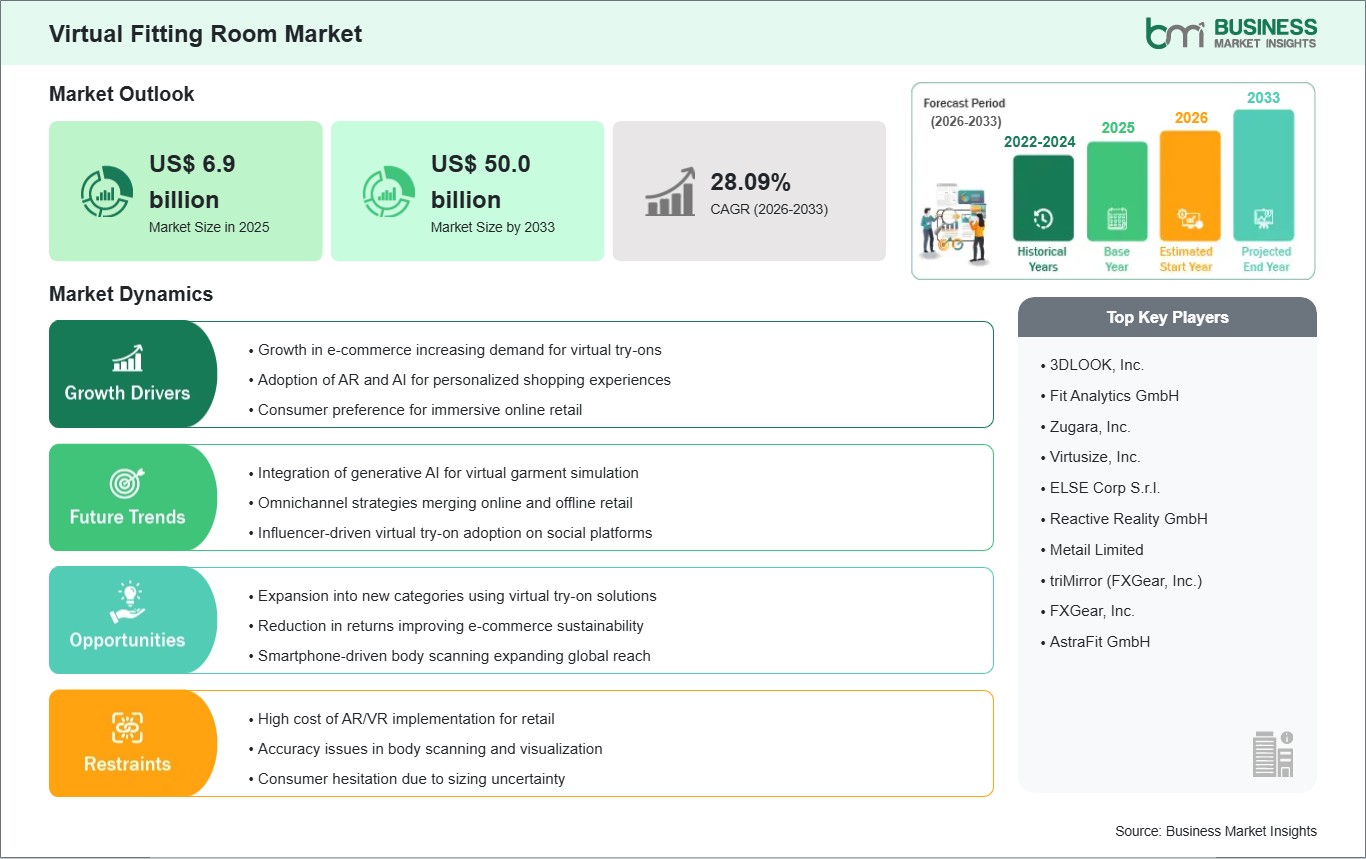
Virtual Fitting Rooms (VFR) represent a transformative convergence of Augmented Reality (AR) , Artificial Intelligence (AI) , and 3D body scanning technology , designed to allow consumers to visualize how products—ranging from apparel and accessories to cosmetics—will look and fit on their own bodies in a digital environment. By creating an immersive " try-before-you-buy " experience, these solutions serve as a critical bridge between the tactile nature of physical retail and the convenience of e-commerce.
As of 2026, the market is characterized by a rapid shift toward high-fidelity 3D garment simulation and Generative AI-driven personalization , which enables brands to offer hyper-accurate sizing recommendations that replicate the physical trial process. However, the market faces significant challenges, including high initial implementation costs for small-to-medium enterprises and technical hurdles related to the realistic rendering of diverse fabric textures and complex garment draping.
Despite these restraints, the market is buoyed by lucrative opportunities stemming from the " Adaptive Retail " movement. The integration of VFR into social commerce platforms like TikTok and Snapchat is redefining the consumer journey for younger demographics. Furthermore, as global brands prioritize ESG goals , the use of virtual trials to mitigate the massive environmental and logistical costs of high return rates—often reaching 30% in fashion e-commerce—presents a compelling value proposition.
Segment Analysis
Virtual Fitting Room Market Segmentation
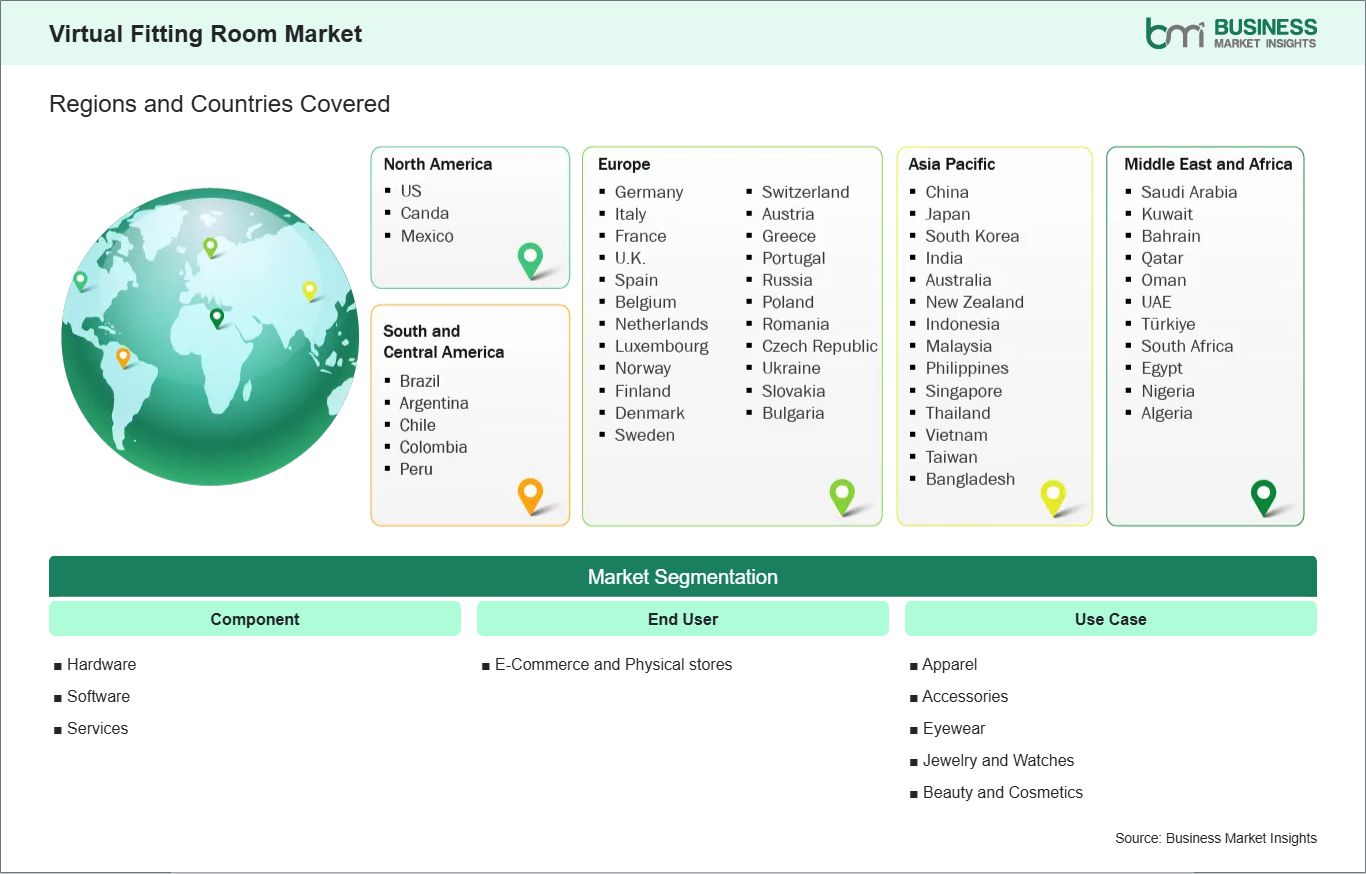
Key segments that contributed to the derivation of the Virtual Fitting Room market analysis are component , end user , and use case .
- By Component, the market is segmented into Hardware , Software , and Services .
- By End User, the market is divided into E-Commerce and Physical stores .
- By Use Case, the market is categorized into Apparel , Accessories , Eyewear , Jewelry and Watches , and Beauty and Cosmetics .
Market Forces
Virtual Fitting Room Market Drivers and Opportunities
Digital Transformation of the Shopping Experience and Return Mitigation
The primary driver for the Virtual Fitting Room market is the deep-seated need for retailers to eliminate the uncertainty inherent in digital apparel shopping, which has historically been hindered by the inability to assess fit and style. In the traditional e-commerce model, the lack of physical interaction leads to a significant psychological barrier for consumers, often resulting in high levels of cart abandonment or the purchase of multiple sizes with the intent to return most of them. This cycle creates a massive logistical burden for brands, involving complex reverse supply chains and significant administrative overhead. Virtual fitting technology addresses this by providing a reliable visual reference that allows shoppers to commit to a purchase with greater confidence.
By leveraging advanced computer vision and machine learning, these systems can analyze a customer's unique proportions and simulate how various fabrics will drape and move against their specific frame. This transition from guesswork to informed decision-making fundamentally alters the unit economics of online retail. Beyond the financial benefits for the seller, the driver is reinforced by a shift in consumer behavior where time-constrained shoppers value the convenience of a "virtual tailor" that ensures a first-time right fit. This alignment between operational efficiency and enhanced customer satisfaction is compelling retailers of all sizes to integrate these tools into their core digital storefronts, making virtual trials a foundational element of the modern omnichannel retail strategy.
The Strategic Emergence of AI-Driven Hyper-Personalization and Social Commerce
The most significant opportunity in the market lies in the fusion of Generative AI and the burgeoning social commerce ecosystem to create a truly personalized and "adaptive" retail environment. As social media platforms evolve from discovery engines into full-service marketplaces, the ability to embed high-fidelity virtual try-on tools directly within a user's feed presents a chance to capture consumer interest at the exact moment of inspiration. This creates a frictionless pathway to purchase that was previously impossible. Furthermore, the rise of "Digital Twins" sophisticated virtual avatars that accurately reflect a user's body morphology and style history—allows brands to offer proactive styling advice. Instead of a passive search, AI-driven assistants can curate entire outfits and virtually "dress" the user's avatar as they browse, suggesting items that complement their existing wardrobe and specific body type.
This level of hyper-personalization transforms the shopping journey into an interactive and entertaining experience, fostering deep brand loyalty and increasing the average value of each transaction. For luxury brands, this technology offers an opportunity to replicate the exclusive, high-touch experience of a private atelier in a digital format, reaching a global audience while maintaining the aura of prestige and bespoke service. As these AI agents become more autonomous, they will transition from being simple visualization tools to intelligent shopping companions that anticipate consumer needs, unlocking entirely new revenue streams for technology providers and retailers alike.
Size and Share Analysis
Virtual Fitting Room Market Size and Share Analysis
The Virtual Fitting Room market demonstrates robust growth , with size and share analysis revealing evolving trends and competitive positioning among key players. The report further examines subsegments categorized within component, end user, and use case, offering insights into their contribution to overall market performance.
Under components, the Software sub-segment currently holds a dominant position as cloud-hosted fit-recommendation engines scale rapidly to meet retailer demand. Within end-user segments, the E-Commerce sub-segment commands the majority of the market share, fueled by the urgent industry need to reduce the high frequency of product returns. From a use-case perspective, the Apparel sub-segment remains the primary revenue generator due to the frequent nature of clothing purchases.
Report Coverage
Virtual Fitting Room Market Report Coverage and Deliverables
The "Virtual Fitting Room Market Size and Forecast (2022–2033)" report provides a detailed analysis of the market covering:
- VFR market size and forecast at global, regional, and country levels for all the key market segments covered under the scope
- Market trends, dynamics such as drivers, restraints, and key opportunities
- Industry landscape and competition analysis covering market concentration, heat map analysis, prominent players, and recent developments
- Detailed company profiles, including SWOT analysis
Geographic Insights
Virtual Fitting Room Market Geographic Insights
The geographical scope of the Virtual Fitting Room market report is divided into five regions: North America, Asia Pacific, Europe, Middle East & Africa, and South & Central America .
North America is primarily characterized by a robust technological ecosystem and early integration of immersive tools by major multinational e-commerce platforms seeking to optimize operational margins. Europe exhibits a sophisticated focus on the luxury segment, where high-end fashion houses utilize virtual mirrors and personalized avatars. The Asia-Pacific region is experiencing a surge in activity driven by the rapid proliferation of mobile-first "super-apps" and a consumer base that heavily favors interactive, camera-based social commerce experiences.
Industry Activity
Recent Developments
The Virtual Fitting Room market is evaluated by gathering qualitative and quantitative data post primary and secondary research. Key developments:
- June 2025: L'Oréal exhibited its largest and most advanced portfolio of beauty innovations powered by technology at Viva Technology in Paris. The company showcased its latest innovations including the YSL Beauty Hyper Look Studio for recreating trending makeup looks and emphasized the integration of its Virtual Fitting Room architecture to allow users to visualize complex beauty transformations and skin-aging simulations in real-time.
- February 2026: Zalando joined Copenhagen Fashion Week's official talk program to discuss the difficulty of finding the right fit online. The company highlighted the significant expansion of its Virtual Fitting Room experience, which moved from localized pilots to a larger-scale rollout for its broader customer base, showcasing how interactive digital tools and 3D renders were being utilized.
Trust & Transparency
Research Methodology
The market analysis combines proprietary research with secondary data from government agencies, company disclosures, regulatory filings, industry databases and expert interviews. Market estimates are validated through data triangulation, cross-market benchmarking and analyst
review.
View Full Research Methodology
Key Sources Referred:
World Bank - Global Trade Indicators World Trade Organization (WTO) International Monetary Fund (IMF) International Trade Administration (ITA) Company website Company annual reports Company investor presentations