Market Summary
Executive Summary and Global Market Analysis
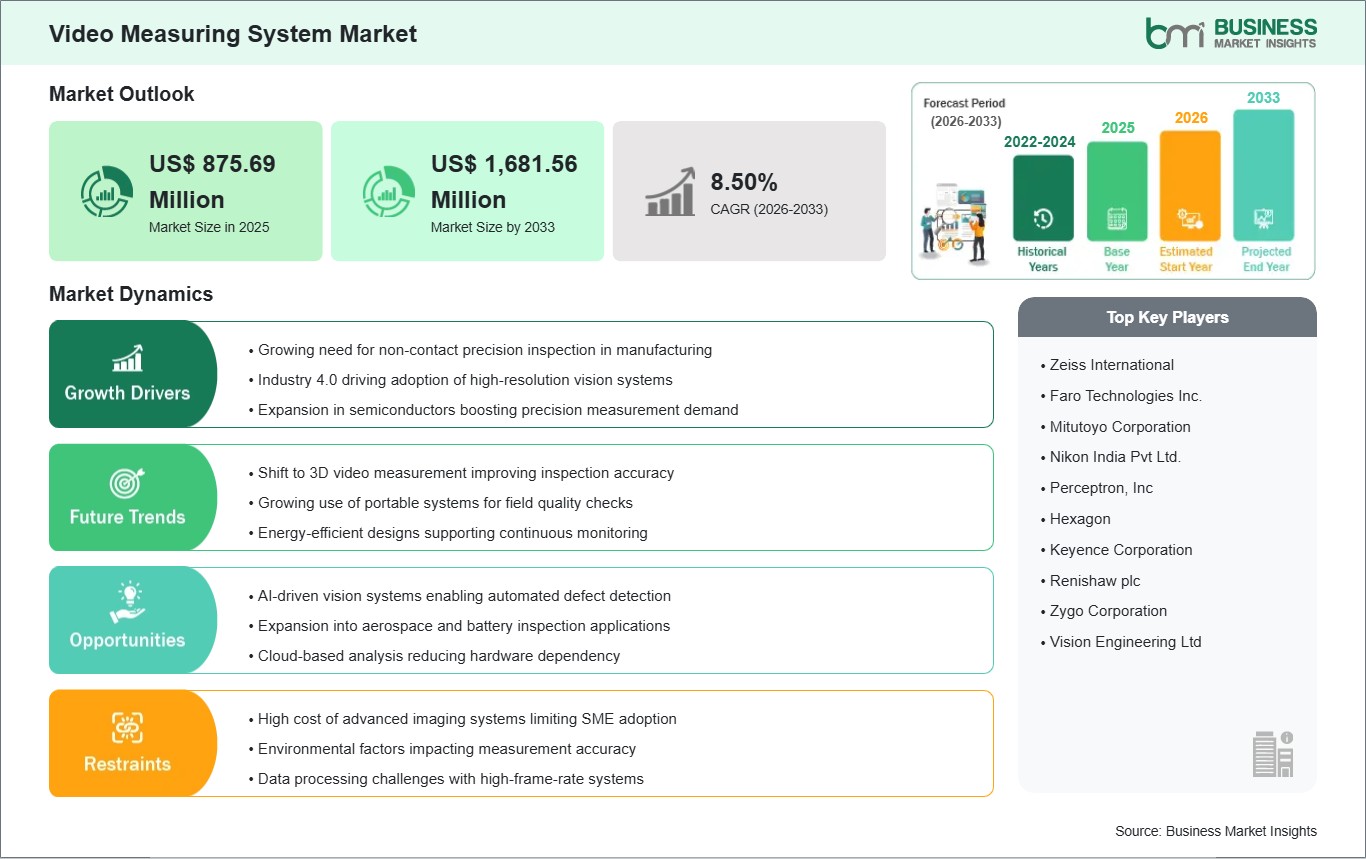
A Video Measuring System (VMS) is a sophisticated non-contact metrology solution that integrates high-resolution digital cameras, precision optics, and advanced image-processing software to perform multi-dimensional measurements. By capturing the digital image of a workpiece and utilizing algorithmic edge detection, these systems allow for the high-speed acquisition of dimensional data without physical contact, making them indispensable for inspecting delicate, flexible, or microscopic components. The technology serves as a cornerstone for quality assurance in high-precision sectors, enabling sub-micron accuracy that traditional tactile probing cannot achieve.
However, the market faces several significant restraints, primarily the high initial capital expenditure associated with advanced automated CNC configurations and the ongoing costs of specialized software licensing. Furthermore, technical challenges such as maintaining measurement stability in shop-floor environments subject to thermal expansion and vibration can limit deployment. The global shortage of metrology experts capable of programming complex multi-sensor routines also acts as a barrier to rapid industrial adoption.
Despite these challenges, the market is buoyed by lucrative opportunities arising from the global shift toward "Smart Manufacturing" and Industry 4.0. The integration of Artificial Intelligence (AI) for autonomous defect recognition and the rising demand for in-line inspection systems—where VMS is embedded directly into production cells—offer significant growth potential. As manufacturers strive for "zero-defect" production in the semiconductor and medical device sectors, the need for high-throughput, non-contact verification is at an all-time high. Innovations in cloud-based data analytics and portable VMS units are further expanding the market's reach, ensuring that video-based metrology remains a vital component of the modern, digitally-connected factory ecosystem.
Segment Analysis
Video Measuring System Market Segmentation
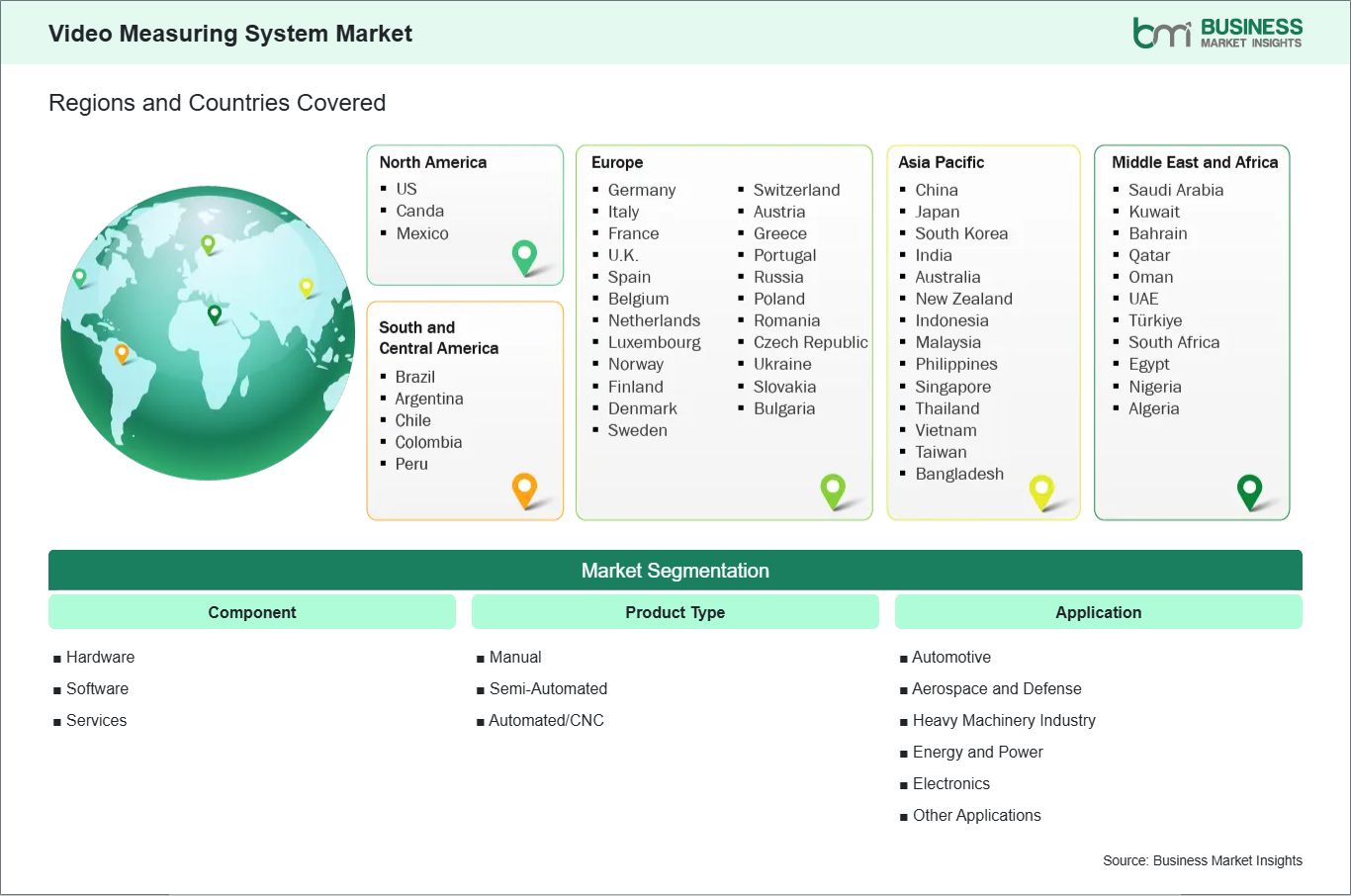
Key segments that contributed to the derivation of the Video Measuring System market analysis are component, product type, and application.
- By Component, the market is segmented into Hardware, Software, and Services.
- By Product Type, the market is divided into Manual, Semi-Automated, and Automated/CNC.
- By Application, the market is categorized into Automotive, Aerospace and Defense, Heavy Machinery Industry, Energy and Power, Electronics, and Others.
Market Forces
Video Measuring System Market Drivers and Opportunities
Growing Imperative for Non-Contact High-Precision Inspection in Electronics
The rapid acceleration of electronic component miniaturization serves as the primary driver for the video measuring system market. As semiconductor fabrication and PCB assembly move toward increasingly microscopic scales, traditional contact-based measurement methods—such as physical probes—become impractical due to the high risk of damaging delicate substrates. Video measuring systems offer a critical non-contact alternative, utilizing advanced LED illumination and high-magnification telecentric lenses to capture sub-micron features without physical interaction. This is particularly vital in the production of smartphones, wearable devices, and automotive electronic control units (ECUs), where even a minor dimensional deviation can lead to total system failure.
By 2026, the global expansion of 5G infrastructure and the transition toward sophisticated AI-capable chipsets will demand even higher throughput in quality control labs. Manufacturers are consequently investing in high-speed VMS units that can process hundreds of measurement points per second, ensuring that the pace of inspection keeps up with high-volume production lines. This trend is bolstered by the rising complexity of multi-layered circuit designs, which require the z-axis focal depth capabilities inherent in modern 3D video measuring systems to ensure vertical and horizontal alignment.
Integration of AI-Driven Autonomous Metrology and Industry 4.0
The emergence of AI-driven autonomous metrology presents the most significant growth opportunity for the market through 2033. Traditionally, programming a video measuring machine required extensive manual intervention and deep technical expertise; however, the new generation of AI-enabled software is capable of "learning" part geometries and autonomously generating optimal inspection paths. This shift addresses the global skills gap by democratizing high-end metrology, allowing less-specialized operators to execute complex measurement routines with high fidelity. Furthermore, as Industry 4.0 matures, VMS units are evolving into "edge" devices that feed real-time dimensional data back into the production loop. This enables predictive process control, where the system can identify a trending drift in manufacturing tolerances and automatically signal for machine tool adjustments before defects occur.
The opportunity for VMS providers lies in developing cloud-native platforms—such as Hexagon's Nexus—that consolidate measurement data across global production sites, providing manufacturers with a unified "digital twin" of their quality status. As factories move toward fully lights-out manufacturing, the demand for these "sensing-to-inference" pipelines will surge, positioning automated VMS as a cornerstone of the intelligent, self-optimizing factory of the future.
Size and Share Analysis
Video Measuring System Market Size and Share Analysis
The Video Measuring System market demonstrates steady growth, with size and share analysis revealing evolving trends and competitive positioning among key players. The report further examines subsegments categorized within component, product type, and application, offering insights into their contribution to overall market performance.
In the component segment, the Software sub-segment is emerging as a critical value-driver due to the necessity for AI-powered image analysis and real-time reporting.
Regarding product types, the Automated/CNC sub-segment is gaining significant traction as manufacturers prioritize high-throughput and "lights-out" operation.
Within applications, the Electronics sub-segment remains a dominant contributor, fueled by the relentless demand for precision in the semiconductor and consumer hardware industries.
Report Coverage
Video Measuring System Market Report Coverage and Deliverables
The "Video Measuring System Market Size and Forecast (2022–2033)" report provides a detailed analysis of the market covering below areas:
- Video Measuring System market size and forecast at global, regional, and country levels for all the key market segments covered under the scope
- Video Measuring System market trends, as well as market dynamics such as drivers, restraints, and key opportunities
- Video Measuring System market analysis covering key market trends, global and regional framework, major players, regulations, and recent market developments
- Industry landscape and competition analysis covering market concentration, heat map analysis, prominent players, and recent developments for the Video Measuring System market
- Detailed company profiles, including SWOT analysis
Geographic Insights
Video Measuring System Market Geographic Insights
The geographical scope of the Video Measuring System market report is divided into five regions: North America, Asia Pacific, Europe, the Middle East & Africa, and South & Central America.
In North America, the market is characterized by a high concentration of aerospace and defense contractors who utilize automated video metrology to ensure the structural integrity of mission-critical flight components. The Asia-Pacific region functions as the primary engine for market expansion, driven by its massive electronics manufacturing ecosystem and the rapid adoption of high-speed inspection systems in semiconductor fabrication hubs. Europe maintains a specialized focus on precision engineering, where stringent regulatory standards in the medical device and automotive sectors necessitate the use of high-fidelity, non-contact measurement solutions to maintain global competitiveness.
In the Middle East & Africa, market activity is increasingly linked to industrial diversification efforts and the modernization of energy infrastructure, leading to a rising demand for localized quality control facilities. Meanwhile, South & Central America are witnessing a steady integration of video measuring technologies as regional automotive assembly plants shift toward digital manufacturing frameworks to enhance production efficiency. This broad regional distribution ensures market resilience, as different territories leverage video metrology to meet specific industrial demands ranging from micro-electronics to heavy machinery.
Industry Activity
Recent Developments
The Video Measuring System market is evaluated by gathering qualitative and quantitative data post primary and secondary research, which includes important corporate publications, association data, and databases. A few of the key developments in the Video Measuring System market are:
- In July 2025, Nikon Corporation (Nikon) announced that the NEXIV VMF-K had received the "Red Dot Award: Product Design 2025," sponsored by Germany's Design Zentrum Nordrhein Westfalen. The NEXIV VMF-K Series was introduced as a high-performance Video Measuring System for automatically measuring the dimensions of semiconductor and electronic components. The system offered significant benefits to a wide range of industries in addition to semiconductor manufacturing, including advanced packaging, substrate production, wafer inspection, and probe card inspection.
- In June 2025, Hexagon's Manufacturing Intelligence division announced the launch of the Autonomous Metrology Suite, a software solution developed on its cloud-based Nexus platform that was designed to transform quality control across manufacturing industries worldwide. By removing all coding from coordinate measuring machine (CMM) and Video Measuring System workflows, the suite helped manufacturers speed up critical R&D and manufacturing processes as experienced metrologists became increasingly harder to find.
Trust & Transparency
Research Methodology
The market analysis combines proprietary research with secondary data from government agencies, company disclosures, regulatory filings, industry databases and expert interviews. Market estimates are validated through data triangulation, cross-market benchmarking and analyst
review.
View Full Research Methodology
Key Sources Referred:
World Bank – Global Trade Indicators World Trade Organization (WTO) (International Monetary Fund )IMF International Trade Administration (ITA) Company website Company annual reports Company investor presentations