Market Summary
Executive Summary and Global Market Analysis
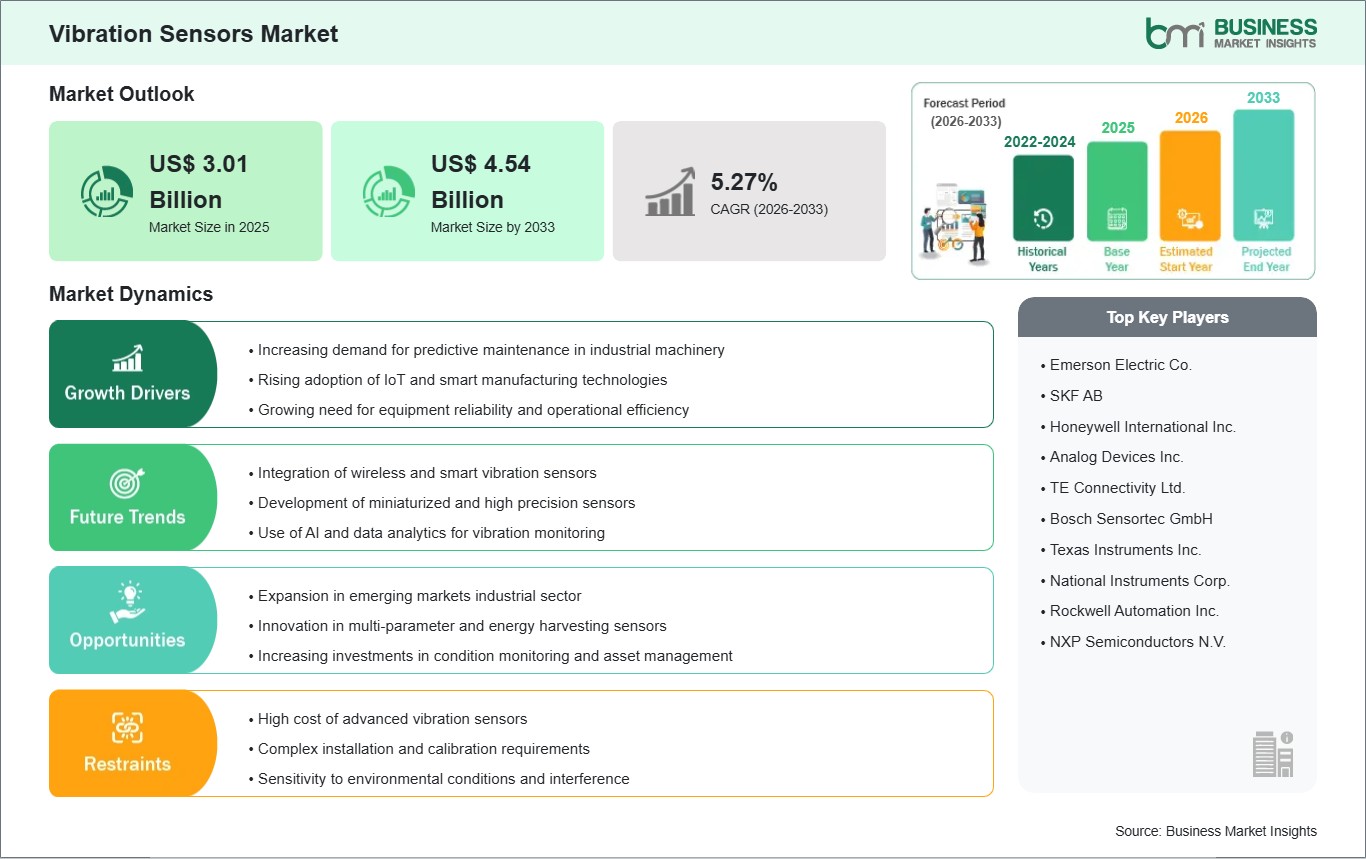
Vibration sensors are sophisticated electromechanical instruments engineered to detect, measure, and analyze mechanical oscillations or movements within various systems. These components serve as the critical "nervous system" for modern machinery, converting physical motion into measurable electrical signals—typically through piezoelectric, piezoresistive, or capacitive technologies. By providing real-time data on displacement, velocity, and acceleration, vibration sensors enable the early detection of structural imbalances, bearing wear, and mechanical fatigue, making them indispensable in high-stakes environments such as aerospace turbines, industrial manufacturing lines, and automotive safety systems. As the backbone of condition-based monitoring, they are the primary enabler of the global shift from reactive repair to intelligent, data-driven maintenance.
Despite their critical utility, the market faces significant restraints, including high initial installation costs for complex multi-sensor networks and technical challenges related to signal interference in electromagnetically noisy industrial environments. Furthermore, the integration of these sensors into legacy equipment often requires specialized expertise and significant downtime, which can deter small-to-medium-sized enterprises from immediate adoption.
However, these challenges are increasingly outweighed by lucrative opportunities stemming from the rapid maturation of Industry 4.0. The convergence of 5G connectivity, miniaturized MEMS (Micro-Electro-Mechanical Systems) technology, and edge-native AI processing is creating a new frontier for "smart" vibration sensing. These advancements allow for ultra-low-power, wireless deployments that provide granular, autonomous insights, ensuring the market remains on a robust upward trajectory as global industries prioritize operational resilience and hyper-automation.
Segment Analysis
Vibration Sensors Market Segmentation
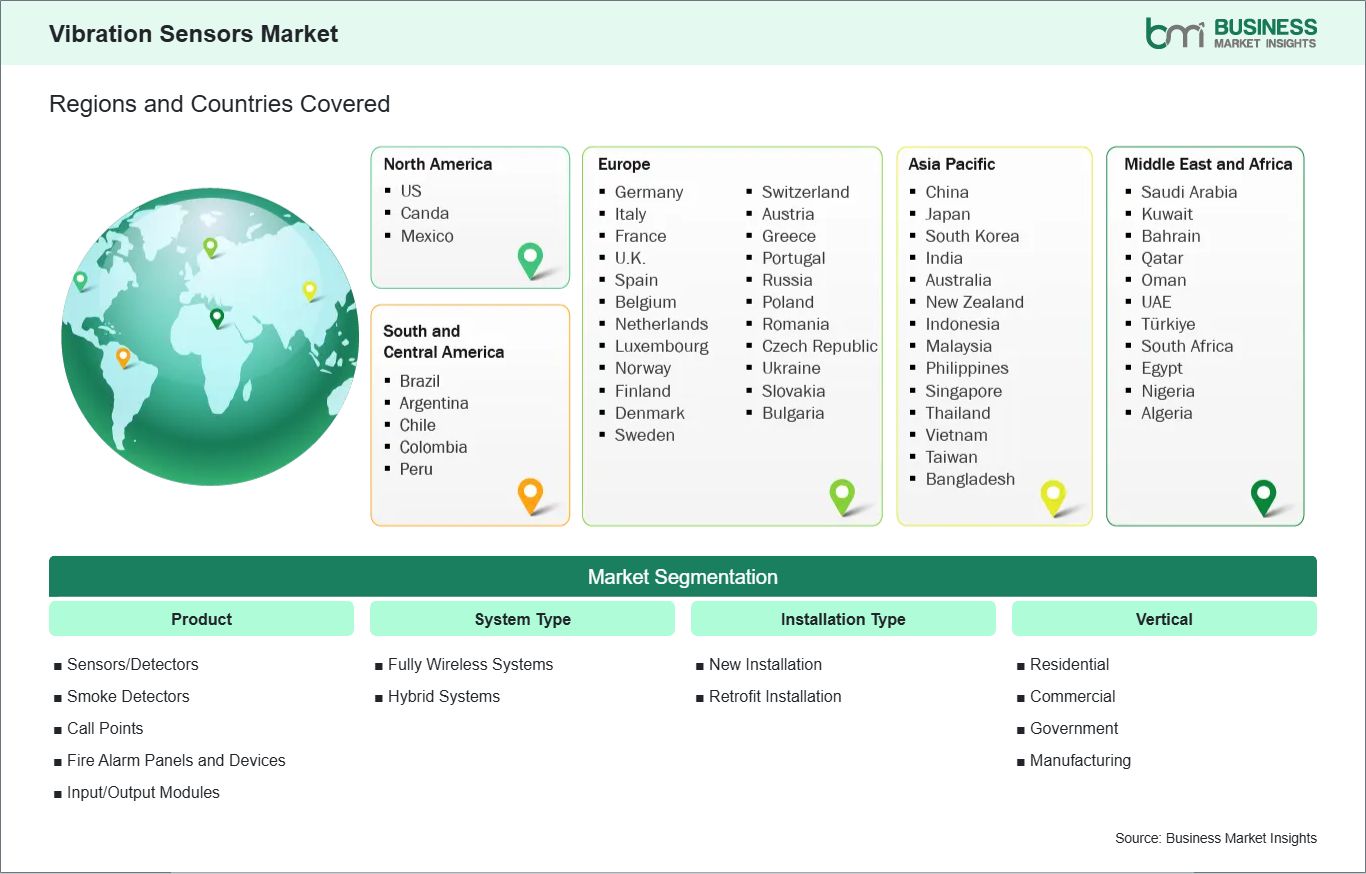
Key segments that contributed to the derivation of the Vibration Sensors market analysis are product and end user.
- By Product, the market is segmented into Accelerometers, Velocity Sensors, Non-contact Displacement Transducers, and Others.
- By End-User, the market is categorized into Automotive, Healthcare, Aerospace and Defense, Consumer Electronics, Oil and Gas, and Others.
Market Forces
Vibration Sensors Market Drivers and Opportunities
The Paradigm Shift Toward Predictive Maintenance and Industrial IoT
The primary catalyst driving the vibration sensors market is the aggressive global transition toward predictive maintenance (PdM) frameworks within the industrial sector. Traditional maintenance cycles—either reactive or strictly schedule-based—are increasingly viewed as inefficient and prone to causing unplanned downtime, which can cost manufacturers millions of dollars in lost productivity. Vibration sensors act as the foundational hardware for Industrial Internet of Things (IIoT) ecosystems, providing the continuous data stream necessary to identify "silent" failures before they manifest as catastrophic breakdowns.
By monitoring the specific frequency signatures of rotating equipment such as motors, pumps, and compressors, these sensors allow facility managers to optimize asset lifecycles and reduce maintenance overhead by up to 30%. This driver is further amplified by the roll-out of 5G Standalone networks, which provide the high-bandwidth, low-latency communication required to manage thousands of sensor nodes in real-time across vast manufacturing footprints. As industries like oil and gas and power generation strive for "zero-downtime" targets, the demand for high-precision, wide-bandwidth vibration sensors continues to escalate, positioning them as a non-discretionary investment in the modern industrial signal chain.
Integration of Edge AI and Autonomous "Sensing-to-Inference" Pipelines
A significant growth opportunity lies in the evolution of vibration sensors from simple data collectors into intelligent edge-processing nodes. Traditionally, raw vibration data—which can be extremely high-frequency—had to be transmitted to centralized servers or the cloud for complex Fast Fourier Transform (FFT) analysis, leading to significant latency and high power consumption. The emergence of Edge AI allows machine learning algorithms to be embedded directly into the sensor's micro-circuitry, enabling the device to perform on-board anomaly detection and only transmit relevant "health alerts" rather than massive streams of raw data. This shift is particularly transformative for the automotive and aerospace sectors, where instantaneous decision-making is critical for safety.
For instance, in autonomous vehicles, edge-integrated vibration sensors can detect subtle changes in road surface or mechanical integrity in milliseconds, informing the vehicle's central computer of potential hazards without the delay of cloud processing. By 2033, as AI-driven "micro-intelligence" becomes the standard, manufacturers have a massive opportunity to develop specialized, low-power vibration SoCs (System-on-Chip) that offer a plug-and-play solution for the next generation of autonomous robotics and intelligent structural health monitoring systems.
Size and Share Analysis
Vibration Sensors Market Size and Share Analysis
The Vibration Sensors market demonstrates steady growth, with size and share analysis revealing evolving trends and competitive positioning among key players. The report further examines subsegments categorized within product and end user, offering insights into their contribution to overall market performance.
Within the product category, the Accelerometers sub-segment represents a major share of the market due to their versatile application in measuring both static and dynamic forces across the automotive and consumer electronics sectors.
From an end-user perspective, the Automotive sub-segment is demonstrating significant growth as manufacturers integrate vibration monitoring into advanced driver assistance systems (ADAS) and electric vehicle (EV) powertrain diagnostics.
Additionally, the Oil and Gas sub-segment under end-user classification continues to be a vital contributor, utilizing high-temperature, explosion-proof vibration sensors to maintain the integrity of critical drilling and refinery infrastructure in harsh environments.
Report Coverage
Vibration Sensors Market Report Coverage and Deliverables
The "Vibration Sensors Market Size and Forecast (2022–2033)" report provides a detailed analysis of the market covering below areas:
- Vibration Sensors market size and forecast at global, regional, and country levels for all the key market segments covered under the scope
- Vibration Sensors market trends, as well as market dynamics such as drivers, restraints, and key opportunities
- Vibration Sensors market analysis covering key market trends, global and regional framework, major players, regulations, and recent market developments
- Industry landscape and competition analysis covering market concentration, heat map analysis, prominent players, and recent developments for the Vibration Sensors market
- Detailed company profiles, including SWOT analysis
Geographic Insights
Vibration Sensors Market Geographic Insights
The geographical scope of the Vibration Sensors market report is divided into five regions: North America, Asia Pacific, Europe, the Middle East & Africa, and South & Central America.
In North America, the market is primarily sustained by an advanced aerospace and defense sector that mandates rigorous structural health monitoring and high-precision signal integrity for mission-critical assets.
Europe demonstrates a sophisticated focus on the integration of high-end vibration sensing within automated automotive production lines and the expanding renewable energy infrastructure, particularly for offshore wind turbine diagnostics.
The Asia Pacific region functions as a high-volume manufacturing hub, where aggressive nationwide digital transformation initiatives and the rapid expansion of semiconductor fabrication facilities propel widespread sensor adoption.
In the Middle East & Africa, market activity is increasingly defined by the modernization of legacy oil and gas infrastructure through the implementation of wireless condition-monitoring systems in remote environments. South & Central America are witnessing a progressive shift toward industrial automation, driven by the digital overhaul of regional mining operations and the adoption of smart processing technologies to enhance worker safety and operational efficiency. This geographical spread ensures a stable market environment as localized industries transition toward high-fidelity, data-centric operational frameworks.
Industry Activity
Recent Developments
The Vibration Sensors market is evaluated by gathering qualitative and quantitative data post primary and secondary research, which includes important corporate publications, association data, and databases. A few of the key developments in the Vibration Sensors market are:
- In January 2026, Texas Instruments (TI) introduced new automotive semiconductors and development resources to enhance safety and autonomy across various vehicle models. At the event, TI's scalable TDA5 high-performance computing system-on-a-chip (SoC) family offered power- and safety-optimized processing and edge artificial intelligence (AI) that supported up to Society of Automotive Engineers Level 3 vehicle autonomy. TI also unveiled the AWR2188, a single-chip, eight-by-eight 4D imaging radar transceiver, which worked alongside high-fidelity Vibration Sensors to help engineers simplify high-resolution radar and safety systems. These devices, alongside the DP83TD555J-Q1 10BASE-T1S Ethernet physical layer (PHY), joined TI's broader automotive portfolio for next-generation advanced driver assistance systems (ADAS) and software-defined vehicles (SDVs). TI debuted these products at CES 2026, held from Jan. 6-9 in Las Vegas, Nevada.
- In March 2025, TE Connectivity launched the 85x1N and 89x1N series of IoT-enabled wireless Vibration Sensors, which utilized long-range LoRaWAN and Bluetooth connectivity to support predictive maintenance in harsh industrial environments. These compact devices featured a high-stability piezoelectric core and integrated edge computing for localized signal processing, providing up to ten years of battery life for remote monitoring applications.
Trust & Transparency
Research Methodology
The market analysis combines proprietary research with secondary data from government agencies, company disclosures, regulatory filings, industry databases and expert interviews. Market estimates are validated through data triangulation, cross-market benchmarking and analyst
review.
View Full Research Methodology
Key Sources Referred:
World Bank – Global Trade Indicators World Trade Organization (WTO) (International Monetary Fund )IMF International Trade Administration (ITA) Company website Company annual reports Company investor presentations