Market Summary
Executive Summary and Global Market Analysis
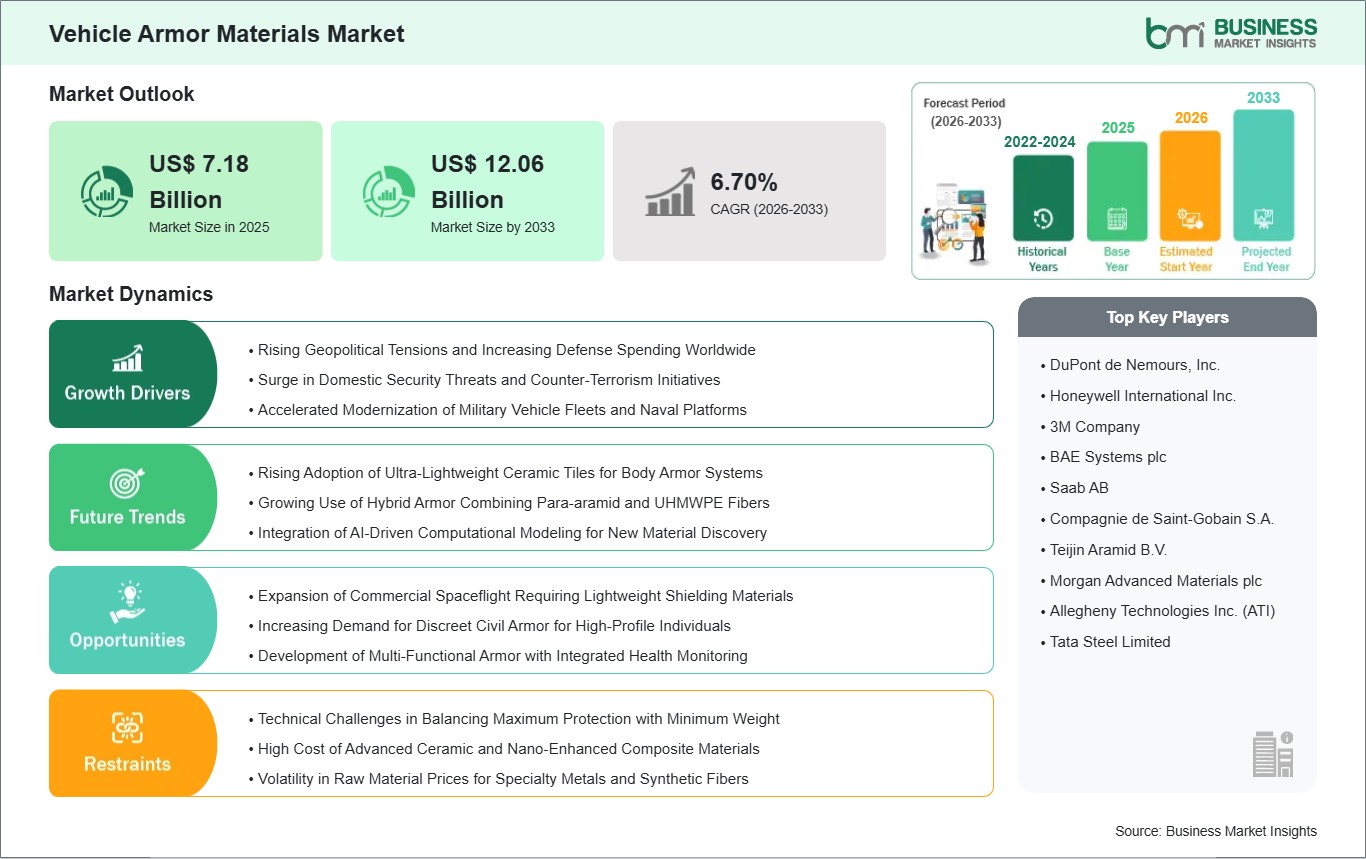
The Vehicle Armor Materials market, which is a part of the aerospace and defense industry, is one of the most important pillars in the sector as it provides the required armor for the protection of personnel, vehicles, and infrastructure. The Vehicle Armor Materials market has witnessed the development of two parallel trends: the continuation of the use of conventional metal alloys in heavy-duty armor, and the rapid growth of advanced materials such as fibers and ceramics in lightweight armor. Although the Vehicle Armor Materials market is dominated by the defense sector, the footprint in the homeland security sector and civil use is increasing due to the instability in urban areas and the need for personal security. The market is in the midst of a high-innovation phase, where the goal is to increase survivability per pound to satisfy the mobility needs of modern security forces.
Growth is being driven by large-scale military modernization initiatives in North America and Asia Pacific, in addition to the commercialization of next-generation materials such as UHMWPE and carbon nanotube composite materials. Despite challenges related to high production costs and fluctuations in raw materials, opportunities related to space exploration and a burgeoning civil security market provide strong avenues for future growth. Going forward, the market is likely to transition toward smarter armor materials, which are capable of performing more than one function, including sensors and even energy harvesting. As a result, the Vehicle Armor Materials market is poised to remain a high-value segment of the global industrial sector.
Segment Analysis
Vehicle Armor Materials Market Segmentation
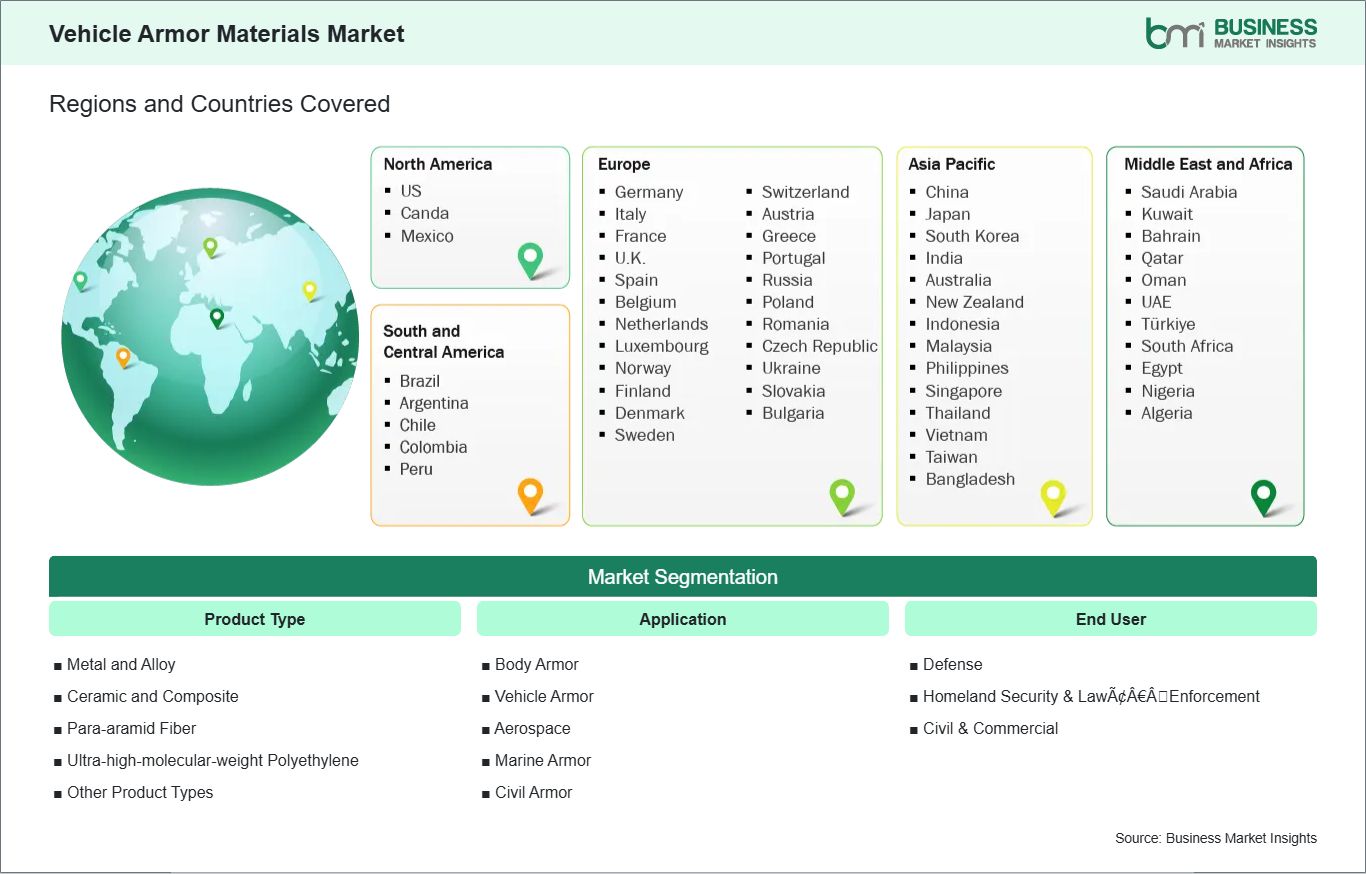
Key segments that contributed to the derivation of the Vehicle Armor Materials market analysis are product type, application, and end user.
- By product type, the Vehicle Armor Materials market is segmented into Metal and Alloy, Ceramic and Composite, Para-aramid Fiber, Ultra-high-molecular-weight Polyethylene (UHMWPE), and Other Product Types. The Metal and Alloy segment dominated the market in 2025.
- By application, the Vehicle Armor Materials market is segmented into Body Armor, Vehicle Armor, Aerospace, Marine Armor, and Civil Armor. The Vehicle Armor segment dominated the market in 2025.
- By end user, the Vehicle Armor Materials market is segmented into Defense, Homeland Security & Law Enforcement, and Civil & Commercial. The Defense segment dominated the market in 2025.
Market Forces
Vehicle Armor Materials Market Drivers and Opportunities
Rising Geopolitical Tensions and Increasing Defense Spending Worldwide
The current world security environment is characterized by changing alliances and regional wars, and in response, nations are in the process of heavily fortifying their defense systems. This has led to an increased budget in the defense sector with the aim of improving the survivability of frontline personnel and equipment. Vehicle Armor Materials are the epicenter of this increased budget in the defense sector as nations focus on acquiring the best materials that can offer protection against changing ballistic and unconventional explosive threats. This is not limited to the traditional defense powers of the world but also the emerging economies that are heavily investing in their local defense systems.
As modern warfare transitions toward more mobile and technologically integrated operations, the requirements for armor are becoming more stringent. Defense agencies are no longer just looking for thick protection but are demanding smart, integrated systems that can be rapidly deployed across various terrains. This environment fosters long-term government contracts for material suppliers, ensuring a stable revenue stream for companies capable of meeting rigorous military specifications. The ongoing cycle of threat-and-response—where new projectiles drive the development of newer, stronger materials—ensures that defense-related demand remains the primary engine for innovation and growth within the armor sector.
Rising Adoption of Ultra-Lightweight Ceramic Tiles for Body Armor Systems
The weight of personal protective equipment has always been a significant burden for soldiers and law enforcement officers, affecting maneuverability and increasing fatigue. To combat this, the industry is seeing a massive shift toward the use of advanced ceramics, such as boron carbide and silicon carbide, in body armor inserts. These materials offer extreme hardness at a fraction of the weight of traditional steel plates. When a projectile hit a ceramic tile, the material shatters locally, absorbing and dissipating the kinetic energy effectively. This allows for the production of Level IV plates that are light enough for extended wear while still providing protection against high-velocity rifle rounds.
This trend is being accelerated by advancements in ceramic manufacturing processes, which have made these once-exotic materials more affordable for large-scale deployment. Manufacturers are now utilizing modular ceramic designs that enhance multi-hit capabilities, a historic weakness of ceramic armor. By nesting small, high-purity tiles within a composite backing, the armor can localize damage and maintain integrity across the rest of the plate. This evolution in material design is transforming soldier systems, enabling a new generation of "high-mobility" infantry that remains fully protected without the physical toll associated with legacy armor systems.
Size and Share Analysis
Vehicle Armor Materials Market Size and Share Analysis
The global Vehicle Armor Materials market is experiencing steady growth, with market size and share analysis reflecting evolving treatment preferences and competitive dynamics among key players. The report evaluates important subsegments categorized within product type, application, and end user, highlighting their respective contributions to overall market performance.
By product type, the Metal and Alloy subsegment dominated the market in 2025 due to its long-standing history of proven ballistic effectiveness and relatively low manufacturing costs. High-hardness steel, aluminum, and titanium remain the primary choices for heavy structural armor in tanks and large naval vessels, where their structural integrity and multi-hit capabilities are essential for survival in high-intensity combat.
By application, the Vehicle Armor subsegment dominated the market in 2025 because of massive global procurement programs for armored personnel carriers and main battle tanks. The high surface area of these platforms requires significant volumes of material, making vehicle protection the largest consumer of both traditional metals and modern composite strike plates.
By end user, the Defense subsegment dominated the market in 2025 as a result of escalating geopolitical tensions and national military modernization initiatives. Defense agencies command the largest budgets for large-scale acquisitions, spanning from individual soldier gear to heavy-duty tactical vehicles and advanced naval shielding.
Report Coverage
Vehicle Armor Materials Market Report Coverage and Deliverables
The "Vehicle Armor Materials Market Size and Forecast (2022 - 2033)" report provides a detailed analysis of the market covering below areas:
- Vehicle Armor Materials market size and forecast at the regional and country levels for segments covered under the scope
- Vehicle Armor Materials market trends, as well as drivers, restraints, and opportunities
- Vehicle Armor Materials market analysis covering key trends, regional framework, major players, regulations, and recent developments
- Industry landscape and competition analysis covering market concentration, heat map analysis, prominent players, and recent developments for the Vehicle Armor Materials market
- Detailed company profiles, including SWOT analysis
Geographic Insights
Vehicle Armor Materials Market Geographic Insights
The geographical scope of the Vehicle Armor Materials market report is divided into: North America, Asia Pacific, Europe, Middle East & Africa, and South & Central America. North America held the largest share in 2025.
North America maintains its status as the leading regional market for Vehicle Armor Materials, a position rooted in having the world’s largest defense budget and a highly advanced military-industrial complex. The United States is the primary driver of this dominance, with consistent funding for multi-year procurement programs such as the modernization of the Army’s vehicle fleet and the continuous upgrading of soldier protection systems. The region is home to industry-leading material science firms like DuPont and Honeywell, whose R&D efforts set the global benchmark for ballistic fibers and composite performance. This concentration of technical expertise and manufacturing capacity allows North America to remain at the forefront of the transition from legacy steel to advanced lightweight materials.
The region’s lead is further reinforced by a strong homeland security sector and a growing civil armor market, where law enforcement agencies and private security firms prioritize high-quality, certified protective gear.
Furthermore, the North American market benefits from a well-established regulatory framework, such as the NIJ standards, which ensure material consistency and build consumer trust. As the U.S. and Canada continue to invest in aerospace defense and naval modernization, the demand for specialized armor for aircraft cockpits and ship hulls remains high. While other regions are growing rapidly, North America’s combination of technological leadership, massive procurement scale, and strategic focus on soldier survivability ensures it will continue to dictate the global direction of the Vehicle Armor Materials industry.
Industry Activity
Recent Developments
The Vehicle Armor Materials market is evaluated by gathering qualitative and quantitative data post primary and secondary research, which includes important corporate publications, association data, and databases. A few of the key developments in the Vehicle Armor Materials market are:
- In March 2023, Iten Defense, announced the acquisition of Transparent Armor Solutions, strengthening its portfolio in advanced transparent armor materials used in military ground vehicles and protective systems.
- In January 2024, DuPont, announced an exclusive agreement with Point Blank Enterprises to supply advanced Kevlar® aramid fiber solutions for protective applications, including vehicle armor systems for law enforcement and defense sectors.
- In 2024, Saint-Gobain, continued expansion of its advanced ceramics portfolio (including ballistic-grade materials) to support lightweight armor solutions for military vehicles and aerospace applications, aligned with growing demand for high-performance protective materials.
Trust & Transparency
Research Methodology
The market analysis combines proprietary research with secondary data from government agencies, company disclosures, regulatory filings, industry databases and expert interviews. Market estimates are validated through data triangulation, cross-market benchmarking and analyst
review.
View Full Research Methodology
Key Sources Referred:
American Chemistry Council (ACC) International Council of Chemical Associations (ICCA) European Chemical Industry Council (Cefic) China National Packaging Industry Association (CNPIA) Indian Institute of Packaging (IIP) Japan Packaging Institute (JPI) Gulf Petrochemicals and Chemicals Association (GPCA) Company Websites Company Annual Reports Company Investor Presentations