Vascular Access Devices Market Outlook (2022-2033)

Historic Data: 2022 - 2024   |   Base Year: 2025   |   Forecast Period: 2026-2033
Report Content: Market Scope, Market Segmentation, Market Dynamics, and Competitive Analysis

Report Coverage:
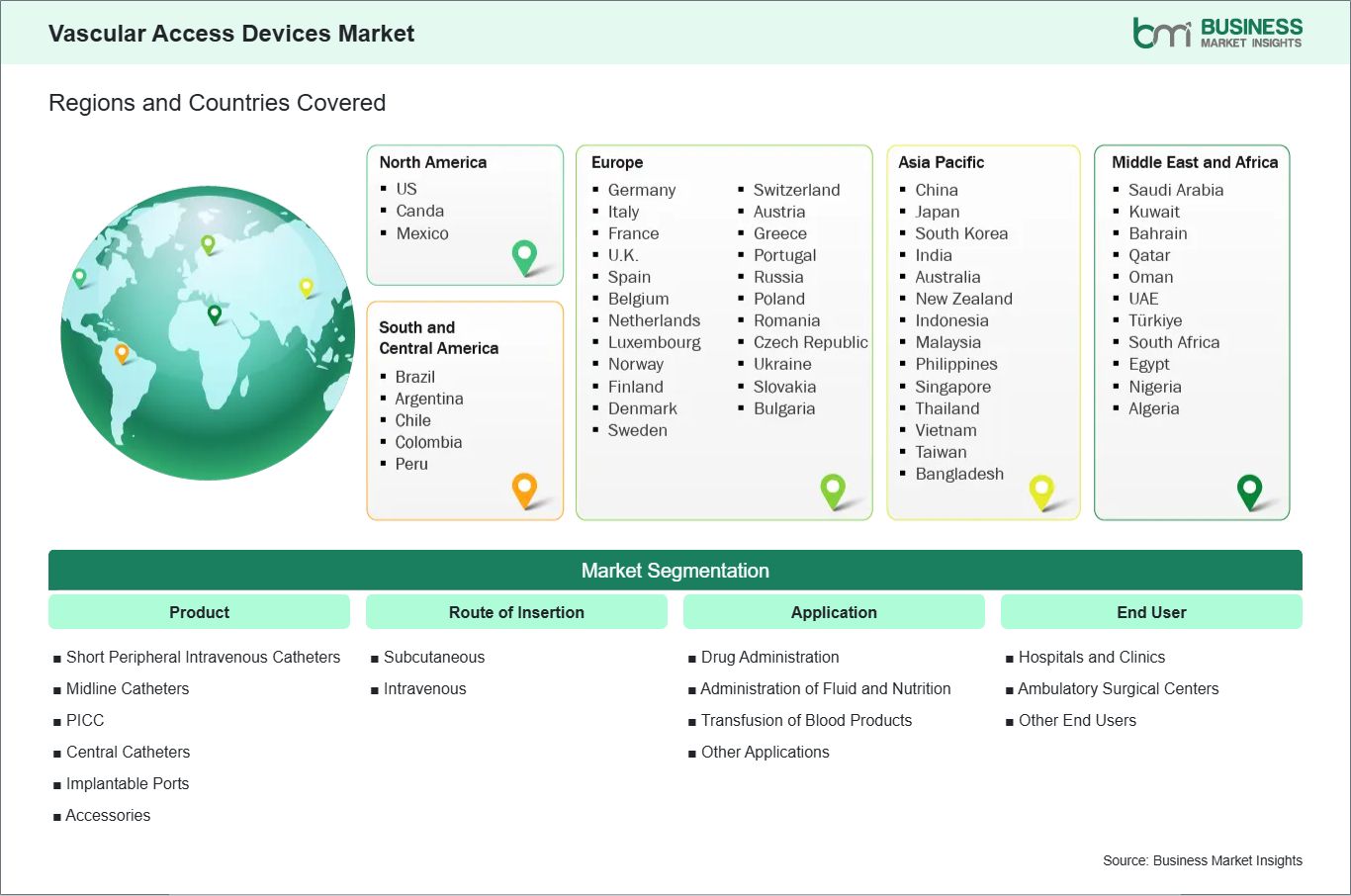
  • Product (Short Peripheral Intravenous Catheters, Midline Catheters, PICC (Peripherally Inserted Central Catheters), Central Catheters [CICC (Centrally Inserted Central Catheter), FICC (Femorally Inserted Central Catheter), Others], Implantable Ports, and Accessories)
  • Route of Insertion (Subcutaneous, Intravenous)
  • Application (Drug Administration, Administration of Fluid and Nutrition, Transfusion of Blood Products, Other Applications)
  • End User (Hospitals and Clinics, Ambulatory Surgical Centers, Other End Users)

No. of Pages: 400
Report Code: BMIPUB00032633
Category: Life Sciences
Vascular Access Devices Market
Buy Now

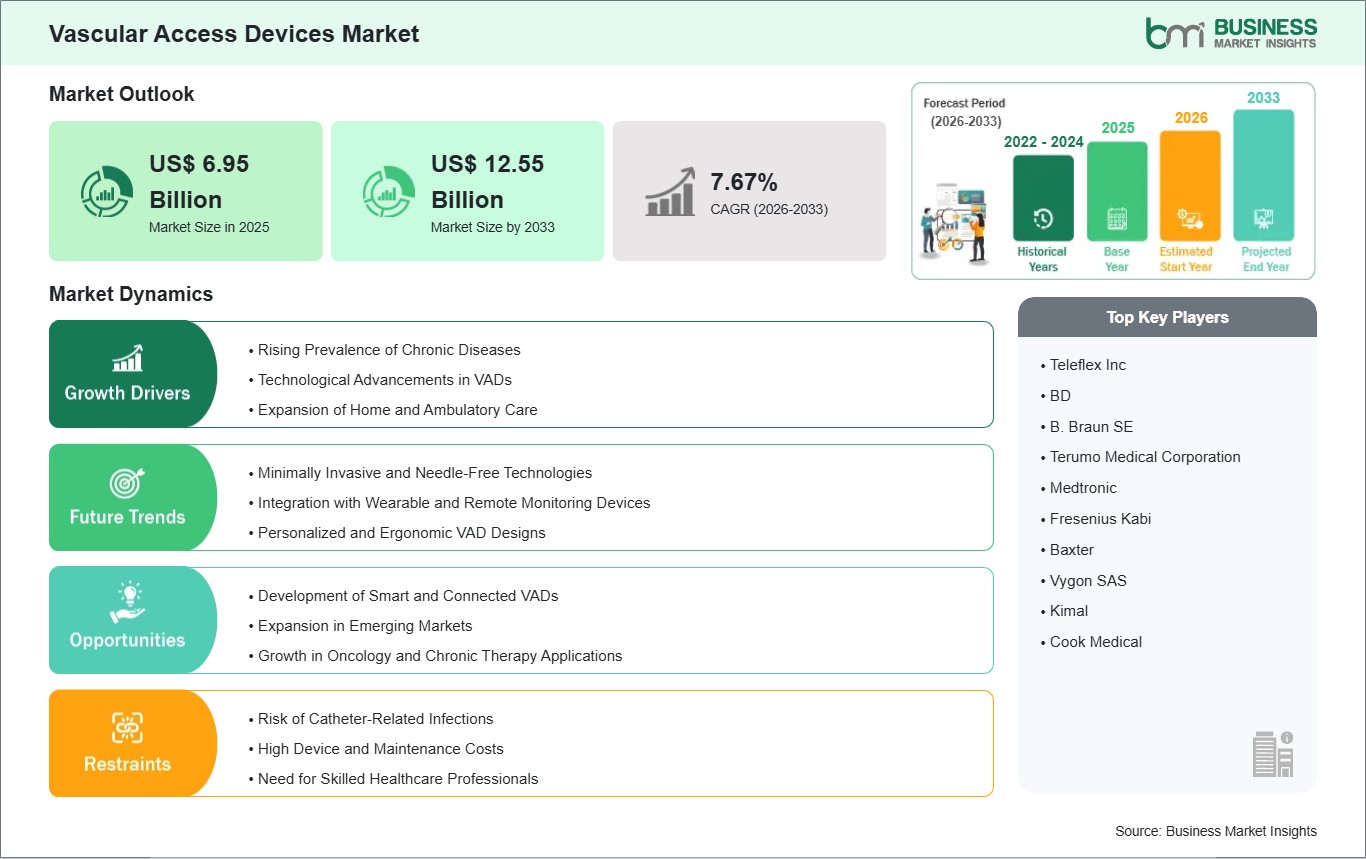
The vascular access devices market size is expected to reach US$ 12.55 billion by 2033 from US$ 6.95 billion in 2025. The market is estimated to record a CAGR of 7.67% from 2026 to 2033.

Executive Summary and Global Market Analysis:

Vascular access devices are indispensable in today's medical practice. They not only guarantee secure but also dependable access to blood for various procedures like administering drugs, performing blood tests, and dialysis. The varieties usually found are peripheral intravenous catheters, central venous catheters, midline catheters, peripherally inserted central catheters, and implantable ports. They are the ones to come forward in addressing different clinical requirements of both short and long-term care. These devices find their biggest applications in the treatment of patients suffering from chronic diseases such as cancer, diabetes, heart, and kidney diseases as they need repeated IV therapy very often. Besides that, the demand for these solutions is rising globally due to an increasing number of surgeries and a growing older population.

The vascular access device market is influenced by a number of factors. The incidence of chronic diseases is growing and so is the demand for intravenous therapy and long-term catheterization. Hospitals are increasingly turning to use of new features such as antibacterial coatings, ultrasound-guided insertion, and better safety which contribute to the growth of this market. There is a shift toward using these devices in the community, with home and outpatient care becoming more prevalent. On the other hand, the market has to deal with obstacles such as infections and blood clots, along with the investments that come with advanced medical devices and the hiring of skilled personnel who will properly operate and take care of the machines.

The vascular access device market is thus likely to witness consistent growth along with the transformation of healthcare systems and the introduction of new technologies to address the needs for safety and clinical care supporting practices outside hospitals.

Vascular Access Devices Market - Strategic Insights:

global-market-strategic-framework
Get more information on this report

Vascular Access Devices Market Segmentation Analysis:

Key segments that contributed to the derivation of the vascular access devices market analysis are product, route of insertion, application, and end user.

  • By product, the vascular access devices market is bifurcated into short peripheral intravenous catheters, midline catheters, PICC (peripherally inserted central catheters), central catheters [CICC (centrally inserted central catheter), FICC (femorally inserted central catheter), others], implantable ports, and accessories. The short peripheral intravenous catheters segment dominated the market in 2025.
  • By route of insertion, the market is bifurcated into subcutaneous, intravenous. The intravenous segment held the largest share of the market in 2025.
  • By application, the market is segmented into drug administration, administration of fluid and nutrition, transfusion of blood products, other applications. The drug administration segment held the largest share of the market in 2025.
  • By end user, the market is segmented into hospitals and clinics, ambulatory surgical centers, other end users. The hospitals and clinics segment held the largest share of the market in 2025.

Vascular Access Devices Market Drivers and Opportunities:

Increasing Demand for Hemodialysis

Chronic kidney disorders are becoming more common worldwide as people age and adopt less healthy lifestyles, such as eating poorly, drinking alcohol, and smoking. As economies grow and people have more disposable income, unhealthy habits are also increasing. Poor sleep and eating patterns are major reasons for the rise in kidney failure, which leads to greater demand for regular hemodialysis treatment.

Vascular access is essential for dialysis because it connects the dialysis machine to the patient’s bloodstream, allowing for the exchange of blood between the patient and the dialysis machine. The main types of vascular access devices used in hemodialysis are arteriovenous fistulas, catheters, and artery-venous grafts. Arteriovenous fistulas are considered the best option for this purpose. As the number of people requiring hemodialysis increases, the demand for vascular access devices is also growing.

  • Around 2 million people worldwide have kidney disease or failure, including 750,000 new cases each year in the United States. In the U.S., over 100,000 patients are waiting for a kidney transplant, and the need for kidney donors is rising by 8% each year.
  • The average annual cost of hemodialysis in the Medicare system in the United States is approximately $90,000 per patient, totaling $28 billion.

Technological Advancement in the Vascular Access Device

Continued investment in healthcare and pharmaceutical infrastructure is helping to develop new treatments and medicines, which support the growth of vascular access devices. Increased spending on new technology in these devices is also creating more opportunities in the market.

  • The FDA has approved two new devices to help prevent dysfunction. Ellipsys, manufactured by Medtronic, is a single-catheter electrocautery device that is placed using ultrasound. WavelinQ from BD is a dual-catheter device that is placed using fluoroscopy.
  • The reimplementation of surgical techniques and radial artery deviation led to the development of the VasQ device by Laminate Medical, which helps support the patient's vasculature to limit the risk of arteriovenous fistula failure. Additionally, the Alio Smartwatch enables remote monitoring of patients with AV access flow surveillance.
  • Vascular Access Devices Market Size and Share Analysis:

    By product, the vascular access devices market is bifurcated into short peripheral intravenous catheters, midline catheters, PICC (peripherally inserted central catheters), central catheters [CICC (centrally inserted central catheter), FICC (femorally inserted central catheter), others], implantable ports, and accessories. The short peripheral intravenous catheters segment dominated the market in 2025. The market for short PIVCs will have a disproportionately large portion of the revenue during the forecast period, primarily due to consumers' preference for more expensive safety short PIVCs over standard devices.

    By route of insertion, the market is bifurcated into subcutaneous, intravenous. The intravenous segment held the largest share of the market in 2025. Intravenous therapy uses vascular access devices to deliver fluids, electrolytes, and blood products directly into a patient’s vein. Peripheral and central catheters enable the administration of safe and steady infusions, which are crucial for hydration, transfusions, and various forms of care that can be either short-term or long-term. This method enables patients to receive effective treatment in hospitals and at home.

    By application, the market is segmented into drug administration, administration of fluid and nutrition, transfusion of blood products, other applications. The drug administration segment held the largest share of the market in 2025. Vascular access devices enable the accurate and safe administration of medications, particularly for treatments such as chemotherapy, antibiotics, biologics, and medications for chronic illnesses. They allow for repeated or ongoing doses, which means less discomfort from injections, better treatment adherence, and safer management of complex treatments in hospitals, clinics, or at home.

    By end user, the market is segmented into hospitals and clinics, ambulatory surgical centers, other end users. The hospitals and clinics segment held the largest share of the market in 2025. The substantial availability of highly skilled and experienced healthcare staff at hospitals will likely allow the industry to continue its dominance over the coming years. In healthcare facilities such as dialysis clinics and hospitals, the presence of qualified and experienced staff provides the best possible care and leads to improved vascular access outcomes.

    Vascular Access Devices Market Report Highlights:

    Report Attribute Details
    Market size in 2025 US$ 6.95 Billion
    Market Size by 2033 US$ 12.55 Billion
    Global CAGR (2026 - 2033)7.67%
    Historical Data 2022 - 2024
    Forecast period 2026-2033
    Segments Covered By Product
    • Short Peripheral Intravenous Catheters
    • Midline Catheters
    • PICC
    • Central Catheters
    • Implantable Ports
    • Accessories
    By Route of Insertion
    • Subcutaneous
    • Intravenous
    By Application
    • Drug Administration
    • Administration of Fluid and Nutrition
    • Transfusion of Blood Products
    • Other Applications
    By End User
    • Hospitals and Clinics
    • Ambulatory Surgical Centers
    • Other End Users
    Regions and Countries Covered North America
    • US
    • Canada
    • Mexico
    Europe
    • Belgium
    • Austria
    • Finland
    • Denmark
    • Greece
    • Poland
    • Romania
    • Russia
    • Ukraine
    • Czech Republic
    • Slovakia
    • Bulgaria
    • Italy
    • Luxembourg
    • Germany
    • Switzerland
    • France
    • Netherlands
    • Norway
    • Portugal
    • Spain
    • Sweden
    • United Kingdom
    Asia-Pacific
    • Australia
    • China
    • India
    • Japan
    • South Korea
    • Indonesia
    • Malaysia
    • Philippines
    • Singapore
    • Thailand
    • Vietnam
    • Bangladesh
    • New Zealand
    • Taiwan
    South and Central America
    • Brazil
    • Argentina
    • Peru
    • Chile
    • Colombia
    Middle East and Africa
    • Bahrain
    • Kuwait
    • Oman
    • Qatar
    • Saudi Arabia
    • United Arab Emirates
    • Turkiye
    • South Africa
    • Egypt
    • Algeria
    • Nigeria
    Market leaders and key company profiles
    • Teleflex Inc
    • BD
    • B. Braun SE
    • Terumo Medical Corporation
    • Medtronic
    • Fresenius Kabi
    • Baxter
    • Vygon SAS
    • Kimal
    Get more information on this report

    Vascular Access Devices Market Report Coverage and Deliverables:

    The "Vascular access devices Market Size and Forecast (2022–2033)" report provides a detailed analysis of the market covering below areas:

    • vascular access devices market size and forecast at global, regional, and country levels for all the key market segments covered under the scope
    • vascular access devices market trends, as well as market dynamics such as drivers, restraints, and key opportunities
    • vascular access devices market analysis covering key market trends, global and regional framework, major players, regulations, and recent market developments
    • Industry landscape and competition analysis covering market concentration, heat map analysis, prominent players, and recent developments for the vascular access devices market
    • Detailed company profiles, including SWOT analysis

    Vascular Access Devices Market Geographic Insights:

    The geographical scope of the vascular access devices market report is divided into five regions: North America, Asia Pacific, Europe, Middle East & Africa, and South & Central America. The vascular access devices market in Asia Pacific is expected to grow significantly during the forecast period.

    The Asia-Pacific vascular access devices market is segmented into China, Japan, South Korea, India, Australia, and the rest of Asia. Asia Pacific is expected to see the fastest market growth during the forecast period. This is due to a growing population and higher demand for better healthcare infrastructure. An increasing number of older adults, who are more likely to have chronic diseases such as heart disease, cancer, high blood pressure, and diabetes, is also boosting the vascular access devices market in the region. For instance, in October 2023, B. Braun Medical Inc. introduced the Introcan Safety 2 IV Catheter with Multi-Access Blood Control. This new catheter is designed to prevent needlestick injuries. It also helps protect clinicians from blood exposure and lowers the risk of bloodborne pathogens during IV procedures.

    The Asia Pacific vascular access devices market is expected to grow at the fastest rate during the forecast period. The increase in R&D investments by international bodies such as the China Cardiovascular Association and the American College of Cardiology, collaborating to advance cardiac care technologies, is one of the reasons behind this.

    global-market-geography
    Get more information on this report

    Vascular Access Devices Market Research Report Guidance:

    • The report includes qualitative and quantitative data in the vascular access devices market across product, route of insertion, application, end user, and geography.
    • The report starts with the key takeaways (chapter 2), highlighting the key trends and outlook of the vascular access devices market.
    • Chapter 3 includes the research methodology of the study.
    • Chapter 4 further includes ecosystem analysis.
    • Chapter 5 highlights the major industry dynamics in the vascular access devices market, including factors that are driving the market, prevailing deterrents, potential opportunities, as well as future trends. Impact analysis of these drivers and restraints is also covered in this section.
    • Chapter 6 discusses the vascular access devices market scenario, in terms of historical market revenues, and forecast till the year 2031.
    • Chapters 7 to 11 cover vascular access devices market segments by product, route of insertion, application, end user, and geography across North America, Europe, Asia Pacific, Middle East and Africa, and South and Central America. They cover the market value revenue forecast and factors driving the market.
    • Chapter 12 describes the competitive analysis along with the heat map analysis for the key players operating in the market.
    • Chapter 13 describes the industry landscape analysis. It provides detailed descriptions of business activities such as market initiatives, new developments, mergers, and joint ventures globally, along with a competitive landscape.
    • Chapter 14 provides detailed profiles of the major companies operating in the vascular access devices market. Companies have been profiled on the basis of their key facts, business descriptions, products and services, financial overview, SWOT analysis, and key developments.
    • Chapter 15, i.e., the appendix is inclusive of a brief overview of the company, list of abbreviations, and disclaimer.

    Vascular Access Devices Market News and Key Development:

    The vascular access devices market is evaluated by gathering qualitative and quantitative data post primary and secondary research, which includes important corporate publications, association data, and databases. A few of the key developments in the vascular access devices market are:

    • In June 2024, Tom Polen, chairman, chief executive officer and president of BD (Becton, Dickinson and Company) and Edwards Lifesciences, announced a definitive agreement under which BD will acquire the Critical Care product group of Edwards for USD 4.2 billion by opening new avenues for growth and value creation opportunities and improving the portfolio of BD smart connected care solutions.
    • In November 2024, BD announced the launch of the BD Intraosseous (IO) Vascular Access System, designed to provide rapid vascular access during critical emergencies. This device is capable of delivering fluids or medication swiftly through the bone marrow cavity when traditional intravenous access is challenging. The BD IO System addresses both adult and pediatric patients by offering unique capabilities tailored to diverse anatomical needs.
    • In November 2023, BD, a globally recognized medical technology company, launched an advanced ultrasound system specifically designed to enhance clinical efficiency for central venous catheters, peripherally inserted central catheters (PICCs), IV lines, and other vascular access devices.

    Key Sources Referred:

    • World Bank – Global Trade Indicators
    • American Medical Association (AMA)
    • National Center for Biotechnology Information (NCBI)
    • National Library of Medicine (NLM)
    • Centers for Disease Control and Prevention (CDC)
    • Company website
    • National Institutes of Health (NIH)
    • International Hospital Federation (IHF)
    • Company annual reports
    • Company investor presentations

The List of Companies - Vascular Access Devices Market

  • Teleflex Inc
  • BD
  • B. Braun SE
  • Terumo Medical Corporation
  • Medtronic
  • Fresenius Kabi
  • Baxter
  • Vygon SAS
  • Kimal
  • Cook Medical
Frequently Asked Questions
How big is the Vascular Access Devices Market?

The Vascular Access Devices Market is valued at US$ 6.95 Billion in 2025, it is projected to reach US$ 12.55 Billion by 2033.

What is the CAGR for Vascular Access Devices Market by (2026 - 2033)?

As per our report Vascular Access Devices Market, the market size is valued at US$ 6.95 Billion in 2025, projecting it to reach US$ 12.55 Billion by 2033. This translates to a CAGR of approximately 7.67% during the forecast period.

What segments are covered in this report?

The Vascular Access Devices Market report typically cover these key segments-

  • Product (Short Peripheral Intravenous Catheters, Midline Catheters, PICC (Peripherally Inserted Central Catheters), Central Catheters [CICC (Centrally Inserted Central Catheter), FICC (Femorally Inserted Central Catheter), Others], Implantable Ports, and Accessories)
  • Route of Insertion (Subcutaneous, Intravenous)
  • Application (Drug Administration, Administration of Fluid and Nutrition, Transfusion of Blood Products, Other Applications)
  • End User (Hospitals and Clinics, Ambulatory Surgical Centers, Other End Users)

What is the historic period, base year, and forecast period taken for Vascular Access Devices Market?

The historic period, base year, and forecast period can vary slightly depending on the specific market research report. However, for the Vascular Access Devices Market report:

  • Historic Period : 2022 - 2024
  • Base Year : 2025
  • Forecast Period : 2026-2033
  • Who are the major players in Vascular Access Devices Market?

    The Vascular Access Devices Market is populated by several key players, each contributing to its growth and innovation. Some of the major players include:

  • Teleflex Inc
  • BD
  • B. Braun SE
  • Terumo Medical Corporation
  • Medtronic
  • Fresenius Kabi
  • Baxter
  • Vygon SAS
  • Kimal
  • Cook Medical
  • Who should buy this report?

    The Vascular Access Devices Market report is valuable for diverse stakeholders, including:

    • Investors: Provides insights for investment decisions pertaining to market growth, companies, or industry insights. Helps assess market attractiveness and potential returns.
    • Industry Players: Offers competitive intelligence, market sizing, and trend analysis to inform strategic planning, product development, and sales strategies.
    • Suppliers and Manufacturers: Helps understand market demand for components, materials, and services related to concerned industry.
    • Researchers and Consultants: Provides data and analysis for academic research, consulting projects, and market studies.
    • Financial Institutions: Helps assess risks and opportunities associated with financing or investing in the concerned market.

    Essentially, anyone involved in or considering involvement in the Vascular Access Devices Market value chain can benefit from the information contained in a comprehensive market report.

    Available Report Formats

    pdf-format excel-format pptx-format
    Buy Now

    Customization Form

    Please tell us your area of interest
    (Market Segments/ Regions and Countries/ Companies)