Urea Market Outlook (2022-2033)

Historic Data: 2022 - 2024   |   Base Year: 2025   |   Forecast Period: 2026-2033
Report Content: Market Scope, Market Segmentation, Market Dynamics, and Competitive Analysis

Report Coverage:
  • By Product Type (Granular, Prilled, and Others)
  • By Grade (Technical Grade, Agricultural Grade, Feed Grade, and Medical Grade)
  • By Application (Nitrogenous Fertilizers, Cattle Feed, Melamine, Others)
  • By End-Use Industry (Agriculture, Chemical, Automotive, Medical, and Others)

No. of Pages: 400
Report Code: BMIPUB00032525
Category: Chemicals and Materials
Urea Market
Buy Now

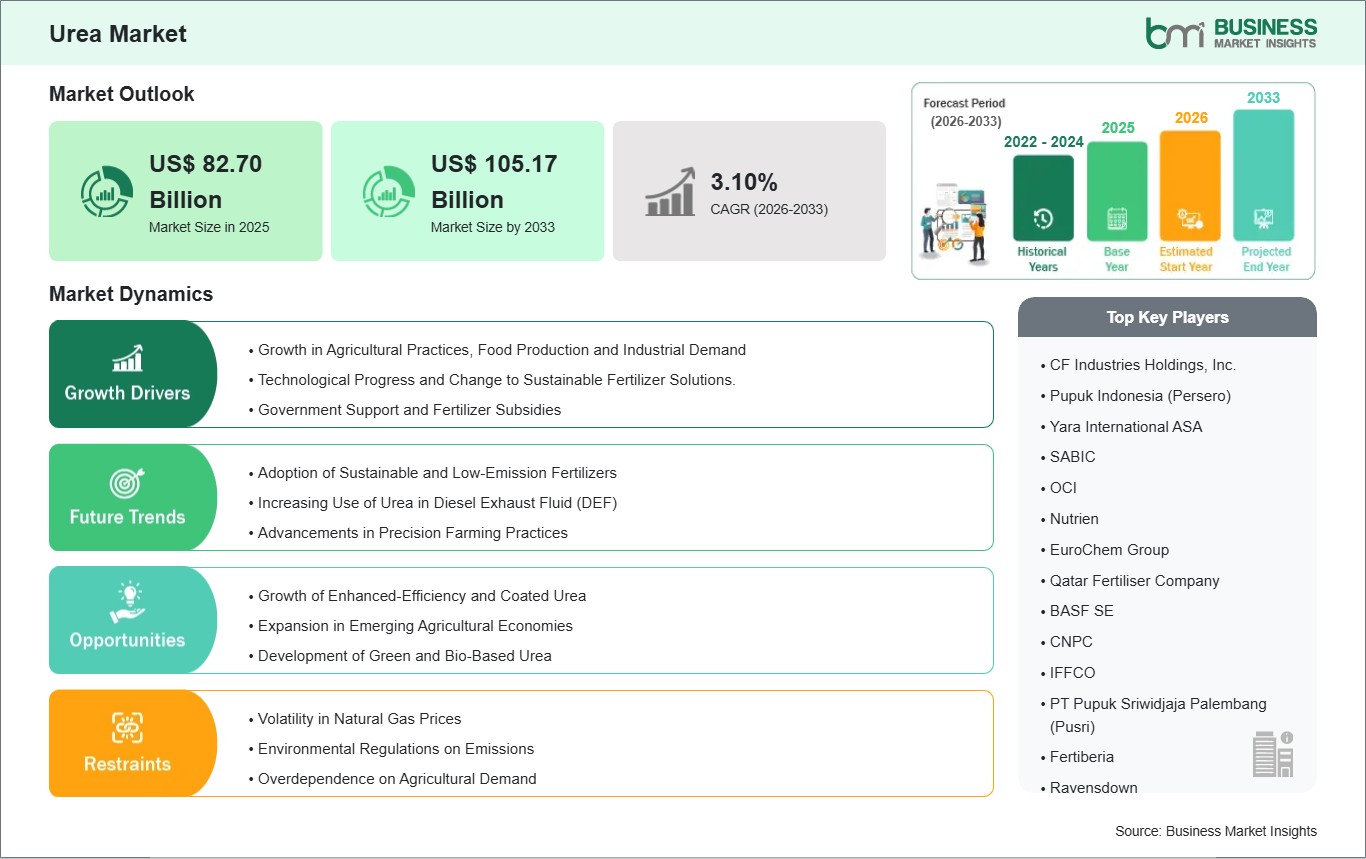
Urea market size is expected to reach US$ 105.17 billion by 2033 from US$ 82.70 billion in 2025. The market is estimated to record a CAGR of 3.1% from 2026 to 2033.

Executive Summary and Global Market Analysis:

Agricultural productivity, food security, and industrial efficiency that are critical in the farming, chemical, automotive, and manufacturing markets are also among other key areas in the world that make up the urea market. Urea provides crop nutrition efficacy, crop fertility and nitrogen reach in the agricultural system, in cultivating, storage, transportation and applying the urea. Urea that is manufactured in the world is largely utilized in fertilizers, resin, adhesives, animal feed, diesel emission fluid and in other industrial or agricultural products. Both the emerging markets and the developed markets have been highly demanded due to the increasing population, growth of agriculture and the rising industrial activities. The rise in agricultural production, the increased interest in high-efficiency fertilizers, and the increase in industrial urea consumption are important aspects that will result in expansion of the market. The necessity to introduce new technologies of sustainable production on farms and improved industrial processes has also caused the increased demand for high-quality products of urea. The result is a new breed of more efficient fertilizers, low-emission formulations and less harmful production procedures, which are enhancing the productivity of crops and their performance in general. There is also high rate of urbanization and industrialization which has increased demand of high quality and performance nitrogen-based inputs. However, there are still such challenges as the environmental problem of emissions of greenhouse gases, the unpredictability of the prices of raw materials and energy, and the extremely strict regulations (particularly the ones connected with environmental preservation). These rules can increase the production costs once they are followed. However, the potential seems to be high due to the development of sustainable, low-emission, and bio-based or green urea solutions. The world urea market is expected to have stable growth in the world, and this will be sustained through the technological innovations and the increasing demand of the sustainable agricultural and industrial solutions in the world.

Urea Market - Strategic Insights:

global-market-strategic-framework
Get more information on this report

Urea Market Segmentation Analysis:

Key segments that contributed to the derivation of the Urea market analysis are product type, grade, application, and end-use industry.

  • By product type, the Urea market is segmented into granular, prilled, and others. The granular segment dominated the market in 2025.
  • By grade, the Urea market is segmented into technical grade, agricultural grade, feed grade, and medical grade. The agricultural grade segment dominated the market in 2025.
  • By application, the Urea market is segmented into nitrogenous fertilizers, cattle feed, melamine, and others. The nitrogenous fertilizers segment dominated the market in 2025.
  • By end-use industry, the market is segmented into agriculture, chemical, automotive, medical, and others. The agriculture segment held the largest share of the market in 2025.

Urea Market Drivers and Opportunities:

Growth in Agricultural Practices, Food Production and Industrial Demand.

It is ascertained that the heightened emphasis on global food security, agricultural output as well as industrial growth has emerged as one of the most important factors in the positive adjustments of the global urea market. Agriculture, chemical manufacturing and automotive related industries are growing and thus it has led to an increase in the consumption of the urea-based substances like nitrogen fertilizers, resins, adhesives and diesel exhaust fluid. The consequence of this increase in agricultural productivity and industrial production has been an impetus in the demand for urea to boost crop productivity, soil nutrient productiveness and emission management. During farming activities and the industrial processes, urea is a very significant component in ensuring continuity in the supply of nitrogen and efficiency.

Using the example of crop farming, there has been an increase in planting of cereals, fruits and vegetables as well as the application of modern agricultural methods which has led to the great demand of fertilizers rich in nitrogen, and which largely depend on the use of urea. The world is experiencing a rapid growth in urea consumption which is due to government programs and the investments made by the individuals in the agricultural and food production sectors. Increased consumption of urea in chemical processing and emission reduction systems is also being enhanced by industrial development particularly in the emerging economies. The market of high-quality urea will continue to grow as agriculture and industrialization in the world continue to grow.

Technological Progress and Change to Sustainable Fertilizer Solutions.

The increased focus on technological innovation and sustainability is another major power that is impacting the global urea market. Manufacturers are also adopting more advanced production technologies and formulations of improved fertilizers that make them more efficient in terms of nutrient benefits, environmental losses, and greenhouse gas emission. A growing trend has been the establishment of improved-efficiency urea, coated manure and low-emission application techniques as agricultural stakeholders strive to attain environmental policies and yet be productive in crop yield.

In modern agricultural systems, especially, in precision farming and emission control technologies to facilitate sustainable development goals, urea is being widely applied. Besides this, there has been an expansion of use of environmentally friendly farming methods and thus a need has arisen to consume products of urea that have less volatilization and better use of nitrogen. As environmental control measures tighten and the world moves towards more sustainable agricultural activities and industrial practices, it is anticipated that the trend of requiring new products of high quality, with high innovation, and environmental compliance is bound to grow steadily in global markets.

Urea Market Size and Share Analysis:

  • By product type, the Urea market is segmented into granular, prilled, and others. In 2025, the market was controlled by the granular segment. The granular segment has a leading position being of better handling ability, even distribution of nutrients, lower caking and applicability using mechanized fertilizers.
  • By grade, the Urea market is segmented into technical grade, agricultural grade, feed grade, and medical grade. The agricultural grade segment dominated the market in 2025. Agricultural grade urea is dominating due to the massive application of agricultural grade urea as a major nitrogen fertilizer to enhance crop production and promote food security in the world.
  • By application, the Urea market is segmented into nitrogenous fertilizers, cattle feed, melamine, and others. The nitrogenous fertilizers segment dominated the market in 2025. This segment has the highest share since urea has high nitrogen levels with low price thus the most sought fertilizer of nitrogen in the world.
  • By end-use industry, the market is segmented into agriculture, chemical, automotive, medical, and others. The agriculture segment held the largest share of the market in 2025. Agriculture is the top performing sector as the demands of food, the growth of agricultural activities, and good support provided by the government through policies and subsidies of fertilizers lead to the growth of this sector.

Urea Market Report Highlights:

Report Attribute Details
Market size in 2025 US$ 82.70 Billion
Market Size by 2033 US$ 105.17 Billion
Global CAGR (2026 - 2033)3.10%
Historical Data 2022 - 2024
Forecast period 2026-2033
Segments Covered By By Product Type
  • Granular
  • Prilled
  • Others
By By Grade
  • Technical Grade
  • Agricultural Grade
  • Feed Grade
  • Medical Grade
By By Application
  • Nitrogenous Fertilizers
  • Cattle Feed
  • Melamine
  • Others
By By End-Use Industry
  • Agriculture
  • Chemical
  • Automotive
  • Medical
  • Others
Regions and Countries Covered North America
  • US
  • Canada
  • Mexico
Europe
  • Belgium
  • Austria
  • Finland
  • Denmark
  • Greece
  • Poland
  • Romania
  • Russia
  • Ukraine
  • Czech Republic
  • Slovakia
  • Bulgaria
  • Italy
  • Luxembourg
  • Germany
  • Switzerland
  • France
  • Netherlands
  • Norway
  • Portugal
  • Spain
  • Sweden
  • United Kingdom
Asia-Pacific
  • Australia
  • China
  • India
  • Japan
  • South Korea
  • Indonesia
  • Malaysia
  • Philippines
  • Singapore
  • Thailand
  • Vietnam
  • Bangladesh
  • New Zealand
  • Taiwan
South and Central America
  • Brazil
  • Argentina
  • Peru
  • Chile
  • Colombia
Middle East and Africa
  • Bahrain
  • Kuwait
  • Oman
  • Qatar
  • Saudi Arabia
  • United Arab Emirates
  • Turkiye
  • South Africa
  • Egypt
  • Algeria
  • Nigeria
Market leaders and key company profiles
  • CF Industries Holdings, Inc.
  • Pupuk Indonesia (Persero)
  • Yara International ASA
  • SABIC
  • OCI
  • Nutrien
  • EuroChem Group
  • Qatar Fertiliser Company
  • BASF SE
Get more information on this report

Urea Market Report Coverage and Deliverables:

The Urea Market Size and Forecast (2022-2033) report provides a detailed analysis of the market covering below areas:

  • Urea market size and forecast at global, regional, and country levels for all the key market segments covered under the scope
  • Urea market trends, as well as market dynamics such as drivers, restraints, and key opportunities
  • Urea market analysis covering key market trends, global and regional framework, major players, regulations, and recent market developments
  • Industry landscape and competition analysis covering market concentration, heat map analysis, prominent players, and recent developments for the Urea market
  • Detailed company profiles, including SWOT analysis

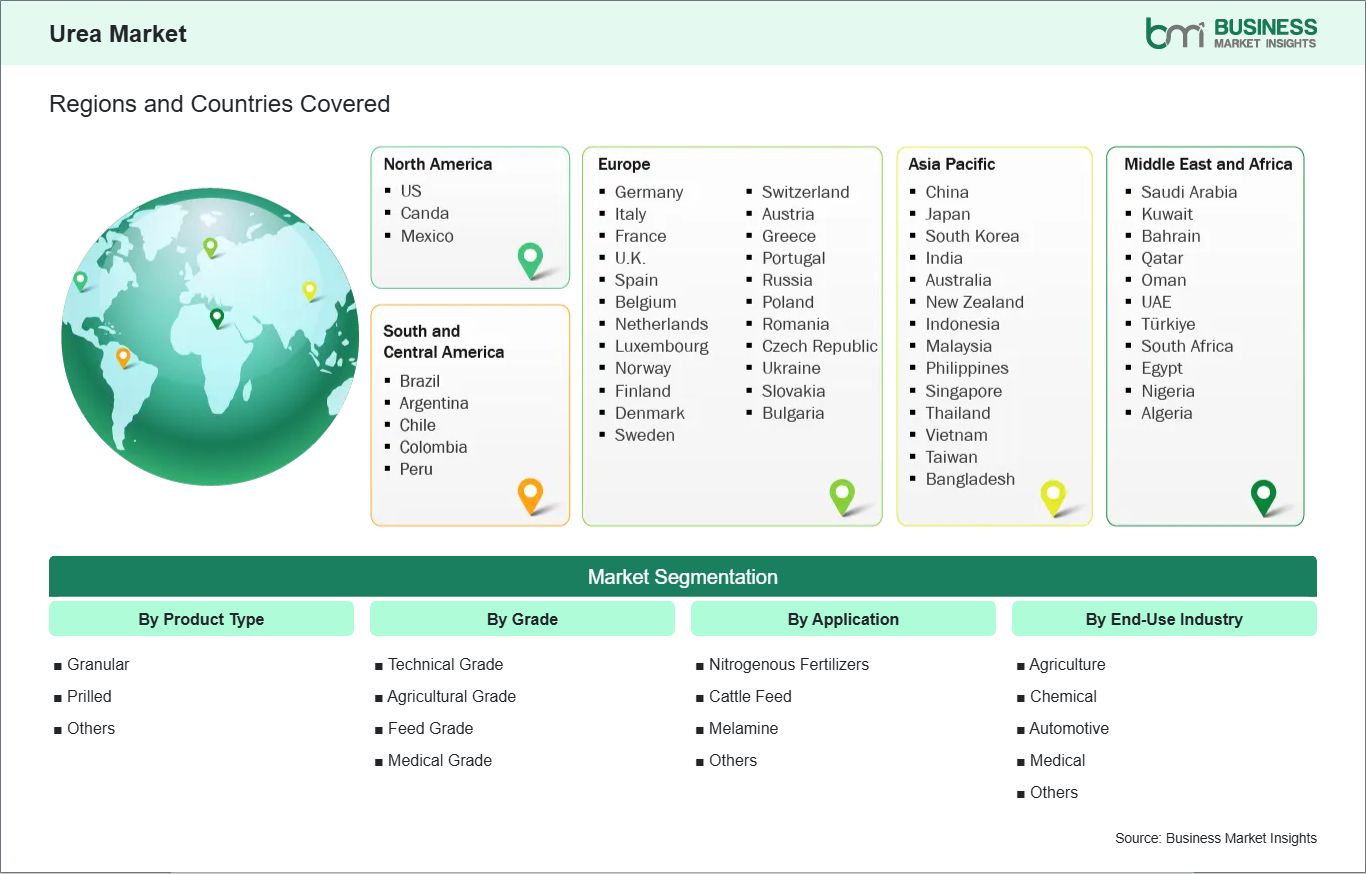
Urea Market Geographic Insights:

The geographical scope of the Urea market report is divided into five regions: North America, Asia Pacific, Europe, Middle East & Africa, and South & Central America. The Urea market in the Asia Pacific is expected to grow significantly during the forecast period.

The Asia-Pacific Urea market is segmented into China, Japan, South Korea, India, Australia, New Zealand, Indonesia, Malaysia, the Philippines, Singapore, Thailand, Vietnam, Taiwan, Bangladesh, and the Rest of Asia.

The Asia-Pacific market is undergoing healthy growth in its market because of the fast population growth, the growth in agricultural activities, increasing industrial production, and an increase in urbanization in the region. China and India control the urea market, and this is backed by the massive investment to modernize agriculture, the capacity of production of fertilizers and the factories of manufacturing industries. The rising food grain demand, fruits and vegetables, as well as the fertilizer subsidy program supported by the government, is greatly raising the urea consumption in the region. Moreover, the growth of industrial use like resins, adhesives and the manufacture of diesel exhaust fluid is also intensifying the regional demand.

The adoption of more advanced technology in the production and application of urea is another significant development which includes the use of advanced fertilizers which are more efficient, coated urea and low-emission nitrogen solutions which are designed to enhance nutrient use efficiency. Better supply stability and operational efficiency are being contributed by the establishment of domestic urea production facilities, the advancement of logistic infrastructure and application of precision farming methods. Additionally, the increased investment in sustainable farming, the higher emission standards of vehicles, and the increase in export of agricultural products are making Asia-Pacific a significant manufacturing and distribution center in the international urea market. The government policies supporting the farmers, subsidies of the fertilizers, and the constant growth of agricultural and industrial industry strengthen the good position of the market in the region.

global-market-geography
Get more information on this report

Urea Market Research Report Guidance:

  • The report includes qualitative and quantitative data in the Urea market across product type, grade, application, end-use industry, and geography.
  • The report starts with the key takeaways (chapter 2), highlighting the key trends and outlook of the Urea market.
  • Chapter 3 includes the research methodology of the study.
  • Chapter 4 further includes ecosystem analysis.
  • Chapter 5 highlights the major industry dynamics in the Urea market, including factors that are driving the market, prevailing deterrents, potential opportunities, as well as future trends. Impact analysis of these drivers and restraints is also covered in this section.
  • Chapter 6 discusses the Urea market scenario, in terms of historical market revenues, and forecast till the year 2031.
  • Chapters 7 to 10 cover Urea market segments by type, application, and geography across North America, Europe, Asia Pacific, Middle East and Africa, and South and Central America. They cover the market volume revenue forecast and factors driving the market.
  • Chapter 11 describes the competitive analysis along with the heat map analysis for the key players operating in the market.
  • Chapter 12 describes the industry landscape analysis. It provides detailed descriptions of business activities such as market initiatives, new developments, mergers, and joint ventures globally, along with a competitive landscape.
  • Chapter 13 provides detailed profiles of the major companies operating in the Urea market. Companies have been profiled on the basis of their key facts, business descriptions, products and services, financial overview, SWOT analysis, and key developments.
  • Chapter 14, i.e., the appendix is inclusive of a brief overview of the company, a list of abbreviations, and a disclaimer.

Urea Market News and Key Development:

The Urea market is evaluated by gathering qualitative and quantitative data post primary and secondary research, which includes important corporate publications, association data, and databases. A few of the key developments in the Urea market are:

  • In December 2025, Uralchem inked MoU with Indian fertilizer PSUs to form urea JV in Russia. The annual capacity of the urea plant is expected to be in the range of 1.8-2 million tons.
  • In September 2025, Adecoagro S.A. (NYSE: AGRO) (Adecoagro or the Company), a leading sustainable production company in South America announced the signing of an agreement to acquire Nutrien Ltd.'s 50% interest in Profertil S.A. (Profertil), the largest producer of granular urea in South America. The remaining 50% stake of Profertil is owned by YPF S.A. the largest oil and gas producer of Argentina. Adecoagro will execute this acquisition through an 80%-20% partnership with Asociación de Cooperativas Argentinas (ACA). The transaction is subject to customary closing conditions and is expected to be completed before the end of 2025. Under the Profertil shareholder agreement, the remaining 50% equity owner holds a 90-day right of first refusal to purchase Nutrien's equity on the same terms and conditions. The purchase price for Nutrien's shares in Profertil is expected to be approximately US$ 600 million.

Key Sources Referred:

  • World Bank – Global Trade Indicators
  • European Chemicals Agency
  • International Council of Chemical Associations
  • (International Monetary Fund )IMF
  • World Trade Organization (WTO)
  • International Trade Administration (ITA)
  • Company website
  • Company annual reports
  • Company investor presentations

The List of Companies - Urea Market

  • CF Industries Holdings, Inc.
  • Pupuk Indonesia (Persero)
  • Yara International ASA
  • SABIC
  • OCI
  • Nutrien
  • EuroChem Group
  • Qatar Fertiliser Company
  • BASF SE
  • CNPC
  • IFFCO
  • PT Pupuk Sriwidjaja Palembang (Pusri)
  • Fertiberia
  • Ravensdown
  • Dubi Chem Marine International
  • Gujarat State Fertilizers & Chemicals (GSFC)
  • GROUP DF
Frequently Asked Questions
How big is the Urea Market?

The Urea Market is valued at US$ 82.70 Billion in 2025, it is projected to reach US$ 105.17 Billion by 2033.

What is the CAGR for Urea Market by (2026 - 2033)?

As per our report Urea Market, the market size is valued at US$ 82.70 Billion in 2025, projecting it to reach US$ 105.17 Billion by 2033. This translates to a CAGR of approximately 3.10% during the forecast period.

What segments are covered in this report?

The Urea Market report typically cover these key segments-

  • By Product Type (Granular, Prilled, and Others)
  • By Grade (Technical Grade, Agricultural Grade, Feed Grade, and Medical Grade)
  • By Application (Nitrogenous Fertilizers, Cattle Feed, Melamine, Others)
  • By End-Use Industry (Agriculture, Chemical, Automotive, Medical, and Others)

What is the historic period, base year, and forecast period taken for Urea Market?

The historic period, base year, and forecast period can vary slightly depending on the specific market research report. However, for the Urea Market report:

  • Historic Period : 2022 - 2024
  • Base Year : 2025
  • Forecast Period : 2026-2033
  • Who are the major players in Urea Market?

    The Urea Market is populated by several key players, each contributing to its growth and innovation. Some of the major players include:

  • CF Industries Holdings, Inc.
  • Pupuk Indonesia (Persero)
  • Yara International ASA
  • SABIC
  • OCI
  • Nutrien
  • EuroChem Group
  • Qatar Fertiliser Company
  • BASF SE
  • CNPC
  • IFFCO
  • PT Pupuk Sriwidjaja Palembang (Pusri)
  • Fertiberia
  • Ravensdown
  • Dubi Chem Marine International
  • Gujarat State Fertilizers & Chemicals (GSFC)
  • GROUP DF
  • Who should buy this report?

    The Urea Market report is valuable for diverse stakeholders, including:

    • Investors: Provides insights for investment decisions pertaining to market growth, companies, or industry insights. Helps assess market attractiveness and potential returns.
    • Industry Players: Offers competitive intelligence, market sizing, and trend analysis to inform strategic planning, product development, and sales strategies.
    • Suppliers and Manufacturers: Helps understand market demand for components, materials, and services related to concerned industry.
    • Researchers and Consultants: Provides data and analysis for academic research, consulting projects, and market studies.
    • Financial Institutions: Helps assess risks and opportunities associated with financing or investing in the concerned market.

    Essentially, anyone involved in or considering involvement in the Urea Market value chain can benefit from the information contained in a comprehensive market report.

    Available Report Formats

    pdf-format excel-format pptx-format
    Buy Now

    Customization Form

    Please tell us your area of interest
    (Market Segments/ Regions and Countries/ Companies)