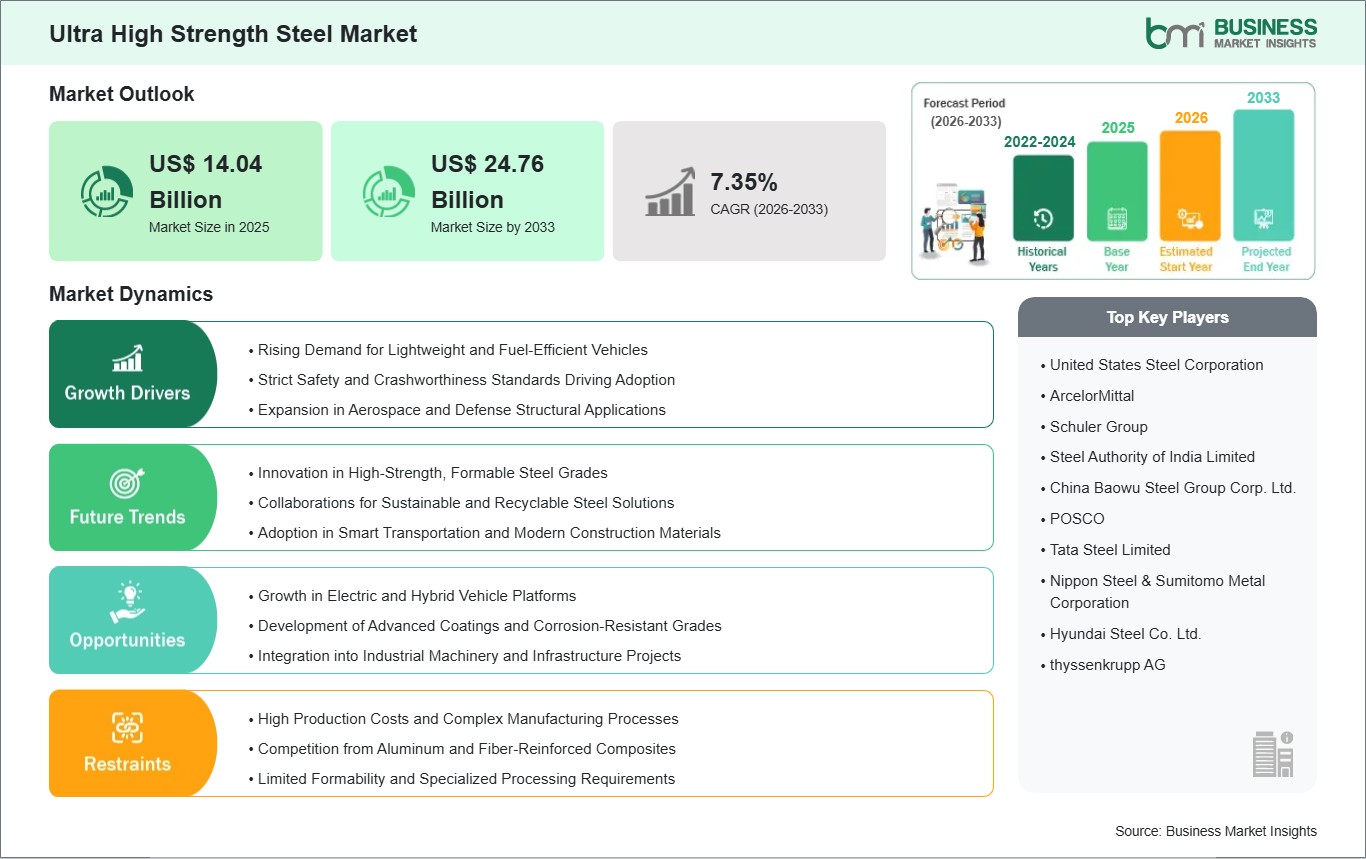
The Ultra-High Strength Steel Market size is expected to reach US$ 24.76 billion by 2033 from US$ 14.04 billion in 2025. The market is estimated to record a CAGR of 7.35% from 2026 to 2033.
The international market for ultra high strength steel (UHSS) materials shows continuous expansion because industrial sectors require advanced materials that provide an exceptional strength-to-weight ratio. The engineered metal alloys known as ultra-high strength steels possess unique physical properties that enable their use in situations where maintaining structural strength and operational safety, and conserving fuel are essential.
The worldwide adoption of UHSS materials results from manufacturing technology advancements and the worldwide trend toward lightweight design in automotive, aerospace, defense and heavy machinery industries. The growing requirement for safety standards combined with performance standards drives the adoption of UHSS for components that need to endure extreme pressure, physical impacts and material wear. Transportation systems benefit from the material, which enables the construction of lighter but stronger structures, because it helps organizations meet sustainability objectives through enhanced energy efficiency and decreased carbon emissions. North America dominates the worldwide UHSS market because its automotive sector has reached full development, and the region invests heavily in infrastructure while implementing strict safety and emissions rules, which promote the use of lightweight materials.
North America serves as the primary market for UHSS materials because Canadian and American automotive manufacturers use advanced steel grades to strengthen vehicle chassis and bumper reinforcements, door beams and crash management systems, which protect passengers while decreasing total vehicle weight. The aerospace and defense industries in North America use UHSS materials to create structural components and armor solutions and load-bearing elements because of the material's exceptional strength and performance under extreme conditions. The market experiences difficulties because it has strong demand. The process of making UHSS requires manufacturers to use special processing techniques, exact thermal treatment methods and advanced alloying techniques, which make production increasingly difficult and more expensive. The development of new lightweight materials, which include aluminum alloys and fiber-reinforced composites, creates competitive challenges for applications where weight reduction is more important than cost.
The production process will experience disruptions because supply chain problems and changes in raw material supply will happen throughout the production cycle. The combination of ongoing research and development funding for steel processing solutions, collaborative research efforts and high-strength steel's crucial role in safety-essential fields will maintain UHSS as a vital material for advanced manufacturing systems used worldwide.

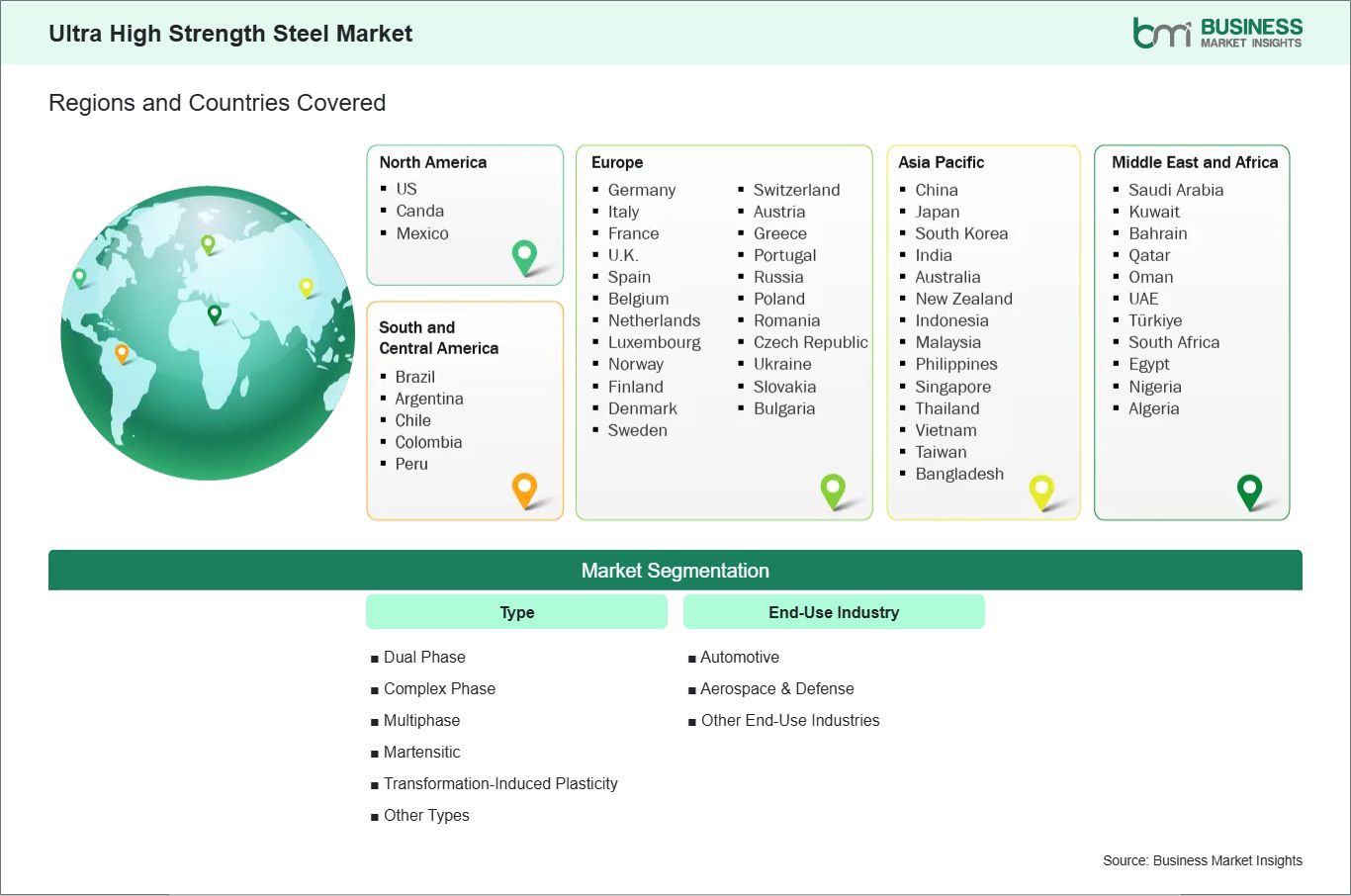
Key segments that contributed to the derivation of the ultra‑high strength steel market analysis are type and end‑use industry.
The global ultra high strength steel market will expand because people want to buy vehicles that weigh less and use less fuel. North American, European and Asia Pacific automotive markets have established stricter emissions regulations, which drive manufacturers to use UHSS materials as a solution for reducing vehicle weight while maintaining both safety standards and structural strength. Ultra high strength steels provide greater strength-to-weight ratios than traditional steel materials, which enables vehicle designers to create smaller parts that improve crash protection and structural strength. This combination supports fuel efficiency improvements that are critical in meeting regional environmental norms and consumer expectations for lower operating costs.
European regulatory systems, which emphasize carbon reduction and safety standards testing, require automotive manufacturers to use UHSS materials for body-in-white structures, bumper reinforcements and side-impact areas. High-strength materials enable automotive manufacturers to achieve performance targets while meeting regulatory requirements because electrification and hybridization increase vehicle weight, which creates a greater need for lightweight materials.
The three major Asian vehicle markets of China, India and Japan use lightweighting methods to improve their fuel efficiency and performance capabilities. The need for fuel-efficient passenger vehicles and SUVs has become a major requirement for regional manufacturers in emerging markets, who now investigate UHSS options. The automotive industry has adopted lightweight designs that use UHSS as a core material that supports industry changes throughout the world..
The global shift toward electric and hybrid vehicle platforms is significantly boosting demand for ultra‑high strength steel. Although electrified powertrains reduce tailpipe emissions, the addition of heavy batteries increases overall vehicle mass. To offset this added weight and preserve driving range and efficiency, automakers are integrating lightweight materials like UHSS into key structural components. This trend is increasingly visible across major EV manufacturing hubs in North America, Europe, and Asia Pacific, where advanced steel grades are used to enhance structural performance without the weight penalty associated with alternative materials. In North America, leading EV producers are incorporating UHSS into battery enclosures, vehicle frames, and crash‑management systems to improve safety while reducing mass.
These applications not only support energy efficiency but also uphold rigorous safety standards critical for consumer acceptance of electric models. Partnerships between OEMs and steel producers have emerged to tailor high‑strength blends that meet unique needs of electric platforms, including improved energy absorption and weldability. Europe’s ambitious electrification targets have similarly influenced material choices.
Automotive engineers in Germany and France are specifying UHSS to balance the demands of both conventional and electric powertrains within modular platforms. In Asia Pacific, China’s large EV production capacity has accelerated UHSS integration in both domestic and export vehicle lines. As hybrid and electric vehicles proliferate globally, the role of ultra‑high strength steel in enabling lightweight yet robust designs will continue expanding across all major automotive markets.

The ultra‑high strength steel market demonstrates steady growth, with size and share analysis highlighting evolving trends and competitive dynamics among key players. The report examines subsegments categorized within type and end‑use industry, offering insights into their contribution to overall market performance.
By type, the martensitic subsegment dominated the market in 2025, driven by its high strength-to-weight ratio and extensive use in safety and structural automotive components.
In terms of end‑use industry, the automotive subsegment dominated the market in 2025, driven by the increasing demand for lightweight, fuel-efficient, and safe vehicles.
| Report Attribute | Details |
|---|---|
| Market size in 2025 | US$ 14.04 Billion |
| Market Size by 2033 | US$ 24.76 Billion |
| Global CAGR (2026 - 2033) | 7.35% |
| Historical Data | 2022-2024 |
| Forecast period | 2026-2033 |
| Segments Covered | By Type
|
|
Regions and Countries Covered
| |
| North America | US, Canada, Mexico |
| Europe | Belgium, Austria, Finland, Denmark, Greece, Poland, Romania, Russia, Ukraine, Czech Republic, Slovakia, Bulgaria, Italy, Luxembourg, Germany, Switzerland, France, Netherlands, Norway, Portugal, Spain, Sweden, United Kingdom |
| Asia-Pacific | Australia, China, India, Japan, South Korea, Indonesia, Malaysia, Philippines, Singapore, Thailand, Vietnam, Bangladesh, New Zealand, Taiwan |
| South and Central America | Brazil, Argentina, Peru, Chile, Colombia |
| Middle East and Africa | Bahrain, Kuwait, Oman, Qatar, Saudi Arabia, United Arab Emirates, Turkiye, South Africa, Egypt, Algeria, Nigeria |
| Market leaders and key company profiles |
|
The "Ultra‑High Strength Steel Market Size and Forecast (2022 - 2033)" report provides a detailed analysis of the market covering below areas:
The geographical scope of the Ultra‑High Strength Steel Market report is divided into North America, Asia Pacific, Europe, Middle East & Africa, and South & Central America. North America held the largest share in 2025.
The advanced automotive and aerospace industries of North America, together with its strict safety and emissions regulations and its extensive research and development facilities, make North America the leading region for producing ultra-high strength steel (UHSS) worldwide. The United States and Canada serve as main production centers that use UHSS in vehicle frames, crash management systems and door beams and reinforcements to achieve safety improvements through weight reductions. The aerospace and defense industries in North America create a demand for UHSS, which steel manufacturers support through their technological advancements and their research partnerships.
Europe presents a developed market where UHSS usage in automotive and industrial machinery and infrastructure projects has reached widespread acceptance. The countries of Germany, France and Italy use advanced steel grades for producing electric and hybrid vehicles, along with industrial equipment and construction frameworks to achieve both lightweighting and safety compliance requirements.
The Asia Pacific market experiences rapid growth through rising automotive production, urbanization and industrialization in China, Japan, India and South Korea, which create increased need for UHSS in vehicles, heavy machinery and construction applications. The region receives advantages from government programs that support fuel efficiency and emission reduction efforts, which result in increased usage of high-strength steels for transportation and energy infrastructure projects.
The Middle East and Africa market is developing because automotive assembly, construction and defense operations demand products from the market in the UAE, Saudi Arabia and South Africa. The region experiences growth because industries invest in new industrial systems, and they implement advanced materials for their building and safety needs. Brazil and Mexico lead South and Central America because they are slowly implementing UHSS technology in their automotive, infrastructure and heavy machinery industries. The region experiences growth through industrial development, technology partnerships and international investment, even though it adopts new technologies at a slower pace than advanced economies.
North America maintains its position as the primary region that establishes technological benchmarks while it shapes global developments in UHSS use throughout various industries.

The Ultra‑High Strength Steel Market is evaluated by gathering qualitative and quantitative data post primary and secondary research, which includes important corporate publications, association data, and databases. A few of the key developments in the ultra‑high strength steel market are:
The Ultra‑High Strength Steel Market is valued at US$ 14.04 Billion in 2025, it is projected to reach US$ 24.76 Billion by 2033.
As per our report Ultra‑High Strength Steel Market, the market size is valued at US$ 14.04 Billion in 2025, projecting it to reach US$ 24.76 Billion by 2033. This translates to a CAGR of approximately 7.35% during the forecast period.
The Ultra‑High Strength Steel Market report typically cover these key segments-
The historic period, base year, and forecast period can vary slightly depending on the specific market research report. However, for the Ultra‑High Strength Steel Market report:
The Ultra‑High Strength Steel Market is populated by several key players, each contributing to its growth and innovation. Some of the major players include:
The Ultra‑High Strength Steel Market report is valuable for diverse stakeholders, including:
Essentially, anyone involved in or considering involvement in the Ultra‑High Strength Steel Market value chain can benefit from the information contained in a comprehensive market report.
Please tell us your area of interest
(Market Segments/ Regions and Countries/ Companies)