Market Summary
Executive Summary and Global Market Analysis
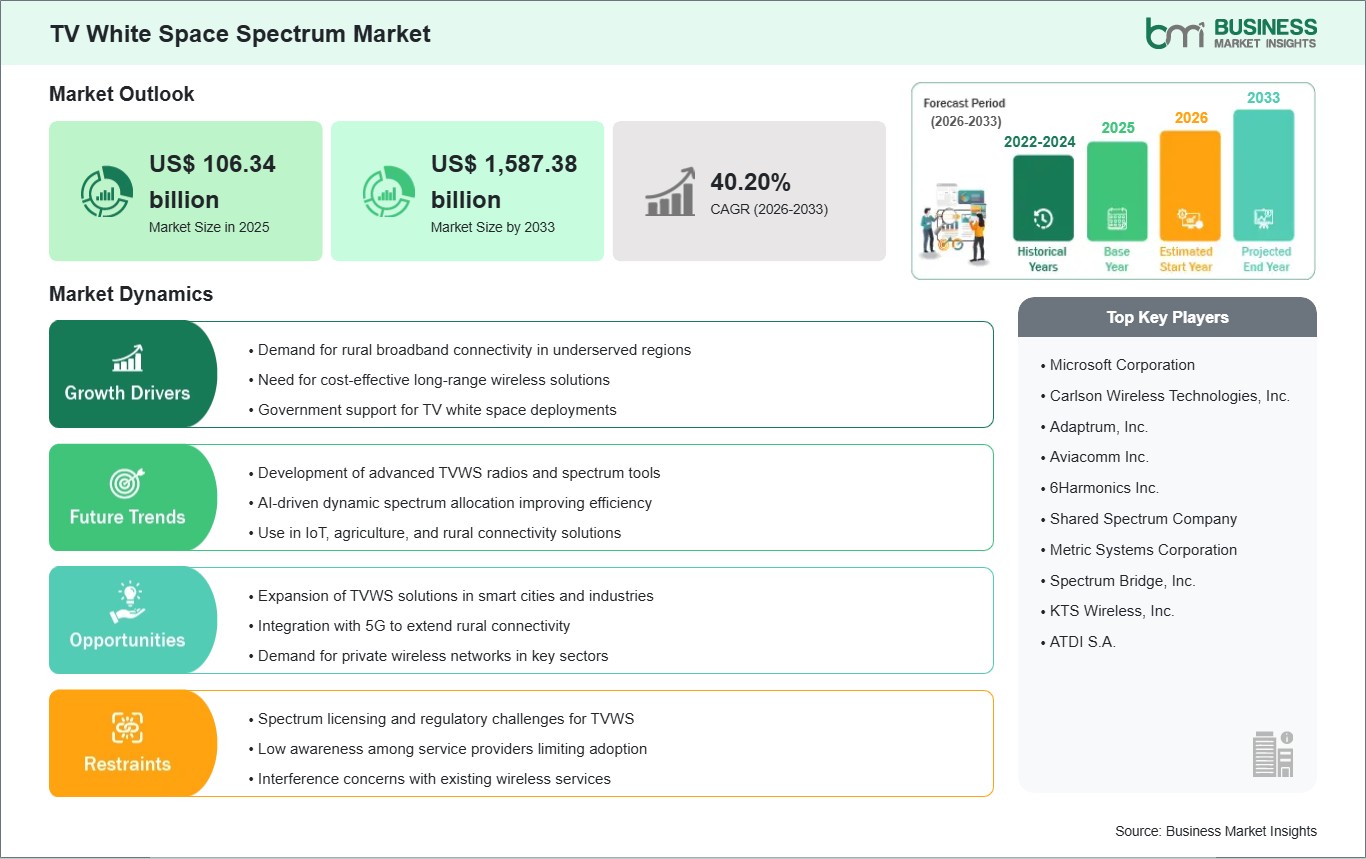
TV White Space (TVWS) spectrum refers to the dormant, unused radio frequencies located between active television broadcast channels in the VHF and UHF bands. By leveraging dynamic spectrum access and cognitive radio technology, these "buffer" frequencies are repurposed as a robust wireless medium for high-speed data transmission. Its superior propagation characteristics distinguish TVWS, as these lower-frequency signals can travel over vast distances (up to 10 kilometers or more) and seamlessly penetrate physical obstructions such as dense foliage and building walls. This "Super Wi-Fi" capability makes it a transformative infrastructure component for bridging the digital divide in regions where traditional fiber or high-frequency cellular networks are economically or geographically unfeasible.
However, the global market faces significant structural challenges that could restrain its near-term expansion. The primary deterrent is the regulatory complexity involved in managing geolocation databases, which must operate with millisecond precision to ensure that secondary TVWS devices do not interfere with primary broadcast signals. Additionally, the industry grapples with a lack of globally harmonized spectrum standards and high initial development costs for specialized hardware that meets stringent emission requirements. Technical hurdles, such as maintaining signal integrity in increasingly crowded unlicensed bands and the limited availability of high-volume consumer chipsets, further complicate wide-scale adoption.
Despite these obstacles, the TV White Space market holds substantial opportunities driven by the urgent global mandate for universal broadband and the rise of the Industrial Internet of Things (IIoT). The surging demand for AI-driven edge computing and the deployment of smart grid networks provide fertile ground for TVWS to serve as a high-reliability, long-range backhaul solution. Furthermore, the global transition toward 6G research—which emphasizes multi-layered spectrum sharing—positions TVWS as a critical testing ground for future dynamic access frameworks. As governments continue to liberalize unlicensed spectrum to foster smart city initiatives and digital inclusion, the market is poised for an era of lucrative growth across telecommunications, public safety, and autonomous logistics.
Segment Analysis
TV White Space Spectrum Market Segmentation
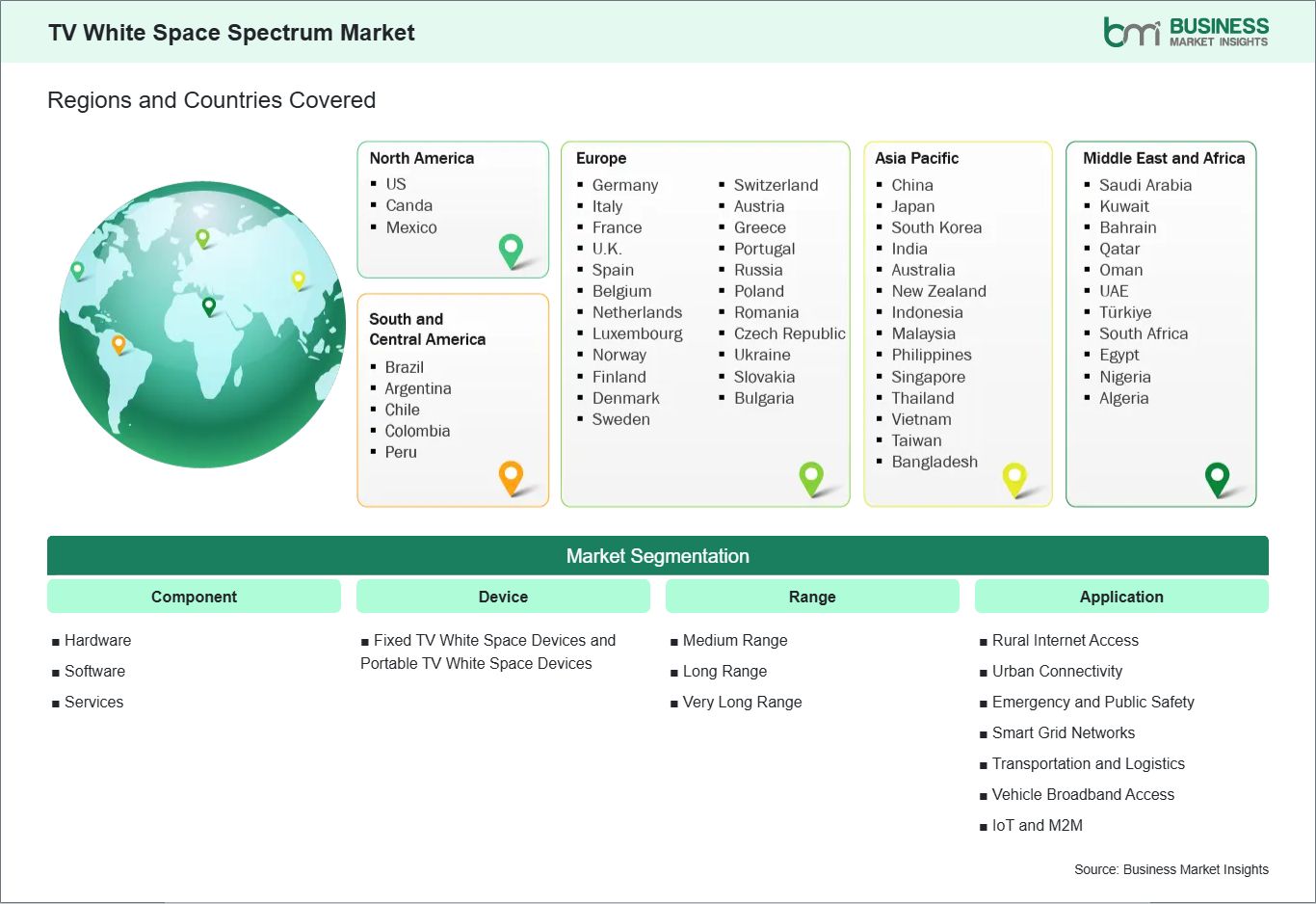
Key segments that contributed to the derivation of the TV White Space Spectrum market analysis are component, Device, range, and application.
- By Component, the market is segmented into Hardware, Software, and Services.
- By Device, the market is divided into Fixed TV White Space Devices and Portable TV White Space Devices.
- By Range, the market is categorized into Medium Range, Long Range, and Very Long Range.
- By Application, the market is categorized into Rural Internet Access (Rural Broadband), Urban Connectivity, Emergency and Public Safety, Smart Grid Networks, Transportation and Logistics, Vehicle Broadband Access, and IoT and M2M.
Market Forces
TV White Space Spectrum Market Drivers and Opportunities
Growing Demand for Cost-Effective Rural Broadband Connectivity
The primary driver propelling the TV White Space spectrum market is the urgent global necessity to establish reliable and affordable internet access in remote and geographically isolated regions. Traditional broadband infrastructure, such as fiber-optic cabling and high-frequency cellular towers, faces significant economic barriers in rural settings due to the prohibitively high cost of installation per user and the limited reach of short-range signals. TV White Space technology addresses these systemic challenges by utilizing underutilized frequencies within the television broadcast bands, which possess exceptional propagation characteristics. Unlike standard wireless signals that struggle with physical obstructions, these lower-frequency waves can travel over vast distances and seamlessly penetrate dense foliage, uneven terrain, and building structures.
This "Super Wi-Fi" capability allows service providers to deploy high-speed networks with a significantly reduced number of base stations, dramatically lowering the capital expenditure required for regional connectivity. Governments and telecommunications operators are increasingly viewing this technology as a cornerstone for digital inclusion initiatives, enabling the delivery of essential services like e-learning, telemedicine, and digital governance to populations previously left behind by the digital revolution. By leveraging existing television broadcast infrastructure and employing dynamic spectrum access to prevent interference, TV White Space provides a scalable and sustainable framework for closing the global connectivity gap without the need for the massive, cost-intensive infrastructure typical of urban telecommunications.
Expansion of Intelligent Infrastructure and Industrial IoT Ecosystems
A transformative opportunity within the TV White Space market resides in its integration with the rapidly maturing Internet of Things and smart city frameworks. As industries transition toward a hyper-connected model characterized by real-time data exchange, the demand for a wireless medium that offers both long-range coverage and deep indoor penetration has reached a critical peak. TV White Space is uniquely positioned to serve as the primary communication backbone for mission-critical applications such as smart grid monitoring, automated utility metering, and large-scale precision agriculture. In these environments, hundreds of localized sensors must transmit data over wide areas—often through metal structures or across vast farm fields—where traditional short-range wireless protocols and high-frequency cellular networks frequently fail to maintain consistent uptime.
The integration of these frequencies into industrial ecosystems enables a robust "sensing-to-action" pipeline, allowing for the autonomous management of resources like water and electricity with unprecedented efficiency. Furthermore, the ability of TV White Space to handle Machine-to-Machine communications over several kilometers makes it an ideal candidate for logistics tracking and emergency public safety networks during natural disasters when conventional infrastructure is compromised. As the global push for "Green" smart cities and automated manufacturing intensifies, there is a specialized opportunity for technology providers to develop low-power, high-performance hardware that utilizes this spectrum to support the next generation of resilient, intelligent, and widely distributed industrial networks.
Size and Share Analysis
TV White Space Spectrum Market Size and Share Analysis
The TV White Space Spectrum market demonstrates steady growth, with size and share analysis revealing evolving trends and competitive positioning among key players. The report further examines subsegments categorized within component, Device, range, and application, offering insights into their contribution to overall market performance.
Within the component segment, the Hardware sub-segment accounts for a major portion of the market as the deployment of base stations and specialized customer premises equipment (CPE) remains the primary capital priority for network operators.
Regarding device types, Fixed TV White Space Devices sub-segment represents the largest share due to their role in establishing permanent backhaul links for rural community hubs.
In terms of range, the Long Range sub-segment is highly favored for its ability to cover up to 10 kilometers, making it ideal for regional connectivity projects.
Among applications, the Rural Internet Access sub-segment remains the dominant contributor as government-led digital inclusion initiatives continue to prioritize the elimination of the "last mile" connectivity gap.
Report Coverage
TV White Space Spectrum Market Report Coverage and Deliverables
The "TV White Space Spectrum Market Size and Forecast (2022 - 2033)" report provides a detailed analysis of the market covering below areas:
- TV White Space Spectrum market size and forecast at global, regional, and country levels for all the key market segments covered under the scope
- TV White Space Spectrum market trends, as well as market dynamics such as drivers, restraints, and key opportunities
- TV White Space Spectrum market analysis covering key market trends, global and regional framework, major players, regulations, and recent market developments
- Industry landscape and competition analysis covering market concentration, heat map analysis, prominent players, and recent developments for the TV White Space Spectrum market
- Detailed company profiles, including SWOT analysis
Geographic Insights
TV White Space Spectrum Market Geographic Insights
The geographical scope of the TV White Space Spectrum market report is divided into five regions: North America, Asia Pacific, Europe, the Middle East and Africa, and South and Central America.
In North America, the market is characterized by a sophisticated regulatory framework and extensive commercial deployments, particularly in the United States, where the focus remains on bridging the rural broadband divide and supporting large-scale municipal smart city projects. The Asia-Pacific region represents a high-growth corridor driven by aggressive government-led initiatives to provide "Super Wi-Fi" connectivity to thousands of underserved villages and the integration of dynamic spectrum access into advanced industrial manufacturing hubs. Europe maintains a specialized focus on the harmonization of spectrum standards to ensure interference-free coexistence with primary broadcasters, prioritizing the use of white spaces for critical public safety networks and high-fidelity environmental monitoring.
In the Middle East and Africa, the market is expanding as a cost-effective alternative to traditional fiber, with regional players utilizing the spectrum to bring essential digital services to remote mining sites and sparsely populated agricultural communities. Meanwhile, South and Central America are witnessing a steady rise in adoption as digital transformation agendas prioritize the modernization of regional utilities and the expansion of automated processing facilities through robust, long-range wireless backhaul. This diversified regional landscape ensures a resilient global market as local economies continue to align their spectrum policies with the demands of a hyper-connected era.
Industry Activity
Recent Developments
The TV White Space Spectrum market is evaluated by gathering qualitative and quantitative data post-primary and secondary research, which includes important corporate publications, association data, and databases. A few of the key developments in the TV White Space Spectrum market are:
- In September 2025, the Instituto Nacional de Comunicações de Moçambique (INCM) and World Mobile announced the successful handover of Mozambique's TV White Space Spectrum database. This milestone transitioned the management of the nation's dynamic spectrum to the state regulator, ensuring the operational integrity of unused television broadcast frequencies for expanding affordable broadband to underserved rural communities.
- In September 2024, Charter Communications (Spectrum) implemented a comprehensive series of network and service announcements aimed at enhancing the consumer experience through its "Customer Commitment" initiative. As part of this broader strategy, the company leveraged its extensive infrastructure to automate speed increases for millions of subscribers, while simultaneously exploring the TV White Space Spectrum as a vital backhaul solution to support its new, simplified pricing and bundling strategies in geographically challenging markets.
Trust & Transparency
Research Methodology
The market analysis combines proprietary research with secondary data from government agencies, company disclosures, regulatory filings, industry databases and expert interviews. Market estimates are validated through data triangulation, cross-market benchmarking and analyst
review.
View Full Research Methodology
Key Sources Referred:
World Bank - Global Trade IndicatorsWorld Trade Organization (WTO)International Monetary Fund (IMF)International Trade Administration (ITA)Company websiteCompany annual reportsCompany investor presentations