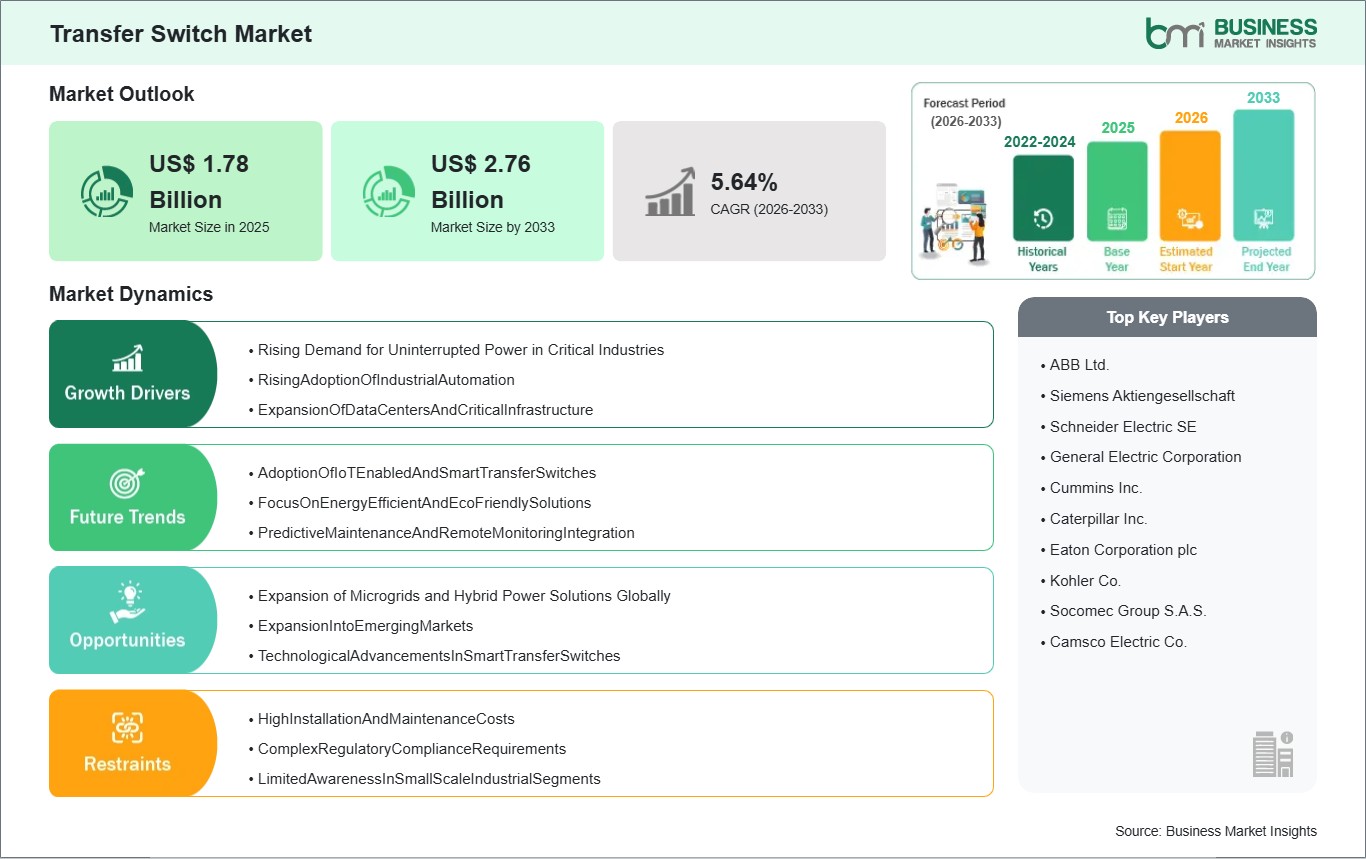
The Transfer Switch Market size is expected to reach US$ 2.76 billion by 2033 from US$ 1.78 billion in 2025. The market is estimated to record a CAGR of 5.64% from 2026 to 2033.
The global transfer switch market is an essential aspect of the current power industry, offering the necessary reliability and security that is expected from the electrical systems of commercial, industrial, residential, and other sectors of the market. Transfer switches are essentially switches that facilitate the smooth transition of electrical load between the main source of power and the alternate source of power, which could be a generator set or an alternate grid supply. The overall concerns that have been building around the necessity of avoiding power outages, grid instability, and the requirement of an uninterrupted power supply in data centers, healthcare facilities, telecommunication facilities, industrial plants, etc., have significantly increased the strategic significance of transfer switches across the globe.
One of the key market drivers is the rapid growth of the overall critical infrastructure across the globe. The digitization of various industries has increased the effects of power outages, making the necessity of backup power supplies crucial in these sectors. Transfer switches form the core of these backup supplies, allowing smooth transitions between different sources of power without the need for manual operation. Moreover, the increasing trend of renewable energy supplies, including solar photovoltaic systems, has created an environment that is conducive to the implementation of smart transfer switches that can handle the complexities of different sources of energy. These developments are crucial in countries that are focusing on the modernization of their energy supplies, with the core of these supplies being the transfer switches that facilitate the distribution of energy with maximum reliability. However, despite this demand, there are challenges that may act as restraints on future market growth if not addressed strategically. The complex installation needs, especially with automated and multi-source transfer systems, may drive up costs and extend installation schedules.
The fragmented regulatory landscape in various regions has also led to different standards being followed with respect to product performance, safety, and compatibility, thereby affecting product development as well as future market scalability. The issue of cybersecurity risks associated with smart transfer switch solutions and power systems is another restraint on future market growth, as increased connectivity increases risks to critical electrical infrastructure without adequate security features being implemented. The Transfer Switch Market is set to grow as power reliability is seen as a strategic issue in various industries, with innovation in control solutions as well as integration with new energy networks.

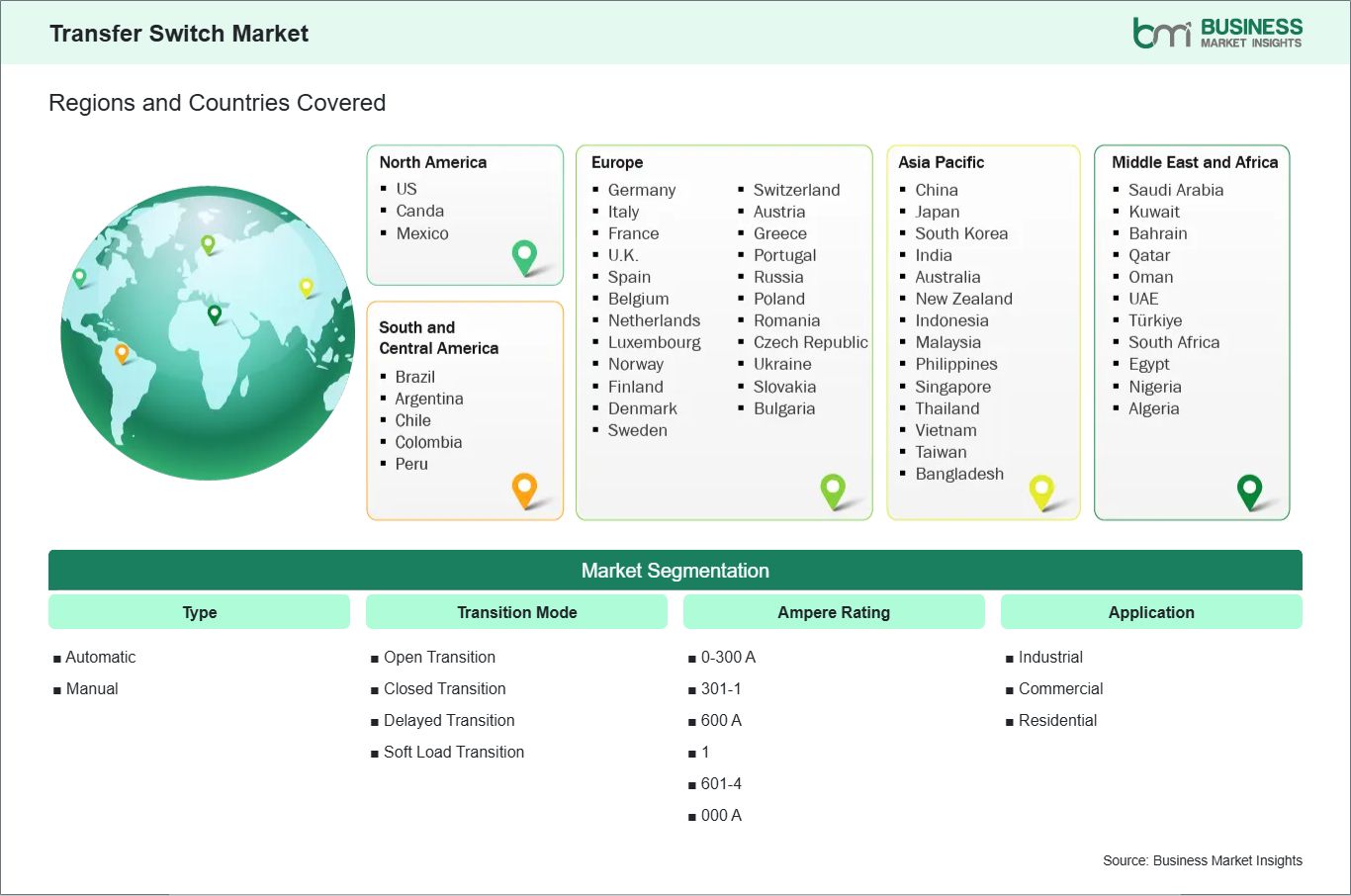
Key segments that contributed to the derivation of the transfer switch market analysis are type, transition mode, ampere rating, and application.
The global transfer switch market is increasingly driven by the imperative for uninterrupted power in critical industries where even brief outages can cause significant financial losses or safety risks. In healthcare, hospitals and emergency facilities depend on transfer switches to rapidly shift to backup generation during power failures, ensuring life‑supporting systems remain operational. Similarly, data centers worldwideespecially in regions with high digital demand such as North America, Europe, and East Asiarequire seamless power transitions to protect sensitive equipment and maintain continuous data flow for cloud services and financial systems.
Transfer switches are central to these architectures, providing the reliability needed for round‑the‑clock operations without manual intervention. Manufacturing sectors also contribute significantly to this demand. Automotive assembly lines, semiconductor plants, and pharmaceutical facilities operate with tightly synchronized processes that cannot tolerate power interruptions. Transfer switches integrated with automated control systems help maintain consistent energy delivery, protecting both machinery and product quality. In regions with older grid infrastructure, such as parts of South & Central America or Africa, transfer switches paired with backup generators are essential to insulating facilities from frequent voltage fluctuations.
The expansion of microgrids and hybrid power solutions is emerging as a major catalyst for innovation and adoption in the global transfer switch market. As renewable energy generationsuch as solar and windbecomes more pervasive, microgrids that blend grid power with local generation and storage are being deployed across campuses, industrial parks, and remote communities. Transfer switches play a pivotal role in these systems by managing transitions between multiple power sources, ensuring stability and seamless load transfers as conditions change. This application is particularly relevant in Europe and Asia Pacific, where governments and utilities are investing in decentralized energy networks.
Hybrid power systems that combine traditional grid input, backup generation, and battery storage also rely on advanced transfer switches to coordinate source transitions automatically. In locations with variable grid reliability or high renewable penetration, these solutions help maintain power quality and prevent disruptions. For example, large industrial facilities in Southeast Asia and the Middle East are integrating transfer switches into hybrid setups to optimize energy use and reduce dependency on diesel generators, while maintaining operational reliability during peak demands or grid interruptions.
The transfer switch market demonstrates steady growth, with size and share analysis highlighting evolving trends and competitive dynamics among key players. The report examines subsegments categorized within type, transition mode, ampere rating, and application, offering insights into their contribution to overall market performance.
By type, the Automatic subsegment dominated the market in 2025, driven by its ability to ensure seamless power switching without manual intervention, enhancing operational reliability.
Based on transition mode, the Closed Transition subsegment dominated the market in 2025, driven by its capacity to maintain continuous power supply with minimal interruption and prevent load disruption during switching.
In terms of ampere rating, the 301 - 1,600 A subsegment dominated the market in 2025, driven by its suitability for medium to large-scale industrial and commercial power requirements.
On the basis of application, the Industrial subsegment dominated the market in 2025, driven by high demand for reliable power management solutions in manufacturing plants, processing units, and large industrial facilities.
| Report Attribute | Details |
|---|---|
| Market size in 2025 | US$ 1.78 Billion |
| Market Size by 2033 | US$ 2.76 Billion |
| Global CAGR (2026 - 2033) | 5.64% |
| Historical Data | 2022-2024 |
| Forecast period | 2026-2033 |
| Segments Covered | By Type
|
|
Regions and Countries Covered
| |
| North America | US, Canada, Mexico |
| Europe | Belgium, Austria, Finland, Denmark, Greece, Poland, Romania, Russia, Ukraine, Czech Republic, Slovakia, Bulgaria, Italy, Luxembourg, Germany, Switzerland, France, Netherlands, Norway, Portugal, Spain, Sweden, United Kingdom |
| Asia-Pacific | Australia, China, India, Japan, South Korea, Indonesia, Malaysia, Philippines, Singapore, Thailand, Vietnam, Bangladesh, New Zealand, Taiwan |
| South and Central America | Brazil, Argentina, Peru, Chile, Colombia |
| Middle East and Africa | Bahrain, Kuwait, Oman, Qatar, Saudi Arabia, United Arab Emirates, Turkiye, South Africa, Egypt, Algeria, Nigeria |
| Market leaders and key company profiles |
|
The "Transfer Switch Market Size and Forecast (2022 - 2033)" report provides a detailed analysis of the market covering below areas:
The geographical scope of the Transfer Switch Market report is divided into North America, Asia Pacific, Europe, Middle East & Africa, and South & Central America. North America held the largest share in 2025.
North America remains the most dominant region in the Transfer Switch Market, given the existing power infrastructure, increased focus on power resiliency, and the importance of critical businesses that require power supplies to be uninterrupted.
The region, comprising the US and Canada, has witnessed increased investment in power backup systems, including those in commercial, industrial, and residential sectors, thereby fueling the adoption of both manual and automated transfer switches, especially in the face of natural calamities that affect the power grid.
On the other hand, the European region also presents an impressive picture in the Transfer Switch Market, given the increased focus on electrical safety regulations, power grid modernization, and the adoption of renewable power sources, with emphasis on transfer switches that enable the development of microgrids and hybrid power systems, as the region continues to shift focus to decarbonized power systems.
In the Asia Pacific region, the industrialization pace and urbanization of China, India, Japan, and Southeast Asian countries are contributing to the adoption of transfer switch solutions to enhance infrastructure reliability, with a growing emphasis on the integration of telemetric control and smart switchgear to facilitate smart buildings and industrial automation.
The South & Central America region’s transfer switch market is influenced by the need to ensure reliable power supply to countries where the quality of power supply varies, thus leading to the adoption of cost-effective transfer switch solutions by Brazil, Mexico, and other countries in the region for commercial buildings, data centers, and other applications.
In the Middle East & Africa region, growing energy infrastructure development schemes, investment in power generation capacities, and rising development of data centers and industrial hubs in countries such as the UAE, Saudi Arabia, and South Africa are creating demand for robust backup power solutions such as transfer switches to function under challenging environmental conditions. I
n all of these regions, the complex interactions of modernized electrical grids, renewable energy sources, and technology innovation are continuing to shape the market landscape, though the advancement of the North American region in terms of automated and smart transfer switch development keeps it at the forefront of global demand for the Transfer Switch Market.

The Transfer Switch Market is evaluated by gathering qualitative and quantitative data post primary and secondary research, which includes important corporate publications, association data, and databases. A few of the key developments in the transfer switch market are:
The Transfer Switch Market is valued at US$ 1.78 Billion in 2025, it is projected to reach US$ 2.76 Billion by 2033.
As per our report Transfer Switch Market, the market size is valued at US$ 1.78 Billion in 2025, projecting it to reach US$ 2.76 Billion by 2033. This translates to a CAGR of approximately 5.64% during the forecast period.
The Transfer Switch Market report typically cover these key segments-
The historic period, base year, and forecast period can vary slightly depending on the specific market research report. However, for the Transfer Switch Market report:
The Transfer Switch Market is populated by several key players, each contributing to its growth and innovation. Some of the major players include:
The Transfer Switch Market report is valuable for diverse stakeholders, including:
Essentially, anyone involved in or considering involvement in the Transfer Switch Market value chain can benefit from the information contained in a comprehensive market report.
Please tell us your area of interest
(Market Segments/ Regions and Countries/ Companies)