Market Summary
Executive Summary and Global Market Analysis
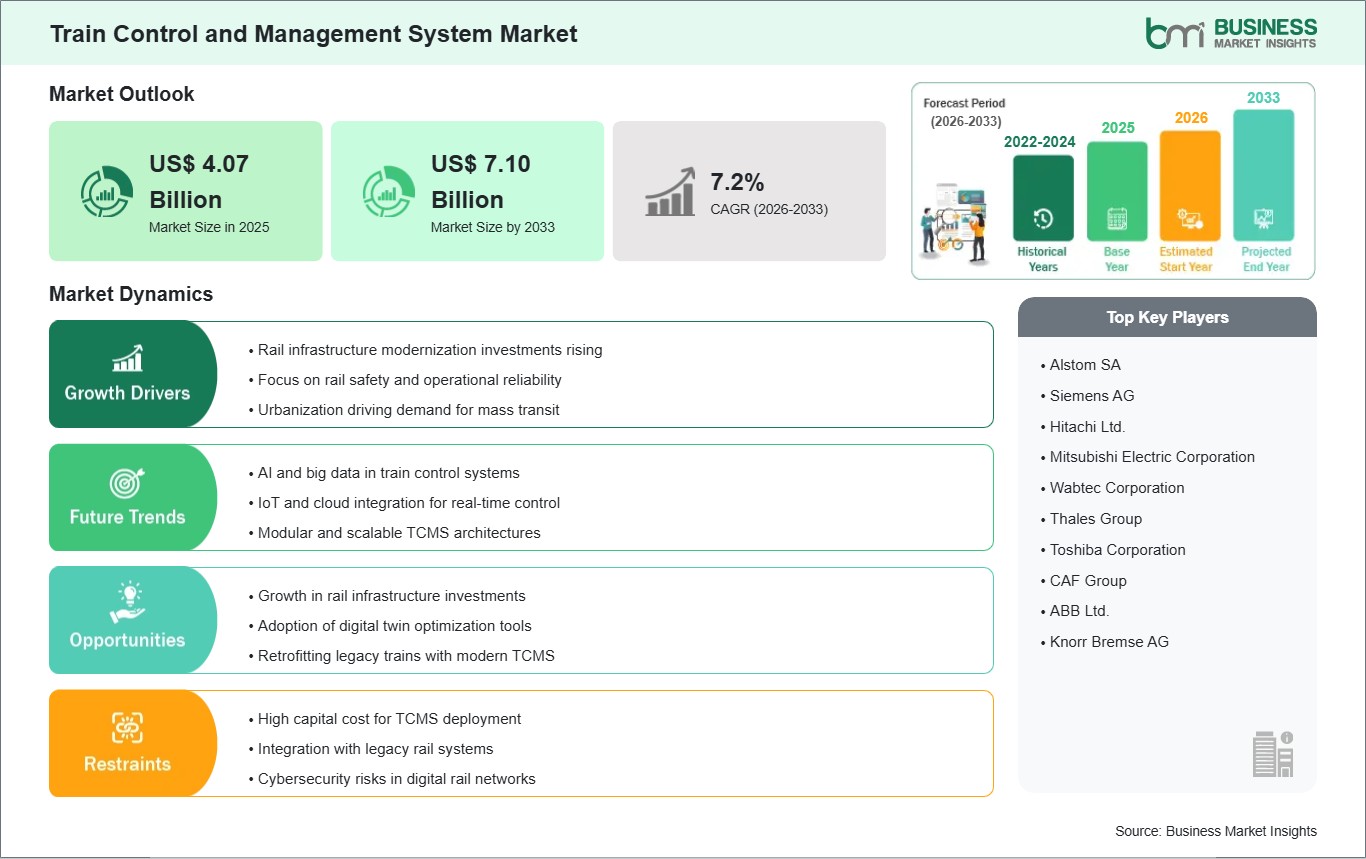
A Train Control and Management System (TCMS) serves as the centralized control and communication system for modern trains. It integrates and manages key onboard functions such as traction control, braking, doors, climate control (HVAC), and passenger information systems. Market growth is driven by global efforts toward rail electrification and decarbonization, the rapid expansion of driverless metro networks, and the adoption of AI-driven diagnostic tools. The transition to Ethernet-based architectures in new rolling stock is also enhancing data throughput and system interoperability.
However, several challenges can restrain market growth: high initial capital expenditure and the complexity of integrating modern TCMS with legacy signaling infrastructure remain major barriers for "brownfield" projects. Lack of global standardization in communication protocols can lead to interoperability issues across cross-border rail corridors, increasing operational costs. Additionally, the industry faces constraints due to cybersecurity vulnerabilities, as the move toward cloud-connected and IoT-enabled trains increases the risk of remote attacks on mission-critical control systems.
Despite these hurdles, the market holds immense opportunities in the universal mandate for smart mobility and the accelerating deployment of virtual coupling technology. The expansion of 5G-R (Railway) communication and the development of modular TCMS software, allowing for easier over-the-air (OTA) updates, are expected to create significant opportunities for market growth.
Segment Analysis
Train Control and Management System Market Segmentation
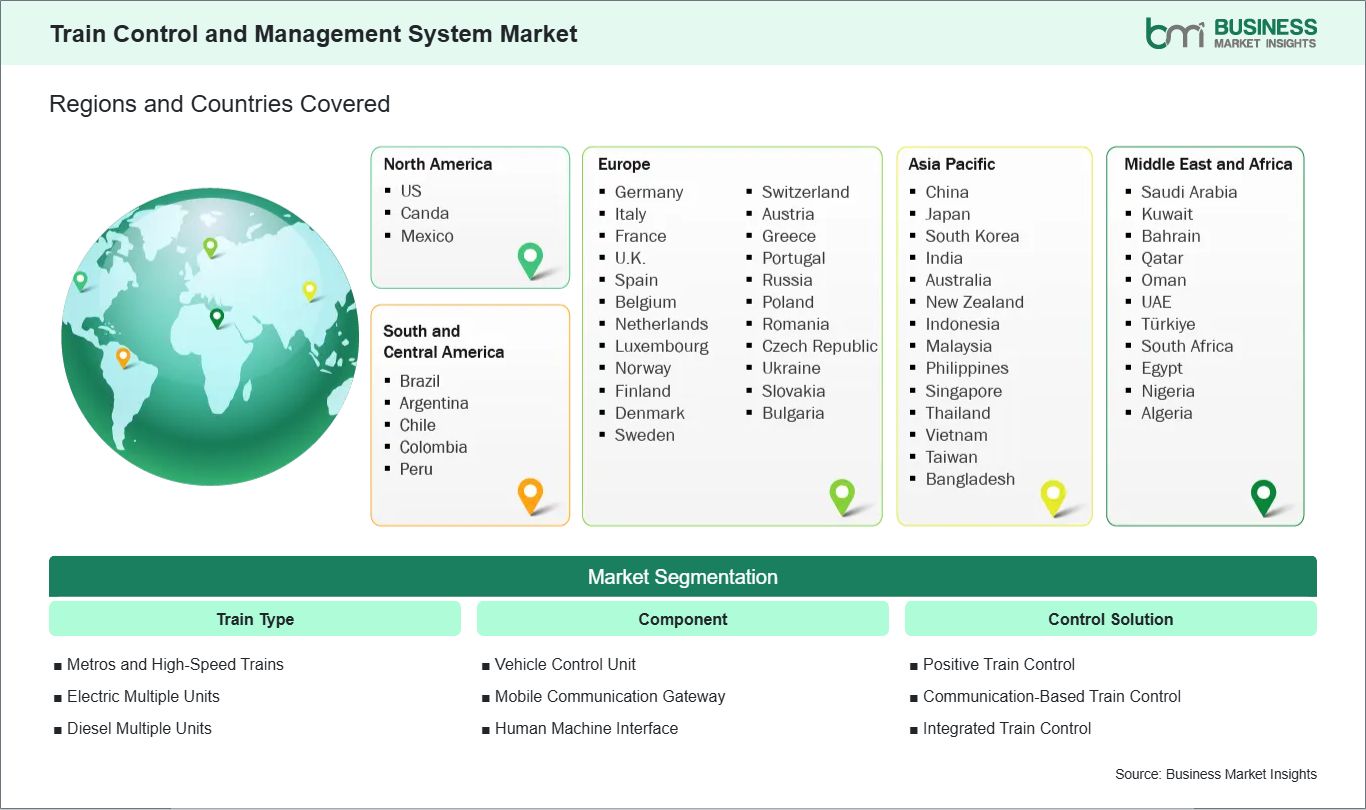
Key segments that contributed to the derivation of the Train Control and Management System market analysis are train type, component, and control solution.
- By Train Type, the market is segmented into Metros and High-Speed Trains, Electric Multiple Units, and Diesel Multiple Units.
- By Component, the market is divided into Vehicle Control Unit, Mobile Communication Gateway, and Human Machine Interface.
- By Control Solution, the market is categorized into Positive Train Control, Communication-Based Train Control, and Integrated Train Control.
Market Forces
Train Control and Management System Market Drivers and Opportunities
Advancing Rail Automation and High-Speed Transit Infrastructure
The primary driver for the Train Control and Management System (TCMS) Market is the accelerating global requirement for integrated rail automation and the expansion of high-speed transit networks. As of 2026, the market is characterized by a systemic transition toward autonomous train operations (Grades of Automation 2 - 4) and the modernization of legacy signaling systems. This demand is further amplified by rapid urbanization in emerging economies, specifically China, where massive capital expenditure is being allocated to metro and high-speed corridors to alleviate road congestion and meet net-zero carbon mandates. TCMS serves as the non-discretionary "brain" of the train, coordinating critical sub-systems such as braking, traction control, and passenger information. To ensure maximum operational reliability and safety, rail operators are aggressively adopting Communication-Based Train Control (CBTC) and European Rail Traffic Management System (ERTMS) standards. These technologies facilitate shorter headways and increased line capacity, which are essential for managing the record-high passenger volumes of the 2026 rail landscape.
AI-Driven Digital Twins and Cloud-Native Architectures
A significant high-value opportunity lies in the convergence of TCMS with AI-driven Digital Twin technology and predictive analytics. By creating a real-time virtual counterpart of the train’s control logic, operators can simulate stress scenarios and identify potential hardware failures before they result in service disruptions. There is also a major growth frontier in the adoption of Cloud-native TCMS architectures and IoT-connected rail networks. These systems allow for seamless, software-defined upgrades and centralized data orchestration, moving away from fragmented on-premise hardware. Furthermore, the rise of Integrated Multi-Modal Transportation presents a lucrative opportunity; TCMS platforms that can synchronize with broader smart city traffic management systems to provide "door-to-door" efficiency are highly sought after. Manufacturers who focus on cyber-resilient communication gateways and those pioneering modular, interoperable software stacks, allowing for the integration of diverse rolling stock fleets, are positioned to lead the most profitable segments of the global rail technology sector.
Size and Share Analysis
Train Control and Management System Market Size and Share Analysis
The Train Control and Management System market demonstrates steady growth, with size and share analysis revealing evolving trends and competitive positioning among key players. The report further examines subsegments categorized within train type, component, and control solution, offering insights into their contribution to overall market performance.
Based on train type, the Metros and High-Speed Trains subsegment holds a significant market position, serving as the industry benchmark for high-capacity, automated urban mobility. Metros and High-Speed Trains are indispensable for the Public Transit sector, where they provide the precise timing and rapid acceleration profiles required for high-frequency city services. A notable trend is the surge in the Electric Multiple Units (EMUs) subsegment, which is registering a higher CAGR as regional rail networks undergo aggressive electrification to replace aging diesel fleets. EMUs are becoming essential for suburban commuter lines, allowing for a strategic reduction in carbon emissions while offering superior reliability through distributed traction systems.
Report Coverage
Train Control and Management System Market Report Coverage and Deliverables
The "Train Control and Management System Market Size and Forecast (2022 - 2033)" report provides a detailed analysis of the market covering below areas:
- Train Control and Management System market size and forecast at global, regional, and country levels for all the key market segments covered under the scope
- Train Control and Management System market trends, as well as market dynamics such as drivers, restraints, and key opportunities
- Train Control and Management System market analysis covering key market trends, global and regional framework, major players, regulations, and recent market developments
- Industry landscape and competition analysis covering market concentration, heat map analysis, prominent players, and recent developments for the Train Control and Management System market
- Detailed company profiles, including SWOT analysis
Geographic Insights
Train Control and Management System Market Geographic Insights
The geographical scope of the Train Control and Management System market report is divided into five regions: North America, Asia Pacific, Europe, Middle East & Africa, and South & Central America.
The Asia-Pacific Train Control and Management System Market is segmented into China, Japan, South Korea, India, Australia, New Zealand, Indonesia, Malaysia, the Philippines, Singapore, Thailand, Vietnam, Taiwan, Bangladesh, and the Rest of Asia. In 2026, this region leads the world in new high-speed rail and metro projects. China and India are at the forefront, with substantial budget allocations for digitalizing their massive rail networks. Japan and South Korea continue to innovate in the development of sophisticated Vehicle Control Units (VCU) and human-machine interfaces, reinforcing the region's position as a technology leader in the "smart train" era.
Growth is further bolstered by a significant shift toward autonomous train operations (GoA 3 and GoA 4) and the integration of AI-driven predictive maintenance systems. The rising demand for real-time rail data analytics and IoT-connected networks, alongside the development of next-generation mobile communication gateways, solidifies Asia-Pacific as a critical hub for innovation and the future scaling of the Train Control and Management System industry.
Report Guidance
Train Control and Management System Market Report Guidance
The report includes qualitative and quantitative data in the Train Control and Management System market across train type, component, control solution, and geography.The report starts with the key takeaways (chapter 2), highlighting the key trends and outlook of the Train Control and Management System market.Chapter 3 includes the research methodology of the study.Chapter 4 further includes ecosystem analysis.Chapter 5 highlights the major industry dynamics in the Train Control and Management System market, including factors that are driving the market, prevailing deterrents, potential opportunities, as well as future trends. Impact analysis of these drivers and restraints is also covered in this section.Chapter 6 discusses the Train Control and Management System market scenario, in terms of historical market revenues, and forecast till the year 2033.Chapters 7 to 10 cover Train Control and Management System market segments by train type, component, control solution, and geography across North America, Europe, Asia Pacific, Middle East and Africa, and South and Central America. They cover the market revenue, forecast, and factors driving the market.Chapter 11 describes the competitive analysis along with the heat map analysis for the key players operating in the market.Chapter 12 describes the industry landscape analysis. It provides detailed descriptions of business activities such as market initiatives, new developments, mergers, and joint ventures globally, along with a competitive landscape.Chapter 13 provides detailed profiles of the major companies operating in the Train Control and Management System market. Companies have been profiled on the basis of their key facts, business descriptions, products and services, financial overview, SWOT analysis, and key developments.Chapter 14, i.e., the appendix, is inclusive of a brief overview of the company, list of abbreviations, and disclaimer.
Industry Activity
Recent Developments
The Train Control and Management System market is evaluated by gathering qualitative and quantitative data post primary and secondary research, which includes important corporate publications, association data, and databases. A few of the key developments in the Train Control and Management System market are:
- In January 2026, Railcare acquired the rights to Traversteknik’s proven radio control technology for locomotives, enabling it to offer a complete turnkey solution including product, installation, service, and support. The system enhances operational safety and efficiency, allowing locomotives to be controlled remotely while retaining key technical expertise for ongoing development.
- In January 2025, Hitachi Rail announced to acquire Omnicom, a leading digital rail monitoring company, strengthening its HMAX digital asset management platform. The acquisition integrates Omnicom’s AI-enabled trackside monitoring and predictive maintenance solutions, enhancing operational efficiency, safety, and reliability across rail infrastructure.
Trust & Transparency
Research Methodology
The market analysis combines proprietary research with secondary data from government agencies, company disclosures, regulatory filings, industry databases and expert interviews. Market estimates are validated through data triangulation, cross-market benchmarking and analyst
review.
View Full Research Methodology
Key Sources Referred:
World Bank - Global Trade IndicatorsWorld Trade Organization (WTO)International Monetary Fund (IMF)International Trade Administration (ITA)Company websiteCompany annual reportsCompany investor presentations