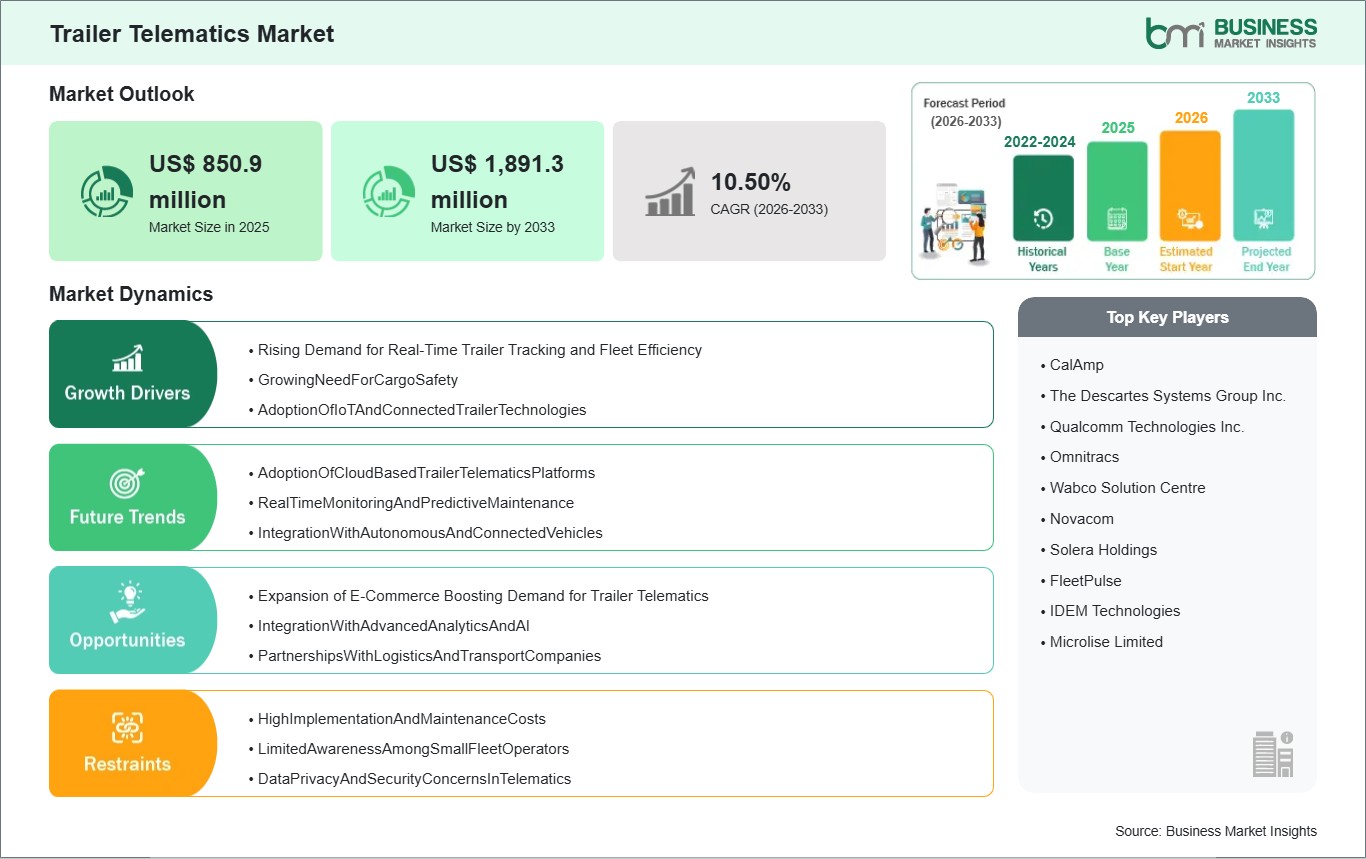
The Trailer Telematics Market size is expected to reach US$ 1,891.3 million by 2033 from US$ 850.9 million in 2025. The market is estimated to record a CAGR of 10.50% from 2026 to 2033.
The global trailer telematics market has developed from being merely a logistics tool into being a fundamental aspect of modern fleet management. It is defined as integrated communication technology used for gathering, transmitting, and analyzing data related to trailers in real-time, thus allowing stakeholders to gain visibility into trailer location, condition, utilization, and operational performance. The growth of the trailer telematics market is mainly attributed to the increased demand for supply chain efficiency, the rise of connected vehicles, and the trend towards intelligent supply chains in various industries such as retail, manufacturing, and transportation.
The increased pressure on supply chain operators, such as shippers and carriers, to optimize delivery times, reduce idle time, and improve safety compliance has made trailer telematics an essential investment for large and mid-sized fleets. The growth of the trailer telematics market is attributed to several factors, such as the move towards predictive rather than reactive fleet management. This allows asset managers to anticipate maintenance needs, reduce theft risks, and minimize downtime by providing them with more in-depth information about the trailer's status and surroundings.
Moreover, the integration of trailer telematics with wider fleet management solutions has created opportunities for new value propositions, such as route intelligence and fuel efficiency, to become integral parts of digital transformation strategies for logistics and transportation companies. Yet, the trailer telematics market faces some restraints. Inconsistencies in the technology space, with telematics system compatibility with existing or traditional enterprise resource planning (ERP) solutions being uneven, also pose challenges for widespread adoption. In addition, privacy and security risks of data being transmitted across networks, especially for traditional operators who may not have adequate cybersecurity solutions in place, also pose a degree of hesitation. While these challenges are being effectively mitigated through standardization and robust data privacy and security solutions, these challenges continue to influence adoption dynamics across the global space.
However, for the trailer telematics space, the long-term outlook appears positive as digital and autonomous vehicle paradigms converge.

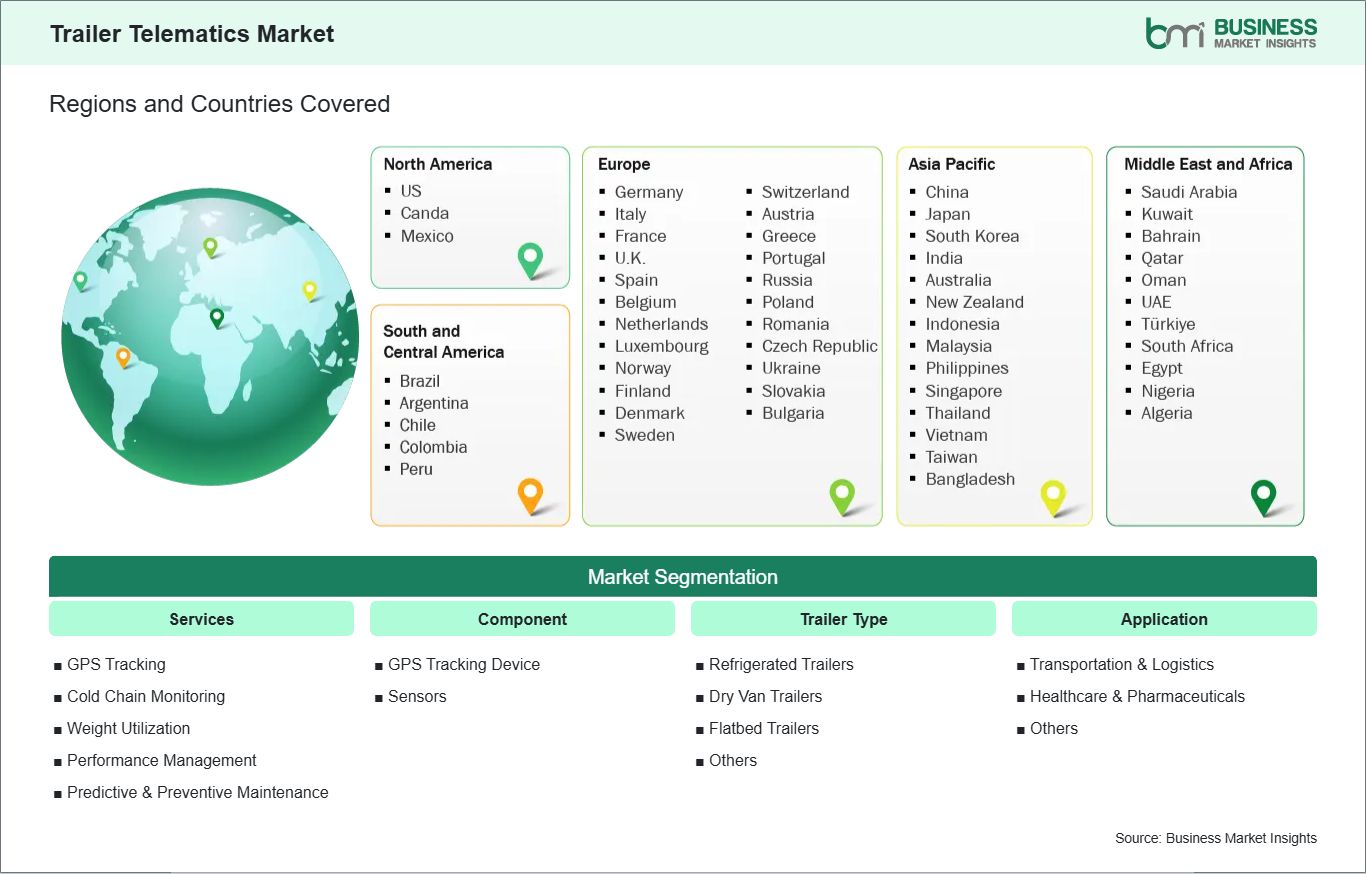
Key segments that contributed to the derivation of the trailer telematics market analysis are services, component, trailer type, application, and offering.
The global rise in real‑time trailer tracking reflects a broader shift in logistics toward total supply‑chain visibility. Fleet operators across continents are investing in trailer telematics systems that provide live location data, helping them eliminate blind spots between origin and destination points. This capability is especially crucial for multinational carriers that manage diverse routes and need consistent insights into trailer status regardless of regional differences in infrastructure maturity. Efficiency gains are also driving adoption, as telematics systems allow logistics managers to better allocate assets, reduce idle time, and synchronize trailer availability with cargo demand. In regions such as North America and Western Europe, where fleets operate across extensive highway networks, the ability to track trailers in real time has become an operational standard rather than a differentiator. These systems support dynamic routing decisions under varying traffic and weather conditions, enabling rapid response to disruptions that would otherwise delay delivery.
The expansion of e‑commerce worldwide has fundamentally reshaped freight movement patterns, placing new emphasis on trailer telematics as a tool for managing rapid delivery cycles. Retailers and logistics service providers are under pressure to meet customer expectations for speedy, reliable delivery, prompting investment in advanced telematics solutions that support precise scheduling and asset monitoring.
As e‑commerce demand grows in Asia Pacific, Europe, and North America, telematics systems are becoming vital for tracking trailers that support fulfillment hubs and last‑mile delivery networks. In emerging markets, expanding online retail penetration has led to shifts in inventory strategies and freight flows. Companies operating in South and Central America, the Middle East, and Africa are increasingly adopting telematics to bridge gaps between distribution centers and end markets. These systems help companies respond to fluctuating demand patterns, ensuring trailers are dispatched efficiently and that delivery commitments are met despite regional logistics challenges.
The trailer telematics market demonstrates steady growth, with size and share analysis highlighting evolving trends and competitive dynamics among key players. The report examines subsegments categorized within services, component, trailer type, application, and offering, offering insights into their contribution to overall market performance.
By services, the GPS Tracking subsegment dominated the market in 2025, driven by its essential role in providing real-time location monitoring and fleet visibility.
Based on component, the Hardware subsegment dominated the market in 2025, driven by the need for reliable sensors and trackers to collect and transmit trailer data.
Based on trailer type, the Dry Van Trailers subsegment dominated the market in 2025, driven by their widespread use in general freight transport across industries.
On the basis of application, the Transportation & Logistics (Fleet Management) subsegment dominated the market in 2025, driven by the high demand for operational efficiency and route optimization in fleet operations.
In terms of offering, the Aftermarket subsegment dominated the market in 2025, driven by the preference for retrofitting existing trailers with telematics solutions.
| Report Attribute | Details |
|---|---|
| Market size in 2025 | US$ 850.9 million |
| Market Size by 2033 | US$ 1,891.3 million |
| Global CAGR (2026 - 2033) | 10.50% |
| Historical Data | 2022-2024 |
| Forecast period | 2026-2033 |
| Segments Covered | By Services
|
|
Regions and Countries Covered
| |
| North America | US, Canada, Mexico |
| Europe | Belgium, Austria, Finland, Denmark, Greece, Poland, Romania, Russia, Ukraine, Czech Republic, Slovakia, Bulgaria, Italy, Luxembourg, Germany, Switzerland, France, Netherlands, Norway, Portugal, Spain, Sweden, United Kingdom |
| Asia-Pacific | Australia, China, India, Japan, South Korea, Indonesia, Malaysia, Philippines, Singapore, Thailand, Vietnam, Bangladesh, New Zealand, Taiwan |
| South and Central America | Brazil, Argentina, Peru, Chile, Colombia |
| Middle East and Africa | Bahrain, Kuwait, Oman, Qatar, Saudi Arabia, United Arab Emirates, Turkiye, South Africa, Egypt, Algeria, Nigeria |
| Market leaders and key company profiles |
|
The "Trailer Telematics Market Size and Forecast (2022 - 2033)" report provides a detailed analysis of the market covering below areas:
The geographical scope of the Trailer Telematics Market report is divided into North America, Asia Pacific, Europe, Middle East & Africa, and South & Central America. North America held the largest share in 2025.
The Trailer Telematics Market has seen considerable regional diversity, with North America being identified as the leading market owing to its advanced logistics infrastructure, large commercial fleets, and early adoption of connected vehicle services. In this market, trailer tracking, maintenance, and overall operation are given prime importance by fleet owners, with a large number of solution providers, regulatory needs, and demand for efficiency in long-haul and refrigerated transport.
Europe is another prominent market that has seen considerable growth, owing to stringent safety and environmental regulations, established international transport corridors, and growing adoption of intelligent logistics services. Countries such as Germany, France, and the UK are leading this segment with respect to telematics adoption in cargo transport, route planning, and regulatory requirements.
The Asia Pacific is another growing market that has seen considerable growth owing to the rise of e-commerce, urban logistics, and industrial transport in countries such as China, India, Japan, and others, with government initiatives promoting intelligent transport systems, but with a restraining influence due to regional disparities in infrastructure and adoption rates.
The South & Central America region is slowly but steadily warming up to trailer telematics solutions, with increased interest coming in from logistics firms that are looking to optimize their trailer utilization and prevent trailer theft and cargo loss. However, the market is growing at a slower pace in this region due to the variable economy and infrastructure.
The Middle East & Africa is an emerging market that is growing in the trailer telematics industry, with the main driver being the need to improve international transportation, monitor temperature-controlled cargo, and improve asset utilization in logistics corridors such as the UAE, Saudi Arabia, and South Africa. Thus, the overall global scenario is such that North America is at the forefront in trailer telematics adoption and utilization, followed by Europe and Asia Pacific, which are catching up with increased interest in trailer telematics solutions.
South & Central America and the Middle East & Africa are emerging markets that are benefiting from the modernization of logistics and increased awareness of the benefits of trailer telematics.

The Trailer Telematics Market is evaluated by gathering qualitative and quantitative data post primary and secondary research, which includes important corporate publications, association data, and databases. A few of the key developments in the trailer telematics market are:
The Trailer Telematics Market is valued at US$ 850.9 million in 2025, it is projected to reach US$ 1,891.3 million by 2033.
As per our report Trailer Telematics Market, the market size is valued at US$ 850.9 million in 2025, projecting it to reach US$ 1,891.3 million by 2033. This translates to a CAGR of approximately 10.50% during the forecast period.
The Trailer Telematics Market report typically cover these key segments-
The historic period, base year, and forecast period can vary slightly depending on the specific market research report. However, for the Trailer Telematics Market report:
The Trailer Telematics Market is populated by several key players, each contributing to its growth and innovation. Some of the major players include:
The Trailer Telematics Market report is valuable for diverse stakeholders, including:
Essentially, anyone involved in or considering involvement in the Trailer Telematics Market value chain can benefit from the information contained in a comprehensive market report.
Please tell us your area of interest
(Market Segments/ Regions and Countries/ Companies)