Traffic Sensor Market Outlook (2022-2033)

Historic Data: 2022-2024   |   Base Year: 2025   |   Forecast Period: 2026-2033
Report Content: Market Scope, Market Segmentation, Market Dynamics, and Competitive Analysis

Report Coverage:
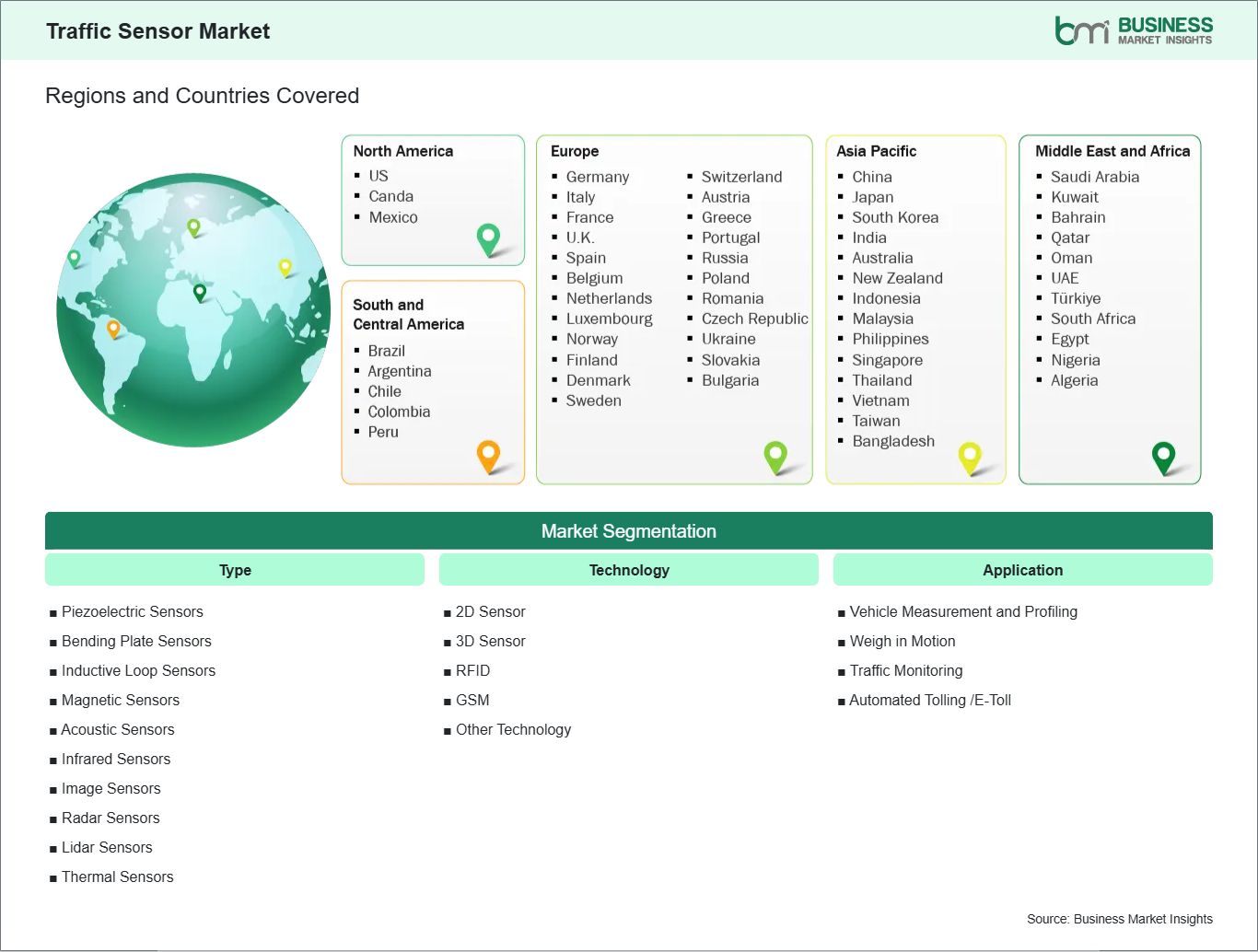
  • Type (Piezoelectric Sensors, Bending Plate Sensors, Inductive Loop Sensors, Magnetic Sensors, Acoustic Sensors, Infrared Sensors, Image Sensors, Radar Sensors, Lidar Sensors, Thermal Sensors)
  • Technology (2D Sensor, 3D Sensor, RFID, GSM, Other Technology)
  • Application (Vehicle Measurement and Profiling, Weigh in Motion, Traffic Monitoring, Automated Tolling /E-Toll)

No. of Pages: 386
Report Code: BMIPUB00034542
Category: Electronics and Semiconductor
Traffic Sensor Market

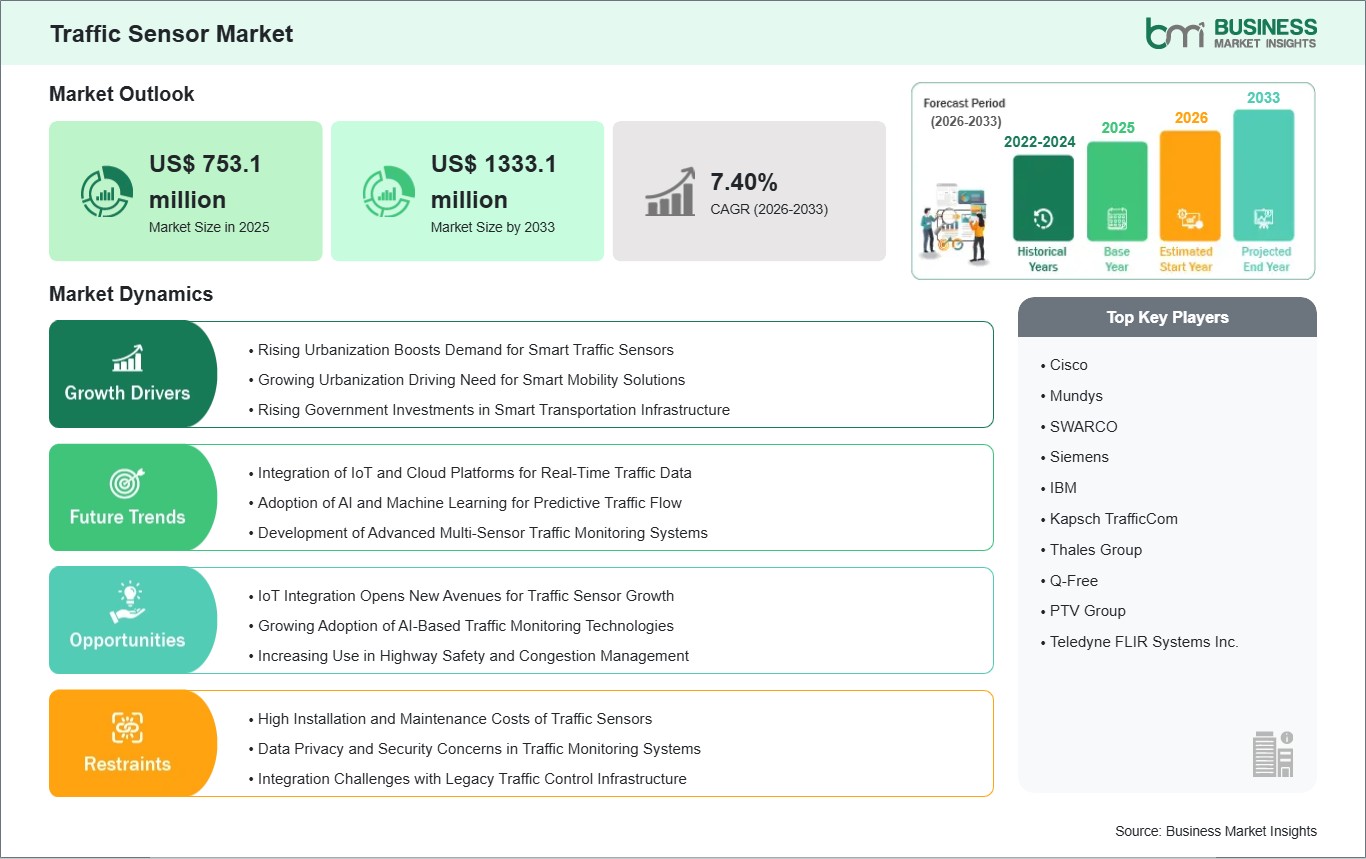
The Traffic Sensor Market size is expected to reach US$ 1,333.1 million by 2033 from US$ 753.1 million in 2025. The market is estimated to record a CAGR of 7.40% from 2026 to 2033.

Executive Summary and Global Market Analysis:

The global traffic sensor market is in a phase of revolutionary growth due to the increasing demand for smart, safe, and efficient transportation systems across the globe. Traffic sensors, such as inductive loops, radar, LiDAR, infrared, magnetic, and video, are playing a vital role in monitoring and controlling traffic flow, handling congestion, detecting accidents, and incorporating intelligent transportation systems. With urbanization and rapid growth in urban areas, there is unprecedented pressure on existing infrastructure. Thus, there is a pressing need for advanced sensor systems to ensure efficient traffic management and road safety. With various governments and local authorities investing in smart cities, there is a focus on infrastructure that allows real-time monitoring and control. Thus, traffic sensors are becoming vital components in urban areas. Technological advancements in incorporating Internet of Things, edge computing, and AI-based analytics are being used in traffic sensors to ensure more efficient and effective traffic management. Environmental factors are also playing a vital role in driving this market. With sensor systems, idle times and fuel consumption are being minimized, resulting in a greener environment.

However, the market is also facing certain challenges, which include the high cost of deploying advanced sensor networks and the complexity of integrating the new technology with existing infrastructure. In addition, issues of data privacy, cybersecurity, and regional regulatory environments may also affect the market's acceptance. Nonetheless, the global market for traffic sensors has great prospects for growth, as the need for mobility in cities will continue to rise, making it essential to have this technology in place to support the development of intelligent transportation systems.

Traffic Sensor Market - Strategic Insights:

global-market-strategic-framework
Get more information on this report

Traffic Sensor Market Segmentation Analysis:

Key segments that contributed to the derivation of the traffic sensor market analysis are type, technology and application.

  • By type, the traffic sensor market is segmented into piezoelectric sensors, bending plate sensors, inductive loop sensors, magnetic sensors, acoustic sensors, infrared sensors, image sensors, radar sensors, lidar sensors, thermal sensors. The image sensors segment dominated the market in 2025.
  • Based on technology, the traffic sensor market is categorized into 2D sensor, 3D sensor, RFID, GSM, other technology. The 2D sensor segment dominated the market in 2025.
  • In terms of application, the traffic sensor market is categorized into vehicle measurement and profiling, weigh in motion, traffic monitoring, automated tolling /e-toll. The traffic monitoring segement dominated the market in 2025.

Traffic Sensor Market Drivers and Opportunities:

Rising Urbanization Boosts Demand for Smart Traffic Sensors

Urbanization is a key driver for traffic sensor adoption across the globe. In North America, metropolitan areas such as New York, Toronto, and Los Angeles are upgrading intersections with radar, video, and wireless sensors to improve traffic flow and reduce congestion. Smart City initiatives in cities like Austin and Seattle integrate these sensors with broader mobility frameworks, enhancing real-time monitoring and adaptive signal control. Similarly, European cities including London, Paris, and Berlin are using traffic sensors not only to manage vehicle flow but also to support emission control strategies, combining mobility and sustainability objectives. In the Asia Pacific, megacities like Shanghai, Seoul, Mumbai, and Jakarta face rising vehicle ownership and congested roads. Municipalities are deploying digital detection tools and multi-modal sensors to improve traffic responsiveness and support adaptive signal systems.

Meanwhile, in Latin America (São Paulo, Mexico City) and Middle East & Africa (Dubai, Riyadh), urban expansion is driving the replacement of legacy loop detectors with video and wireless sensors. Even in emerging African cities, basic sensor deployment is laying the foundation for future intelligent traffic systems. Across all regions, urban growth is creating a pressing need for real-time, data-driven traffic management.

IoT Integration Opens New Avenues for Traffic Sensor Growth

The integration of IoT is enhancing traffic sensor capabilities worldwide by enabling connected, data-rich transportation networks. In North America, traffic sensors are linked to IoT platforms for predictive analytics, adaptive signal control, and real-time monitoring. European cities are similarly connecting sensors with public transit systems and environmental monitoring networks, optimizing traffic flow and reducing congestion while supporting multi-modal mobility. In the Asia Pacific, IoT-enabled sensors are being deployed in Japan, South Korea, and China to feed real-time traffic data into AI-powered management centers. These networks also integrate with vehicle-to-infrastructure systems, providing drivers with dynamic route suggestions. Southeast Asian countries are adopting low-power wide-area network (LPWAN) sensors for scalable, cost-efficient deployments.

In Latin America and MEA, IoT traffic sensors are improving operational efficiency by supporting remote monitoring and asset management. Brazilian and Mexican cities use connected sensors to analyze traffic patterns, while Dubai and Riyadh integrate IoT sensors with smart highways, dynamic lighting, and driver information systems. In emerging African regions, pilot IoT-based sensor networks provide a foundation for future smart city expansions, linking traffic management with urban planning initiatives.

Traffic Sensor Market Size and Share Analysis:

The traffic sensor market demonstrates steady growth, with size and share analysis highlighting evolving trends and competitive dynamics among key players. The report examines subsegments categorized within type, technology and application, offering insights into their contribution to overall market performance.

By type, the image sensors subsegment dominated the market in 2025, driven by their high sensitivity and ability to capture detailed traffic data under varying light and weather conditions.

Based on technology, the 2D sensor subsegment dominated the market in 2025, driven by its widespread adoption, cost-effectiveness, and reliable performance in conventional traffic monitoring systems.

Based on application, the traffic monitoring subsegment dominated the market in 2025, driven by the the critical need for real-time vehicle flow, congestion management, and optimized traffic signal control.

Traffic Sensor Market Report Highlights:

Report Attribute Details
Market size in 2025 US$ 753.1 million
Market Size by 2033 US$ 1333.1 million
Global CAGR (2026 - 2033)7.40%
Historical Data 2022-2024
Forecast period 2026-2033
Segments Covered By Type
  • Piezoelectric Sensors
  • Bending Plate Sensors
  • Inductive Loop Sensors
  • Magnetic Sensors
  • Acoustic Sensors
  • Infrared Sensors
  • Image Sensors
  • Radar Sensors
  • Lidar Sensors
  • Thermal Sensors
By Technology
  • 2D Sensor
  • 3D Sensor
  • RFID
  • GSM
  • Other Technology
By Application
  • Vehicle Measurement and Profiling
  • Weigh in Motion
  • Traffic Monitoring
  • Automated Tolling /E-Toll
Regions and Countries Covered
North America US, Canada, Mexico
Europe Belgium, Austria, Finland, Denmark, Greece, Poland, Romania, Russia, Ukraine, Czech Republic, Slovakia, Bulgaria, Italy, Luxembourg, Germany, Switzerland, France, Netherlands, Norway, Portugal, Spain, Sweden, United Kingdom
Asia-Pacific Australia, China, India, Japan, South Korea, Indonesia, Malaysia, Philippines, Singapore, Thailand, Vietnam, Bangladesh, New Zealand, Taiwan
South and Central America Brazil, Argentina, Peru, Chile, Colombia
Middle East and Africa Bahrain, Kuwait, Oman, Qatar, Saudi Arabia, United Arab Emirates, Turkiye, South Africa, Egypt, Algeria, Nigeria
Market leaders and key company profiles
  • Cisco
  • Mundys
  • SWARCO
  • Siemens
  • IBM
  • Kapsch TrafficCom
  • Thales Group
  • Q-Free
  • PTV Group
  • Teledyne FLIR Systems Inc.
Get more information on this report

Traffic Sensor Market Report Coverage and Deliverables:

The "Traffic Sensor Market Size and Forecast (2022 - 2033)" report provides a detailed analysis of the market covering below areas:

  • Traffic Sensor Market size and forecast at global, regional, and country levels for all the key market segments covered under the scope
  • Traffic Sensor Market trends, as well as drivers, restraints, and opportunities
  • Traffic Sensor Market analysis covering key trends, global and regional framework, major players, regulations, and recent developments
  • Industry landscape and competition analysis covering market concentration, heat map analysis, prominent players, and recent developments for the Traffic Sensor Market
  • Detailed company profiles, including SWOT analysis

Traffic Sensor Market Geographic Insights:

The geographical scope of the Traffic Sensor Market report is divided into North America, Asia Pacific, Europe, Middle East & Africa, and South & Central America. North America held the largest share in 2025.

The global market for traffic sensors is expanding at a healthy rate, and the region leading this growth is North America, followed by Europe. The growth in the region is attributed to the increasing smart city initiatives, high adoption rates for ITS, and significant investments by governments in infrastructure for managing traffic. The United States and Canada are the major contributors to the growth in the region due to the high adoption rates for inductive loop detectors, radar, LiDAR, and video sensors for enhancing road safety.

The European region is the next major growth contributor, attributed to the stringent regulations for enhancing road safety, emission control, and the increasing adoption rates for connected vehicle technology in countries such as Germany, the UK, and France.

The Asia-Pacific region is also experiencing significant growth due to the increasing need for smart city initiatives, high rates of urbanization, and increasing ownership rates for vehicles in countries such as China, Japan, India, and Korea, which are driving the need for high-end traffic sensors compatible with IoT and V2X technology.

Meanwhile, the Middle East & Africa market is growing steadily with increasing investment in urban development schemes and highway up-gradation initiatives of countries such as the UAE,

Saudi Arabia, and South Africa. However, the adoption of traffic sensor technology is moderate in this region due to infrastructural issues. The South & Central America market is growing steadily, with countries such as Brazil, Mexico, and Argentina focusing on addressing issues such as traffic congestion within cities and improving public transportation infrastructure. However, the adoption of traffic sensor technology is slow when compared to other regions. In conclusion, the North American market will be the major contributor to the growth of the global traffic sensor market due to its leadership in technology, support for technology adoption through policies, and the high level of infrastructure development.

The European and Asia-Pacific markets will be the secondary contributors to the growth of the global market, while the Middle East & Africa and South & Central America markets will be emerging markets due to increasing adoption of smart cities.

global-market-geography
Get more information on this report

Traffic Sensor Market Research Report Guidance:

  • The report includes qualitative and quantitative data in the Traffic Sensor Market across type, technology, application and geography.
  • The report starts with the key takeaways (chapter 2), highlighting key trends and outlook of the Traffic Sensor Market.
  • Chapter 3 focuses on the research methodology of the study.
  • Chapter 4 includes ecosystem analysis.
  • Chapter 5 highlights the major industry dynamics in the Traffic Sensor Market, including factors that are driving the market, prevailing deterrents, potential opportunities, as well as future trends. Impact analysis of these drivers and restraints is also covered in this section.
  • Chapter 6 discusses the Traffic Sensor Market scenario, in terms of historical market revenues, and forecast till the year 2033.
  • Chapters 7 to 10 cover Traffic Sensor Market segments by type, technology, application and geography across North America, Asia Pacific, Europe, Middle East & Africa, and South & Central America. They cover the market revenue forecast and factors driving the market.
  • Chapter 11 describes the competitive analysis along with the heat map analysis for the key players operating in the market.
  • Chapter 12 describes the industry landscape analysis. It provides detailed descriptions of business activities such as market initiatives, new developments, mergers, and joint ventures globally, along with a competitive landscape.
  • Chapter 13 provides detailed profiles of the major companies operating in the Traffic Sensor Market. Companies have been profiled on the basis of their key facts, business descriptions, products, financial overview, SWOT analysis, and key developments.
  • Chapter 14, i.e., the appendix, is inclusive of a brief overview of the company, a list of abbreviations, and a disclaimer.

Traffic Sensor Market News and Key Development:

The Traffic Sensor Market is evaluated by gathering qualitative and quantitative data post primary and secondary research, which includes important corporate publications, association data, and databases. A few of the key developments in the traffic sensor market are:

  • In August 2025, Sensys Networks announced that it launched its MultiSens Intersection platform, the industry’s first unified traffic detection system that combines AI‑powered video analytics with wireless sensor technologies in a single solution to improve accuracy for traffic signal actuation and intersection analysis unveiled at the International Municipal Signal Association (IMSA) World Congress.
  • In January 2025, Ouster, Inc. announced that its BlueCity traffic management solution was selected in a U.S. deployment to create the largest LiDAR‑enabled smart traffic network in the United States. This deployment integrates digital lidar sensors and edge AI at intersections to manage traffic flow, detect safety incidents, and deliver advanced detection analytics.

Key Sources Referred:

  • World Health Organization (WHO)
  • Organisation for Economic Cooperation and Development (OECD)
  • The World Bank Group
  • Worldometer
  • The Lancet
  • International Bar Association
  • International Trade Administration
The List of Companies - Traffic Sensor Market
  • Cisco
  • Mundys
  • SWARCO
  • Siemens
  • IBM
  • Kapsch TrafficCom
  • Thales Group
  • Q-Free
  • PTV Group
  • Teledyne FLIR Systems Inc.
Frequently Asked Questions
How big is the Traffic Sensor Market?

The Traffic Sensor Market is valued at US$ 753.1 million in 2025, it is projected to reach US$ 1333.1 million by 2033.

What is the CAGR for Traffic Sensor Market by (2026 - 2033)?

As per our report Traffic Sensor Market, the market size is valued at US$ 753.1 million in 2025, projecting it to reach US$ 1333.1 million by 2033. This translates to a CAGR of approximately 7.40% during the forecast period.

What segments are covered in this report?

The Traffic Sensor Market report typically cover these key segments-

  • Type (Piezoelectric Sensors, Bending Plate Sensors, Inductive Loop Sensors, Magnetic Sensors, Acoustic Sensors, Infrared Sensors, Image Sensors, Radar Sensors, Lidar Sensors, Thermal Sensors)
  • Technology (2D Sensor, 3D Sensor, RFID, GSM, Other Technology)
  • Application (Vehicle Measurement and Profiling, Weigh in Motion, Traffic Monitoring, Automated Tolling /E-Toll)

What is the historic period, base year, and forecast period taken for Traffic Sensor Market?

The historic period, base year, and forecast period can vary slightly depending on the specific market research report. However, for the Traffic Sensor Market report:

  • Historic Period : 2022-2024
  • Base Year : 2025
  • Forecast Period : 2026-2033
  • Who are the major players in Traffic Sensor Market?

    The Traffic Sensor Market is populated by several key players, each contributing to its growth and innovation. Some of the major players include:

  • Cisco
  • Mundys
  • SWARCO
  • Siemens
  • IBM
  • Kapsch TrafficCom
  • Thales Group
  • Q-Free
  • PTV Group
  • Teledyne FLIR Systems Inc.
  • Who should buy this report?

    The Traffic Sensor Market report is valuable for diverse stakeholders, including:

    • Investors: Provides insights for investment decisions pertaining to market growth, companies, or industry insights. Helps assess market attractiveness and potential returns.
    • Industry Players: Offers competitive intelligence, market sizing, and trend analysis to inform strategic planning, product development, and sales strategies.
    • Suppliers and Manufacturers: Helps understand market demand for components, materials, and services related to concerned industry.
    • Researchers and Consultants: Provides data and analysis for academic research, consulting projects, and market studies.
    • Financial Institutions: Helps assess risks and opportunities associated with financing or investing in the concerned market.

    Essentially, anyone involved in or considering involvement in the Traffic Sensor Market value chain can benefit from the information contained in a comprehensive market report.

    Available Report Formats

    pdf-format excel-format pptx-format
    Buy Now
    Sales Assistance
    +1 646 791 7070 (US & UK)
    Customization Form

    Please tell us your area of interest
    (Market Segments/ Regions and Countries/ Companies)