
Traction Inverter Market Outlook: Size, Share, Trends, Growth Analysis, Competitive Landscape & Forecast, 2026-2033

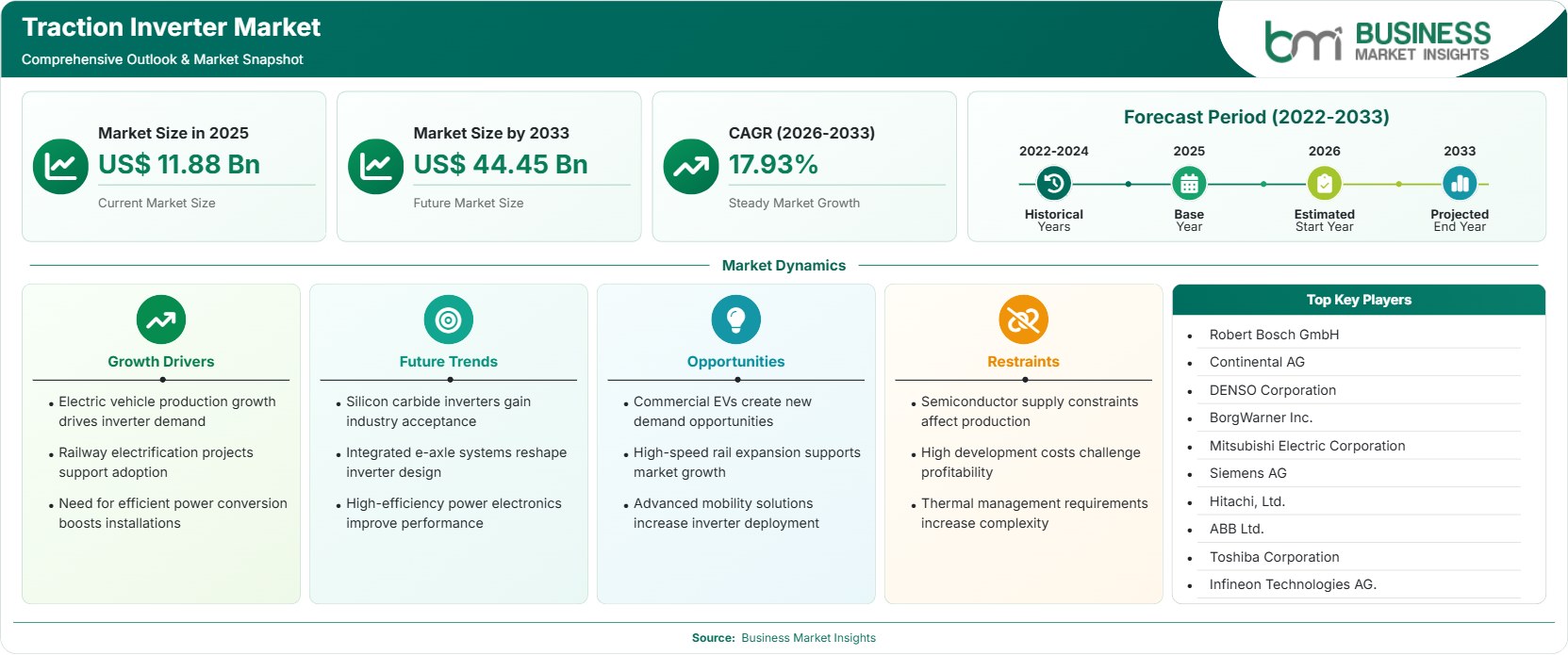
The Traction Inverter Market size was valued at US$ 11.88 Billion in 2025 and is projected to reach US$ 44.45 Billion by 2033, growing at a CAGR of 17.93% during 2026–2033, driven by accelerating EV adoption, silicon-carbide power electronics integration, high-voltage platform deployment, and expanding electrified rail investments creating strong technology upgrade opportunities.

Report Coverage
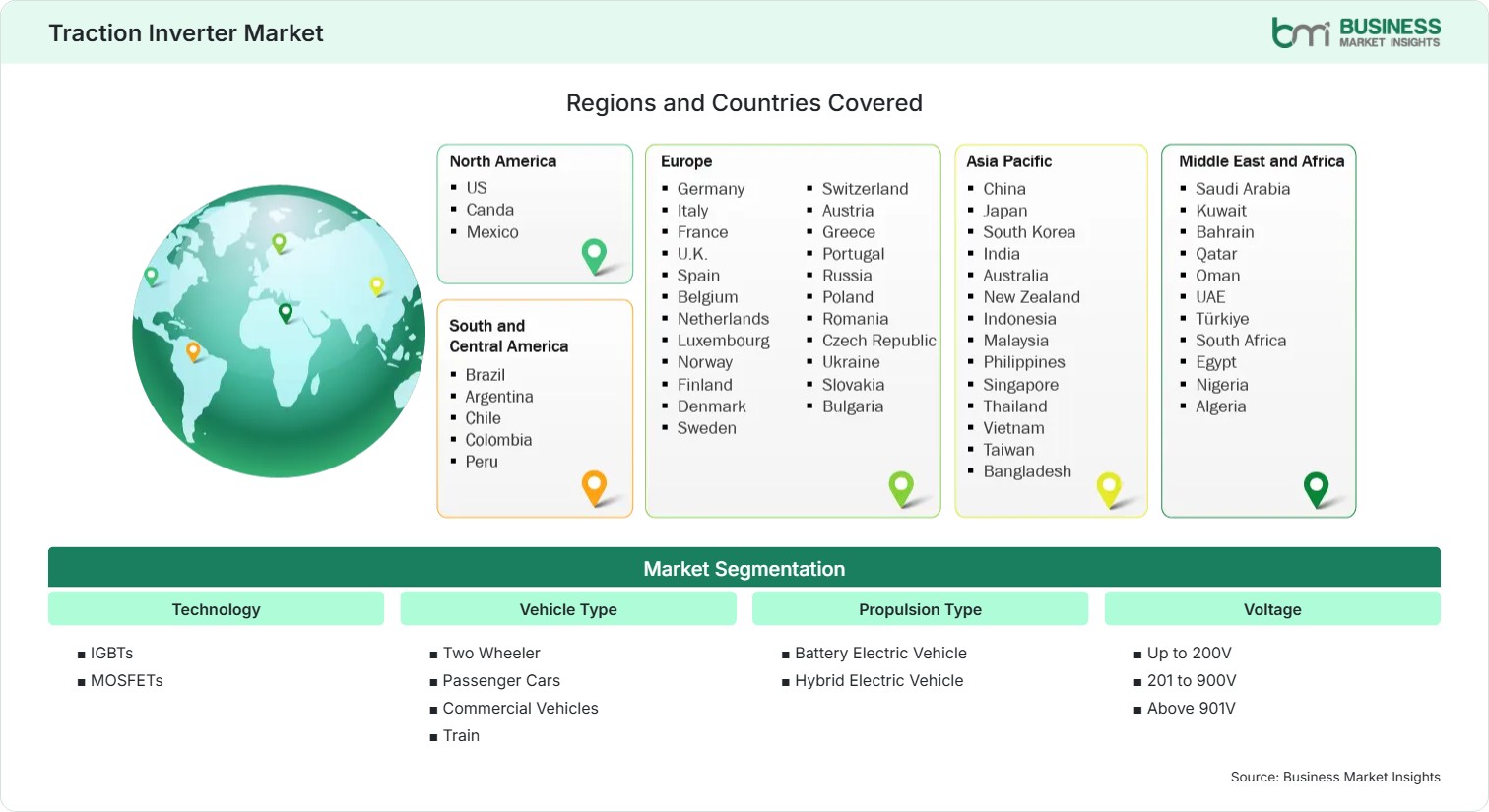
  • Technology: IGBTs, MOSFETs
  • Vehicle Type: Two Wheeler, Passenger Cars, Commercial Vehicles, Train
  • Propulsion Type: Battery Electric Vehicle, Hybrid Electric Vehicle
  • Voltage: Up to 200V, 201 to 900V, Above 901V
US$ 11.88 Bn Market size in 2025
US$ 44.45 Bn Market Size by 2033
17.93% CAGR, 2026 - 2033
2026-2033 Forecast Period

AI Overview

Traction Inverter Market Summary

  • North America Region: Holds a 22%–25% share in 2025, growing at a CAGR of 15%–17% during 2026–2033. Demand is supported by EV manufacturing localization, semiconductor investments, charging infrastructure expansion, fleet electrification programs, and rail modernization. The U.S. benefits from domestic power electronics production and EV platform development, advancing at an estimated 16%–18% CAGR.
  • Fastest Growing Region: Asia Pacific accounts for 44%–47% share in 2025 and expands at 19%–21% CAGR through 2033. Growth stems from China-led EV production, battery investments, silicon-carbide adoption, government incentives, and growing electrified mobility ecosystems.
  • Leading Segment: Battery Electric Vehicle (BEV) represents 66%–69% share in 2025 with a CAGR of 18%–20%. Strong demand for high-efficiency propulsion systems, premium range performance, and high-voltage architectures supports continued adoption across global vehicle platforms.
  • High Growth Segment: Above 901V voltage systems account for 10%–13% share in 2025 while advancing at 22%–24% CAGR. OEM migration toward ultra-fast charging and efficiency improvement drives segment expansion.
  • Key Market Opportunity: Rising adoption of silicon-carbide traction inverters in commercial vehicles, heavy-duty mobility, and next-generation passenger EVs creates opportunities for efficiency gains, thermal optimization, and premium product differentiation.
  • Major Market Players: Robert Bosch GmbH, Continental AG, DENSO Corporation, BorgWarner Inc., Mitsubishi Electric Corporation, Siemens AG, Hitachi, Ltd., ABB Ltd., Toshiba Corporation, Infineon Technologies AG.
Strategic Insights

Traction Inverter Market: Strategic Insights

Traction Inverter Market Strategic Framework
FREE PDF
Request your free sample
Request free sample
Stakeholder View

Key Takeaways

  • The value chain increasingly integrates semiconductor suppliers, inverter manufacturers, e-axle developers, battery producers, and vehicle OEMs, creating tighter technology collaboration requirements.
  • High-voltage passenger EVs and commercial electric fleets offer the strongest revenue upside because efficiency gains translate directly into vehicle range improvement.
  • Silicon-carbide power modules are reshaping product design by reducing energy losses, enabling compact architectures, and supporting higher switching frequencies.
  • China, India, and Southeast Asia provide compelling investment opportunities owing to manufacturing expansion, government incentives, and increasing electrified mobility adoption.
  • Strategic acquisitions and technology partnerships are focusing on power electronics, thermal management systems, and integrated drivetrain solutions.
  • Rail electrification programs are creating a complementary demand stream beyond automotive applications, improving market diversification.
Geographic Outlook

Traction Inverter Market Regional Highlights

North America Traction Inverter Market

North America represents approximately 22%–25% of global revenue in 2025 and is expected to grow at 15%–17% CAGR through 2033. The region benefits from EV assembly investments, supportive industrial policies, and accelerating electrification among commercial vehicle operators. The Traction Inverter Market share remains supported by domestic semiconductor capacity expansion and battery manufacturing projects. Adoption of advanced silicon-carbide systems is increasing among leading OEMs seeking vehicle efficiency improvements and reduced powertrain losses.

  • U.S. and Canada continue investing in localized EV supply chains and advanced power electronics manufacturing.
  • Commercial fleet electrification accelerates demand for robust high-power inverter platforms.
  • Silicon-carbide adoption improves drivetrain efficiency and charging performance.
  • Rail modernization initiatives generate incremental demand for traction technologies.
  • Automotive OEM partnerships enhance regional technology commercialization.

US Traction Inverter Market

The U.S. accounts for roughly 78%–82% of North American revenue and is projected to advance at 16%–18% CAGR. Strong domestic EV production, battery investments, and electrification policies sustain demand. The region demonstrates increasing deployment of integrated drive units combining motors, power electronics, and thermal-management solutions. Advanced manufacturing incentives support local component sourcing while technology suppliers expand research and development activities.

  • Large-scale EV assembly facilities continue strengthening domestic traction electronics demand.
  • Commercial truck electrification expands inverter deployment across logistics applications.
  • Semiconductor investments improve supply-chain resilience and production capacity.
  • Growing charging infrastructure supports adoption of high-voltage vehicle platforms.

Europe Traction Inverter Market

Europe holds a 24%–27% share in 2025 and is expected to grow at 16%–18% CAGR through 2033. Decarbonization targets, stringent emissions regulations, and EV adoption support regional demand. Germany leads regional revenue generation, while Eastern European manufacturing hubs demonstrate faster expansion. Demand remains strong across passenger EVs, rail transportation, and commercial mobility platforms using advanced power electronics architectures.

  • Germany leads deployment supported by automotive engineering capabilities.
  • France and the Nordic countries accelerate electrification initiatives.
  • Eastern Europe records higher growth rates driven by manufacturing investments.
  • Rail modernization programs generate long-term equipment demand.
  • Silicon-carbide technology adoption strengthens efficiency-focused product development.

Asia Pacific Traction Inverter Market

The Asia Pacific region will contribute about 44%-47% of market share in 2025 and show the fastest growth rate of 19%-21%. China continues to lead, as it contributes significantly to the manufacturing of electric vehicles and battery infrastructure. India and Southeast Asia are showing increased acceptance through a localization strategy. The region leads in the Traction Inverter Market growth through its large-scale mobility investments and manufacturing capacity expansion.

  • China dominates global EV manufacturing and inverter deployment volumes.
  • India benefits from production-linked incentive schemes and infrastructure development.
  • South Korea and Japan strengthen advanced semiconductor innovation.
  • Regional suppliers expand silicon-carbide production and integration.
  • Public transportation electrification supports diversified demand.

Rest of World Traction Inverter Market

The Rest of World region accounts for 8%–11% of the market share in 2025 and is expected to grow at a CAGR of 17%–19%. Latin America gains an advantage from public transportation electrification and electric vehicle (EV) adoption. Middle Eastern countries are progressively investing in sustainable mobility infrastructure. The major players in the region include South Africa, Brazil, Saudi Arabia, and the UAE, which lead regional development initiatives supporting long-term electrification opportunities.

  • Brazil remains the largest Latin American revenue contributor.
  • UAE and Saudi Arabia advance smart mobility investments.
  • Transit electrification projects support adoption in metropolitan areas.
  • Infrastructure development improves EV ecosystem readiness.
  • Government sustainability strategies attract technology investments.
Global Market Geography
FREE PDF
Request your free sample
Request free sample
Segment Analysis

Traction Inverter Market Segmentation

Technology

Technologies define the key product differentiation map. The market share of IGBT solutions remains between 52% and 56% in 2025, while MOSFET growth is faster due to efficiency advantages, with a CAGR of around 19%- 22%. The Traction Inverter Market scope continues to expand as silicon-carbide-based MOSFET structures become more efficient.

  • IGBTs: Remain widely adopted across passenger vehicles, commercial fleets, and rail applications because of established manufacturing ecosystems, reliable performance, and competitive production economics.
  • MOSFETs: Gain momentum through silicon-carbide integration, higher switching frequencies, reduced energy losses, and suitability for premium electric mobility architectures.

Vehicle Type

Passenger cars hold a market share of 48% to 52% in 2025, with strong demand due to the increasing production of electric vehicles. The commercial vehicles segment shows increased growth owing to the need for power electronics for electric logistics, buses, and industrial transportation.

  • Two Wheeler: Strong adoption across Asia due to urban mobility needs, affordability advantages, and supportive electrification policies.
  • Passenger Cars: Largest revenue contributor owing to rapid EV penetration and continuous platform innovation.
  • Commercial Vehicles: Benefit from fleet decarbonization initiatives and total-cost-of-ownership advantages.
  • Train: Driven by rail electrification, modernization projects, and high-capacity propulsion requirements.

Propulsion Type

Battery electric platforms dominate, with market share ranging from 66% to 69% by 2025, but they continue to grow rapidly. Hybrids remain important where the development of charging infrastructure happens slowly. Further growth of EVs contributes positively to the Traction Inverter Market trends across both propulsion categories.

  • Battery Electric Vehicle (BEV): Driven by zero-emission mandates, expanding charging infrastructure, and consumer demand for longer driving ranges.
  • Hybrid Electric Vehicle (HEV): Maintains relevance through fuel-efficiency improvements and transitional electrification strategies.

Voltage

The 201-900V voltage range dominates the market, with a 55%-59% share in 2025, driven by widespread adoption across popular EV architectures. The higher voltage range of 901V is witnessing the fastest growth, owing to high charging speeds and efficiency.

  • Up to 200V: Common in compact electrified mobility solutions and selected low-power applications.
  • 201 to 900V: Dominant category supporting most contemporary passenger and commercial EV architectures.
  • Above 901V: Expands rapidly through premium EV platforms, heavy-duty transportation, and performance-focused vehicles.
Market Forces

Traction Inverter Market Dynamics

Key Market Drivers

Rapid Expansion of Battery Electric Vehicle Production

The global demand for electric vehicles is a major driver of market growth. According to figures from the International Energy Agency, the total number of electric vehicles sold in 2023 is roughly 14 million. That means the adoption rate of electric vehicles was 18% of total vehicle sales. Increased vehicle production in regions such as China, Europe, and North America boosts demand for inverters. Advancements in design result in increased efficiency and energy recovery. This trend will contribute to the future success of the Traction Inverter Market and also motivate OEMs towards scalable manufacturing and advanced propulsion systems.

Growing Adoption of Silicon-Carbide Power Electronics

The use of silicon carbide enables high-frequency operation, low power loss, low cooling requirements, and an extended travel range. Adoption of this technology by companies is increasing as original equipment manufacturers strive to differentiate on performance. Recent market tracking suggests increasing adoption of SiC-based systems in EVs. Companies investing in semiconductor manufacturing through advanced technology can achieve competitiveness through efficiency gains.

Government Regulations Supporting Vehicle Electrification

Strict emission standards in key automotive markets have led to an increased uptake of electrified vehicles. Government investment programs aimed at building charging stations and expanding battery production provide favorable operating environments. Policies have helped reduce market uncertainty and promote product development. Good policy synergy will ensure continued purchasing of traction inverters in passenger and commercial fleets.

Key Market Opportunities

High-Voltage Architectures Above 901V

Car manufacturers have embraced ultra-high-voltage platforms operating at voltages greater than 901 volts to provide rapid charging, higher energy efficiency, and improved performance. The latest traction inverter systems demand advanced power inverter technology that provides high performance, thermal stability, and reliability at very high voltages. Electric vehicle manufacturers are increasingly embracing technologically sophisticated powertrains, and those that can offer power inverters are well-positioned to secure lucrative deals. There will also be tremendous growth opportunities within commercial and industrial vehicles. Long-term Traction Inverter Market forecasts indicate bright growth prospects for manufacturers of high-voltage inverter systems and power electronics.

Commercial Vehicle Electrification Expansion

The rapid development of commercial transport electrification has created several opportunities for highly advanced power electronics. Electric buses, trucks, delivery vehicles, and industrial transport require highly durable inverters capable of operating in harsh environments. More attention is being paid to fleet operations that strive to achieve low cost of ownership, energy efficiency, and sustainability goals. In addition, substantial developments in terms of charging infrastructure have been fueling their adoption. This lays the groundwork for increased demand for inverter solutions, which are more efficient, reliable, and durable, enable predictive maintenance, and provide additional revenue streams.

Rail and Public Transportation Modernization

Rapid advances in railroads and public transportation have led to increased demand for innovative propulsion electronics that improve energy efficiency and performance. With governments around the world investing in sustainable mobility infrastructure, there are ample buying opportunities for companies capable of supplying technology. Companies with experience in automotive and railroad applications have an opportunity to capitalize on synergies in common engineering competencies and achieve cost savings and innovation throughout the process. Additionally, the long project life cycle and subsequent upgrade needs create steady income streams while adopting innovative transportation technologies.

Market Restraints and Challenges

Semiconductor Supply Volatility and Production Disruptions

Factor: Traction inverter manufacturing depends heavily on semiconductor availability, particularly advanced power devices. Supply imbalances, geopolitical uncertainty, and fabrication capacity constraints can delay production schedules. Impact: OEMs may encounter longer lead times, increased component costs, and inventory management challenges. Although localization efforts are improving resilience, global supply-chain dependencies remain significant. Manufacturers must diversify sourcing strategies and expand supplier relationships to minimize operational risks.

High Development Costs and Commercialization Barriers

Factor: Advanced traction inverter systems require significant investment in semiconductor development, thermal management, software integration, and validation testing. Impact: Smaller suppliers face commercialization barriers and profitability pressure. Compliance with automotive reliability requirements further adds engineering expense. Cost-sensitive market conditions can limit adoption of premium technologies until production volumes increase sufficiently to improve economies of scale and reduce system costs.

Company Analysis

Competitive Landscape

The following Traction Inverter Market analysis highlights leading companies shaping technology innovation and supply expansion.

Company Name

Overview

Products and Services relevant to this market

Robert Bosch GmbH

Global automotive technology leader focused on electrification, power electronics, and integrated drivetrain systems.

EV traction inverters, e-axles, power electronics modules, vehicle control systems.

Continental AG

Major automotive supplier with strong electrified propulsion and software integration capabilities.

Inverters, electric drive systems, powertrain electronics, mobility technologies.

DENSO Corporation

Leading mobility technology company with large-scale inverter manufacturing capabilities.

Automotive inverters, e-axle solutions, electrification components, thermal management.

BorgWarner Inc.

Specialized electrification supplier actively expanding power electronics portfolio.

High-voltage inverters, integrated drive modules, propulsion technologies.

Mitsubishi Electric Corporation

Industrial and mobility electronics specialist serving transportation sectors globally.

Traction inverters, propulsion systems, power semiconductor solutions.

Siemens AG

Technology and mobility infrastructure provider with rail electrification expertise.

Rail traction systems, power conversion equipment, inverter technologies.

Hitachi, Ltd.

Diversified industrial company with transportation and electrification operations.

Rail traction converters, power electronics, mobility technologies.

ABB Ltd.

Global electrification company supporting industrial and transport applications.

Power conversion systems, traction solutions, electrification technologies.

Toshiba Corporation

Electronics manufacturer with advanced semiconductor and power systems expertise.

Power modules, inverter technologies, energy management equipment.

Infineon Technologies AG

Semiconductor leader supplying critical power devices for automotive electrification.

IGBTs, MOSFETs, silicon-carbide components, power semiconductor solutions.

Trust & Transparency

Research Methodology

The market analysis combines proprietary research with secondary data from government agencies, company disclosures, regulatory filings, industry databases and expert interviews. Market estimates are validated through data triangulation, cross-market benchmarking and analyst review.

View Full Research Methodology

Questions Answered

Frequently Asked Questions

What value does a Traction Inverter Market Report provide to stakeholders?

It helps manufacturers, investors, suppliers, and policymakers evaluate technology trends, competitive positioning, growth opportunities, regional demand patterns, and investment priorities.

How are rail applications influencing demand?

Rail modernization projects require reliable high-capacity power conversion systems, creating stable demand beyond automotive applications and improving market diversification.

Which end-use category generates the highest demand?

Passenger cars currently represent the largest revenue contribution due to global EV production expansion and increasing consumer adoption of battery electric vehicles.

What makes traction inverters critical to EV performance?

They convert battery DC power into AC power for electric motors, directly affecting acceleration, efficiency, regenerative braking capability, and overall energy utilization.

Which technology is gaining traction faster in new electric vehicles?

Silicon-carbide MOSFET-based solutions are gaining share because they reduce switching losses, improve thermal efficiency, support high-voltage architectures, and help extend vehicle driving range.

Access the Full Traction Inverter Market Report

Get segment-level forecasts, regional estimates, competitive benchmarking, company profiles and downloadable Excel datasets.

Access the full Traction Inverter Market Report
350 pages PDF & Excel | 2026-08-28