Market Summary
Executive Summary and Global Market Analysis
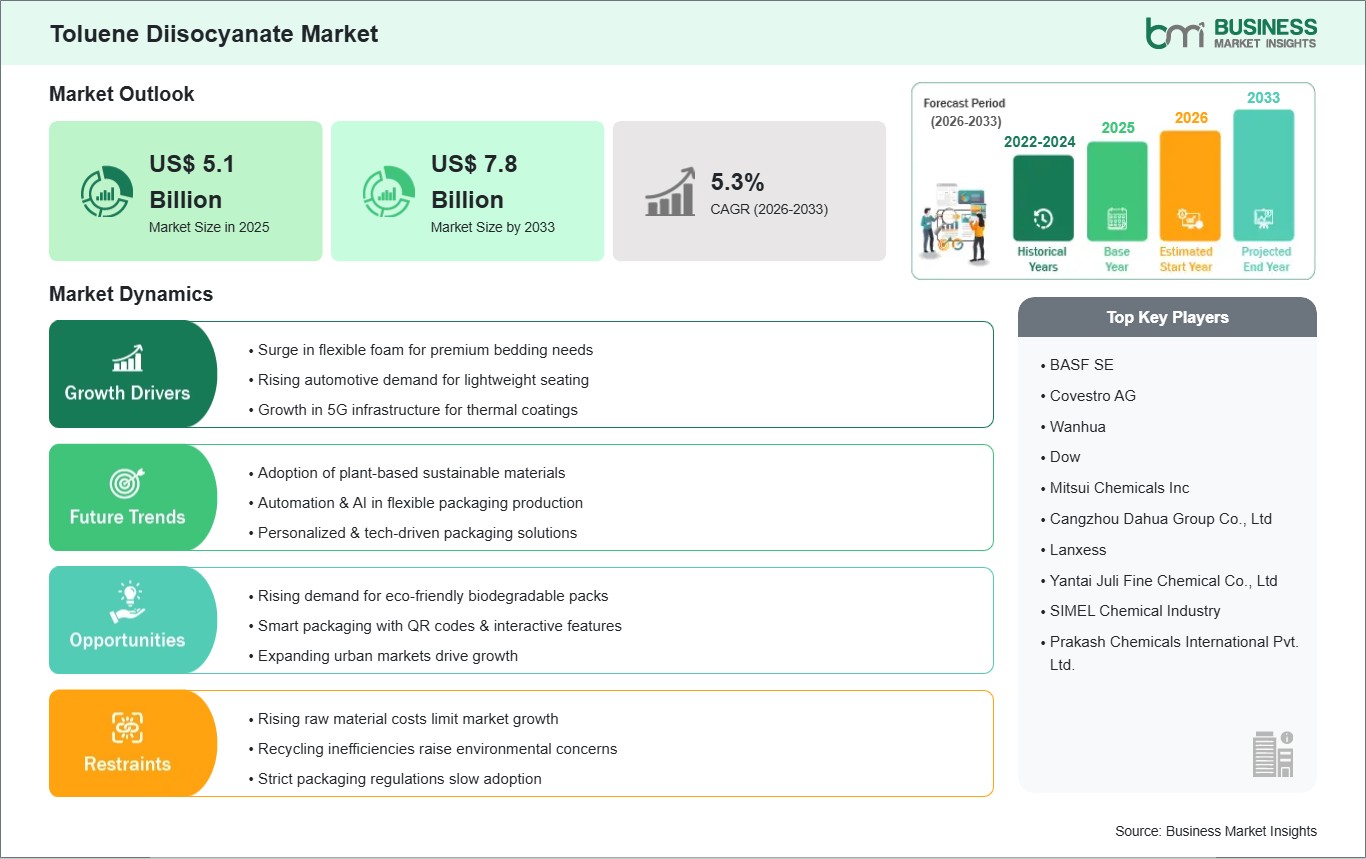
Toluene Diisocyanate provides the essential chemical building blocks for the flexible foam and polymer industries, encompassing mixed isomers (80:20 and 65:35 blends) and high-purity grades. These formulations offer distinct advantages, including superior energy absorption for automotive seating, high-resilience comfort for bedding, and excellent thermal resistance for building insulation. Growth is primarily driven by the massive global demand for flexible polyurethane foams, the rising production of lightweight and electric vehicles (EVs), and the rapid expansion of the furniture and bedding sectors in Asia Pacific. Additionally, the shift toward renewable, mass-balanced TDI is fundamentally enhancing the industry's alignment with "Green Chemistry" and carbon-neutral manufacturing goals.
However, several challenges can restrain market growth: extreme price volatility of petrochemical feedstocks, particularly toluene and chlorine, creates significant margin pressure and supply chain instability. Stringent regulatory scrutiny regarding TDI’s toxicity and workplace exposure limits (OSHA/REACH) necessitates high compliance costs and investment in closed-loop systems. Furthermore, the industry faces constraints due to regional overcapacity and a persistent substitution risk from alternative isocyanates such as MDI in certain rigid foam applications. Despite these hurdles, the market holds immense opportunities in the universal mandate for energy-efficient construction, the accelerating deployment of low-volatile organic compound (VOC) formulations, and the increasing reliance on bio-based precursors. The transition toward digitalized, AI-driven dosage optimization in foam manufacturing is expected to create significant opportunities for market growth.
Segment Analysis
Toluene Diisocyanate Market Segmentation
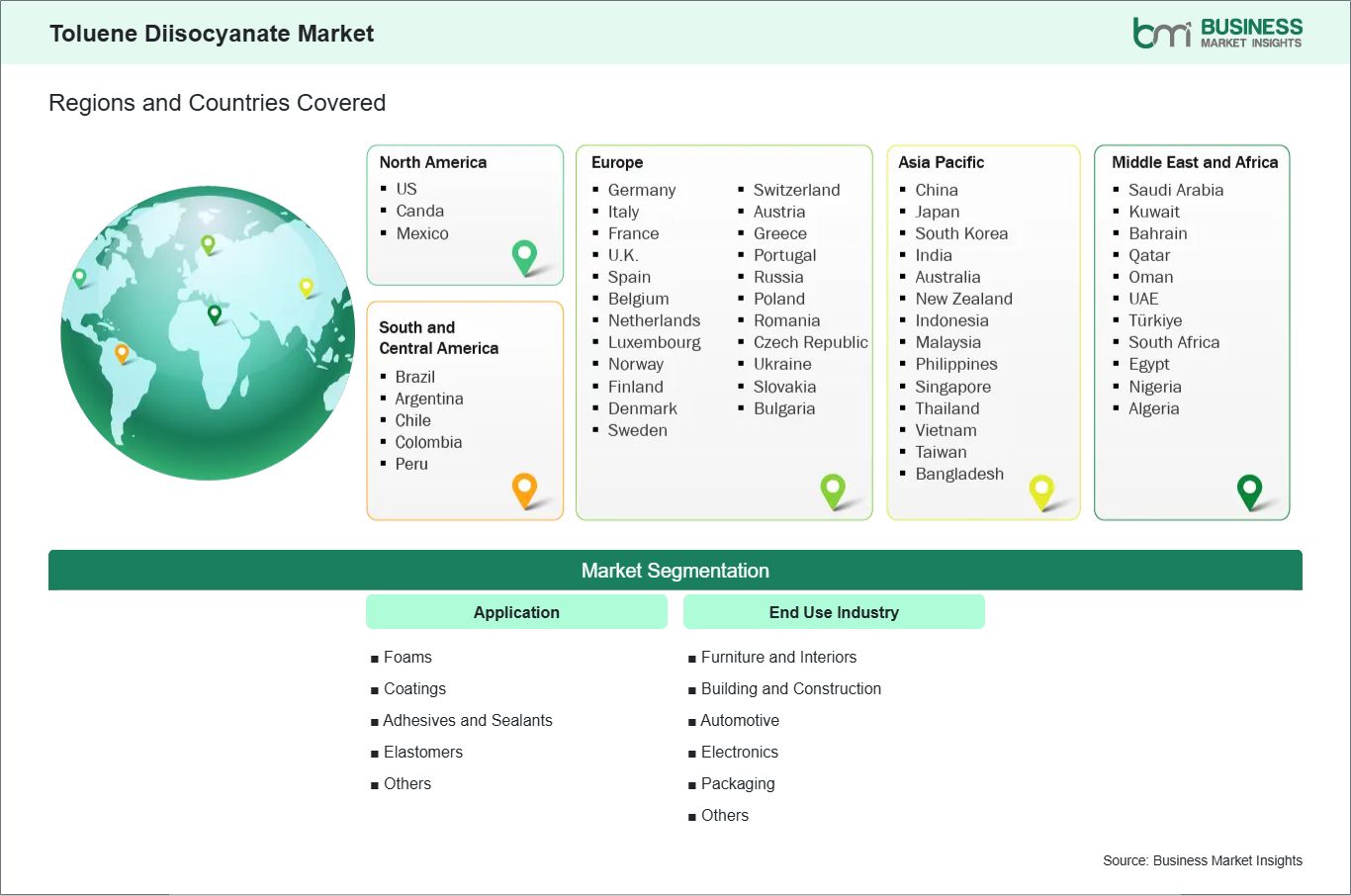
Key segments that contributed to the derivation of the Toluene Diisocyanate market analysis are application and end use industry.
- By Application, the market is segmented into Foams, Coatings, Adhesives and Sealants, Elastomers, and Others.
- By End Use Industry, the market is segmented into Furniture and Interiors, Building and Construction, Automotive, Electronics, Packaging, and Others.
Market Forces
Toluene Diisocyanate Market Drivers and Opportunities
Automotive Lightweighting and Global Urbanization
Vehicle manufacturers are increasingly prioritizing lightweight materials as they seek to improve fuel efficiency, enhance overall vehicle performance, and accommodate the added weight of electric vehicle (EV) batteries. In this context, TDI-based foams have become especially valuable. These foams are widely used in car seats, headrests, interior panels, and soundproofing components because they offer an ideal balance of strength, durability, and low density. Their ability to provide comfort while keeping vehicles light makes them a preferred choice for modern automotive design, particularly as the shift toward EVs accelerates.
At the same time, rapid urbanization and the expansion of the middle class in many developing countries are driving strong demand for comfortable furniture, high-quality bedding, and supportive mattresses. TDI-based flexible foams are well suited to these products due to their long-lasting cushioning, resilience, and affordability, making them the dominant material for large-scale production of everyday consumer goods.
Additionally, the construction sector is increasingly adopting TDI-derived rigid foams and specialty coatings to improve building insulation, moisture resistance, and structural protection. As global energy-efficiency regulations grow more stringent, builders and architects are turning to these advanced materials to help reduce energy consumption and enhance overall building performance. This broad adoption across automotive, consumer goods, and construction industries continues to support the steady growth of the TDI market.
Bio-Based Chemistry and Renewable Energy Infrastructure
A significant high-value opportunity exists in developing bio-based and sustainable TDI alternatives to meet the rigorous environmental standards of the "green" building and consumer sectors. Manufacturers are increasingly investing in phosgene-free production methods and circular feedstocks to reduce the carbon footprint of isocyanate chemistry, creating a competitive edge among eco-conscious brands. Another major opportunity is emerging in the renewable energy sector, particularly in the manufacture of wind turbine blades. Polyurethane composites derived from TDI offer exceptional fatigue resistance and durability in harsh environments, positioning the chemical as a key material for the global energy transition. Additionally, the rise of "smart" and high-performance coatings, offering advanced corrosion resistance for industrial machinery and aerospace components, presents a high-margin growth path. By focusing on specialized, low-emission formulations and expanding into high-growth regions such as Southeast Asia and India, producers can tap into a more diversified and resilient industrial base.
Size and Share Analysis
Toluene Diisocyanate Market Size and Share Analysis
The Toluene Diisocyanate market demonstrates steady growth, with size and share analysis revealing evolving trends and competitive positioning among key players. The report further examines subsegments categorized within application and end use industry, offering insights into their contribution to overall market performance.
For instance, the Foams subsegment, particularly flexible polyurethane foam, is a primary driver of the market. This material is extensively utilized in the Furniture and Interiors sector for mattresses, cushions, and upholstered seating. The market is currently seeing a shift toward low-VOC and bio-based foam formulations as manufacturers respond to stricter environmental regulations and growing consumer demand for sustainable home furnishings. The rise of the e-commerce "bed-in-a-box" industry has also bolstered this segment by requiring high-performance foams that can withstand compression for shipping.
Report Coverage
Toluene Diisocyanate Market Report Coverage and Deliverables
The Toluene Diisocyanate Market Size and Forecast (2022–2033) report provides a detailed analysis of the market covering below areas:
- Toluene Diisocyanate market size and forecast at global, regional, and country levels for all the key market segments covered under the scope
- Toluene Diisocyanate market trends, as well as market dynamics such as drivers, restraints, and key opportunities
- Toluene Diisocyanate market analysis covering key market trends, global and regional framework, major players, regulations, and recent market developments
- Industry landscape and competition analysis covering market concentration, heat map analysis, prominent players, and recent developments for the Toluene Diisocyanate market
- Detailed company profiles, including SWOT analysis
Geographic Insights
Toluene Diisocyanate Market Geographic Insights
The geographical scope of the Toluene Diisocyanate market report is divided into five regions: North America, Asia Pacific, Europe, Middle East & Africa, and South & Central America.
The Asia-Pacific Toluene Diisocyanate Market is segmented into China, Japan, South Korea, India, Australia, New Zealand, Indonesia, Malaysia, the Philippines, Singapore, Thailand, Vietnam, Taiwan, Bangladesh, and the Rest of Asia. The market is primarily driven by the region's massive furniture and bedding manufacturing base and a booming automotive sector, as well as government-led infrastructure initiatives.
Growth is further bolstered by the rising demand for flexible polyurethane foams and high-performance coatings for industrial machinery. The transition toward low-VOC formulations to meet new environmental standards and the adoption of phosgene-free production routes solidify Asia-Pacific as the critical hub for TDI innovation and supply chain expansion.
Industry Activity
Recent Developments
The Toluene Diisocyanate market is evaluated by gathering qualitative and quantitative data post primary and secondary research, which includes important corporate publications, association data, and databases. A few of the key developments in the Toluene Diisocyanate market are:
- In September 2024, BASF and Future Foam announced the first commercial production of flexible foam for the bedding industry made with 100% domestically produced Biomass Balance (BMB) Lupranate® T 80 toluene diisocyanate (TDI). The TDI is produced at BASF's Verbund production site in Geismar, Louisiana. This achievement marks a significant milestone in foam production and underscores both companies' commitments to sustainability.
- In March 2025, Covestro successfully completed the modernization of its TDI plant in Dormagen. At an event with around 60 invited guests from politics, business, and staff, including North Rhine-Westphalia Environmental Minister Oliver Krischer, Covestro officially commissioned the plant and announced its new target for increasing energy efficiency in production.
Trust & Transparency
Research Methodology
The market analysis combines proprietary research with secondary data from government agencies, company disclosures, regulatory filings, industry databases and expert interviews. Market estimates are validated through data triangulation, cross-market benchmarking and analyst
review.
View Full Research Methodology
Key Sources Referred:
World Bank – Global Trade IndicatorsWorld Trade Organization (WTO)International Monetary Fund (IMF)International Trade Administration (ITA)Company WebsitesCompany Annual ReportsCompany Investor Presentations