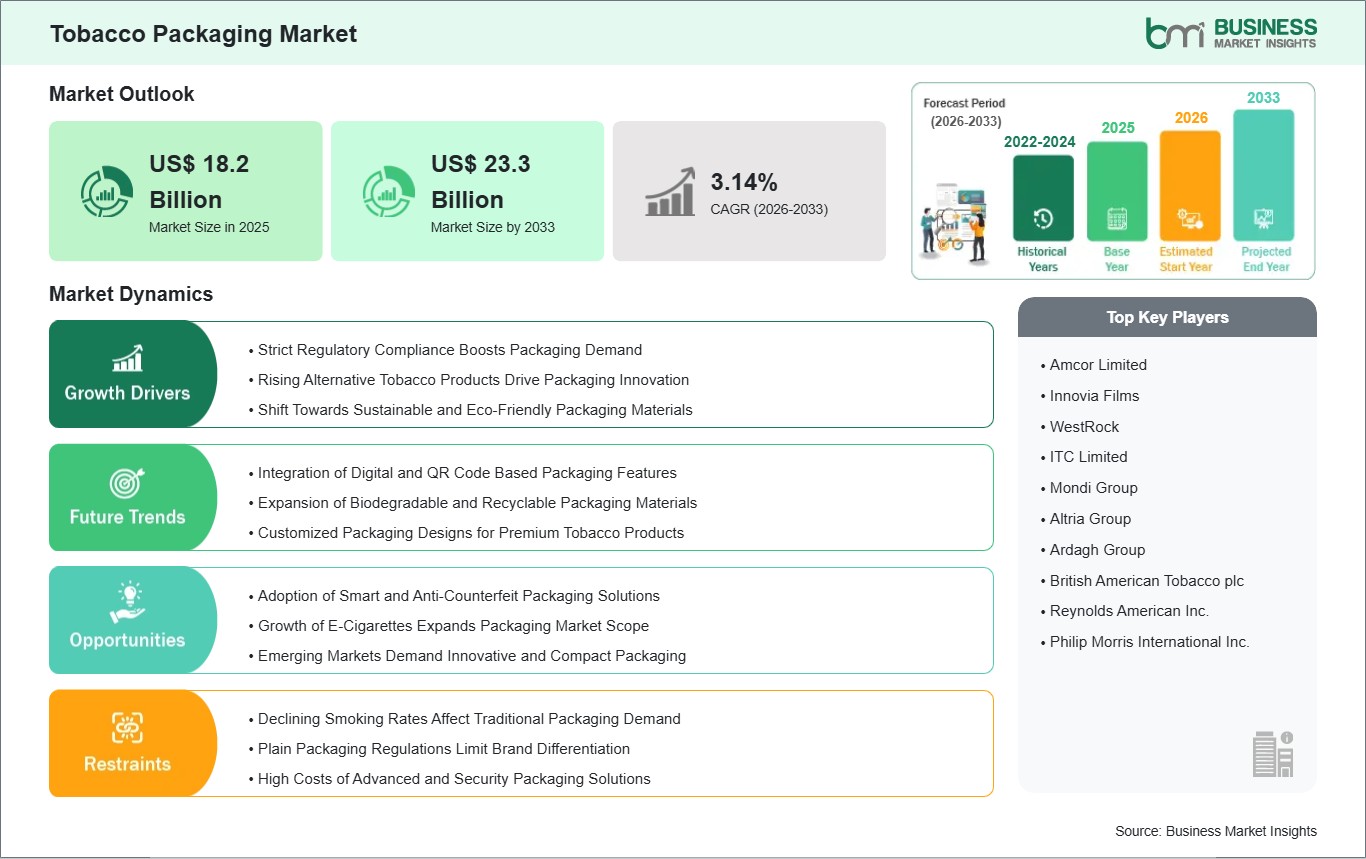
The Tobacco Packaging Market size is expected to reach US$ 23.3 billion by 2033 from US$ 18.2 billion in 2025. The market is estimated to record a CAGR of 3.14% from 2026 to 2033.
The global tobacco packaging market reaches its highest level in North America, which maintains strict regulations and requires businesses to follow compliance procedures for their innovative development activities. The market in this region does not focus on increasing sales through product expansion but rather on delivering packaging solutions that create additional value by satisfying new legal requirements and environmental standards, and customer demands. The United States represents the largest share of market demand, while Canada establishes essential packaging regulations through its federal framework, which impacts the entire area.
The market expands because packaging regulations undergo constant changes, which force manufacturers to revise their labeling systems, health warning content and packaging designs. The process generates ongoing requirements for printing improvements, material modifications and packaging design changes. The tobacco industry now requires distinct packaging solutions to maintain product safety and shelf life and make products easy to transport because of its expansion into smokeless products and next-generation nicotine delivery technologies. The rising need for environmentally friendly packaging that companies use in their operations serves as another key market driver. North American tobacco companies face increasing demands from regulators and consumers to decrease their environmental effects, which drives them to adopt recyclable paperboard materials, decrease their plastic consumption and implement simple packaging designs.
The market faces limitations because of its fundamental structural issues. Standardized packaging formats through plain packaging have become more common, which creates challenges for brands to create distinct market identities through their packaging designs. Public health awareness has increased through declining smoking rates, which leads to lower tobacco product consumption across the region, thereby decreasing packaging requirements. The tobacco packaging industry in North America operates through strict regulations, which drive sustainability efforts and support the advancement of new products to create a secure environment for packaging companies.

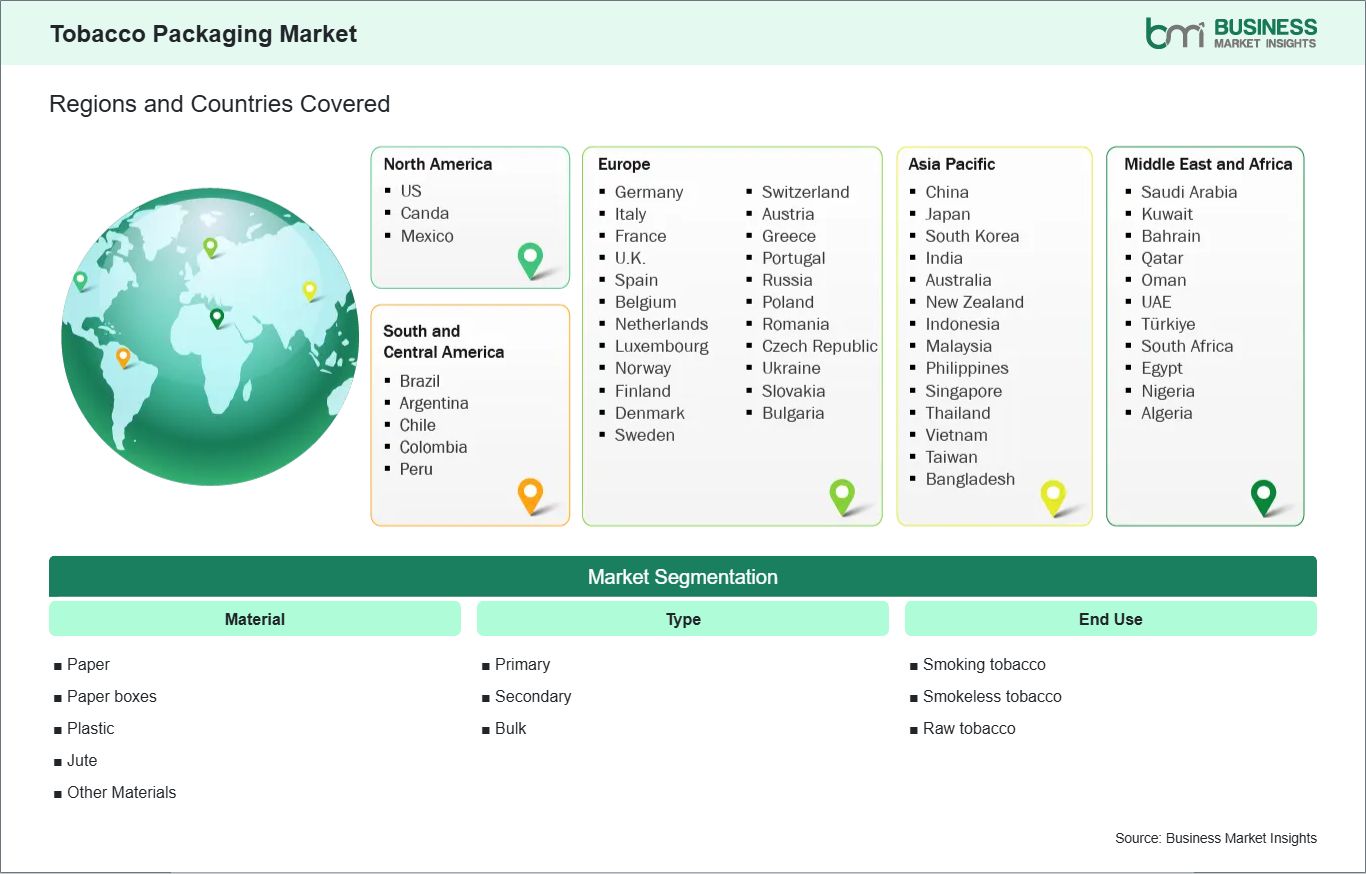
Key segments that contributed to the derivation of the tobacco packaging market analysis are material, type, and end use.
Regulatory compliance stands as the primary element that determines the tobacco packaging industry throughout the world. Manufacturers must continually change their packaging designs because governments throughout different regions impose strict regulations on labeling requirements, health warnings and package design standards. North America requires its large-format graphic warnings together with its traceability rules, while European nations establish plain packaging requirements and standardize their product labeling procedures. The regulatory requirements enable consumers to understand product information, while businesses must adopt new printing methods and particular materials that can show complete product details.
The Asia Pacific region sees rapid regulatory shifts, which create market opportunities in India and Thailand because these countries need packaging to display local language warnings, together with anti-counterfeiting elements. Companies now direct their resources towards creating production facilities that support their need to adapt designs while keeping their required brand identity. The global demand for child-resistant and tamper-evident packaging systems has increased because organizations need to follow safety regulations while consumers want such security features.
The growing importance of sustainability has emerged as a key requirement for businesses to meet their compliance needs because regulatory systems throughout the world continue to change. Europe and North America now mandate that all packaging materials must be either recyclable or biodegradable, which creates a connection between health standards and environmental protection efforts. The tobacco packaging industry experiences worldwide expansion because businesses pursue product compliance requirements, driving innovation throughout packaging materials, design and technology development.
The global tobacco packaging market is increasingly embracing smart and anti-counterfeit solutions to address illicit trade and enhance product authenticity. Advanced technologies such as QR codes, RFID tags, and holographic seals are being incorporated across markets to ensure traceability from production to retail. In North America and Europe, leading manufacturers are leveraging these solutions to meet government-mandated tracking systems while also providing consumers with transparency about product origin and quality.
Emerging regions in Asia Pacific and South America are also adopting these technologies, albeit gradually, to combat counterfeit products that dominate informal markets. Manufacturers are deploying serialized codes and digital markers to protect brand integrity and maintain regulatory compliance. These solutions often integrate with mobile applications, allowing consumers to verify authenticity, access product information, and even participate in loyalty programs, combining security with enhanced customer engagement.
Furthermore, smart packaging innovations are aligning with sustainability trends by reducing the need for additional security labels or external inserts. Digital verification and embedded codes help streamline production and reduce material waste while maintaining robust anti-counterfeit measures. Overall, global adoption of smart and anti-counterfeit packaging is transforming tobacco packaging into a technology-driven and security-conscious segment, ensuring brand trust and regulatory adherence worldwide.

The tobacco packaging market demonstrates steady growth, with size and share analysis highlighting evolving trends and competitive dynamics among key players. The report examines subsegments categorized within material, type, and end use, offering insights into their contribution to overall market performance.
By material, the paper boxes subsegment dominated the market in 2025, driven by its recyclability, cost-effectiveness, and widespread use in cigarette packaging.
Based on type, the secondary subsegment dominated the market in 2025, driven by its role in branding, regulatory compliance, and product protection.
In terms of end use, the smoking tobacco subsegment dominated the market in 2025, driven by the high global consumption of cigarettes and related products.
| Report Attribute | Details |
|---|---|
| Market size in 2025 | US$ 18.2 Billion |
| Market Size by 2033 | US$ 23.3 Billion |
| Global CAGR (2026 - 2033) | 3.14% |
| Historical Data | 2022-2024 |
| Forecast period | 2026-2033 |
| Segments Covered | By Material
|
|
Regions and Countries Covered
| |
| North America | US, Canada, Mexico |
| Europe | Belgium, Austria, Finland, Denmark, Greece, Poland, Romania, Russia, Ukraine, Czech Republic, Slovakia, Bulgaria, Italy, Luxembourg, Germany, Switzerland, France, Netherlands, Norway, Portugal, Spain, Sweden, United Kingdom |
| Asia-Pacific | Australia, China, India, Japan, South Korea, Indonesia, Malaysia, Philippines, Singapore, Thailand, Vietnam, Bangladesh, New Zealand, Taiwan |
| South and Central America | Brazil, Argentina, Peru, Chile, Colombia |
| Middle East and Africa | Bahrain, Kuwait, Oman, Qatar, Saudi Arabia, United Arab Emirates, Turkiye, South Africa, Egypt, Algeria, Nigeria |
| Market leaders and key company profiles |
|
The "Tobacco Packaging Market Size and Forecast (2022 - 2033)" report provides a detailed analysis of the market covering below areas:
The geographical scope of the Tobacco Packaging Market report is divided into North America, Asia Pacific, Europe, Middle East & Africa, and South & Central America. North America held the largest share in 2025.
The global tobacco packaging market is currently dominated by North America because of its strict regulations, its developed tobacco market and its emphasis on compliance-based product development. The United States and Canada lead regional demand, driven by requirements for standardized health warnings, anti-counterfeiting measures, and packaging for emerging products like e-cigarettes and smokeless tobacco. The region has identified sustainable recyclable materials as an essential trend because both regulatory demands and consumer demand for sustainability have increased.
European markets develop under EU-wide regulations and national rules that focus on plain packaging requirements, health warning standards and traceability system mandates. European countries have established themselves as advanced packaging centers because international tobacco corporations operate there and promote high-grade printing solutions, secure packaging methods and environmentally sustainable materials.
The Asia Pacific region shows strong growth potential because China, India, and Indonesia have large customer bases, and there is increasing demand for new packaging solutions for both traditional tobacco products and modern tobacco alternatives. The market here has multiple competing players who are increasingly using compact child-resistant moisture-proof packaging solutions to satisfy the needs of different regional markets.
The Middle East and Africa region experiences steady growth, with the urban population growth and premium tobacco product development and South Africa and UAE regulatory initiatives that mandate better packaging and labeling standards. The region is also witnessing increased interest in sustainable materials and packaging designs to align with global environmental standards.
Traditional tobacco consumption patterns continue to shape the South and Central American market while new health regulations start to establish packaging standards. Brazil and Argentina have implemented new labeling and warning requirements, which create a need for packaging solutions that meet safety standards while maintaining visual appeal and brand compliance. North America leads in innovation through regulations, while different consumer behaviors, regulatory frameworks, and sustainability objectives shape tobacco packaging standards in each worldwide market.

The Tobacco Packaging Market is evaluated by gathering qualitative and quantitative data post primary and secondary research, which includes important corporate publications, association data, and databases. A few of the key developments in the tobacco packaging market are:
The Tobacco Packaging Market is valued at US$ 18.2 Billion in 2025, it is projected to reach US$ 23.3 Billion by 2033.
As per our report Tobacco Packaging Market, the market size is valued at US$ 18.2 Billion in 2025, projecting it to reach US$ 23.3 Billion by 2033. This translates to a CAGR of approximately 3.14% during the forecast period.
The Tobacco Packaging Market report typically cover these key segments-
The historic period, base year, and forecast period can vary slightly depending on the specific market research report. However, for the Tobacco Packaging Market report:
The Tobacco Packaging Market is populated by several key players, each contributing to its growth and innovation. Some of the major players include:
The Tobacco Packaging Market report is valuable for diverse stakeholders, including:
Essentially, anyone involved in or considering involvement in the Tobacco Packaging Market value chain can benefit from the information contained in a comprehensive market report.
Please tell us your area of interest
(Market Segments/ Regions and Countries/ Companies)