Market Summary
Executive Summary and Global Market Analysis
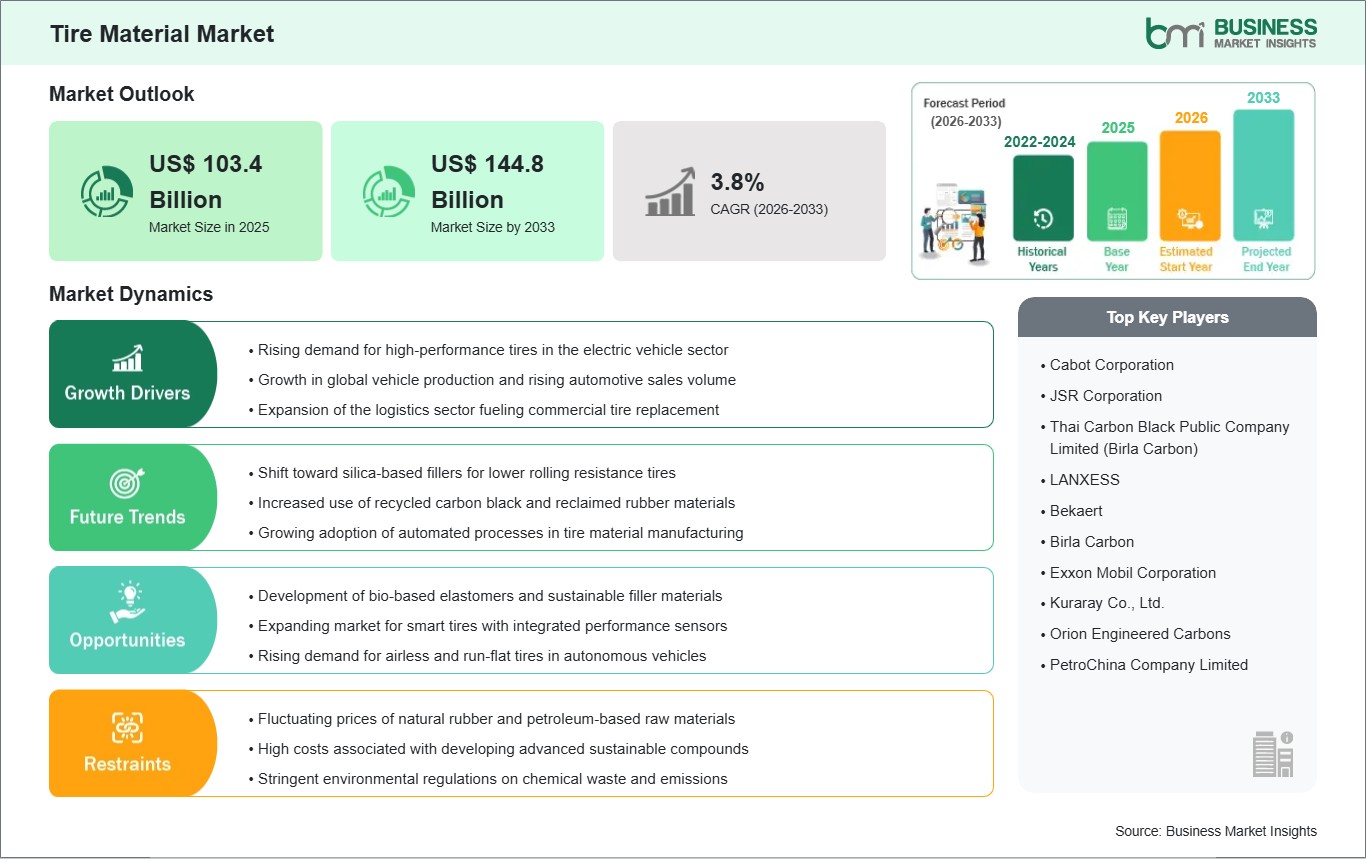
Tire material represents a sophisticated cross-section of the chemical and polymer industries, dedicated to the production of high-performance components such as elastomers, reinforcing fillers, plasticizers, and textile reinforcements. These materials are engineered to meet the grueling demands of modern mobility, providing the essential balance of traction, structural integrity, and thermal stability required for vehicle safety. At its core, the market is shifting from a commodity-driven sector to one defined by advanced materials science, as manufacturers strive to optimize "the magic triangle"—the trade-off between rolling resistance, wet grip, and wear resistance.
However, the industry currently navigates a complex landscape of restraints. Volatility in petrochemical feedstocks and natural rubber prices remains a significant hurdle, directly impacting the cost of synthetic rubbers like SBR and BR. Furthermore, stringent environmental mandates, such as the European Union's tire labeling regulations and the EPA's standards for hazardous air pollutants, have increased R&D expenditures. These pressures are compounded by the technical difficulty of maintaining high-speed performance while increasing the percentage of recycled content within the tire's complex chemical matrix.
Despite these deterrents, the market is entering a phase of lucrative expansion. The accelerated adoption of Electric Vehicles (EVs) acts as a primary catalyst, as these vehicles require specialized materials to manage higher torque and increased battery weight. This transition has opened significant avenues for bio-based silica, recovered carbon black, and sustainable oils (such as soybean or orange oil). Innovations in airless tire technology and System-on-Chip (SoC) sensor integration for smart tires also present high-value opportunities, positioning the market to reach a projected valuation as the global fleet transitions toward a carbon-neutral and intelligent future.
Segment Analysis
Tire Material Market Segmentation
Key segments that contributed to the derivation of the Tire Material market analysis are type and vehicle type.
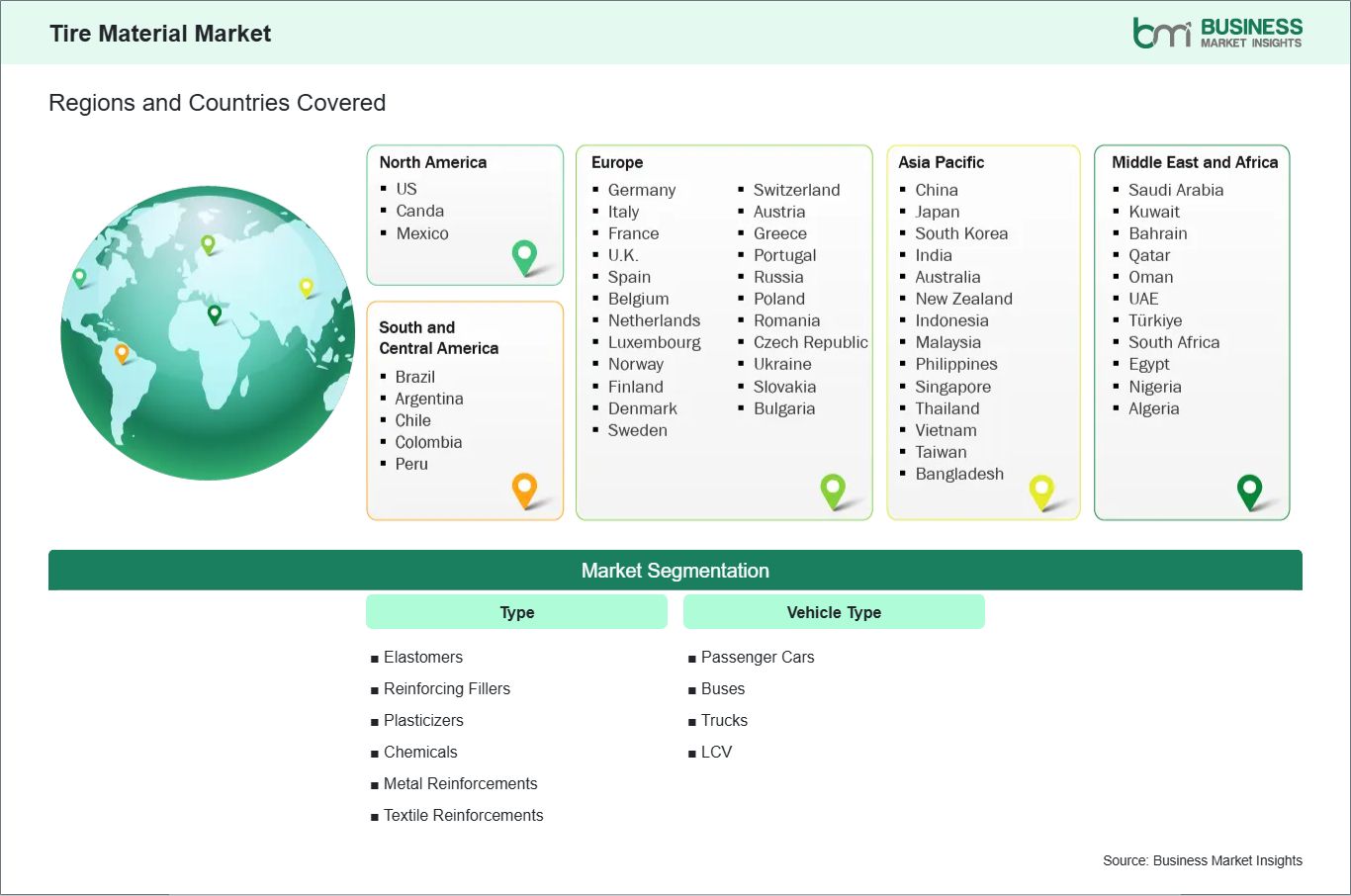
- By Type, the market is segmented into Elastomers, Reinforcing Fillers, Plasticizers, Chemicals, Metal Reinforcements, and Textile Reinforcements.
- By Vehicle Type, the market is categorized into Passenger Cars, Buses, Trucks, and LCV (Light Commercial Vehicles).
Market Forces
Tire Material Market Drivers and Opportunities
Escalating Demand for High-Performance Electric Vehicle (EV) Tires
The global transition toward vehicle electrification serves as a primary driver for the tire material market. Electric vehicles present unique mechanical challenges that traditional internal combustion engine tires are not fully equipped to handle. Primarily, the substantial weight of battery packs necessitates tires with significantly higher load-bearing capacities and reinforced sidewalls. Furthermore, the instantaneous torque delivered by electric motors subjects the tread to extreme frictional forces during acceleration, which typically results in much faster rubber degradation. This shift is compelling tire manufacturers to move away from standard rubber blends toward high-performance, functionalized elastomers that offer superior abrasion resistance. These advanced materials are essential for ensuring that tire longevity remains comparable to traditional vehicles despite the harsher operating conditions.
Additionally, because tire-road friction is a major contributor to energy loss, there is an intensified focus on reducing rolling resistance to maximize battery range. Consequently, the market is seeing a surge in demand for specialized reinforcing fillers and silane coupling agents that can minimize energy dissipation within the rubber matrix. This evolution in vehicle architecture is effectively transforming tires from simple rubber components into high-tech, material-intensive systems, creating a robust growth trajectory for suppliers of premium synthetic rubbers and specialized chemical additives.
Integration of Bio-Based and Circular Raw Materials
A significant opportunity within the market lies in the industrial-scale adoption of sustainable and circular material alternatives. As leading global manufacturers commit to ambitious goals of using only sustainable materials in their products by mid-century, the demand for bio-circular inputs is reaching a critical inflection point. This includes the replacement of traditional, sand-mined silica with highly dispersible silica derived from rice husk ash—a byproduct of agricultural processing that offers a much lower carbon footprint while maintaining high performance. Similarly, the emergence of recovered carbon black, produced through the pyrolysis of end-of-life tires, presents a lucrative opportunity to close the production loop and reduce reliance on fossil-fuel-based furnace blacks. Beyond fillers, there is a growing market for bio-based resins and oils—such as those derived from soybean, sunflower, or orange peels—to replace petroleum-based plasticizers.
These "green" materials not only help companies comply with increasingly strict environmental, social, and governance (ESG) reporting standards but also cater to a growing segment of environmentally conscious consumers and fleet operators. By developing a supply chain rooted in renewable feedstocks and recycled content, material providers can differentiate their offerings in a competitive market, secure long-term partnerships with major automotive brands, and insulate themselves from the price volatility and regulatory risks associated with traditional petrochemical-based manufacturing.
Size and Share Analysis
Tire Material Market Size and Share Analysis
The Tire Material market demonstrates steady growth, with size and share analysis revealing evolving trends and competitive positioning among key players. The report further examines subsegments categorized within type and vehicle type, offering insights into their contribution to overall market performance.
Within the type segment, elastomers continue to represent the largest portion of material volume due to their fundamental role in providing elasticity and grip.
On the other hand, under the vehicle type category, the passenger cars sub-segment accounts for the highest share of consumption as a result of the sheer volume of global annual vehicle production and the shorter replacement cycles associated with private commuting.
Report Coverage
Tire Material Market Report Coverage and Deliverables
The "Tire Material Market Size and Forecast (2022 - 2033)" report provides a detailed analysis of the market covering below areas:
- Tire Material market size and forecast at global, regional, and country levels for all the key market segments covered under the scope
- Tire Material market trends, as well as market dynamics such as drivers, restraints, and key opportunities
- Tire Material market analysis covering key market trends, global and regional framework, major players, regulations, and recent market developments
- Industry landscape and competition analysis covering market concentration, heat map analysis, prominent players, and recent developments for the Tire Material market
- Detailed company profiles, including SWOT analysis
Geographic Insights
Tire Material Market Geographic Insights
The geographical scope of the Tire Material market report is divided into five regions: North America, Asia Pacific, Europe, the Middle East &Africa, and South &Central America.
In North America, the market is characterized by a sophisticated focus on high-durability compounds and advanced reinforcements to support an extensive roadway network and a robust long-haul logistics sector. Europe maintains a leading position in the adoption of sustainable chemistries, where stringent environmental directives drive the integration of bio-based elastomers and circular raw materials within premium automotive supply chains. The Asia-Pacific region functions as the primary global hub for both production and consumption, sustained by a massive manufacturing ecosystem and the rapid expansion of domestic vehicle ownership in emerging economies.
In the Middle East &Africa, the market is expanding through the modernization of transportation infrastructure and a growing industrial interest in localized chemical processing facilities to reduce import reliance. Meanwhile, South &Central America are witnessing steady development fueled by the digital and industrial transformation of regional fleets and the increasing demand for specialized tires in the agricultural and mining sectors. Collectively, these regions contribute to a resilient global framework, as local markets align their material requirements with broader international trends toward performance optimization and environmental stewardship.
Industry Activity
Recent Developments
The Tire Material market is evaluated by gathering qualitative and quantitative data post primary and secondary research, which includes important corporate publications, association data, and databases. A few of the key developments in the Tire Material market are:
- In July 2025, Pirelli launched the first standard production tire for the global market composed of over 70% bio-based and recycled materials. This breakthrough in Tire Material innovation included the integration of FSC™-certified natural rubber, a certification that verified the responsible management of the supply chain from the plantation to the factory level. As part of a long-term sustainability roadmap, the company confirmed that by 2026, all natural rubber processed in its European facilities would meet these FSC™ standards. Developed as a bespoke version for JLR, the new Pirelli P Zero was initially made available for selected 22-inch wheel options on the Range Rover, supporting JLR's strategic objective to implement more sustainable Tire Material solutions across its luxury vehicle portfolio.
- In January 2024, at CES 2024, The Goodyear Tire &Rubber Company unveiled the latest addition to its ElectricDrive family, the Goodyear ElectricDrive 2. This all-season electric vehicle (EV) tire was enhanced with advanced Tire Material technology, featuring improved rolling resistance and a long-lasting tread life designed to maximize EV performance. As a significant milestone in the company's sustainability maturity, the ElectricDrive 2 contained at least 50% sustainable Tire Material by weight, incorporating bio-based and recycled components to meet the evolving demands of the electric mobility sector.
Trust & Transparency
Research Methodology
The market analysis combines proprietary research with secondary data from government agencies, company disclosures, regulatory filings, industry databases and expert interviews. Market estimates are validated through data triangulation, cross-market benchmarking and analyst
review.
View Full Research Methodology
Key Sources Referred:
World Bank - Global Trade IndicatorsWorld Trade Organization (WTO)International Monetary Fund (IMF)International Trade Administration (ITA)Company websiteCompany annual reportsCompany investor presentations