Market Summary
Executive Summary and Global Market Analysis
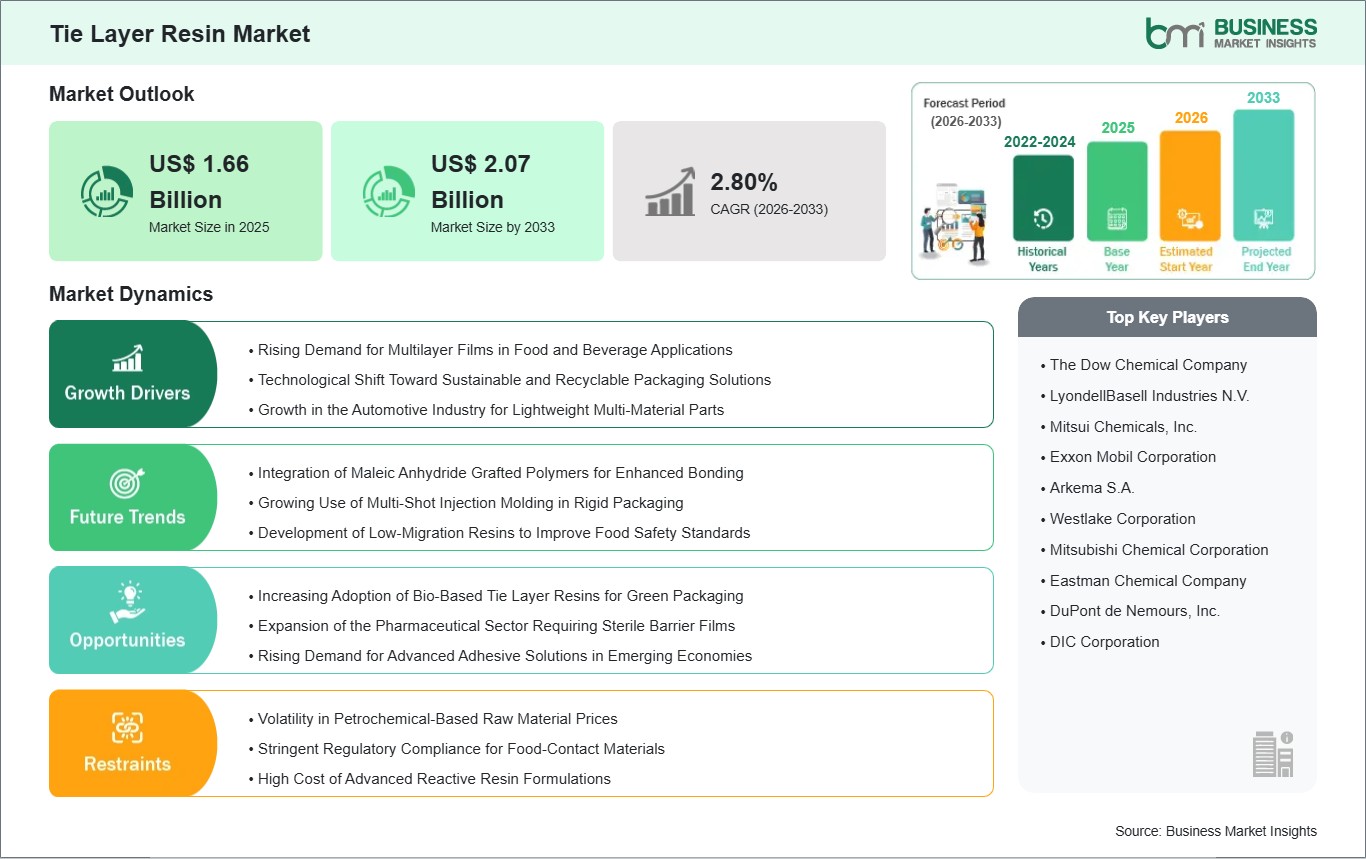
The global tie layer resin market is entering a phase of high-precision growth, underpinned by its essential role in the production of high-performance multilayer structures. These specialty adhesive polymers are the technical bridge that allows manufacturers to combine the disparate properties of different resins such as, the moisture resistance of polyethylene and the oxygen barrier of polyamides, into a single, unified material. This capability is currently driving a massive shift across the packaging, automotive, and medical industries toward more complex and functional material designs. The market is increasingly defined by its ability to solve the technical challenges of delamination and material incompatibility in high-speed manufacturing environments.
Technological Innovation and Sustainability are the two primary forces currently reshaping the way markets operate. Recyclable multilayer film and some forms of bio-resin development reflect a broader Industry shift towards a commitment to the Circular Economy. Despite continued challenges faced by the market, such as volatility in raw material prices, the long-term outlook for this market remains very positive due to the essential function that Tie Layers will serve within critical Industries such as food safety and Pharmaceutical protection.
Asia-Pacific and North America are the two largest global consumers of multilayer tie layer resins, however, there are also significant levels of supply and innovation occurring from an extensive network of global chemical manufacturing companies, as well as from high volume packaging converters. As Industry Continues to seek out smarter, thinner, and more environmentally friendly materials, tie layer resins will continue to be a core component of advanced materials science.
Segment Analysis
Tie Layer Resin Market Segmentation
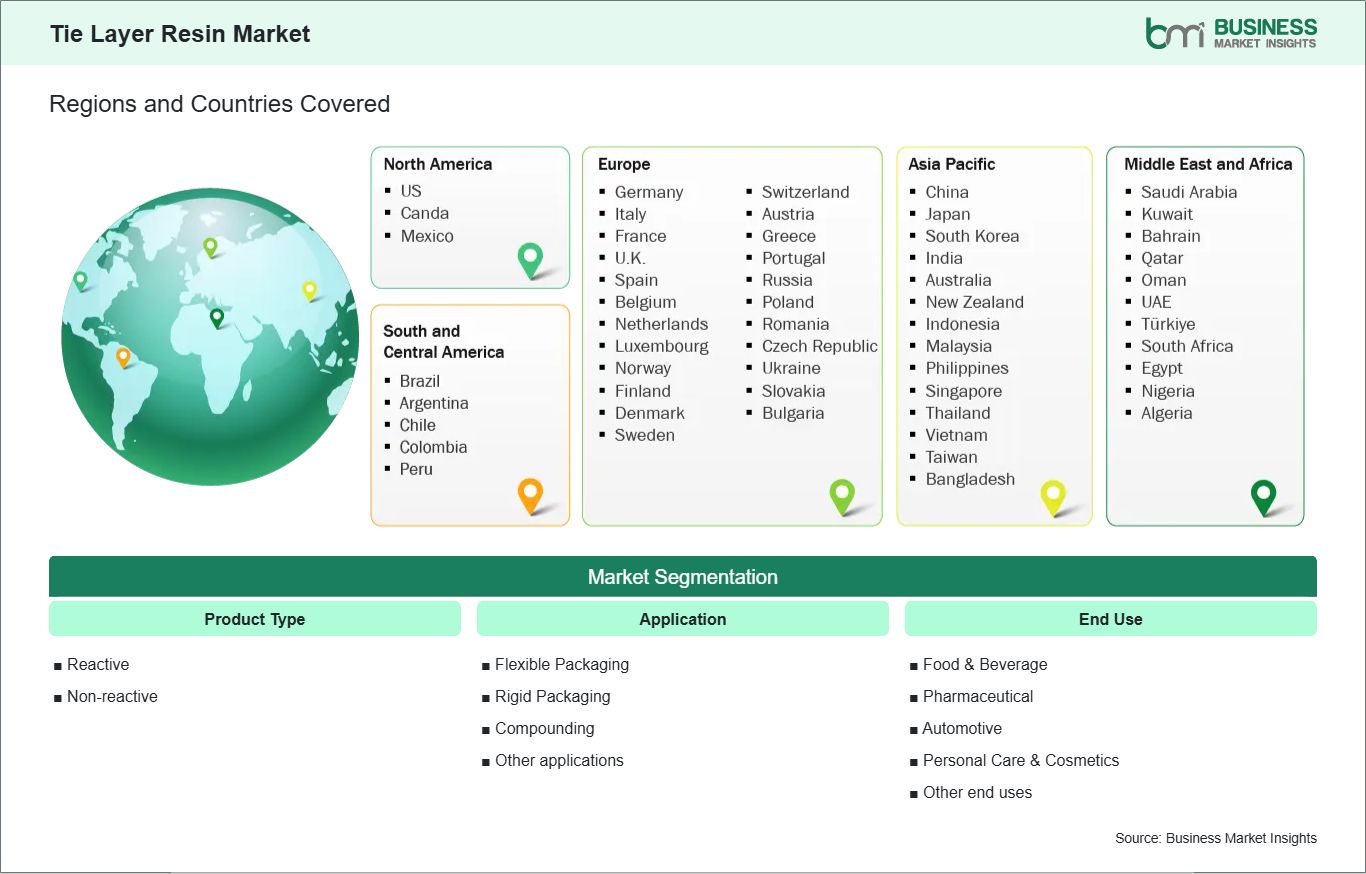
Key segments that contributed to the derivation of the Tie Layer Resin market analysis are product type, application, and end use.
- By product type, the tie layer resin market is segmented into Reactive and Non-reactive. The Reactive segment dominated the market in 2025.
- By application, the tie layer resin market is segmented into Flexible Packaging, Rigid Packaging, Compounding, and Other applications. The Flexible Packaging segment dominated the market in 2025.
- By end use, the tie layer resin market is segmented into Food & Beverage, Pharmaceutical, Automotive, Personal Care & Cosmetics, and Other end uses. The Food & Beverage segment dominated the market in 2025.
Market Forces
Tie Layer Resin Market Drivers and Opportunities
Rising Demand for Multilayer Films in Food and Beverage Applications
The food and beverage industry is the primary engine driving the expansion of the tie layer resin market. As global supply chains lengthen and consumer expectations for product freshness increase, the need for sophisticated packaging that can provide an absolute barrier against oxygen, moisture, and light has become paramount. Tie layer resins are the fundamental component that allows for the co-extrusion of otherwise incompatible materials, such as polyethylene and ethylene vinyl alcohol. This integration creates a functional shield that prevents food spoilage and significantly extends the shelf life of perishable items, ranging from dairy products to processed meats.
Beyond mere preservation, the shift toward flexible packaging formats like pouches and lidding films is further accelerating this demand. These formats rely on extremely thin but robust multilayer constructions to maintain their protective qualities while minimizing material use. Tie layer resins ensure that these thin layers do not delaminate during high-speed manufacturing or transportation. As urbanization continues to change consumption patterns toward packaged convenience foods, the reliance on these specialty adhesive resins to ensure food safety and quality will remain a structural necessity for the global packaging industry.
Increasing Adoption of Bio-Based Tie Layer Resins for Green Packaging
The global push for environmental sustainability is creating a transformative opportunity for the development and adoption of bio-based tie layer resins. Traditionally, these resins have been derived from petroleum-based feedstocks, which are increasingly scrutinized under new circular economy regulations and plastic waste reduction mandates. Manufacturers are now successfully engineering tie layer resins from renewable biological sources that maintain the high-performance adhesion and barrier compatibility of their synthetic predecessors. These bio-renewable solutions allow brand owners in the pharmaceutical and food sectors to market fully sustainable packaging without compromising the safety or integrity of the contents.
This transition is particularly critical as retailers and consumers move toward mono-material packaging structures that are easier to recycle. Bio-based tie layers can be formulated to be compatible with a variety of sustainable polymer systems, facilitating the creation of "green" multilayer films that can be processed in existing recycling streams. As governments implement taxes on non-recyclable plastic content and promote bio-content targets, the shift from conventional to bio-derived resins is moving from a premium specialty niche to a mainstream requirement. This evolution is fostering deep collaborations between chemical producers and packaging converters to optimize these new materials for high-throughput industrial environments.
Size and Share Analysis
Tie Layer Resin Market Size and Share Analysis
The global Tie Layer Resin market is experiencing steady growth, with market size and share analysis reflecting evolving treatment preferences and competitive dynamics among key players. The report evaluates important subsegments categorized within product type, application, and end use highlighting their respective contributions to overall market performance.
By product type, the Reactive subsegment dominated the market in 2025 due to its superior ability to form permanent chemical bonds between dissimilar polymers, such as polyolefins and barrier resins, which is essential for ensuring the structural integrity of high-performance multilayer films.
By application, the Flexible Packaging subsegment dominated the market in 2025 due to the rising global preference for lightweight, cost-effective, and highly adaptable packaging solutions that require complex multilayer structures to maintain product freshness and extend shelf life across various consumer goods.
By end use, the Food & Beverage subsegment dominated the market in 2025 due to the critical necessity for advanced oxygen and moisture barriers in food preservation, combined with increasing urbanization and the resulting surge in demand for safely processed and packaged convenience foods.
Report Coverage
Tie Layer Resin Market Report Coverage and Deliverables
The "Tie Layer Resin Market Size and Forecast (2022 - 2033)" report provides a detailed analysis of the market covering below areas:
- Tie Layer Resin market size and forecast at the regional and country levels for segments covered under the scope
- Tie Layer Resin market trends, as well as drivers, restraints, and opportunities
- Tie Layer Resin market analysis covering key trends, regional framework, major players, regulations, and recent developments
- Industry landscape and competition analysis covering market concentration, heat map analysis, prominent players, and recent developments for the Tie Layer Resin market
- Detailed company profiles, including SWOT analysis
Geographic Insights
Tie Layer Resin Market Geographic Insights
The geographical scope of the Tie Layer Resin market report is divided into: North America, Asia Pacific, Europe, Middle East & Africa, and South & Central America. North America held the largest share in 2025.
North America maintains a commanding position in the tie layer resin market, a dominance fueled by a highly mature packaging industry and a heavy concentration of global chemical innovation hubs. The region is home to some of the world's largest food and beverage corporations and pharmaceutical giants, all of whom rely on sophisticated multilayer films to ensure product integrity across massive logistical networks. In the United States, a strong emphasis on research and development has led to the early adoption of advanced reactive tie layers that offer superior adhesion at lower processing temperatures. This technological edge allows North American manufacturers to produce high-performance barrier solutions that meet the stringent safety and environmental standards required by regional regulatory bodies.
The regional market is also benefiting from a resurgence in domestic automotive and industrial manufacturing. The push for electric vehicle production in North America has created a specialized demand for tie layer resins in the fabrication of lightweight, multi-material components such as advanced fuel tanks and battery enclosures. Furthermore, the region’s leadership in sustainable manufacturing practices is driving the rapid commercialization of bio-based and recyclable tie layer formulations. This ecosystem of advanced technical requirements, combined with a robust supply chain of major resin producers and sophisticated converters, ensures that North America continues to set the global standard for high-value tie layer resin applications. As the industry moves toward more localized and resilient supply chains, the region’s established infrastructure remains a primary driver of market stability and growth.
Industry Activity
Recent Developments
The Tie Layer Resin market is evaluated by gathering qualitative and quantitative data post primary and secondary research, which includes important corporate publications, association data, and databases. A few of the key developments in the Tie Layer Resin market are:
- In May 2025, LyondellBasell announced that it launched the Plexar PX3990 high‑performance LLDPE tie‑layer resin for film orientation applications, expanding its Plexar tie‑layer portfolio with improved processability and adhesion for co‑extruded films.
- In May 2025, Mitsui Chemicals announced that it implemented a price adjustment on its ADMER™ adhesive tie‑layer resin, reflecting rising raw material and logistics costs for deliveries starting in July 2025, underscoring commercial momentum for its tie‑layer products.
Trust & Transparency
Research Methodology
The market analysis combines proprietary research with secondary data from government agencies, company disclosures, regulatory filings, industry databases and expert interviews. Market estimates are validated through data triangulation, cross-market benchmarking and analyst
review.
View Full Research Methodology
Key Sources Referred:
American Chemistry Council (ACC) International Council of Chemical Associations (ICCA) European Chemical Industry Council (Cefic) China Petroleum and Chemical Industry Federation (CPCIF) Indian Chemical Council (ICC) Japan Chemical Industry Association (JCIA) Brazilian Chemical Industry Association (ABIQUIM) Company Websites Company Annual Reports Company Investor Presentations