
Threat Hunting Market Outlook (2022-2033)

Historic Data: 2022-2024   |   Base Year: 2025   |   Forecast Period: 2026-2033
Report Content: Market Scope, Market Segmentation, Market Dynamics, and Competitive Analysis

Report Coverage:
  • Offering (Tools, Services)
  • Organization Size (Small and Medium Enterprises (SMEs), Large Enterprises)
  • Deployment Mode (On-Premises, Cloud)
  • Vertical (BFSI, IT & ITES, Government, Energy & Utilities, Manufacturing, Healthcare, Retail & E-commerce, Other Verticals)

No. of Pages: 423
Report Code: BMIPUB00034531
Category: Electronics and Semiconductor
Threat Hunting Market

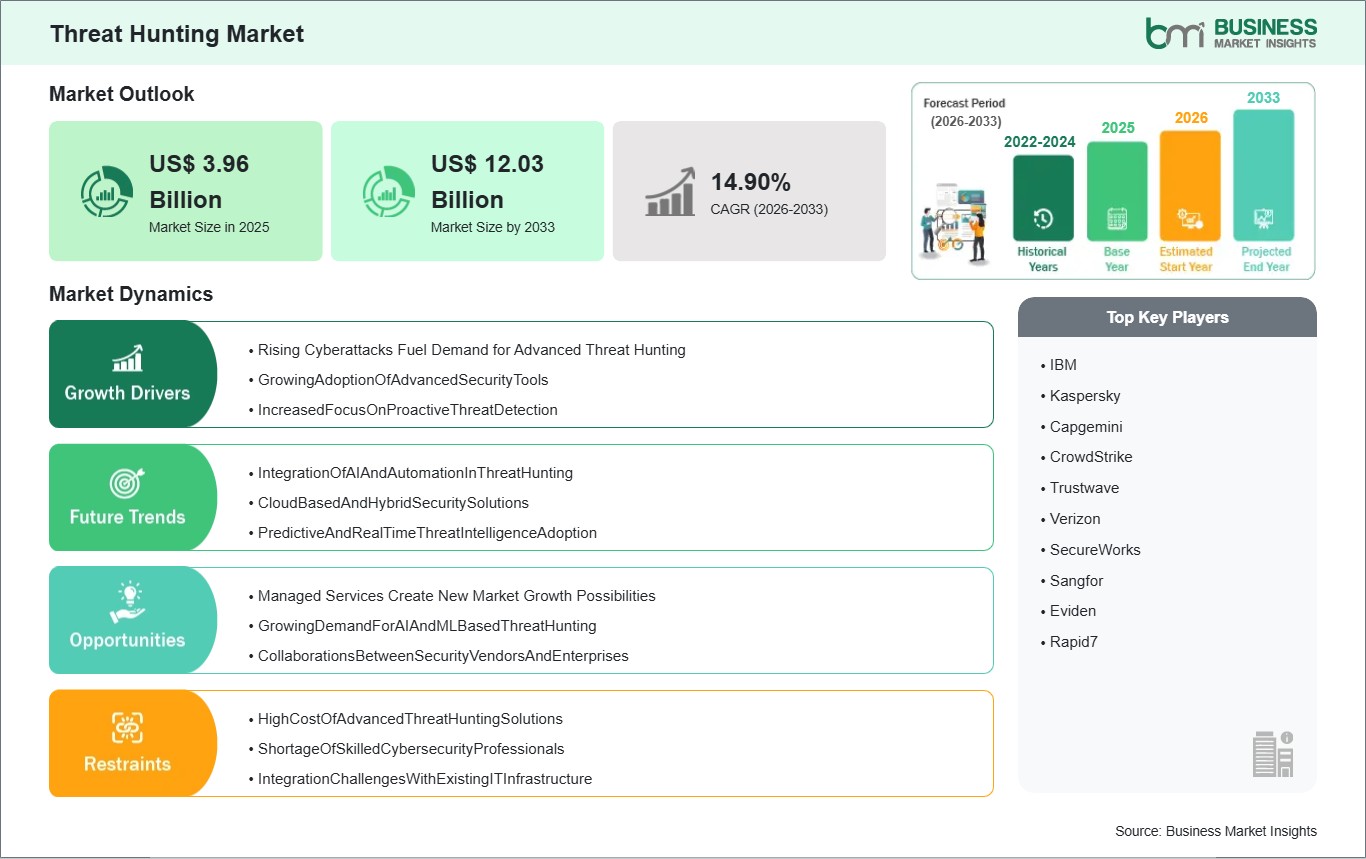
The Threat Hunting Market size is expected to reach US$ 12.03 billion by 2033 from US$ 3.96 billion in 2025. The market is estimated to record a CAGR of 14.90% from 2026 to 2033.

Executive Summary and Global Market Analysis:

The Global Threat Hunting Market has become an essential feature of modern-day cybersecurity solutions, driven by the rising complexity and frequency of cyberattacks on enterprises, governments, and even the nation as a whole. The traditional security paradigm of reacting to security incidents is not proving effective in the detection of advanced persistent threats, insider threats, ransomware, and polymorphic malware attacks, leading organizations around the world to increasingly adopt threat hunting as a proactive security solution that utilizes the best of human resources, advanced data analysis, and threat intelligence services to identify security vulnerabilities before they evolve into major security breaches.

The major drivers of the threat hunting market are the rapid growth of digital transformation services, the proliferation of connected devices, and the growth of cloud environments, which are creating a much larger threat surface that is difficult to defend with the current security paradigm. Organizations are increasingly using endpoint detection and response, security information, event management, and security orchestration, automation, and response solutions to improve their threat hunting capabilities. In addition, the integration of artificial intelligence and machine learning in the field of threat analytics has greatly enhanced the speed and accuracy of detecting threats, thus enabling the anticipation of various threats and mitigation of the associated risks.

Despite these opportunities, there are various challenges associated with the market. Firstly, the shortage of skilled cybersecurity experts who are in a position to carry out advanced threat hunting activities is a notable restraint in the market. Secondly, the complexity associated with integrating various security tools, data, and systems, which are often used in the operation of various threat hunting activities, has been known to hinder the efficiency of such activities, especially in large and distributed enterprises. The global Threat Hunting Market has been identified as an industry with significant strategic importance for modern cybersecurity infrastructures, robust technology adoption, and an ongoing drive for proactive threat mitigation.

Although challenges such as skill sets and integration challenges hinder the industry, the rising need for dwell time reduction, enhanced security operations, and intelligence-driven strategies has been identified as having robust potential for future growth.

Threat Hunting Market - Strategic Insights:

global-market-strategic-framework
Get more information on this report

Threat Hunting Market Segmentation Analysis:

Key segments that contributed to the derivation of the threat hunting market analysis are offering, organization size, deployment mode, vertical, and threat type.

  • By offering, the threat hunting market is segmented into tools, services. The tools segment dominated the market, driven by organizations prioritizing advanced detection and proactive threat-hunting technologies.
  • Based on organization size, the threat hunting market is categorized into small and medium enterprises (SMEs), large enterprises. The large enterprises segment dominated the market, driven by higher investment capacity and complex IT infrastructure requiring robust threat-hunting solutions.
  • Based on deployment mode, the threat hunting market is categorized into on-premises, cloud. The on-premises segment dominated the market, driven by strict data control, regulatory compliance, and preference for internal security management.
  • On the basis of vertical, the threat hunting market is categorized into BFSI, IT & ITES, government, energy & utilities, manufacturing, healthcare, retail & e-commerce, other verticals. The BFSI segment dominated the market, driven by critical data protection needs and stringent regulatory compliance requirements.
  • In terms of threat type, the threat hunting market is categorized into advanced persistent threats (APTs), malware and ransomware, insider threats, phishing and social engineering, other threats. The advanced persistent threats (APTs) segment dominated the market, driven by their complexity and high demand for proactive, specialized threat-hunting solutions..
Threat Hunting Market Drivers and Opportunities:

Rising Cyberattacks Fuel Demand for Advanced Threat Hunting

Globally, the surge in cyberattacksransomware campaigns targeting healthcare networks in North America, supply‑chain breaches impacting European manufacturers, and state‑sponsored intrusions in APAChas shifted cybersecurity focus from reactive defense to proactive threat hunting. Traditional perimeter defenses are no longer sufficient as attackers leverage polymorphic malware and living‑off‑the‑land techniques that evade conventional controls. Organizations worldwide increasingly prioritize threat hunting to detect these sophisticated threats early in the attack lifecycle. Threat hunting complements security monitoring by combining human intelligence with analytics to uncover subtle indicators of compromise. In sectors such as finance, energy, and government, threat hunters are tasked with actively searching for hidden anomalies in network behavior. These efforts help reduce dwell timethe duration threats remain undetectedand strengthen incident response capabilities across global security operations.

Managed Services Create New Market Growth Possibilities

The global shortage of highly skilled cybersecurity professionals has made managed threat hunting services an attractive option for many organizations. Enterprises in emerging markets such as Latin America and Southeast Asia, which may lack mature in‑house security teams, are increasingly turning to managed detection and response (MDR) providers. These services offer real‑time hunting capabilities without the burden of staffing, enabling broader adoption of advanced threat hunting practices. Managed services also provide cost efficiencies for organizations of all sizes. Instead of investing heavily in tools and talent, companies can leverage service providers that maintain up‑to‑date threat intelligence, threat‑hunting playbooks, and skilled analysts. This model is particularly appealing to small and mid‑sized enterprises in Europe and Africa looking to enhance their security posture with predictable operational costs.

Threat Hunting Market Size and Share Analysis:

The threat hunting market demonstrates steady growth, with size and share analysis highlighting evolving trends and competitive dynamics among key players. The report examines subsegments categorized within offering, organization size, deployment mode, vertical, and threat type, offering insights into their contribution to overall market performance.

By offering, the tools subsegment dominated the market, driven by organizations prioritizing advanced detection and proactive threat-hunting technologies.

Based on organization size, the large enterprises subsegment dominated the market, driven by higher investment capacity and complex IT infrastructure requiring robust threat-hunting solutions.

Based on deployment mode, the on-premises subsegment dominated the market, driven by strict data control, regulatory compliance, and preference for internal security management.

On the basis of vertical, the BFSI subsegment dominated the market, driven by critical data protection needs and stringent regulatory compliance requirements.

In terms of threat type, the advanced persistent threats (APTs) subsegment dominated the market, driven by their complexity and high demand for proactive, specialized threat-hunting solutions.

Threat Hunting Market Report Highlights:

Report Attribute Details
Market size in 2025 US$ 3.96 Billion
Market Size by 2033 US$ 12.03 Billion
Global CAGR (2026 - 2033)14.90%
Historical Data 2022-2024
Forecast period 2026-2033
Segments Covered By Offering
  • Tools
  • Services
By Organization Size
  • Small and Medium Enterprises
  • Large Enterprises
By Deployment Mode
  • On-Premises
  • Cloud
By Vertical
  • BFSI
  • IT & ITES
  • Government
  • Energy & Utilities
  • Manufacturing
  • Healthcare
  • Retail & E-commerce
  • Other Verticals
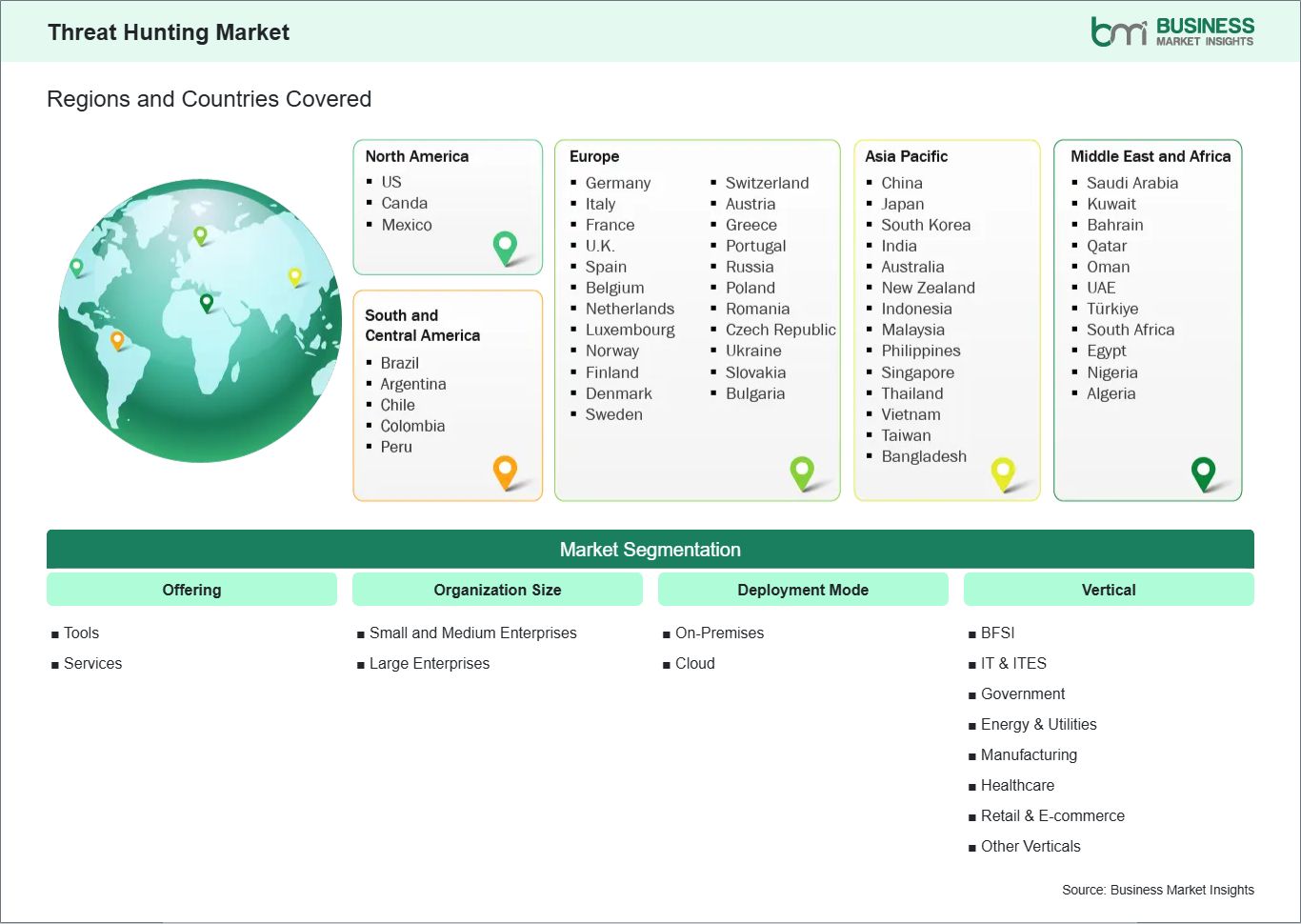
Regions and Countries Covered
North America US, Canada, Mexico
Europe Belgium, Austria, Finland, Denmark, Greece, Poland, Romania, Russia, Ukraine, Czech Republic, Slovakia, Bulgaria, Italy, Luxembourg, Germany, Switzerland, France, Netherlands, Norway, Portugal, Spain, Sweden, United Kingdom
Asia-Pacific Australia, China, India, Japan, South Korea, Indonesia, Malaysia, Philippines, Singapore, Thailand, Vietnam, Bangladesh, New Zealand, Taiwan
South and Central America Brazil, Argentina, Peru, Chile, Colombia
Middle East and Africa Bahrain, Kuwait, Oman, Qatar, Saudi Arabia, United Arab Emirates, Turkiye, South Africa, Egypt, Algeria, Nigeria
Market leaders and key company profiles
  • IBM
  • Kaspersky
  • Capgemini
  • CrowdStrike
  • Trustwave
  • Verizon
  • SecureWorks
  • Sangfor
  • Eviden
  • Rapid7
Get more information on this report

Threat Hunting Market Report Coverage and Deliverables:

The "Threat Hunting Market Size and Forecast (2022 - 2033)" report provides a detailed analysis of the market covering below areas:

  • Threat Hunting Market size and forecast at global, regional, and country levels for all the key market segments covered under the scope
  • Threat Hunting Market trends, as well as drivers, restraints, and opportunities
  • Threat Hunting Market analysis covering key trends, global and regional framework, major players, regulations, and recent developments
  • Industry landscape and competition analysis covering market concentration, heat map analysis, prominent players, and recent developments for the Threat Hunting Market
  • Detailed company profiles, including SWOT analysis

Threat Hunting Market Geographic Insights:

The geographical scope of the Threat Hunting Market report is divided into North America, Asia Pacific, Europe, Middle East & Africa, and South & Central America. North America held the largest share in 2025.

North America is the leading segment in the Threat Hunting Market due to its established cybersecurity ecosystem, large number of tech vendors, and stringent regulatory standards that promote threat hunting. Organizations in the US and Canada are increasingly integrating threat hunting into their security operation centers, utilizing advanced analytics, artificial intelligence, and machine learning tools to identify complex attacks before they get out of hand. Europe is second in line, with growing adoption in industries such as finance, manufacturing, and healthcare, with regulatory standards such as GDPR that focus on data security and security compliance.

The Asia Pacific segment is growing rapidly due to increased digitalization, cloud adoption, and cyberattacks, with countries such as Japan, Australia, India, and Singapore increasingly adopting threat hunting as organizations outsource threat detection services to managed service providers due to skill shortages. The Middle East and African regions are experiencing a gradual growth in the market for cybersecurity as governments and key sectors of critical infrastructure are focusing on cybersecurity initiatives. In addition,

South and Central America are experiencing growth in the threat hunting market, driven by factors such as increased rates of cybercrime, digitalization of financial services, and increased awareness of the importance of proactive mitigation of threats by enterprises.

However, the growth of the threat hunting market in these regions is hindered by factors such as inadequate infrastructure and a lack of skilled cybersecurity personnel. It is observed that all regions are focusing on reducing dwell time, strengthening SOCs, and integrating threat intelligence into existing security infrastructure. Although the rate of adoption varies in different regions depending on factors such as technological maturity, regulatory environments, and cybersecurity awareness, it is observed that the global trend indicates a strong focus on proactive, intelligent threat hunting as a key aspect of cybersecurity, with North America leading the way in terms of early adoption, technological maturity, and investment in SOCs.

global-market-geography
Get more information on this report

Threat Hunting Market Research Report Guidance:

  • The report includes qualitative and quantitative data in the Threat Hunting Market across offering, organization size, deployment mode, vertical, threat type and geography.
  • The report starts with the key takeaways (chapter 2), highlighting key trends and outlook of the Threat Hunting Market.
  • Chapter 3 focuses on the research methodology of the study.
  • Chapter 4 includes ecosystem analysis.
  • Chapter 5 highlights the major industry dynamics in the Threat Hunting Market, including factors that are driving the market, prevailing deterrents, potential opportunities, as well as future trends. Impact analysis of these drivers and restraints is also covered in this section.
  • Chapter 6 discusses the Threat Hunting Market scenario, in terms of historical market revenues, and forecast till the year 2033.
  • Chapters 7 to 12 cover Threat Hunting Market segments by offering, organization size, deployment mode, vertical, threat type and geography across North America, Asia Pacific, Europe, Middle East & Africa, and South & Central America. They cover the market revenue forecast and factors driving the market.
  • Chapter 13 describes the competitive analysis along with the heat map analysis for the key players operating in the market.
  • Chapter 14 describes the industry landscape analysis. It provides detailed descriptions of business activities such as market initiatives, new developments, mergers, and joint ventures globally, along with a competitive landscape.
  • Chapter 15 provides detailed profiles of the major companies operating in the Threat Hunting Market. Companies have been profiled on the basis of their key facts, business descriptions, products, financial overview, SWOT analysis, and key developments.
  • Chapter 16, i.e., the appendix, is inclusive of a brief overview of the company, a list of abbreviations, and a disclaimer.

Threat Hunting Market News and Key Development:

The Threat Hunting Market is evaluated by gathering qualitative and quantitative data post primary and secondary research, which includes important corporate publications, association data, and databases. A few of the key developments in the threat hunting market are:

  • In April 2025, Intel 471 announced that its HUNTER Platform, an intelligence‑driven threat hunting solution, strengthened its global capabilities with enhanced threat hunting features designed to help security teams hunt advanced threat behaviors that evade traditional detection mechanisms. The platform’s enhancements were introduced following the integration of threat hunting capabilities and expanded its customer base significantly.
  • In April 2025, CrowdStrike announced that it delivered an industry‑first managed threat hunting solution across third‑party data through its Falcon® Adversary OverWatch Next‑Gen SIEM platform, extending expert‑led threat hunting visibility beyond traditional endpoints and identity sources to include unmanaged attack surfaces, thereby broadening the scope of global threat hunting operations.

Key Sources Referred:

  • World Health Organization (WHO)
  • Organisation for Economic Cooperation and Development (OECD)
  • The World Bank Group
  • Worldometer
  • The Lancet
  • International Bar Association
  • International Trade Administration
The List of Companies - Threat Hunting Market
  • IBM
  • Kaspersky
  • Capgemini
  • CrowdStrike
  • Trustwave
  • Verizon
  • SecureWorks
  • Sangfor
  • Eviden
  • Rapid7
Frequently Asked Questions
How big is the Threat Hunting Market?

The Threat Hunting Market is valued at US$ 3.96 Billion in 2025, it is projected to reach US$ 12.03 Billion by 2033.

What is the CAGR for Threat Hunting Market by (2026 - 2033)?

As per our report Threat Hunting Market, the market size is valued at US$ 3.96 Billion in 2025, projecting it to reach US$ 12.03 Billion by 2033. This translates to a CAGR of approximately 14.90% during the forecast period.

What segments are covered in this report?

The Threat Hunting Market report typically cover these key segments-

  • Offering (Tools, Services)
  • Organization Size (Small and Medium Enterprises (SMEs), Large Enterprises)
  • Deployment Mode (On-Premises, Cloud)
  • Vertical (BFSI, IT & ITES, Government, Energy & Utilities, Manufacturing, Healthcare, Retail & E-commerce, Other Verticals)

What is the historic period, base year, and forecast period taken for Threat Hunting Market?

The historic period, base year, and forecast period can vary slightly depending on the specific market research report. However, for the Threat Hunting Market report:

  • Historic Period : 2022-2024
  • Base Year : 2025
  • Forecast Period : 2026-2033
  • Who are the major players in Threat Hunting Market?

    The Threat Hunting Market is populated by several key players, each contributing to its growth and innovation. Some of the major players include:

  • IBM
  • Kaspersky
  • Capgemini
  • CrowdStrike
  • Trustwave
  • Verizon
  • SecureWorks
  • Sangfor
  • Eviden
  • Rapid7
  • Who should buy this report?

    The Threat Hunting Market report is valuable for diverse stakeholders, including:

    • Investors: Provides insights for investment decisions pertaining to market growth, companies, or industry insights. Helps assess market attractiveness and potential returns.
    • Industry Players: Offers competitive intelligence, market sizing, and trend analysis to inform strategic planning, product development, and sales strategies.
    • Suppliers and Manufacturers: Helps understand market demand for components, materials, and services related to concerned industry.
    • Researchers and Consultants: Provides data and analysis for academic research, consulting projects, and market studies.
    • Financial Institutions: Helps assess risks and opportunities associated with financing or investing in the concerned market.

    Essentially, anyone involved in or considering involvement in the Threat Hunting Market value chain can benefit from the information contained in a comprehensive market report.

    Available Report Formats

    pdf-format excel-format pptx-format
    Buy Now
    Sales Assistance
    +1 646 791 7070 (US & UK)
    Customization Form

    Please tell us your area of interest
    (Market Segments/ Regions and Countries/ Companies)