
Thin Film Encapsulation Market Outlook: Size, Share, Trends, Growth Analysis, Competitive Landscape & Forecast, 2026-2033

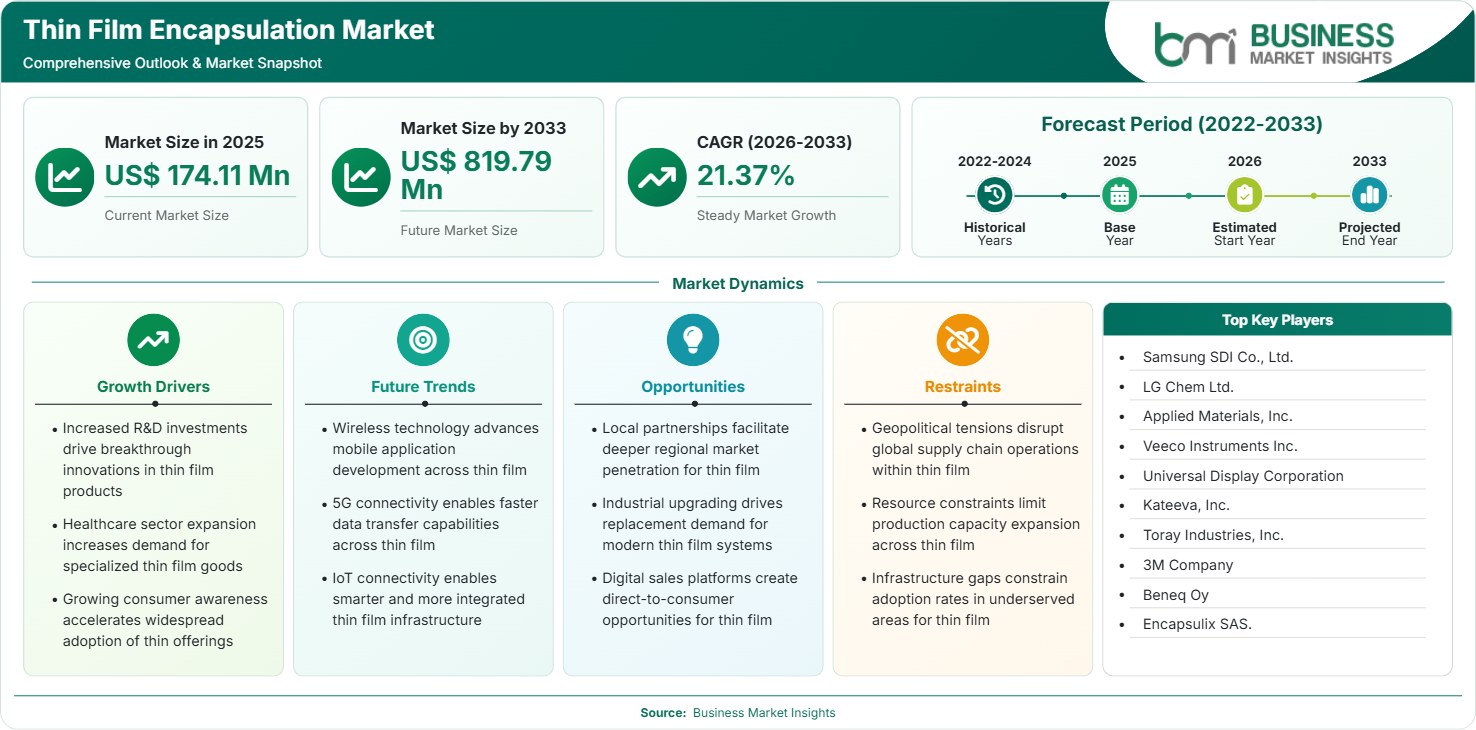
The Thin Film Encapsulation Market size was valued at US$ 174.11 Million in 2025 and is projected to reach US$ 819.79 Million by 2033, growing at a CAGR of 21.37% during 2026–2033, driven by flexible OLED adoption, advanced barrier technologies, foldable electronics expansion, and rising photovoltaic integration opportunities.

Report Coverage
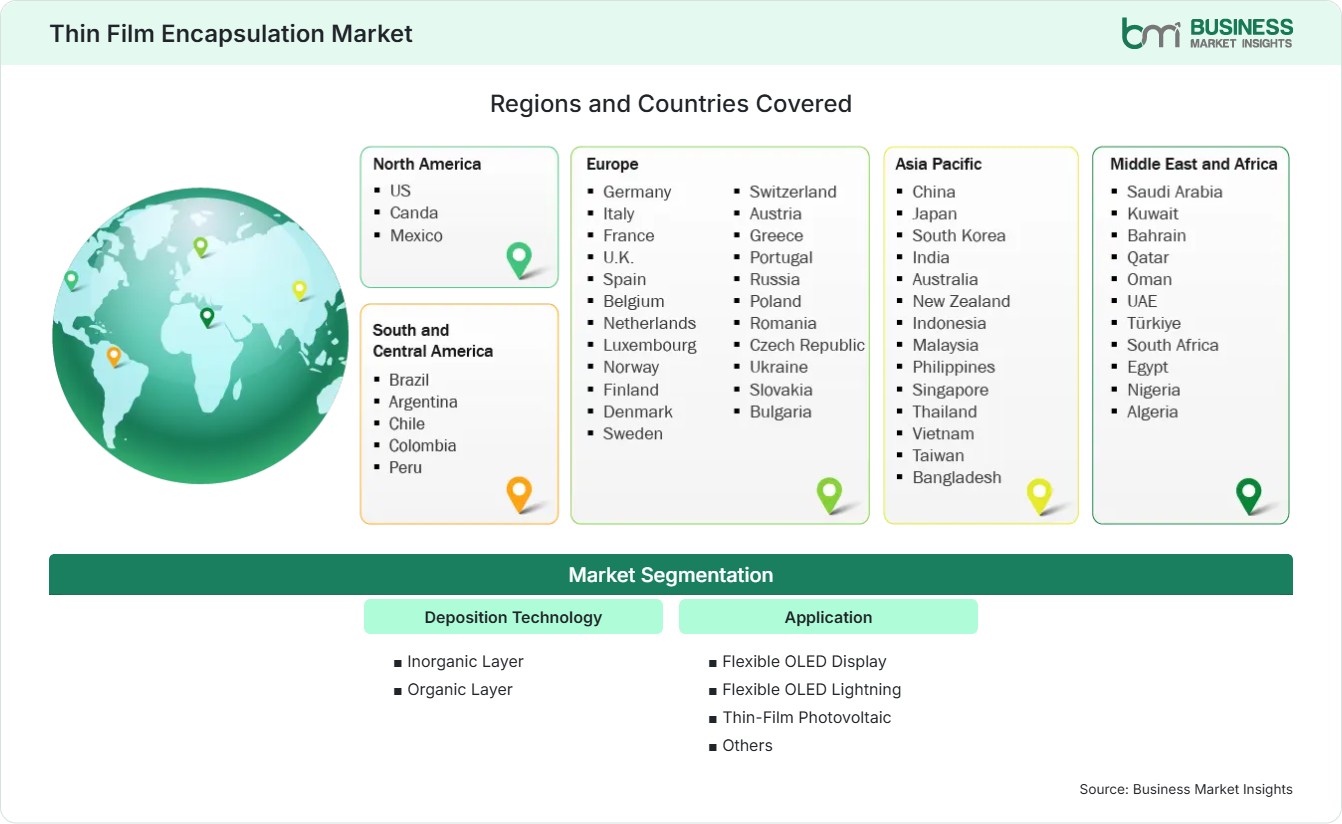
  • Deposition Technology: Inorganic Layer, Organic Layer
  • Application: Flexible OLED Display, Flexible OLED Lightning, Thin-Film Photovoltaic, Others
US$ 174.11 Mn Market size in 2025
US$ 819.79 Mn Market Size by 2033
21.37% CAGR, 2026 - 2033
2026-2033 Forecast Period

AI Overview

Thin Film Encapsulation Market Summary

  • North America Region: North America holds a Thin Film Encapsulation Market share of 24%–27% in 2025, growing with a CAGR of 18%–20% during 2026–2033. Demand is supported by OLED innovation, semiconductor investments, advanced deposition equipment deployment, barrier material development, display manufacturing collaborations, research commercialization, wearable electronics expansion, domestic supply chain strengthening, and sustainability-focused production initiatives globally. The U.S. accounts for 76%–80% of regional demand and advances at 18.5%–20.5% CAGR through electronics innovation and equipment investments.
  • Fastest Growing Region: Asia Pacific holds a market share of 42%–46% in 2025, growing with a CAGR of 23%–25% during 2026–2033. Growth is fueled by large-scale OLED capacity additions, display manufacturing leadership, expanding consumer electronics production, government-backed semiconductor programs, material innovation, foldable device demand, photovoltaic integration, and increasing capital expenditure across technology ecosystems.
  • Leading Segment: Flexible OLED Display holds a Thin Film Encapsulation Market share of 48%–52% in 2025, growing with a CAGR of 21%–23% during 2026–2033. Expansion reflects rising smartphone penetration, foldable displays, lightweight device designs, higher durability requirements, premium display differentiation, improved encapsulation performance, manufacturing optimization, longer product lifecycles, and enhanced user experience expectations.
  • High Growth Segment: Thin-Film Photovoltaic holds a market share of 16%–20% in 2025, growing with a CAGR of 24%–26% during 2026–2033. Adoption benefits from renewable energy deployment, flexible solar applications, lightweight module requirements, improved moisture resistance, efficiency gains, sustainable infrastructure projects, distributed power generation, and advanced coating technologies supporting durability.
  • Key Market Opportunity: Commercialization of ultra-thin barrier structures for foldable electronics and next-generation microdisplays creates opportunities for premium performance, lower defect rates, extended operational life, manufacturing efficiency, and differentiated product development.
  • Major Market Players: Samsung SDI Co., Ltd.; LG Chem Ltd.; Applied Materials, Inc.; Veeco Instruments Inc.; Universal Display Corporation; Kateeva, Inc.; Toray Industries, Inc.; 3M Company; Beneq Oy; Encapsulix SAS.
Strategic Insights

Thin Film Encapsulation Market: Strategic Insights

Thin Film Encapsulation Market Strategic Framework
FREE PDF
Request your free sample
Request free sample
Stakeholder View

Key Takeaways

  • The value chain is increasingly integrated, with deposition equipment vendors, barrier material suppliers, OLED manufacturers, and device brands collaborating to reduce defect rates and improve production yields.
  • Flexible displays and thin-film photovoltaic applications present the strongest revenue upside due to rising demand for lightweight, durable, and bendable electronic components.
  • Research spending is shifting toward multilayer barrier stacks combining inorganic and organic films that achieve superior moisture protection without compromising flexibility.
  • Asia Pacific remains the most compelling expansion destination due to concentrated display manufacturing ecosystems, established supplier networks, and substantial production capacity additions.
  • Strategic partnerships, technology licensing agreements, and targeted acquisitions are becoming common as companies seek proprietary encapsulation expertise and manufacturing scale.
  • Microdisplays for augmented reality and mixed reality systems are creating premium-margin opportunities that require highly reliable encapsulation performance.
Geographic Outlook

Thin Film Encapsulation Market Regional Highlights

North America Thin Film Encapsulation Market

North America accounted for 24%–27% of global revenue in 2025 and is projected to expand at a CAGR of 18%–20% through 2033. Regional demand is concentrated in advanced electronics, display equipment development, and research commercialization. The Thin Film Encapsulation Market share in North America benefits from strong semiconductor investment, innovation ecosystems, and intellectual property portfolios. Growing adoption of wearable electronics, defense displays, and micro-OLED technologies supports continued expansion. Partnerships between materials developers and equipment suppliers enhance technology deployment and process reliability.

  • U.S.-based technology firms continue investing in advanced deposition systems, supporting high-performance OLED manufacturing and improved encapsulation reliability across next-generation consumer and industrial electronics applications.
  • Expansion of augmented reality and mixed reality ecosystems is increasing demand for microdisplay protection technologies with superior barrier performance and extended operational durability.
  • Collaborative research among universities, national laboratories, and technology companies accelerates commercialization of lower-temperature encapsulation methods suitable for flexible substrates.
  • Semiconductor reshoring initiatives indirectly support ecosystem development by strengthening equipment supply networks and promoting localized advanced manufacturing capabilities.

US Thin Film Encapsulation Market

The United States represents 76%–80% of North American demand and is expected to register an 18.5%–20.5% CAGR during 2026–2033. The market benefits from leadership in display manufacturing equipment, materials science innovation, and advanced electronics research. Strong investment in AR/VR devices, aerospace displays, and semiconductor infrastructure sustains technology adoption. Large corporations and specialized technology suppliers continue expanding development programs focused on high-barrier, low-defect encapsulation solutions.

  • Advanced display equipment providers are introducing integrated deposition and encapsulation platforms that improve manufacturing efficiency and support scaling for larger display formats.
  • Growing demand from defense, aviation, and medical visualization applications supports deployment of long-lifetime OLED technologies.
  • Venture funding and strategic partnerships encourage commercialization of novel barrier materials capable of improving flexibility and device longevity.

Europe Thin Film Encapsulation Market

Europe accounted for 20%–23% of global revenue in 2025 and is estimated to register a CAGR of 19%–21% through 2033. Germany is the most rapidly adopting country in the region, whereas France is one of the fastest-growing countries, with growth of 21%–23%. The regional demand is driven by technical expertise in advanced materials, industrial automation technology, and renewable energy. Innovation in the electronics sector drives developments in flexible displays and photovoltaic systems, which require robust encapsulation performance and manufacturing precision.

  • German engineering expertise supports development of advanced coating systems and precision manufacturing tools used in barrier layer production.
  • French technology companies are expanding research activities in organic electronics, creating demand for next-generation encapsulation materials.
  • Sustainability and energy-efficiency targets encourage adoption of lightweight electronic components and flexible renewable-energy technologies.
  • Collaborative EU-funded research programs accelerate innovation in atomic layer deposition and hybrid barrier architectures.

Asia Pacific Thin Film Encapsulation Market

The Asia Pacific has accounted for 42%–46% of worldwide revenue in 2025 and will continue to be the leading regional market over the next few years, growing at a CAGR of 23%-25% through 2033. China, South Korea, and Japan dominate technology production and deployment, whereas India is one of the rapidly expanding markets, with growth at 24%-26%. Asia Pacific is characterized by electronics manufacturing clusters, OLED fabrication plants, and investments in display capacity building. The Thin Film Encapsulation Market share remains highest in the Asia Pacific region due to vertically integrated supply chains and strong consumer electronics output.

  • South Korean display leaders continue investing in advanced flexible OLED production technologies supported by sophisticated encapsulation processes.
  • Chinese manufacturers are expanding display fabrication capacity, requiring larger volumes of deposition materials and production equipment.
  • Japanese companies maintain strong positions in specialty materials, process engineering, and precision equipment for barrier layer development.
  • Government incentives across several countries encourage domestic electronics production and supply chain localization.
  • Rapid adoption of foldable smartphones and wearable devices supports sustained demand for high-performance encapsulation solutions.

Rest of World Thin Film Encapsulation Market

Rest of World accounts for 9%–12% of global revenue and is expected to grow at a CAGR of 20%–22% between 2026 and 2033. South & Central America are witnessing rising electronics assembly activity and renewable-energy investments. Meanwhile, Middle East & Africa markets are attracting technology infrastructure investments supporting advanced materials adoption. Brazil leads Latin American demand, whereas the United Arab Emirates demonstrates one of the fastest technology adoption rates across the region.

  • Brazil's manufacturing ecosystem supports incremental adoption of advanced display and electronic component technologies.
  • Renewable-energy deployment increases attention toward flexible photovoltaic applications requiring reliable environmental protection layers.
  • Gulf economies are investing in technology diversification strategies that encourage advanced materials research and electronics innovation.
  • Regional partnerships with global technology providers facilitate access to specialized deposition equipment and process expertise.
Global Market Geography
FREE PDF
Request your free sample
Request free sample
Segment Analysis

Thin Film Encapsulation Market Segmentation

Deposition Technology

This category held a market revenue share of 54%–58% in 2025 and was forecast to grow at a CAGR of 21%–23%. The scope of the Thin Film Encapsulation Market is expanding as companies develop technologies with barrier structures that offer durability, transparency, flexibility, and high throughput. The choice of technology is determined by water resistance needs, substrates, and other criteria.

  • Inorganic Layer: Widely adopted for superior barrier performance against moisture and oxygen ingress. Atomic layer deposition and PECVD technologies support high durability, improved transparency, and enhanced operational lifetimes across demanding display applications.
  • Organic Layer: Utilized to relieve mechanical stress, improve flexibility, and complement inorganic barriers. Growth is supported by foldable electronics, multilayer stack designs, and compatibility with advanced inkjet deposition approaches.

Application

Application-based demand is influenced by changes in electronics design and the growing need for light, high-reliability products. Flexible OLED Display will dominate the market with a 48%-52% share and a 21%-23% CAGR in 2025, whereas the Thin Film Encapsulation Market trends are influenced by growing use in photovoltaics and lighting solutions.

  • Flexible OLED Display: Primary consumption segment driven by smartphones, tablets, wearables, and foldable devices. Performance requirements emphasize long lifetimes, thin profiles, optical clarity, and resistance to environmental degradation.
  • Flexible OLED Lighting: Adoption is supported by architectural lighting, automotive interiors, and decorative illumination applications. Encapsulation enhances durability while enabling thin, lightweight, and aesthetically versatile lighting solutions.
  • Thin-Film Photovoltaic: Increasing deployment in portable energy systems, building-integrated photovoltaics, and lightweight solar installations expands demand for advanced barrier technologies capable of long-term environmental protection.
Market Forces

Thin Film Encapsulation Market Dynamics

Key Market Drivers

Expansion of Flexible OLED Manufacturing Capacity

The adoption of OLED technology in smartphones, tablets, folding phones, and wearables continues to gain momentum, thus creating a strong need for state-of-the-art moisture and oxygen barriers. Investment by the industry in next-generation display fabrication facilities in Asia has boosted display output and increased the need for efficient encapsulation technologies. Flexible devices cannot rely on the old technology of using glass, hence making multilayered encapsulation systems inevitable. The need to increase yields, reduce thickness, and prolong product lifetimes has led to the adoption of atomic layer deposition and hybrid barrier films. The need for premium-quality screens and capacity expansion has become a fundamental driver of the adoption of these technologies by screen manufacturers and material suppliers.

Rising Need for Ultra-Low Moisture Barrier Performance

Organic electronics are highly sensitive to environmental exposure, leading to high technical demands for encapsulation materials. Organizations, both research institutions and industrial organizations, continue to pursue reductions in water vapor transmission to extend the lifetimes of these products. Growth in the thin-film encapsulation market is driven by the increasing need to deploy devices in harsh environments, such as wearable and automotive electronics. Advancements in deposition precision, layering design, and process uniformity lead to improved results. Equipment providers provide equipment that can accommodate these advanced barriers while meeting throughput requirements.

Advancements in Atomic Layer Deposition Technologies

Atomic layer deposition is gaining wider commercial acceptance because it enables highly uniform, pinhole-free coatings at relatively low process temperatures. Companies such as Beneq and other equipment suppliers promote ALD-based encapsulation solutions for sensitive OLED structures. Superior process control enables thinner films, greater flexibility, and enhanced reliability compared to traditional methods. In line with the increasing complexity of display structures, deposition processes have become increasingly important. Further development of manufacturing automation, measurement equipment, and new materials justifies the use of sophisticated deposition processes, supporting broader implementation across high-performance electronics production environments.

Key Market Opportunities

Commercialization of AR and VR Microdisplays

Micro-OLED displays used in augmented reality and virtual reality systems require exceptional barrier performance due to their small form factors and demanding operating conditions. With increasing consumer and enterprise uptake, encapsulation providers can target premium end markets distinguished by their high technical needs and high margins. Development of immersive technologies continues across hardware manufacturers, semiconductor companies, and software communities. Encapsulation techniques that enable long lifetimes, low defect counts, and optical performance are anticipated to be highly enabling. Opportunities are created for material suppliers, deposition equipment manufacturers, and process technology providers.

Flexible Solar Energy Deployment

With more people showing interest in lightweight renewable energy technology, there is an increasing need for encapsulation systems to safeguard photovoltaic materials against environmental degradation. Portable electricity generation, building-integrated PV applications, transport applications, and remote infrastructure development projects are among the growth sectors. The Thin Film Encapsulation Market Forecasts increasingly make clear that emerging solar application markets have an opportunity to benefit from the flexibility and durability of thin-film encapsulation.

Development of Hybrid Multilayer Barrier Architectures

Materials that incorporate both inorganic and organic components are becoming increasingly popular owing to their ability to combine flexibility and efficiency. Further advancements could enable performance capabilities necessary for the next generation of foldable devices, rollable displays, and innovative lighting technologies. Companies have been funding research into improved bonding capabilities, reduced stress build-up, and increased clarity. The commercialization of such materials would broaden the scope of potential applications while reducing the cost of ownership by increasing durability. These trends offer great potential for IP differentiation and future supplier positioning.

Market Restraints and Challenges

High Production Complexity and Capital Requirements

Factor: Advanced encapsulation manufacturing depends on specialized equipment, precise process control, and extensive materials expertise. Impact: High capital expenditure can limit adoption among smaller manufacturers and increase commercialization timelines. Production environments often require tight contamination control and sophisticated quality assurance systems. Multilayer deposition sequences further elevate operating complexity and introduce yield management challenges. Companies entering the industry frequently encounter substantial development costs before achieving commercial-scale production. These barriers can slow capacity additions and create concentration among established suppliers with greater technical resources and manufacturing experience.

Material Compatibility and Reliability Limitations

Factor: Encapsulation layers must maintain adhesion, transparency, and barrier performance while accommodating thermal and mechanical stress. Impact: Performance inconsistencies can shorten device lifetimes and increase warranty risks for manufacturers. As products become thinner and more flexible, maintaining long-term reliability becomes increasingly difficult. Variation in deposition conditions, substrate characteristics, and material interfaces can influence results significantly. Extensive validation testing is often required before commercial deployment, extending development cycles. Addressing compatibility concerns remains essential for achieving broader adoption in demanding electronics and energy applications.

Company Analysis

Competitive Landscape

Thin Film Encapsulation Market analysis indicates competition is centered on deposition platforms, barrier materials, intellectual property, and partnerships with OLED manufacturers.

Company Name

Overview

Products and Services relevant to this market

Samsung SDI Co., Ltd.

Advanced materials and electronics company supporting display supply chains and barrier technology innovation.

OLED-related materials, encapsulation technologies, specialty electronic materials, manufacturing support solutions.

LG Chem Ltd.

Major materials supplier with extensive involvement in advanced display and electronic-material ecosystems.

OLED materials, advanced films, barrier technologies, specialty chemical solutions.

Applied Materials, Inc.

Leading semiconductor and display equipment provider with strong deposition technology portfolio.

Thin-film encapsulation systems, deposition equipment, OLED manufacturing solutions.

Veeco Instruments Inc.

Develops precision process equipment used in advanced electronics and thin-film manufacturing.

Deposition systems, process technology platforms, manufacturing equipment.

Universal Display Corporation

OLED technology innovator focused on materials and intellectual property development.

OLED materials, licensing solutions, performance enhancement technologies.

Kateeva, Inc.

Specialist in inkjet-based manufacturing systems serving flexible display producers.

Inkjet deposition systems, encapsulation process equipment, OLED manufacturing platforms.

Toray Industries, Inc.

Diversified materials company with capabilities in films and advanced functional materials.

Barrier films, specialty polymers, electronic materials solutions.

3M Company

Global technology company serving electronics manufacturing and specialty materials markets.

Protective films, barrier materials, adhesive technologies, display solutions.

Beneq Oy

Atomic layer deposition specialist focused on advanced coating and encapsulation applications.

ALD equipment, OLED encapsulation systems, moisture barrier technologies.

Encapsulix SAS

Thin-film coating specialist serving advanced electronics and research markets.

Encapsulation equipment, deposition solutions, barrier coating technologies.

Trust & Transparency

Research Methodology

The market analysis combines proprietary research with secondary data from government agencies, company disclosures, regulatory filings, industry databases and expert interviews. Market estimates are validated through data triangulation, cross-market benchmarking and analyst review.

View Full Research Methodology

Questions Answered

Frequently Asked Questions

What does this Thin Film Encapsulation Market Report help stakeholders evaluate?

The report helps assess technology adoption patterns, investment opportunities, regional competitiveness, application demand, supply-chain developments, and strategic positioning within emerging flexible electronics ecosystems.

Which region offers the strongest investment potential?

Asia Pacific offers the strongest investment potential because it combines large OLED manufacturing capacity, extensive supplier ecosystems, government support, and ongoing display production expansion.

Why is atomic layer deposition gaining attention in this industry?

Atomic layer deposition provides highly uniform coatings, excellent conformality, low-temperature processing, and strong moisture barrier performance, making it suitable for advanced flexible electronic applications.

What application generates the highest demand for these technologies?

Flexible OLED displays account for the greatest demand due to widespread use in smartphones, wearables, tablets, and foldable consumer electronics requiring lightweight and durable barrier structures.

What is the primary factor driving adoption of thin-film encapsulation technologies?

The need to protect OLED and other moisture-sensitive electronic devices from oxygen and water ingress is the leading adoption factor, particularly for flexible and foldable product designs where glass encapsulation is unsuitable.

Access the Full Thin Film Encapsulation Market Report

Get segment-level forecasts, regional estimates, competitive benchmarking, company profiles and downloadable Excel datasets.

Access the full Thin Film Encapsulation Market Report
350 pages PDF & Excel | 2026-08-28