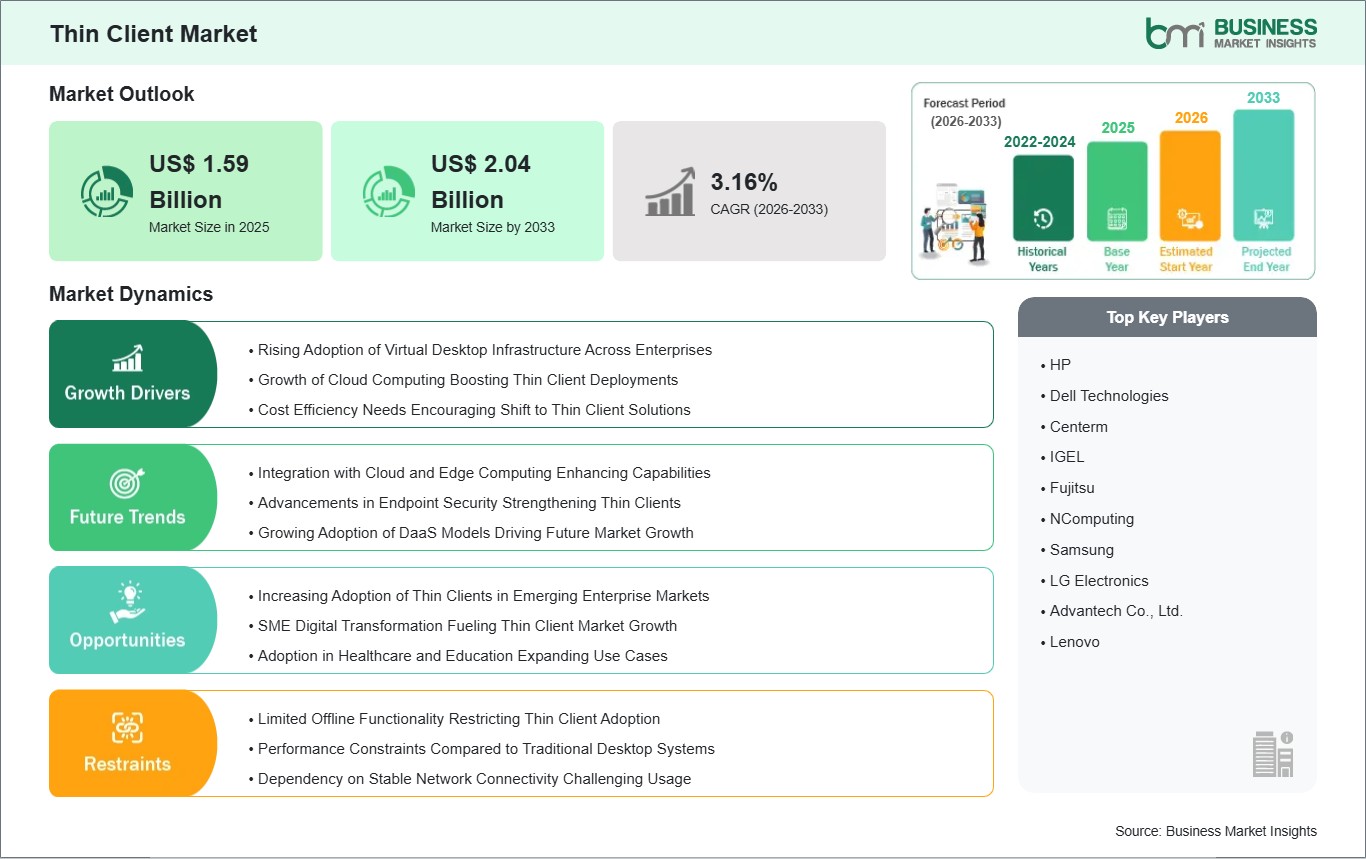
The Thin Client Market size is expected to reach US$ 2.04 billion by 2033 from US$ 1.59 billion in 2025. The market is estimated to record a CAGR of 3.16% from 2026 to 2033.
The global thin client market is recording steady growth as organizations continue to modernize their IT infrastructure, moving towards centralized computing systems. Thin clients, which operate on centralized computing systems or cloud-based systems, are increasingly being used in organizations seeking to minimize the complexities associated with traditional endpoints, improve security, and reduce the management burden on the IT team. With the acceleration of digital transformation initiatives across the globe, organizations are moving from traditional desktop computing systems to virtual desktop infrastructure and cloud-based computing systems, which has increased the relevance of thin clients, especially in organizations with a large number of endpoints across geographies.
Another important factor contributing to the growth of the thin client market is the increased focus on cybersecurity and data protection, as thin clients store minimal data, allowing organizations to have better control over data with centralized data management systems. Banking, healthcare, government, and education sectors are increasingly using thin client technology to ensure the secure usage of enterprise systems while preventing data breaches and device usage issues. In addition, thin client devices require less power compared to traditional desktop devices, thereby aligning with the sustainability goals of the enterprise, which focus on the green initiatives of the organization. However, the market for thin client devices comes with certain limitations as well.
The performance of thin client technology is largely dependent on the availability of a strong network connection, as the server plays a vital role in the operation of thin client devices. In regions where the availability of a strong network connection is still inconsistent, organizations are reluctant to move from traditional desktop devices to thin client technology. In addition, the adoption of thin client technology involves a certain level of investment in virtualization technology, which acts as a hindrance for small-scale organizations with limited IT budgets.

Key segments that contributed to the derivation of the thin client market analysis are form factor and application.
The growing implementation of Virtual Desktop Infrastructure (VDI) across global enterprises is a key factor driving demand for thin clients. Organizations are increasingly shifting toward centralized computing models to simplify IT operations and improve system security. In a VDI environment, applications and data are hosted on centralized servers or cloud platforms, while thin clients act as secure endpoints for users. This architecture allows companies to manage software updates, access permissions, and system monitoring from a central location, reducing administrative complexity and improving operational efficiency across large enterprise networks.
The expansion of digital workplaces and hybrid working models has further accelerated VDI adoption worldwide. Many enterprises are adopting virtual desktop environments to ensure employees can securely access corporate applications from different locations and devices. Thin clients support this transition by providing reliable and secure access points while minimizing local hardware requirements. As organizations continue to prioritize centralized IT management and flexible work environments, the adoption of VDI-enabled thin client infrastructure is expected to expand across multiple industries.
Emerging enterprise markets are increasingly adopting thin client solutions as businesses modernize their IT infrastructure and pursue cost-efficient computing environments. Organizations in developing economies are focusing on centralized computing models that reduce hardware maintenance and improve system scalability. Thin clients provide an attractive solution for enterprises that need to deploy large numbers of workstations while maintaining centralized control over applications and data. This approach helps organizations reduce operational costs associated with device upgrades, maintenance, and energy consumption.
Industries such as education, government services, and outsourcing centers are contributing significantly to thin client adoption in emerging markets. These sectors often require standardized computing environments where multiple users access centralized applications and databases. Thin clients enable institutions to deploy large computing networks while maintaining simplified management and improved security. As digital infrastructure and enterprise IT spending continue to grow in emerging economies, the adoption of thin client technologies is expected to expand steadily across a wide range of organizational environments.
The thin client market demonstrates steady growth, with size and share analysis highlighting evolving trends and competitive dynamics among key players. The report examines subsegments categorized within form factor and application, offering insights into their contribution to overall market performance.
By form factor, the standalone subsegment dominated the market in 2025, driven by their cost-effectiveness and ease of deployment in centralized enterprise IT environments.
Based on application, the healthcare subsegment dominated the market in 2025, driven by the requirement for secure, centralized access to patient data and electronic medical records.
| Report Attribute | Details |
|---|---|
| Market size in 2025 | US$ 1.59 Billion |
| Market Size by 2033 | US$ 2.04 Billion |
| Global CAGR (2026 - 2033) | 3.16% |
| Historical Data | 2022-2024 |
| Forecast period | 2026-2033 |
| Segments Covered | By Form Factor
|
|
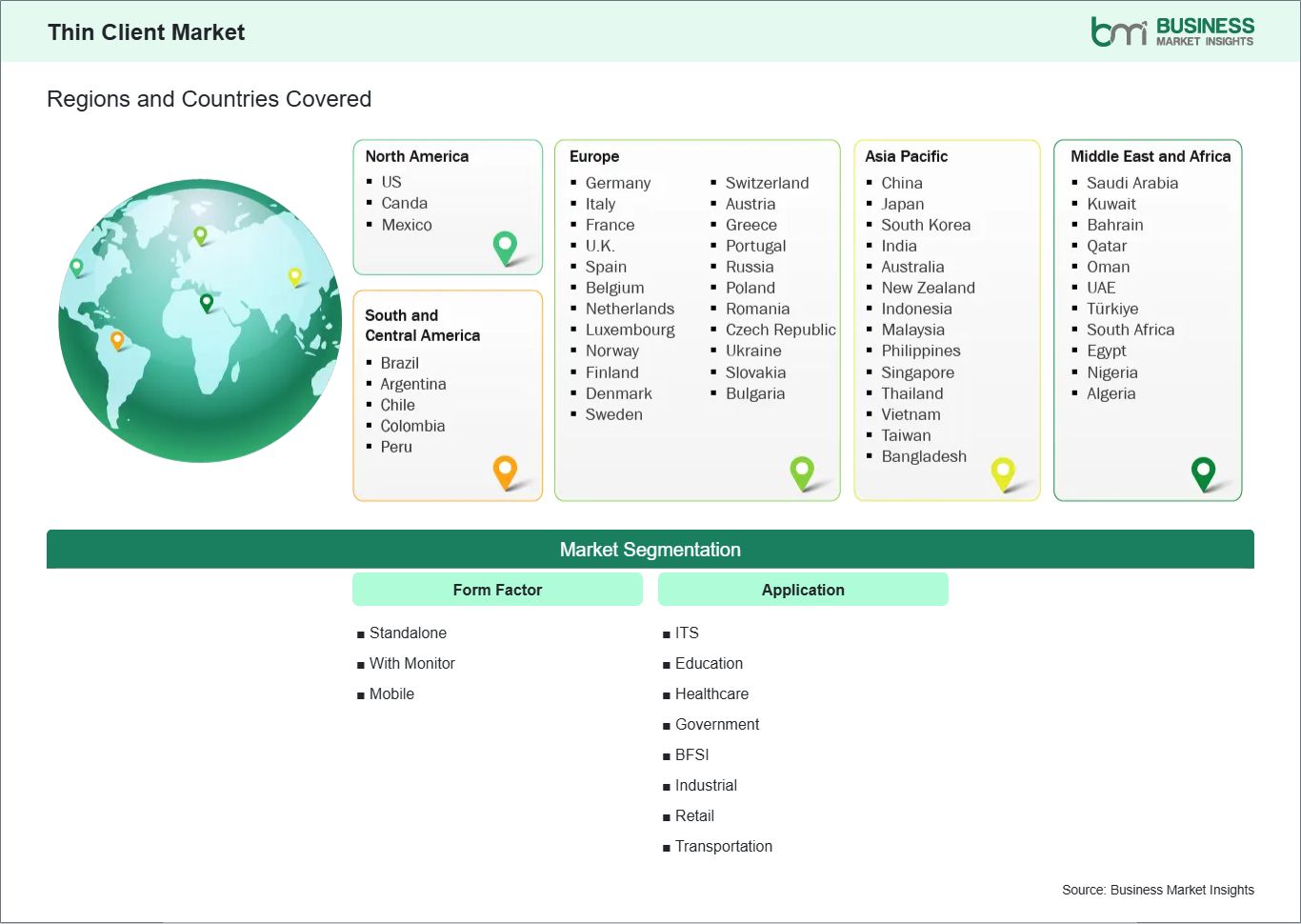
Regions and Countries Covered
| |
| North America | US, Canada, Mexico |
| Europe | Belgium, Austria, Finland, Denmark, Greece, Poland, Romania, Russia, Ukraine, Czech Republic, Slovakia, Bulgaria, Italy, Luxembourg, Germany, Switzerland, France, Netherlands, Norway, Portugal, Spain, Sweden, United Kingdom |
| Asia-Pacific | Australia, China, India, Japan, South Korea, Indonesia, Malaysia, Philippines, Singapore, Thailand, Vietnam, Bangladesh, New Zealand, Taiwan |
| South and Central America | Brazil, Argentina, Peru, Chile, Colombia |
| Middle East and Africa | Bahrain, Kuwait, Oman, Qatar, Saudi Arabia, United Arab Emirates, Turkiye, South Africa, Egypt, Algeria, Nigeria |
| Market leaders and key company profiles |
|
The "Thin Client Market Size and Forecast (2022 - 2033)" report provides a detailed analysis of the market covering below areas:
The geographical scope of the Thin Client Market report is divided into North America, Asia Pacific, Europe, Middle East & Africa, and South & Central America. North America held the largest share in 2025.
The Global Thin Client Market is characterized by regional differences, and as a result, the North American region is seen as the leader in the Thin Client Market due to the high maturity level of IT infrastructure in this region. Thin clients are gaining popularity in this region as enterprises in the United States and Canada are increasingly adopting thin clients for centralized IT infrastructure management, improved data security, and support for flexible work styles such as remote and hybrid work. Some of the key industries in this region, such as banking, healthcare, government, and education, are heavily dependent on thin clients for secure access to critical data and for effective IT infrastructure management. The presence of prominent technology companies, virtualization technology providers, and cloud companies is also contributing to the leadership role of this region in the Thin Client Market.
Asia Pacific is another key market for thin clients due to the increasing number of digital transformation initiatives in this region. This is due to the increasing demand from industries such as education, IT outsourcing, and healthcare, as well as government initiatives towards digital governance and smart cities. In Europe, the market is growing steadily, with factors such as stringent data security policies, energy-saving initiatives, and virtualization, as well as cloud-based desktop solutions, driving market growth, especially in public sector enterprises and healthcare institutions.
In Middle East & Africa, there is a growth trend, with countries such as the UAE, Saudi Arabia, and South Africa adopting centralized computing solutions, such as virtualization, to increase workplace productivity, reduce operational costs, and improve data security, especially in banking, telecom, and government institutions.
Finally, South & Central America is a developing market, where organizations such as those in Brazil, Mexico, and Argentina are increasingly adopting thin client solutions, especially in the education, BFSI, and government segments, to increase IT efficiencies, reduce hardware maintenance costs, and address data security concerns. Thus, while there is growth in all regions, there is no denying that factors such as increasing digitalization, cloud computing, and centralized IT solutions continue to drive the global thin client market.

The Thin Client Market is evaluated by gathering qualitative and quantitative data post primary and secondary research, which includes important corporate publications, association data, and databases. A few of the key developments in the thin client market are:
The Thin Client Market is valued at US$ 1.59 Billion in 2025, it is projected to reach US$ 2.04 Billion by 2033.
As per our report Thin Client Market, the market size is valued at US$ 1.59 Billion in 2025, projecting it to reach US$ 2.04 Billion by 2033. This translates to a CAGR of approximately 3.16% during the forecast period.
The Thin Client Market report typically cover these key segments-
The historic period, base year, and forecast period can vary slightly depending on the specific market research report. However, for the Thin Client Market report:
The Thin Client Market is populated by several key players, each contributing to its growth and innovation. Some of the major players include:
The Thin Client Market report is valuable for diverse stakeholders, including:
Essentially, anyone involved in or considering involvement in the Thin Client Market value chain can benefit from the information contained in a comprehensive market report.
Please tell us your area of interest
(Market Segments/ Regions and Countries/ Companies)