Market Summary
Executive Summary and Global Market Analysis
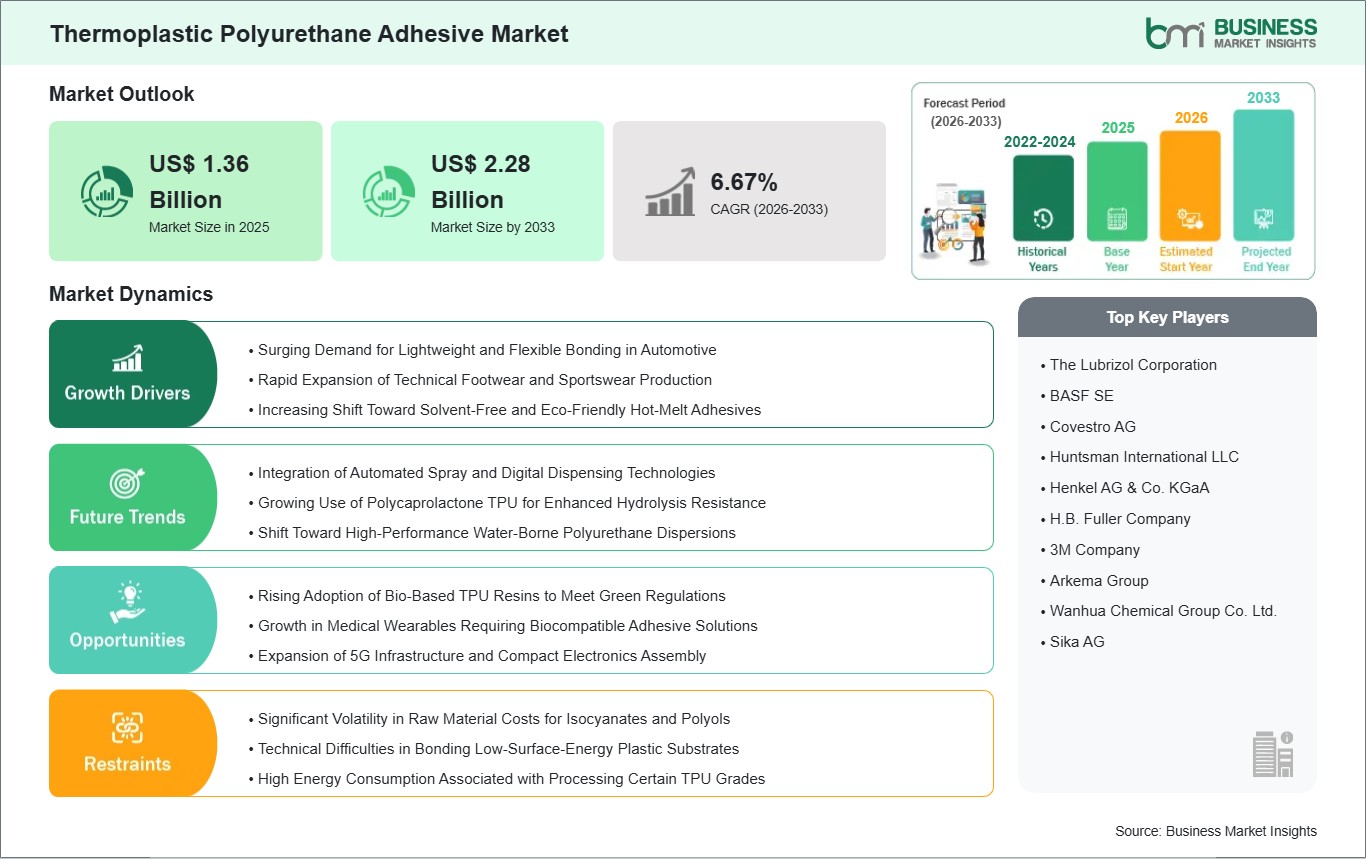
The global thermoplastic polyurethane adhesive market is characterized by its rapid adaptation to modern industrial requirements for flexibility, durability, and environmental compliance. These adhesives provide an intermediate bonding solution between rigid structural adhesives and flexible elastic performance. Therefore, the adhesive market is considered an essential component in a variety of industries, including high-fashion footwear and advanced automotive applications. As a result of technological developments in hot-melt formulations, the adhesive market will continue to grow due to global demand for lightweight materials, as well as the shift towards chemical bonding instead of mechanical fastening. As a result of this trend, TPUs with high peel strength and rapid set times are among the most sought-after adhesives in the manufacturing of high-volume products.
Strategic growth in the market is also being fueled by the rise of smart electronics and medical wearables, where thin-film bonding and biocompatibility are paramount. Despite challenges such as raw material price fluctuations, the market remains resilient due to the continuous development of specialty grades like polycaprolactone-based TPUs, which offer superior resistance to moisture and microbial attack. Looking forward, the industry is poised for a significant shift toward water-borne and bio-renewable systems as sustainability mandates become more stringent. With a strong manufacturing base in Asia-Pacific and a high-tech innovation core in North America, the market is set to remain a vital component of the global specialty chemicals landscape.
Segment Analysis
Thermoplastic Polyurethane Adhesive Market Segmentation
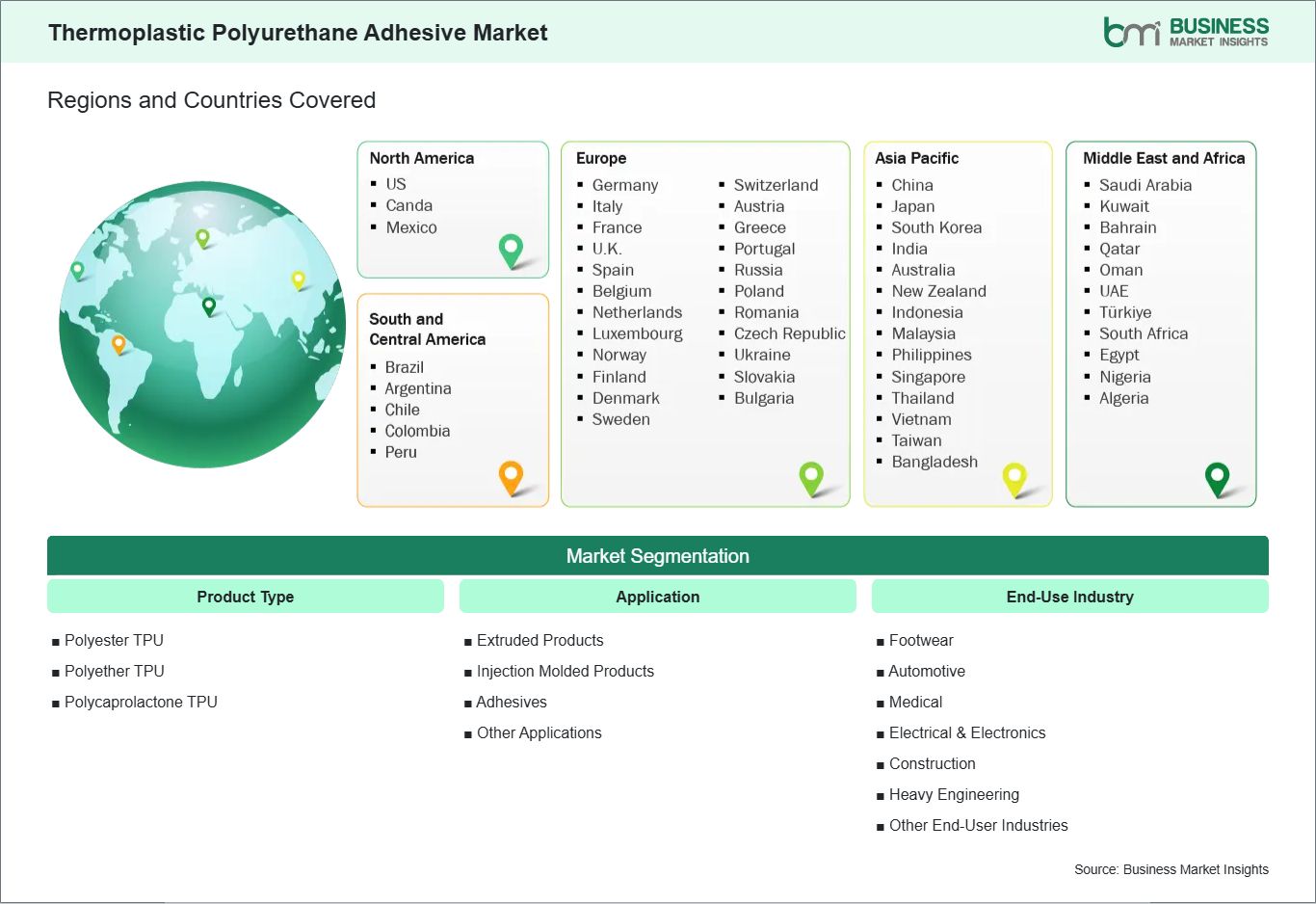
Key segments that contributed to the derivation of the Thermoplastic Polyurethane Adhesive market analysis are product type, application, and end-use industry.
- By product type, the Thermoplastic Polyurethane Adhesive market is segmented into Polyester TPU, Polyether TPU, and Polycaprolactone TPU. The Polyester TPU segment dominated the market in 2025.
- By application, the Thermoplastic Polyurethane Adhesive market is segmented into Extruded Products, Injection Molded Products, Adhesives, and Other Applications. The Adhesives segment dominated the market in 2025.
- By end-use industry, the Thermoplastic Polyurethane Adhesive market is segmented into Footwear, Automotive, Medical, Electrical & Electronics, Construction, Heavy Engineering, and Other End-User Industries. The Footwear segment dominated the market in 2025.
Market Forces
Thermoplastic Polyurethane Adhesive Market Drivers and Opportunities
Surging Demand for Lightweight and Flexible Bonding in Automotive
The global automotive industry is undergoing a significant transition toward vehicle lightweighting to enhance fuel efficiency and extend the range of electric vehicles. Thermoplastic polyurethane adhesives have become a cornerstone of this movement, offering a high-strength alternative to traditional mechanical fasteners and heavy epoxy resins. These adhesives allow for the seamless bonding of dissimilar materials, such as plastics to metals or textiles to composites, which is essential for modern interior trims, headliners, and instrument panels. By reducing the overall weight of the vehicle`s interior and structural components, manufacturers can achieve better energy economy without compromising the safety or durability of the vehicle's assembly.
Besides the reduction of weight, the inherent flexibility of adhesives is critical to coping with the stresses of thermal expansion and vibration, which are characteristics of the environment of a car. The increasing tendency of modern automobiles to integrate electronic sensors and digital displays means that the need to use adhesives that can cope with vibration and impact is critical. The flexibility of TPU-based bonding agents at a wide range of temperatures ensures that interior components of a car do not come loose or rattle over the product lifecycle. The structural and functional characteristics of this adhesive make it a choice product for original equipment manufacturers of premium cabin space and environmentally friendly products.
Rising Adoption of Bio-Based TPU Resins to Meet Green Regulations
Environmental sustainability, which was previously a goal for corporations, is now a major driver for the market, as global regulators are enforcing more stringent limits on volatile organic compounds and carbon emissions. The creation and commercialization of bio-based thermoplastic polyurethane adhesives can be a significant opportunity for businesses to deliver on the principles of a circular economy. This is because they are based on renewable resources, such as castor oil or other plant-based polyols, which can eliminate a significant carbon footprint from traditional petrochemical-based adhesives. This is especially evident in textile and footwear brands, which are under pressure from consumers to deliver fully recyclable and environmentally friendly products.
The shift toward bio-based formulations does not come at the expense of performance, as modern green TPU resins now match the durability, heat resistance, and peel strength of their synthetic counterparts. Manufacturers are increasingly investing in research to optimize the curing profiles and substrate compatibility of these sustainable adhesives to ensure they can be integrated into existing high-speed production lines. As government procurement policies begin to favor materials with verified bio-content, the market for sustainable TPU adhesives is expected to move from niche applications into high-volume industrial standards. This trend is fostering a new wave of innovation in polymer chemistry, aimed at creating fully biodegradable adhesive systems for the packaging and consumer goods industries.
Size and Share Analysis
Thermoplastic Polyurethane Adhesive Market Size and Share Analysis
The global Thermoplastic Polyurethane Adhesive market is experiencing steady growth, with market size and share analysis reflecting evolving treatment preferences and competitive dynamics among key players. The report evaluates important subsegments categorized within product type, application, and end-use industry, highlighting their respective contributions to overall market performance.
By product type, the Polyester TPU subsegment dominated the market in 2025 due to its superior mechanical properties, high tensile strength, and excellent oil and chemical resistance, which are critical for high-stress bonding applications in industrial and automotive sectors.
By application, the Adhesives subsegment dominated the market in 2025 due to the surging demand for high-performance hot-melt and solvent-based bonding solutions that offer rapid curing times and exceptional flexibility across diverse substrates like leather, textiles, and plastics.
By end-use industry, the Footwear subsegment dominated the market in 2025 due to the massive global production of athletic and technical footwear, where these adhesives are indispensable for bonding outsoles, midsoles, and uppers while maintaining lightweight and flexible performance characteristics.
Report Coverage
Thermoplastic Polyurethane Adhesive Market Report Coverage and Deliverables
The "Thermoplastic Polyurethane Adhesive Market Size and Forecast (2022 - 2033)" report provides a detailed analysis of the market covering below areas:
- Thermoplastic Polyurethane Adhesive market size and forecast at the regional and country levels for segments covered under the scope
- Thermoplastic Polyurethane Adhesive market trends, as well as drivers, restraints, and opportunities
- Thermoplastic Polyurethane Adhesive market analysis covering key trends, regional framework, major players, regulations, and recent developments
- Industry landscape and competition analysis covering market concentration, heat map analysis, prominent players, and recent developments for the Thermoplastic Polyurethane Adhesive market
- Detailed company profiles, including SWOT analysis
Geographic Insights
Thermoplastic Polyurethane Adhesive Market Geographic Insights
The geographical scope of the Thermoplastic Polyurethane Adhesive market report is divided into: North America, Asia Pacific, Europe, Middle East & Africa, and South & Central America. North America held the largest share in 2025.
North America maintains a commanding lead in the thermoplastic polyurethane adhesive market, supported by a highly sophisticated industrial infrastructure and an early-adopter culture for advanced material science. The region's dominance is largely anchored in its massive aerospace and defense sectors, alongside a rapidly evolving automotive industry that is pioneering electric vehicle technologies. In the United States, major chemical manufacturers and adhesive specialists are focusing on high-value, low-VOC formulations that meet stringent environmental standards set by regional agencies. This focus on premium, high-performance adhesives has made North America the primary hub for the development of medical-grade and electronic-grade TPU bonding solutions, where precision and reliability are more critical than bulk volume.
Furthermore, the regional market benefits from a strong trend toward reshoring and the automation of manufacturing processes. North American companies are at the forefront of integrating robotic dispensing and 3D-printing technologies that utilize TPU adhesives for complex industrial applications. The growth of the regional market is also bolstered by a robust consumer goods sector that demands high-quality, durable products ranging from outdoor equipment to premium electronics. While manufacturing volume is high in other regions, the North American market distinguishes itself through its concentration of research and development activities and its leadership in the transition toward bio-based and sustainable adhesive chemistries. This innovative edge ensures that North America remains the focal point for the global commercialization of next-generation thermoplastic polyurethane technologies.
Industry Activity
Recent Developments
The Thermoplastic Polyurethane Adhesive market is evaluated by gathering qualitative and quantitative data post primary and secondary research, which includes important corporate publications, association data, and databases. A few of the key developments in the Thermoplastic Polyurethane Adhesive market are:
- In May 2024, The Lubrizol Corporation, announced the launch of Pearlbond™ ECO 590 HMS, a bio‑based thermoplastic polyurethane (TPU) resin designed for hot melt adhesive (HMA) and extrusion applications, offering renewable content and improved processability for adhesives used in furniture, textiles, electronics, and transportation.
- In August 2025, Henkel AG & Co. KGaA, announced the introduction of Technomelt EM 335 RE, a new alkali‑dispersible TPU hot‑melt adhesive tailored for PET bottle labeling that enables up to 98 % adhesive removal during recycling, supporting circular packaging goals and regulatory compliance in Europe.
- In September 2025, The Lubrizol Corporation, showcased next‑generation TPU specialties including advanced formulations for cables, films, and adhesives at the K 2025 trade show, highlighting broader commercial rollout and application support for hot melts and adhesive extrusion solutions.
Trust & Transparency
Research Methodology
The market analysis combines proprietary research with secondary data from government agencies, company disclosures, regulatory filings, industry databases and expert interviews. Market estimates are validated through data triangulation, cross-market benchmarking and analyst
review.
View Full Research Methodology
Key Sources Referred:
American Chemistry Council (ACC)International Council of Chemical Associations (ICCA)European Chemical Industry Council (Cefic)China National Packaging Industry Association (CNPIA)Indian Institute of Packaging (IIP)Japan Packaging Institute (JPI)Gulf Petrochemicals and Chemicals Association (GPCA)Company WebsitesCompany Annual ReportsCompany Investor Presentations