Market Summary
Executive Summary and Global Market Analysis
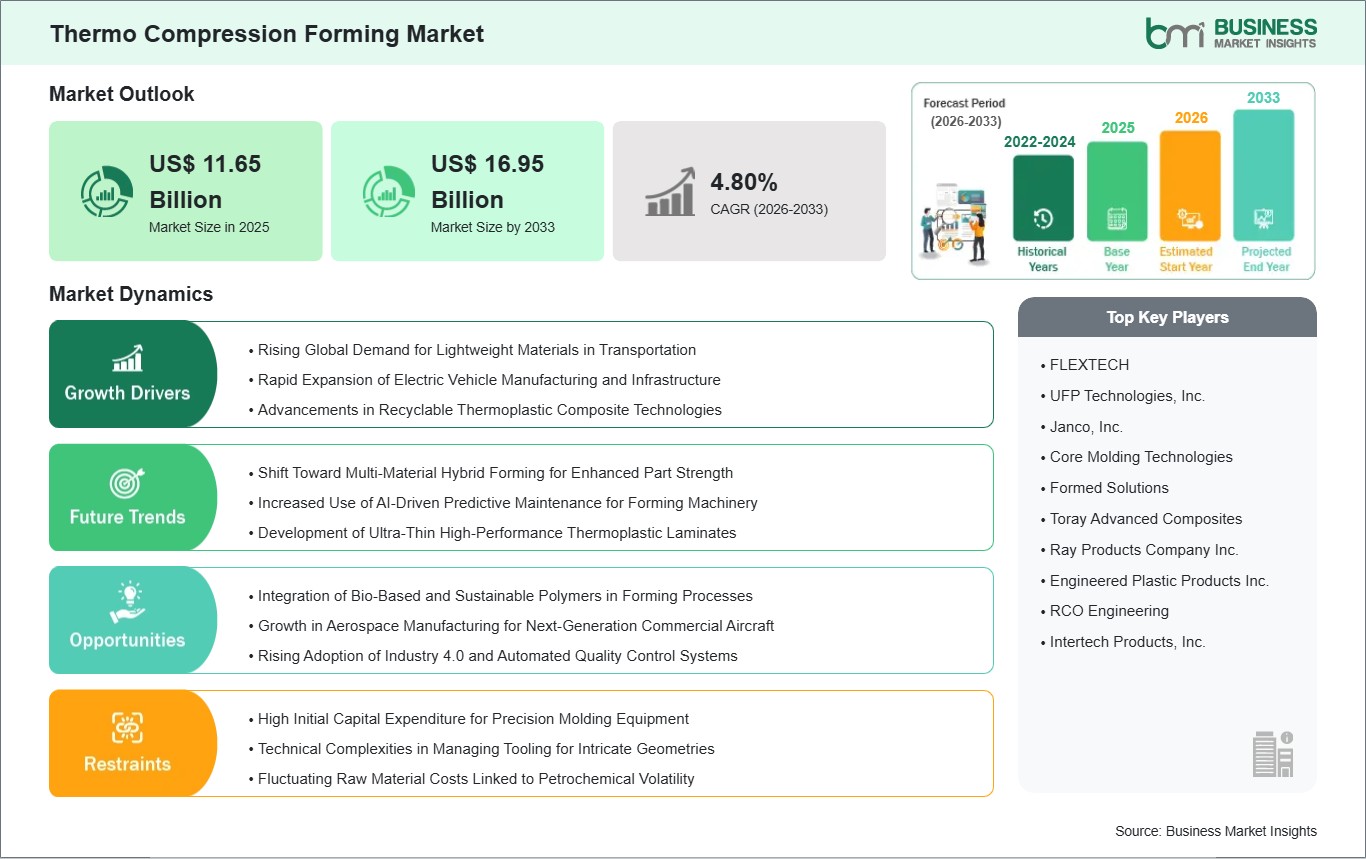
The global thermo compression forming market is undergoing a growth phase where the need for high-performance and lightweight products is a pressing concern for the industrial world. This form of manufacturing has been established as a benchmark for various industries where precision-designed components are required to perform under considerable stress while still being cost-effectively produced. The integration of high-performance thermoplastic foam and glass mat composite materials has enabled the market to move beyond the realm of basic protective packaging components to more demanding applications in the automotive, aerospace, and medical industries. Advances in material science, especially the creation of high-heat-resistant polymers, are further extending the capabilities of the components produced by this method.
Strategic investments in automation technologies and the application of Industry 4.0 concepts have greatly improved the efficiency of thermo compression lines. By using real-time sensor technologies and automated pressure control systems, manufacturers are now able to achieve higher yields and lower rejection rates. This has effectively mitigated the disadvantages related to high initial investment costs. With the increasing focus on environmentally friendly practices in global supply chains, the market is now witnessing a shift towards more environmentally friendly resins and energy-efficient processes. With a strong foothold in North American industrial centers and a high growth rate in the Asia-Pacific region, the thermo compression forming market is now positioned as a key enabler for the future of green manufacturing
Segment Analysis
Thermo Compression Forming Market Segmentation
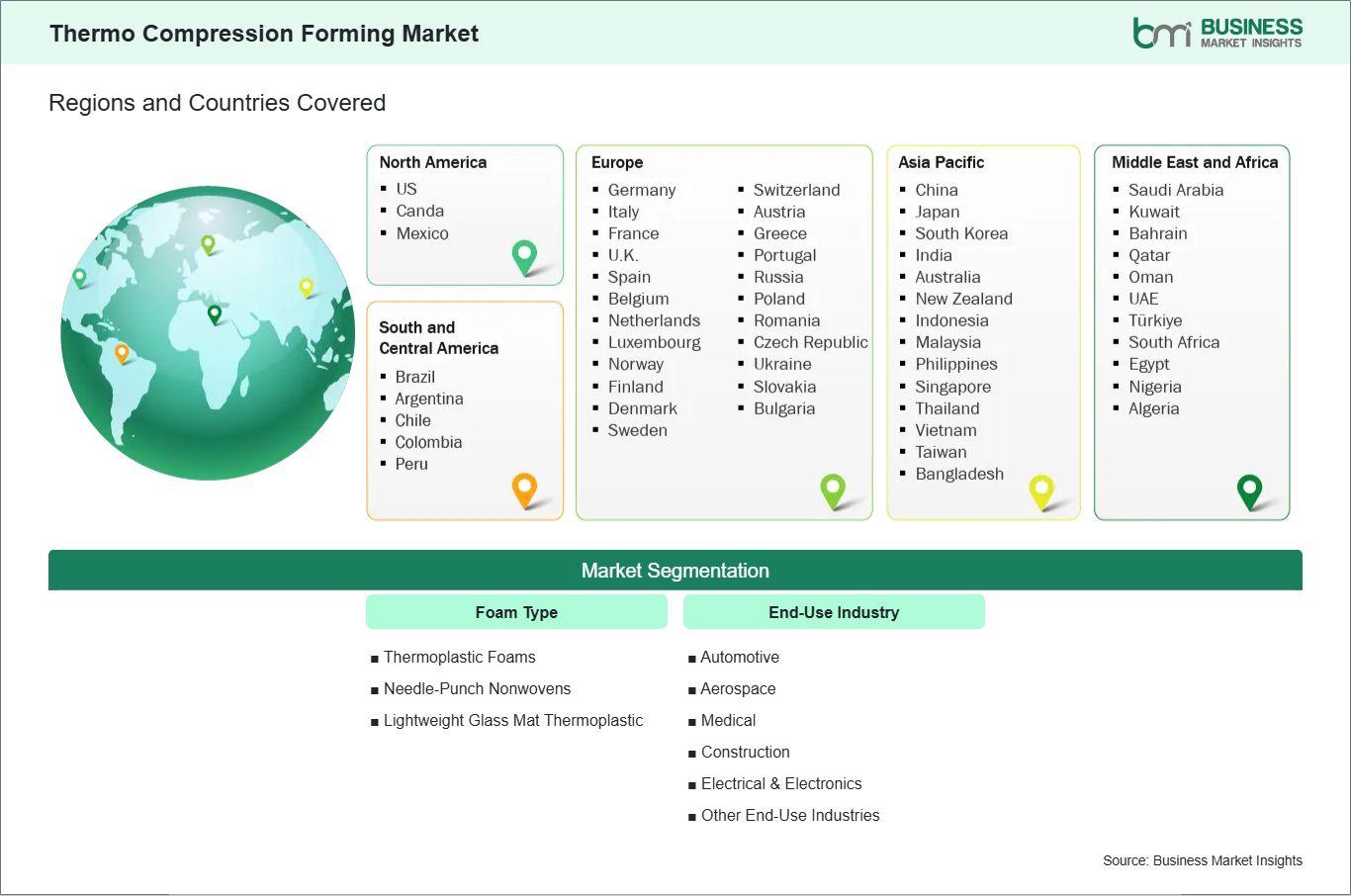
Key segments that contributed to the derivation of the Thermo Compression Forming market analysis are foam type and end use industry.
- By foam type, the thermo compression forming market is segmented into Thermoplastic Foams, Needle-Punch Nonwovens, and Lightweight Glass Mat Thermoplastic. The Thermoplastic Foams segment dominated the market in 2025.
- By end-use industry, the thermo compression forming market is segmented into Automotive, Aerospace, Medical, Construction, Electrical & Electronics, and Other End-Use Industries. The Automotive segment dominated the market in 2025.
Market Forces
Thermo Compression Forming Market Drivers and Opportunities
Rising Global Demand for Lightweight Materials in Transportation
The global drive for fuel efficiency and the reduction of carbon emissions is one of the major drivers for the use of thermo compression forming. In the automotive and aerospace industries, reducing the overall weight of a vehicle translates directly to fuel efficiency and increased payload capacity. This method of manufacturing can provide the ability to design structural components that are much lighter than their metal counterparts without a loss in performance. This can be accomplished by utilizing the latest advances in thermoplastic composite materials to design a complex formed component that can replace several components within a vehicle or aircraft frame.
Beyond simple weight reduction, these materials offer enhanced vibration damping and acoustic insulation, which are critical for passenger comfort. The ability to fine-tune the density and orientation of the reinforcement fibers during the compression process enables engineers to optimize parts for specific stress points. As environmental regulations become increasingly stringent across Europe and North America, the transition from traditional steel and aluminum to high-performance formed plastics is moving from a luxury option to a standard manufacturing requirement. This structural shift ensures a steady demand for precision forming technologies that can handle the unique thermal profiles of advanced polymers.
Integration of Bio-Based and Sustainable Polymers in Forming Processes
The move towards a circular economy is creating a huge opportunity for the development and utilization of sustainable resins in thermo compression forming processes. Traditional plastics are under growing pressure from both regulators and consumers to prove their green credentials, creating a need for alternative materials that have a lower environmental impact without compromising on performance. New families of sustainable thermoplastics, developed from sustainable raw materials such as corn starch or cellulose, are being developed specifically for high-pressure forming processes. They can be processed using conventional thermo compression forming equipment, minimizing disruption for the end user in making the change to a more sustainable material.
Furthermore, the inherent recyclability of thermoplastics provides a distinct advantage over thermoset materials, which are often difficult to reclaim at the end of a product's life cycle. In a thermo compression setup, off-cuts and scraps from the production process can often be reground and reintegrated into the supply chain, significantly reducing material waste. This capability aligns with the corporate sustainability goals of major original equipment manufacturers in the electronics and medical sectors. As the technology for bio-resins matures, the ability to market products as fully recyclable or carbon-neutral will become a powerful competitive differentiator for players in the forming industry.
Size and Share Analysis
Thermo Compression Forming Market Size and Share Analysis
The global Thermo Compression Forming market is experiencing steady growth, with market size and share analysis reflecting evolving treatment preferences and competitive dynamics among key players. The report evaluates important subsegments categorized within foam type and end use industry highlighting their respective contributions to overall market performance.
By foam type, the Thermoplastic Foams subsegment dominated the market in 2025 due to its exceptional strength-to-weight ratio, recyclability, and versatility in processing, which allows manufacturers to create highly durable yet lightweight structural components for demanding industrial and consumer-facing applications.
By end-use industry, the Automotive subsegment dominated the market in 2025 due to the aggressive push for vehicle lightweighting and the surging production of electric vehicles, where thermoformed components are essential for battery enclosures, interior panels, and aerodynamic structural parts to improve range.
Report Coverage
Thermo Compression Forming Market Report Coverage and Deliverables
The "Thermo Compression Forming Market Size and Forecast (2022 - 2033)" report provides a detailed analysis of the market covering below areas:
- Thermo Compression Forming market size and forecast at the regional and country levels for segments covered under the scope
- Thermo Compression Forming market trends, as well as drivers, restraints, and opportunities
- Thermo Compression Forming market analysis covering key trends, regional framework, major players, regulations, and recent developments
- Industry landscape and competition analysis covering market concentration, heat map analysis, prominent players, and recent developments for the Thermo Compression Forming market
- Detailed company profiles, including SWOT analysis
Geographic Insights
Thermo Compression Forming Market Geographic Insights
The geographical scope of the Thermo Compression Forming market report is divided into: North America, Asia Pacific, Europe, Middle East & Africa, and South & Central America. North America held the largest share in 2025.
North America stands as the most influential region in the thermo compression forming market, underpinned by a mature industrial base and a high concentration of aerospace and defense giants. The United States, in particular, has seen massive investments in advanced manufacturing facilities that leverage thermoforming to produce mission-critical components for commercial aviation and space exploration. The region's leadership is further supported by a robust research and development infrastructure, where collaborations between material scientists and machinery manufacturers have led to the commercialization of specialized thermoplastic composites that offer industry-leading durability and heat resistance.
In addition to the aerospace sector, the North American automotive industry is a major driver of regional growth. The rapid pivot toward electric vehicle production in the U.S. and Canada has created a localized demand for lightweight battery enclosures and interior structural elements produced via thermo compression. Furthermore, the region benefits from a well-established medical device manufacturing sector that utilizes this technology for sterilized trays and equipment housings. Stringent quality standards and a preference for high-precision, automated production have made North America the primary hub for high-value thermo compression applications. As reshoring initiatives continue to bring manufacturing back to the continent, the regional market is expected to maintain its dominant position through technological superiority and supply chain integration.
Industry Activity
Recent Developments
The Thermo Compression Forming market is evaluated by gathering qualitative and quantitative data post primary and secondary research, which includes important corporate publications, association data, and databases. A few of the key developments in the Thermo Compression Forming market are:
- In January 2026, Amcor Plc, announced investments to expand its thermoforming capabilities across North America and Europe, particularly targeting sustainable healthcare packaging applications.
- In December 2025, Sonoco Products Company, announced the acquisition of Thermoform Engineered Quality (TEQ), strengthening its portfolio in thermoformed and compression-based packaging for medical and pharmaceutical applications.
Trust & Transparency
Research Methodology
The market analysis combines proprietary research with secondary data from government agencies, company disclosures, regulatory filings, industry databases and expert interviews. Market estimates are validated through data triangulation, cross-market benchmarking and analyst
review.
View Full Research Methodology
Key Sources Referred:
American Chemistry Council (ACC) International Council of Chemical Associations (ICCA) European Chemical Industry Council (Cefic) China Petroleum and Chemical Industry Federation (CPCIF) Indian Chemical Council (ICC) Japan Chemical Industry Association (JCIA) Brazilian Chemical Industry Association (ABIQUIM) Gulf Petrochemicals and Chemicals Association (GPCA) Company Websites Company Annual Reports Company Investor Presentations