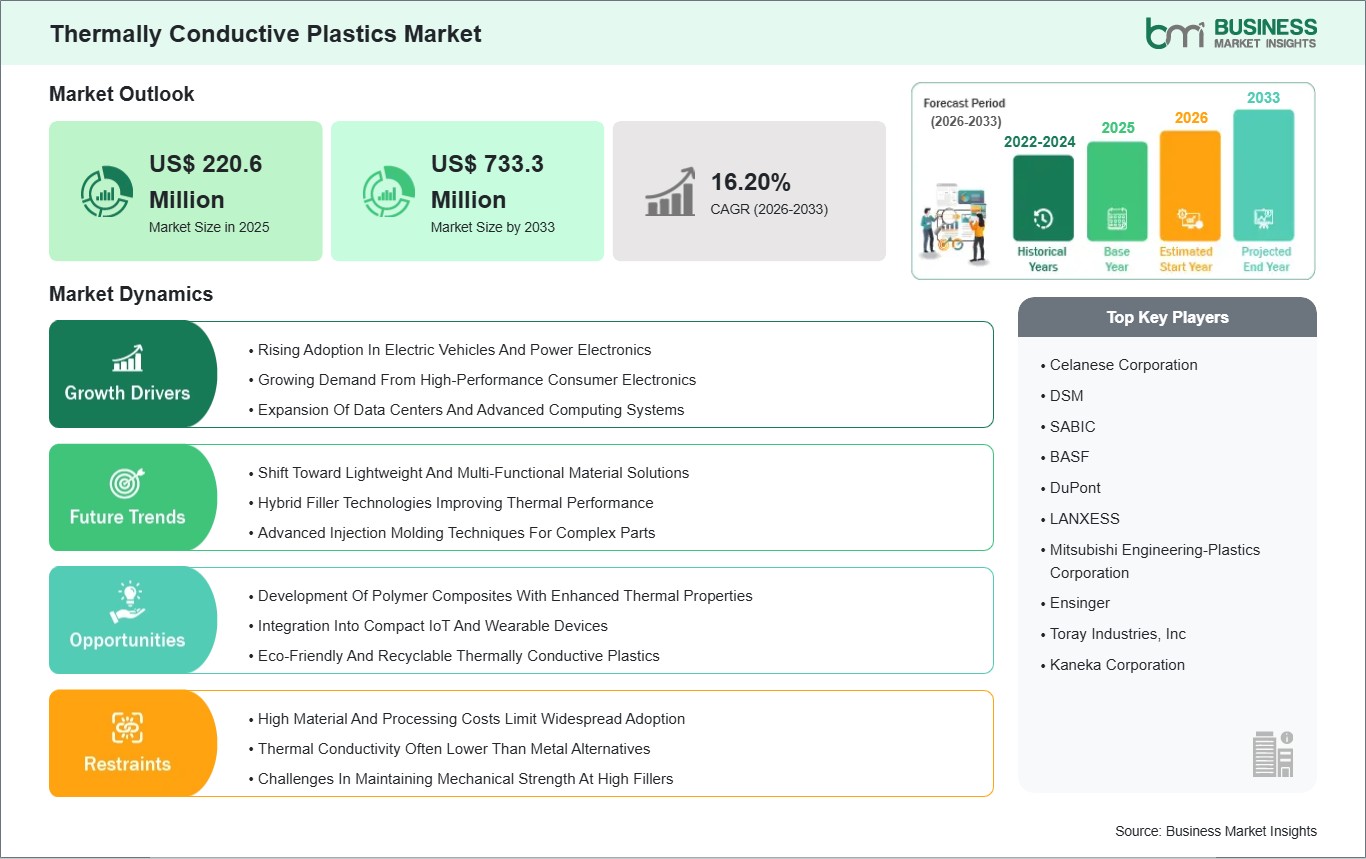
The Thermally Conductive Plastics Market size is expected to reach US$ 733.3 million by 2033 from US$ 220.6 million in 2025. The market is estimated to record a CAGR of 16.20% from 2026 to 2033.
Executive Summary and Global Market Analysis:
The global thermally conductive plastics market contains specialized polymer compounds that create better heat conduction properties than standard plastic materials while maintaining lightweight, corrosion-resistant and flexible design capabilities. The materials function as thermal management solutions, which enable simultaneous heat dissipation, electrical insulation and mechanical strength maintenance.
The main uses of these materials extend to automotive parts, which include battery enclosures and power electronics housings and to electronic enclosures and heat spreader components used in consumer devices, LED lighting systems and industrial machinery. Thermally conductive plastics serve advanced applications by providing a performance bridge between traditional polymers and expensive metal alternatives, which weigh more.
The global market exists because North America contains established electronics, automotive, aerospace and industrial sectors, which begin using advanced materials during their earliest stages of product development. The region concentrates on electric and hybrid vehicles together with data center infrastructure and 5G telecommunications, which has led to increased demand for plastics that provide both thermal conductivity and design flexibility.
The thermally conductive plastics deliver weight reduction for high-performance systems through their thermal performance capabilities because they balance essential system requirements. The presence of leading material manufacturers together with strong R&D ecosystems and partnership activities between polymer suppliers and OEMs establishes North America as the leading market area. The world needs portable electronic devices that require higher power capacities and electric vehicles that need better thermal systems for their compact designs.
The process of developing materials that need to fulfill exact industrial requirements without special design changes remains a challenge because companies must find ways to manage their thermal conductivity, mechanical durability and production expenses. The market faces competition from traditional metal-based thermal solutions and thermally conductive ceramics, which perform better than plastics in specific high-temperature situations but lose their advantages in weight and shape. The field of polymer chemistry has reached new possibilities, which result from advances in filler technology and composite design. The thermal performance of graphene, carbon nanotubes and metal-oxide fillers has improved while their electrical insulation and production capabilities have not been significantly affected. The increasing demand for thermal management solutions that also reduce system weight will drive the growth of thermally conductive plastics in situations that require performance, cost and design flexibility to work together.
Key segments that contributed to the derivation of the thermally conductive plastics market analysis are type and end‑use industry.
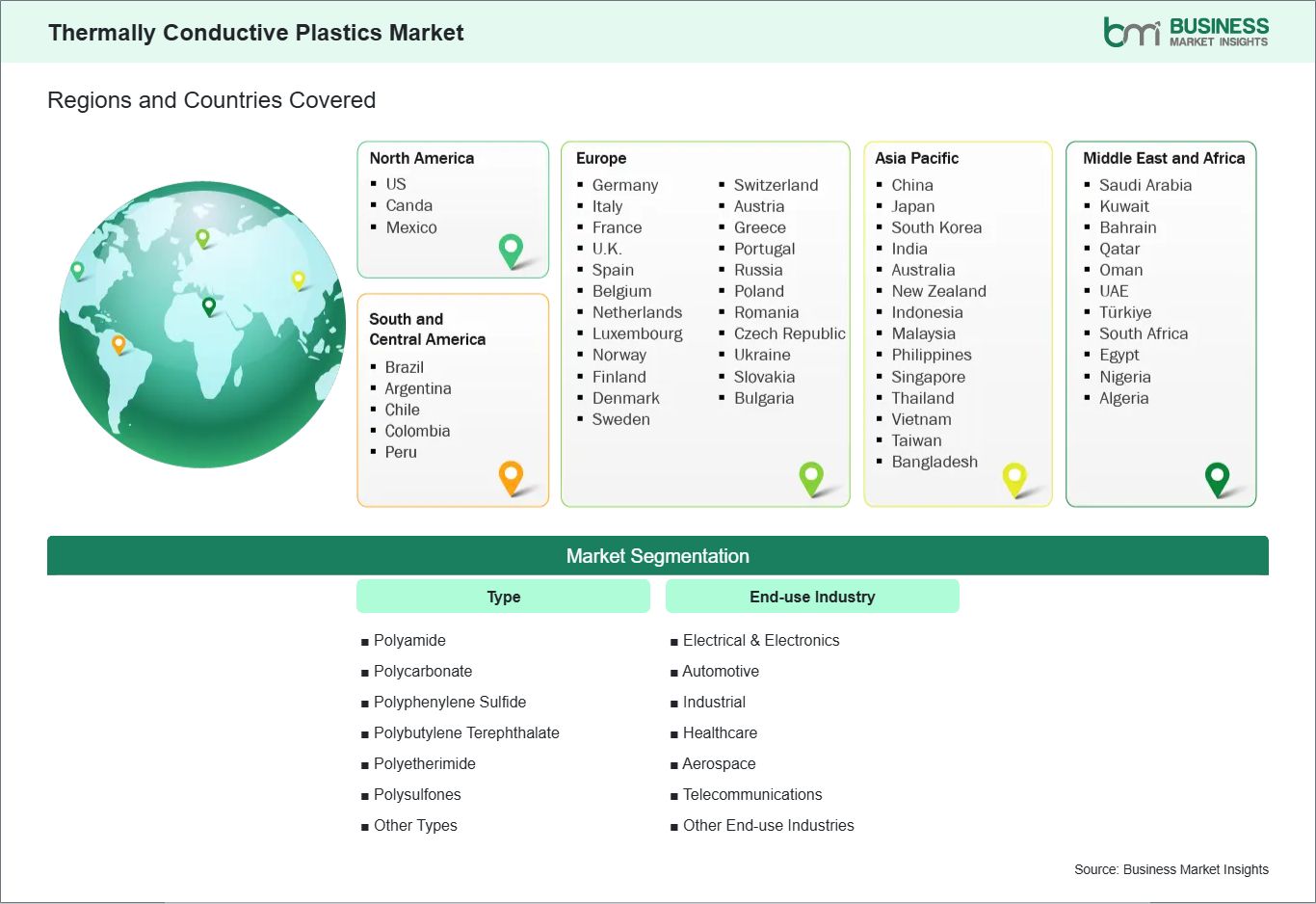
By type, the thermally conductive plastics market is segmented into polyamide (PA), polycarbonate (PC), polyphenylene sulfide (PPS), polybutylene terephthalate (PBT), polyetherimide (PEI), polysulfones (PSU), other types. The polyamide (PA) segment dominated the market in 2025.
In terms of end‑use industry, the thermally conductive plastics market is categorized into electrical & electronics, automotive, industrial, healthcare, aerospace, telecommunications, other end‑use industries. The electrical & electronics segment dominated the market in 2025.
Thermally Conductive Plastics Market Drivers and Opportunities:
Rising Adoption In Electric Vehicles And Power Electronics
The worldwide transition to electric vehicles (EVs) has created significant demand for thermally conductive plastics, which enable vehicle weight reduction through efficient heat dissipation capabilities that surpass metal materials. The growing use of these materials in EV battery enclosures, inverter housings and powertrain components helps maintain temperature control while enhancing energy efficiency. North America, Europe and China lead the implementation of advanced polymer composites, which they use in high-voltage modules to improve vehicle range and thermal management of compact systems.
Thermally conductive plastics provide power electronics applications with effective heat management solutions, which power inverters, converters and renewable energy modules use in their high-power densely packed components. The semiconductor sector requires higher power densities, which creates rising demand in Asia Pacific and Europe as manufacturers work with material suppliers to fulfill their thermal and mechanical specifications.
South America and the Middle East & Africa have begun using these plastics in their industrial and electrical systems to improve system reliability. The global markets show that thermally conductive plastics have gained acceptance in EVs and power electronics because these materials develop lightweight structures that achieve high performance while providing thermal efficiency, easy manufacturing and flexible design options.
Development Of Polymer Composites With Enhanced Thermal Properties
Innovation in polymer composites is advancing thermally conductive plastics by integrating high-performance fillers such as graphite, graphene, boron nitride, and metal oxides. These fillers create thermal pathways, enabling heat dissipation while maintaining plastic’s lightweight, moldable, and corrosion-resistant properties. North America and Europe dominate R&D, producing composites for automotive, aerospace, and electronics applications requiring reliable thermal management.
Collaborations between polymer manufacturers and OEMs have led to composites tailored for compact consumer electronics, such as smartphones, laptops, and LED lighting systems, where efficient heat spread is critical. Asia Pacific manufacturers leverage these innovations for high-volume production, meeting design and thermal performance demands in electronics and power modules.
Next-generation composites are extending to renewable energy equipment, telecommunication infrastructure, and industrial electronics. Advancements in hybrid fillers, dispersion methods, and polymer matrices allow fine-tuning of thermal conductivity, mechanical strength, and manufacturability. Globally, these developments strengthen the adoption of thermally conductive plastics, offering lightweight, high-performance solutions that meet diverse industrial and consumer requirements while supporting energy efficiency and compact designs.
Thermally Conductive Plastics Market Size and Share Analysis:
The thermally conductive plastics market demonstrates steady growth, with size and share analysis highlighting evolving trends and competitive dynamics among key players. The report examines subsegments categorized within type and end‑use industry, offering insights into their contribution to overall market performance.
By type, the polyamide (PA) subsegment dominated the market in 2025, driven by its excellent thermal conductivity, mechanical strength, and versatility across multiple high-performance applications.
In terms of end‑use industry, the electrical & electronics subsegment dominated the market in 2025, driven by the increasing demand for thermally efficient plastics in devices such as smartphones, laptops, LEDs, and power electronics.
Australia, China, India, Japan, South Korea, Indonesia, Malaysia, Philippines, Singapore, Thailand, Vietnam, Bangladesh, New Zealand, Taiwan
South and Central America
Brazil, Argentina, Peru, Chile, Colombia
Middle East and Africa
Bahrain, Kuwait, Oman, Qatar, Saudi Arabia, United Arab Emirates, Turkiye, South Africa, Egypt, Algeria, Nigeria
Market leaders and key company profiles
CelaneseCorporation
DSM
SABIC
BASF
DuPont
LANXESS
MitsubishiEngineeringâPlasticsCorporation
Ensinger
TORAYINDUSTRIES,INC
KANEKACorporation
Get more information on this report
Thermally Conductive Plastics Market Report Coverage and Deliverables:
The "Thermally Conductive Plastics Market Size and Forecast (2022 - 2033)" report provides a detailed analysis of the market covering below areas:
Thermally Conductive Plastics Market size and forecast at global, regional, and country levels for all the key market segments covered under the scope
Thermally Conductive Plastics Market trends, as well as drivers, restraints, and opportunities
Thermally Conductive Plastics Market analysis covering key trends, global and regional framework, major players, regulations, and recent developments
Industry landscape and competition analysis covering market concentration, heat map analysis, prominent players, and recent developments for the Thermally Conductive Plastics Market
Detailed company profiles, including SWOT analysis
The geographical scope of the Thermally Conductive Plastics Market report is divided into North America, Asia Pacific, Europe, Middle East & Africa, and South & Central America. North America held the largest share in 2025.
North America dominates the international market for thermally conductive plastics because it possesses advanced technological industries and developed electronics manufacturing capabilities while adopting electric power systems in its automotive and industrial markets.
The United States and Canada showcase a high demand for thermally conductive plastics, which electric vehicle (EV) battery systems, power electronics and data center infrastructure require because these materials must efficiently remove heat while keeping their design and weight properties intact. The region's original equipment manufacturers (OEMs) use thermally conductive polymers for their housings and heat sinks, and structural components because these materials improve performance and decrease weight while satisfying demanding thermal management standards.
Europe displays a developed market, which shows strong growth in both automotive electrification and industrial automation and LED lighting systems. German, French, and Italian manufacturers integrate thermally conductive plastics into modules for EVs and hybrid vehicles, telecommunication equipment, and energy‑efficient industrial machinery, supported by stringent performance and sustainability standards.
The Asia Pacific region experiences rapid development because it possesses a vast manufacturing industry and an increasing consumer electronics market, and it actively develops 5G networks and renewable energy systems. The major contributors to thermally conductive plastics research work for high-power electronics and smartphone and computing devices, and power module applications from China, Japan, South Korea and India, because their production volume requirements and design specifications continue to change.
The Middle East and Africa market shows growth because electrical infrastructure, industrial equipment, and automotive electronics receive investment, but different industrial development stages cause lower adoption rates. South and Central America show economic growth as Brazil, Mexico and Argentina increase their thermally conductive plastics usage for consumer electronics and automotive applications while regional manufacturers improve their product performance and reliability. The global market uses thermally conductive plastics because all regions need to achieve energy-efficient and miniaturized designs with strong thermal performance, while North America leads through its innovative products and multiple industrial uses.
Get more information on this report
Thermally Conductive Plastics Market Research Report Guidance:
The report includes qualitative and quantitative data in the Thermally Conductive Plastics Market across type, end‑use industry and geography.
The report starts with the key takeaways (chapter 2), highlighting key trends and outlook of the Thermally Conductive Plastics Market.
Chapter 3 focuses on the research methodology of the study.
Chapter 4 includes ecosystem analysis.
Chapter 5 highlights the major industry dynamics in the Thermally Conductive Plastics Market, including factors that are driving the market, prevailing deterrents, potential opportunities, as well as future trends. Impact analysis of these drivers and restraints is also covered in this section.
Chapter 6 discusses the Thermally Conductive Plastics Market scenario, in terms of historical market revenues, and forecast till the year 2033.
Chapters 7 to 9 cover Thermally Conductive Plastics Market segments by type, end‑use industry and geography across North America, Asia Pacific, Europe, Middle East & Africa, and South & Central America. They cover the market revenue forecast and factors driving the market.
Chapter 10 describes the competitive analysis along with the heat map analysis for the key players operating in the market.
Chapter 11 describes the industry landscape analysis. It provides detailed descriptions of business activities such as market initiatives, new developments, mergers, and joint ventures globally, along with a competitive landscape.
Chapter 12 provides detailed profiles of the major companies operating in the Thermally Conductive Plastics Market. Companies have been profiled on the basis of their key facts, business descriptions, products, financial overview, SWOT analysis, and key developments.
Chapter 13, i.e., the appendix, is inclusive of a brief overview of the company, a list of abbreviations, and a disclaimer.
Thermally Conductive Plastics Market News and Key Development:
The Thermally Conductive Plastics Market is evaluated by gathering qualitative and quantitative data post primary and secondary research, which includes important corporate publications, association data, and databases. A few of the key developments in the thermally conductive plastics market are:
In August 2024, Covestro announced that it appointed Rico Products, Inc. as an authorized distributor for its Makrolon TC thermally conductive product line in the United States and Canada, expanding its distribution network to support broader market reach and service for high‑performance thermally conductive plastics.
In March 2026, SABIC announced that it debuted new specialty thermally conductive compound materials — including LNP™ KONDUIT™ WTF2C — designed for thermal management in advanced driver assistance systems (ADAS) and automotive electronics, showcased at PIAE 2026. These compounds support lightweight metal replacement in housings while enhancing thermal performance and design flexibility.
Key Sources Referred:
World Health Organization (WHO)Organisation for Economic Cooperation and Development (OECD)The World Bank GroupWorldometerThe LancetInternational Bar AssociationInternational Trade Administration
The List of Companies - Thermally Conductive Plastics Market
CelaneseCorporation
DSM
SABIC
BASF
DuPont
LANXESS
MitsubishiEngineering‑PlasticsCorporation
Ensinger
TORAYINDUSTRIES,INC
KANEKACorporation
Frequently Asked Questions
How big is the Thermally Conductive Plastics Market?
The Thermally Conductive Plastics Market is valued at US$ 220.6 Million in 2025, it is projected to reach US$ 733.3 Million by 2033.
What is the CAGR for Thermally Conductive Plastics Market by (2026 - 2033)?
As per our report Thermally Conductive Plastics Market, the market size is valued at US$ 220.6 Million in 2025, projecting it to reach US$ 733.3 Million by 2033. This translates to a CAGR of approximately 16.20% during the forecast period.
What segments are covered in this report?
The Thermally Conductive Plastics Market report typically cover these key segments-
Type (Polyamide (PA), Polycarbonate (PC), Polyphenylene Sulfide (PPS), Polybutylene Terephthalate (PBT), Polyetherimide (PEI), Polysulfones (PSU), Other Types)
End-use Industry (Electrical & Electronics, Automotive, Industrial, Healthcare, Aerospace, Telecommunications, Other End-use Industries)
What is the historic period, base year, and forecast period taken for Thermally Conductive Plastics Market?
The historic period, base year, and forecast period can vary slightly depending on the specific market research report. However, for the Thermally Conductive Plastics Market report:
Historic Period : 2022-2024
Base Year : 2025
Forecast Period : 2026-2033
Who are the major players in Thermally Conductive Plastics Market?
The Thermally Conductive Plastics Market is populated by several key players, each contributing to its growth and innovation. Some of the major players include:
CelaneseCorporation
DSM
SABIC
BASF
DuPont
LANXESS
MitsubishiEngineeringâÂÂPlasticsCorporation
Ensinger
TORAYINDUSTRIES,INC
KANEKACorporation
Who should buy this report?
The Thermally Conductive Plastics Market report is valuable for diverse stakeholders, including:
Investors: Provides insights for investment decisions pertaining to market growth, companies, or industry insights. Helps assess market attractiveness and potential returns.
Industry Players: Offers competitive intelligence, market sizing, and trend analysis to inform strategic planning, product development, and sales strategies.
Suppliers and Manufacturers: Helps understand market demand for components, materials, and services related to concerned industry.
Researchers and Consultants: Provides data and analysis for academic research, consulting projects, and market studies.
Financial Institutions: Helps assess risks and opportunities associated with financing or investing in the concerned market.
Essentially, anyone involved in or considering involvement in the Thermally Conductive Plastics Market value chain can benefit from the information contained in a comprehensive market report.




 Get Free Sample For Thermally Conductive Plastics Market