Market Summary
Executive Summary and Global Market Analysis
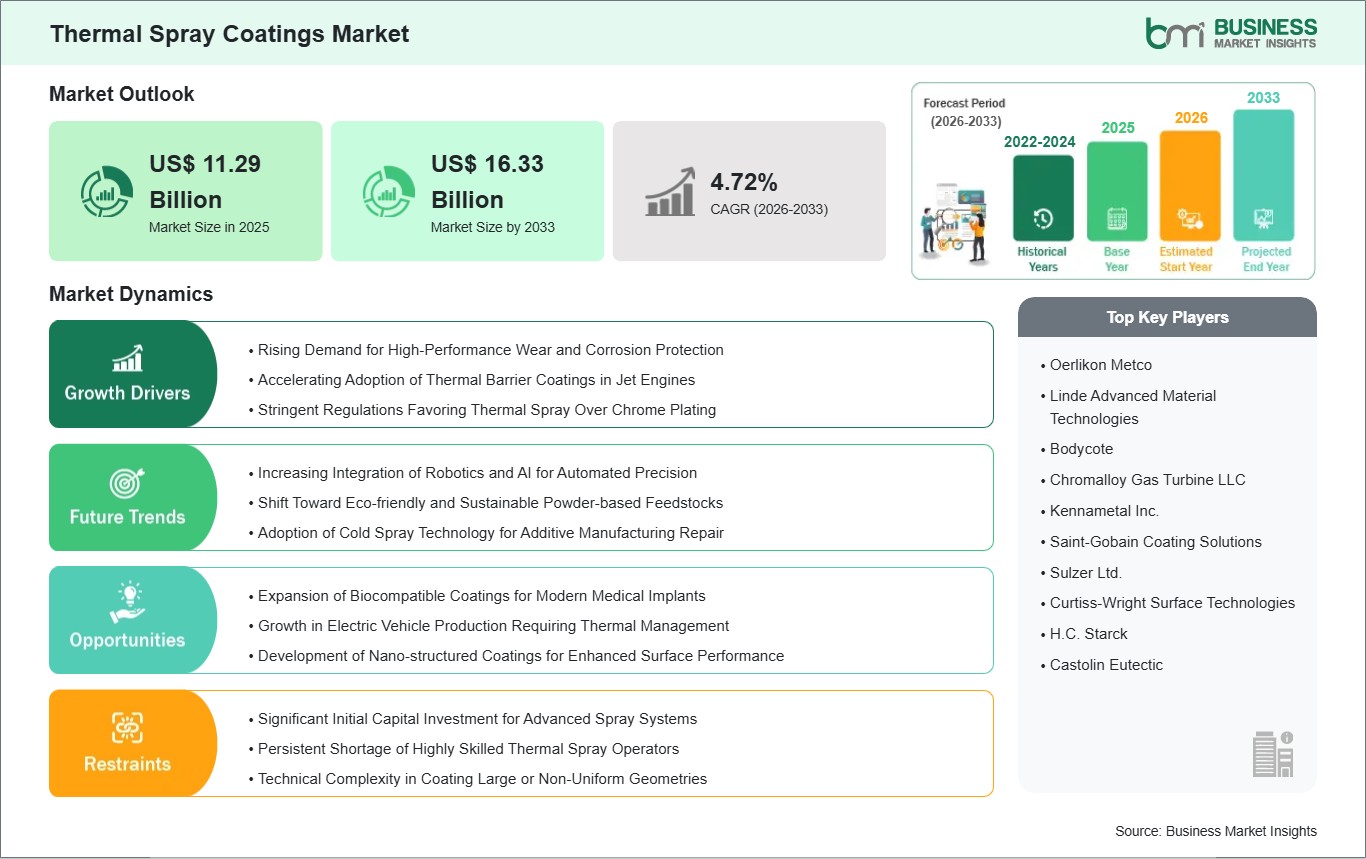
The global market for thermal spray coatings is in a high-growth phase, and this is mainly due to the relentless need for better surface coating technologies in the aerospace, automotive, and energy sectors. The need for increased efficiency and reduced carbon emissions in these sectors makes the role of thermal spray coatings in enhancing heat resistance, wear, and corrosion immunity more critical than ever. The market is undergoing a significant change from manual to completely automated processes, as robotics plays an important role in the spraying process. This change can be seen in the aerospace industry, as the move towards fuel-efficient jet engines requires complex thermal barrier systems that can be obtained through highly complex and efficient plasma or HVOF spraying.
Another major market pillar is emerging in the form of sustainability, as thermal spray is increasingly being accepted as a more environmentally friendly option to traditional hard chrome plating, which is under severe regulatory scrutiny due to its toxic byproducts. Innovation in feedstock materials, including nano-ceramics and bio-based polymers, is creating new market avenues in the medical and electronics industries. Despite the major challenges posed by the high cost of equipment and the lack of skilled labor, the outlook for the market is extremely bright. In terms of geography, North America is still the largest market, driven by its well-developed aviation industry, and the Asia-Pacific region is expanding its manufacturing industry, indicating a diversified world market for thermal spray.
Segment Analysis
Thermal Spray Coatings Market Segmentation
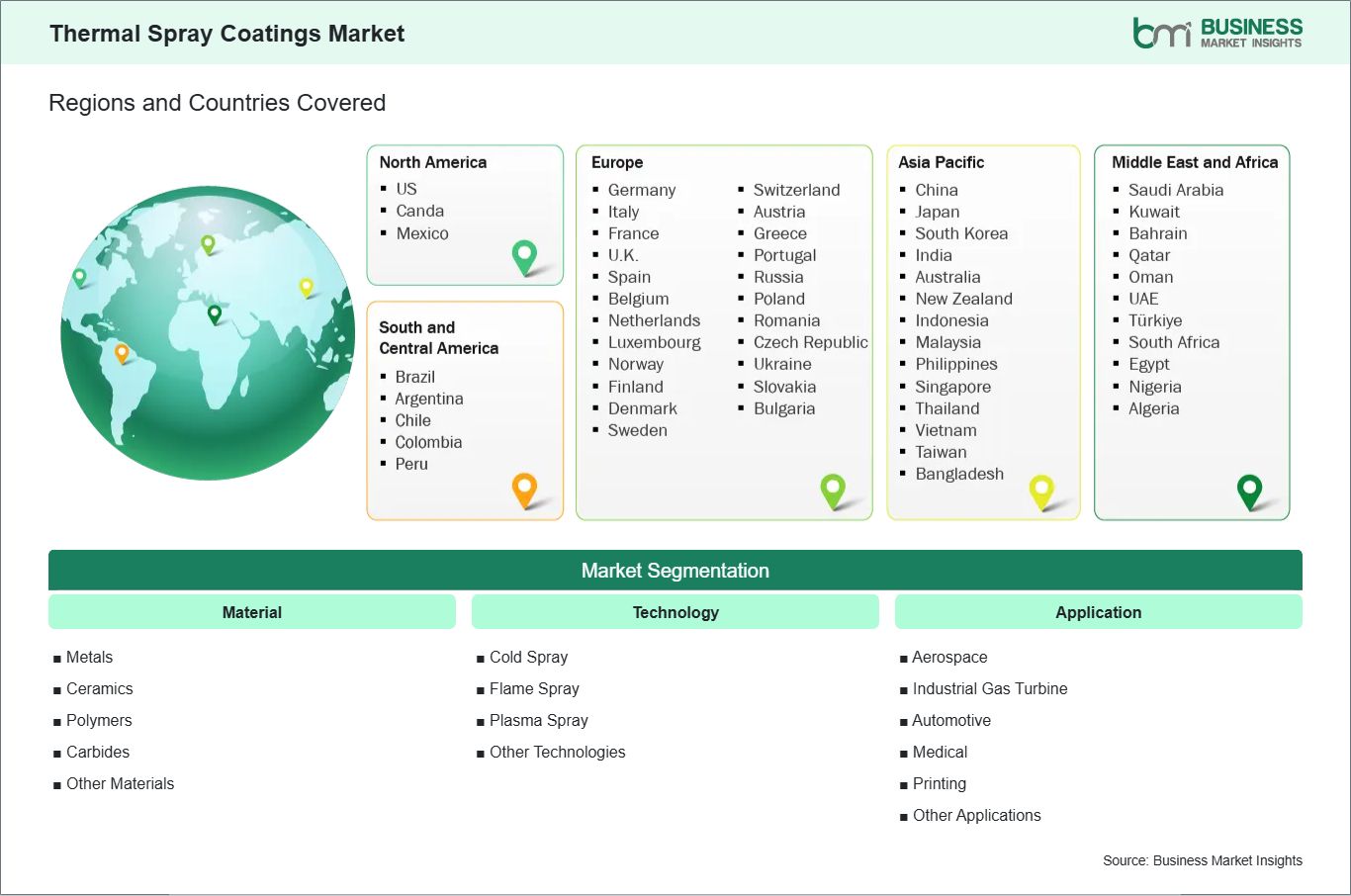
Key segments that contributed to the derivation of the Thermal Spray Coatings market analysis are material, technology, and application.
- By material, the thermal spray coatings market is segmented into Metals, Ceramics, Polymers, Carbides, and Others. The Ceramics segment dominated the market in 2025.
- By technology, the thermal spray coatings market is segmented into Cold Spray, Flame Spray, Plasma Spray, and Others. The Plasma Spray segment dominated the market in 2025.
- By application, the thermal spray coatings market is segmented into Aerospace, Industrial Gas Turbine, Automotive, Medical, Printing, and Others. The Aerospace segment dominated the market in 2025.
Market Forces
Thermal Spray Coatings Market Drivers and Opportunities
Rising Demand for High-Performance Wear and Corrosion Protection
The industrial sector is experiencing a significant shift toward the use of thermal spray coatings to combat the perennial challenges of wear, erosion, and corrosion. As machinery in the oil and gas, mining, and power generation industries is pushed to operate under increasingly harsh conditions, the cost of equipment downtime has skyrocketed. Thermal spray coatings can be a cost-effective way to revitalize worn parts or as a proactive measure to prevent chemical and mechanical degradation. High-performance carbide and metallic coatings can be applied to extend maintenance cycles of critical parts such as valves, pumps, and drill bits, thereby increasing profitability and efficiency.
Furthermore, the drive for asset life extension is bolstered by the economic benefits of reclamation over replacement. In heavy industries, the ability to refurbish massive components through thermal spraying—rather than purchasing new ones—reduces both capital expenditure and the environmental impact associated with manufacturing new steel parts. This trend is especially prevalent in emerging economies where rapid industrialization is occurring alongside a growing emphasis on cost-optimization. As material science continues to evolve, the development of specialized coatings tailored for specific corrosive environments is expected to further entrench thermal spray as a foundational technology for industrial maintenance and reliability.
Expansion of Biocompatible Coatings for Modern Medical Implants
The medical application segment represents one of the most promising frontiers for thermal spray technology, specifically through the application of hydroxyapatite and titanium coatings on orthopedic and dental implants. As global populations age, the frequency of joint replacement surgeries and dental procedures is rising, creating a parallel demand for implants that offer superior osseointegration. Thermal spray processes are uniquely capable of creating a porous surface structure that mimics natural bone, allowing for faster healing and a more secure biological bond between the implant and the patient's skeletal system. This functionality is vital for the long-term success of implants, reducing the risk of loosening or rejection.
In addition to bone integration, thermal spray coatings are being utilized to enhance the durability and biocompatibility of various surgical instruments. The ability to apply thin, precise layers of specialized ceramics or polymers helps in reducing friction during procedures and protecting tools from the rigorous sterilization processes they undergo. This niche market benefits from high profit margins and stringent quality standards that favor established players with advanced technological capabilities. As healthcare infrastructure continues to modernize globally, the integration of thermal spray solutions into the medical device value chain will likely accelerate, driven by the ongoing pursuit of better patient outcomes and longer-lasting medical interventions.
Size and Share Analysis
Thermal Spray Coatings Market Size and Share Analysis
The global Thermal Spray Coatings market is experiencing steady growth, with market size and share analysis reflecting evolving treatment preferences and competitive dynamics among key players. The report evaluates important subsegments categorized within material, technology, and application highlighting their respective contributions to overall market performance.
By material, the Ceramics subsegment dominated the market in 2025 because of its exceptional thermal insulation and high-temperature resistance. These properties are critical for protecting turbine blades and engine components from thermal degradation, allowing machinery to operate at higher efficiencies while extending the overall lifespan of expensive metallic substrates.
By technology, the Plasma Spray subsegment dominated the market in 2025 due to its incredible versatility and ability to melt a wide range of feedstock materials, including high-melting-point ceramics. Its capacity to produce dense, high-quality coatings with superior bond strength makes it the preferred choice for mission-critical aerospace and energy applications.
By application, the Aerospace subsegment dominated the market in 2025 as thermal spray coatings are indispensable for enhancing the durability and performance of jet engine components. The industry`s constant push for fuel efficiency and reduced emissions necessitates advanced thermal barrier coatings that can withstand the extreme heat and corrosive environments of modern aviation.
Report Coverage
Thermal Spray Coatings Market Report Coverage and Deliverables
The "Thermal Spray Coatings Market Size and Forecast (2022 - 2033)" report provides a detailed analysis of the market covering below areas:
- Thermal Spray Coatings market size and forecast at the regional and country levels for segments covered under the scope
- Thermal Spray Coatings market trends, as well as drivers, restraints, and opportunities
- Thermal Spray Coatings market analysis covering key trends, regional framework, major players, regulations, and recent developments
- Industry landscape and competition analysis covering market concentration, heat map analysis, prominent players, and recent developments for the Thermal Spray Coatings market
- Detailed company profiles, including SWOT analysis
Geographic Insights
Thermal Spray Coatings Market Geographic Insights
The geographical scope of the Thermal Spray Coatings market report is divided into: North America, Asia Pacific, Europe, Middle East & Africa, and South & Central America. North America held the largest share in 2025.
North America stands as the preeminent leader in the global thermal spray coatings market, primarily due to its massive aerospace and defense ecosystem. The region hosts a dense concentration of the world`s leading aircraft engine manufacturers and Tier-1 aerospace suppliers, all of whom rely heavily on thermal spray for the production and maintenance of hot-section components. This established industrial base is complemented by a robust network of independent coating service providers and specialized MRO (Maintenance, Repair, and Overhaul) facilities. The high standard of technical expertise in the United States and Canada ensures that the region remains at the forefront of process innovation, particularly in the development of sophisticated ceramic-matrix-composite coatings.
Beyond aerospace, the North American market is bolstered by a strong recovery in the automotive sector and a significant push toward domestic energy independence. The revitalization of the industrial gas turbine market for power generation further drives the demand for specialized coatings. Furthermore, the region`s strict environmental and occupational safety regulations have accelerated the phase-out of hexavalent chromium, pushing manufacturers toward thermal spray alternatives. A well-developed supply chain for high-purity powders and specialized gases also provides a competitive advantage, ensuring consistent quality and rapid turnaround times. As the region continues to invest in high-tech manufacturing and additive manufacturing integration, its dominance in the thermal spray sector is expected to remain unshakable.
Industry Activity
Recent Developments
The Thermal Spray Coatings market is evaluated by gathering qualitative and quantitative data post primary and secondary research, which includes important corporate publications, association data, and databases. A few of the key developments in the Thermal Spray Coatings market are:
- In February 2024, Oerlikon, announced the launch of its advanced Metco 600 series thermal spray coating materials, designed to enhance wear resistance and high-temperature performance in aerospace and energy applications.
- In March 2024, Bodycote, announced the expansion of its thermal spray coating services in North America, including new capabilities for high-velocity oxygen fuel (HVOF) coatings to support aerospace and industrial customers.
- In June 2023, Kennametal Inc., announced the expansion of its surface technologies portfolio, including thermal spray coating solutions, to improve component life and performance in harsh industrial environments.
Trust & Transparency
Research Methodology
The market analysis combines proprietary research with secondary data from government agencies, company disclosures, regulatory filings, industry databases and expert interviews. Market estimates are validated through data triangulation, cross-market benchmarking and analyst
review.
View Full Research Methodology
Key Sources Referred:
American Chemistry Council (ACC)European Chemical Industry Council (Cefic)International Council of Chemical Associations (ICCA)ASTM International - Committee on Thermal Insulation MaterialsInternational Organization for Standardization (ISO)North American Insulation Manufacturers Association (NAIMA)European Industrial Insulation Foundation (EiiF)Indian Thermal Insulation Manufacturers Association (ITIMA)Company WebsitesCompany Annual ReportsCompany Investor Presentations