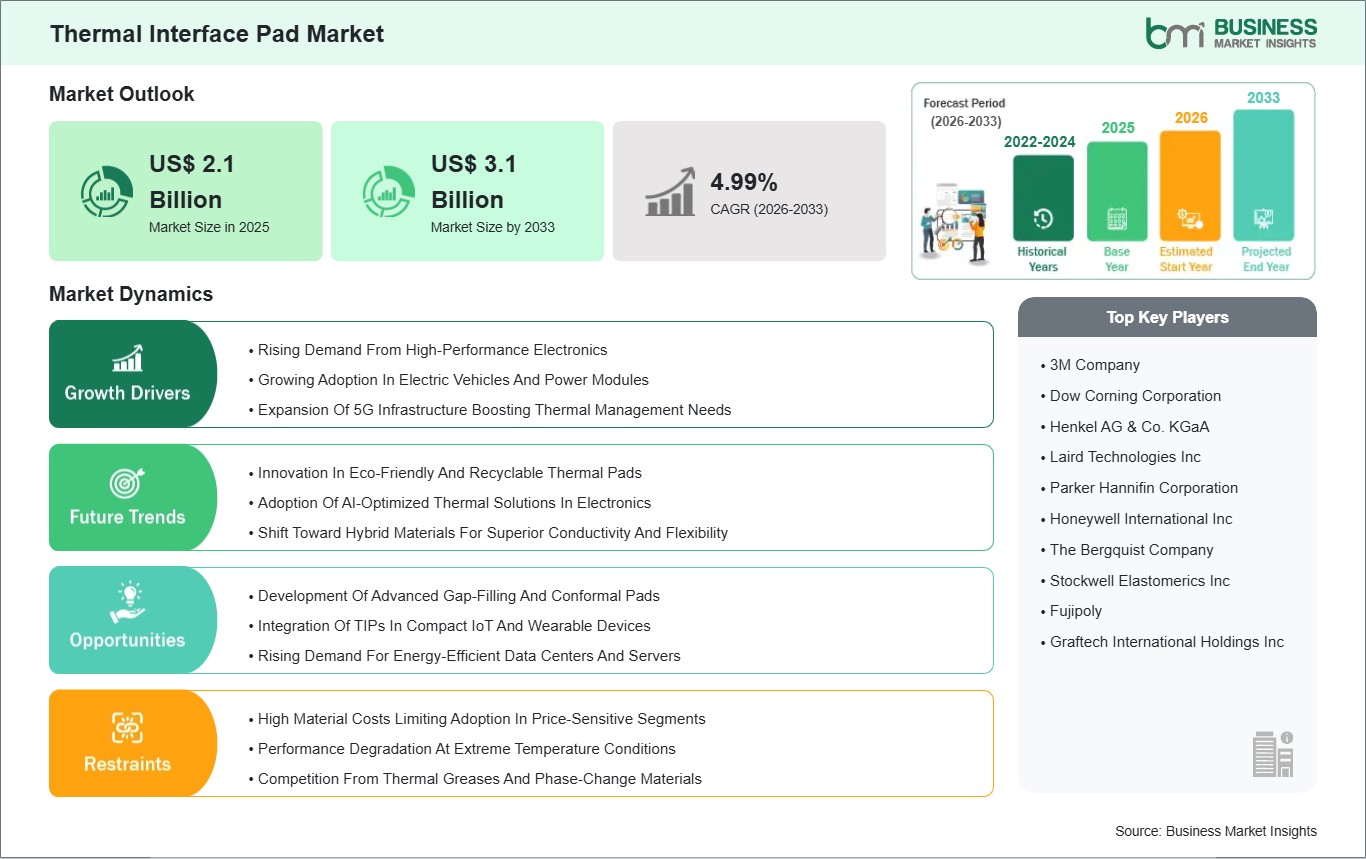
The Thermal Interface Pad Market size is expected to reach US$ 3.1 billion by 2033 from US$ 2.1 billion in 2025. The market is estimated to record a CAGR of 4.99% from 2026 to 2033.
The Thermal Interface Pad (TIP) market concentrates on materials that help transfer heat from heat-producing electronic parts to heat-dissipation surfaces like heat sinks and spreaders, and chassis systems. Thermal interface pads fill microscopic air gaps that impede heat flow, ensuring uniform thermal conductivity and preventing overheating in electronics. Thermal management has emerged as an essential requirement for design work in all industries because of the rising demand for high-performance computing and power electronics, LED lighting and portable mobile devices. The growing use of thermal interface pads in electric vehicles, data centers, telecommunications systems and consumer electronics shows how the market needs thermal dissipation products that provide dependable performance and simple integration.
The thermal interface pad market in North America leads the world because semiconductor manufacturing and communications equipment, high-performance computing, healthcare devices and automotive electronics drive high market demand. The United States and Canada contain technology leaders and advanced manufacturing ecosystems and major research and development facilities, which drive the use of thermal interface materials that meet advanced standards. The region's companies focus on thermal management solutions, which help them handle high power distribution and extend their device operational life.
The thermal interface pads (TIPs) get selected because they maintain steady thermal output while producing less mechanical strain than liquid thermal greases or gap fillers. The global market drivers stem from the expanded 5G network development together with the increasing adoption of electric and hybrid vehicles, the miniaturization of electronics and the rising power consumption of processors and LEDs. Thermal interface pads provide devices with cooling solutions that maintain their required temperature limits while protecting their design specifications and operational reliability need protection. The situation faces two main obstacles, which include rising material expenses and unpredictable performance when exposed to extreme temperatures and the presence of competing thermal management solutions that include thermal greases, phase change materials and thermally conductive adhesives. Material manufacturers are continuously creating new product formulations that provide an optimal combination of performance, durability, and cost efficiency to satisfy the growing worldwide application needs.

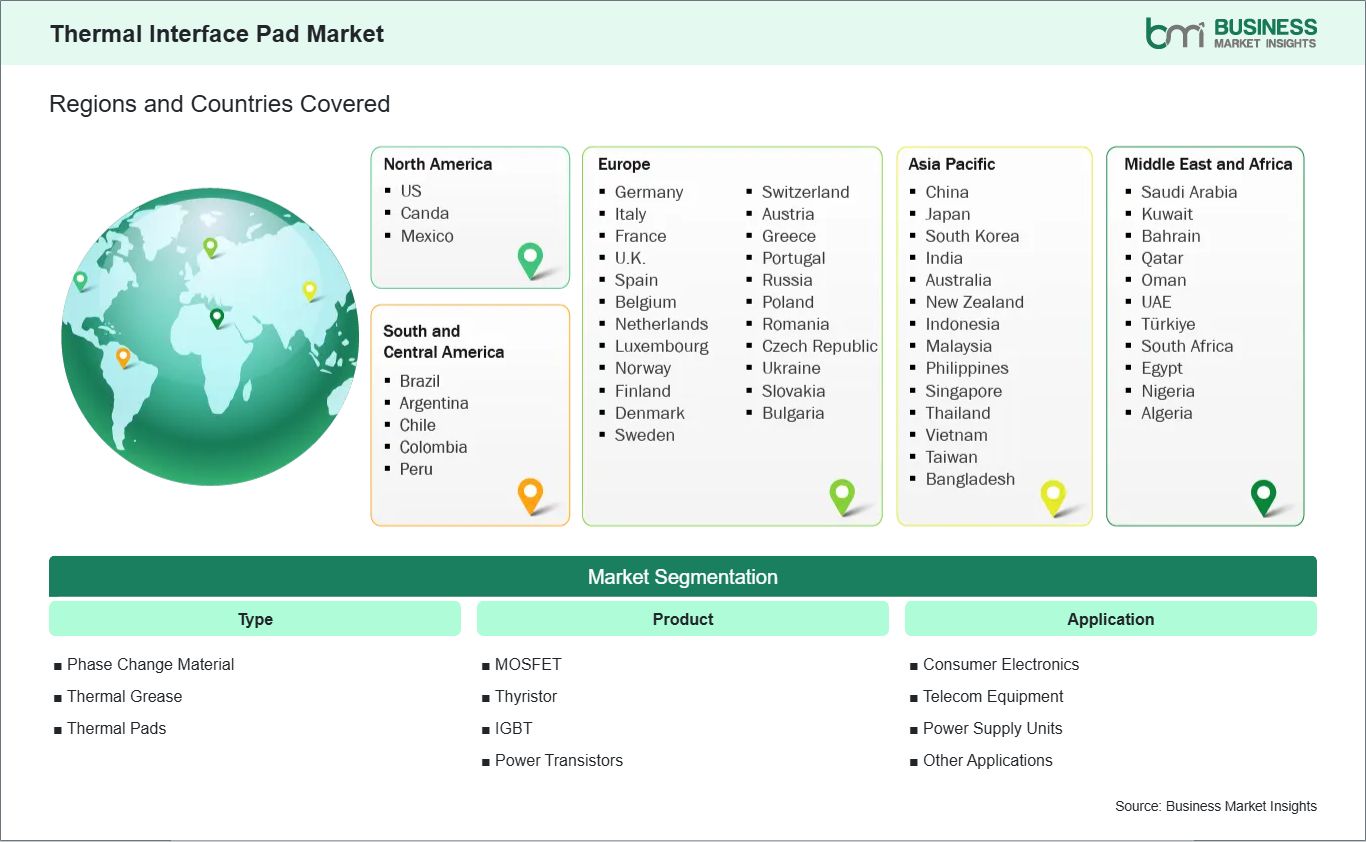
Key segments that contributed to the derivation of the thermal interface pad market analysis are type, product and application.
The global transition towards high-performance electronics has created an urgent need for effective thermal management systems, which now require thermal interface pads as critical elements for modern device design. The increasing power densities generated by processors and GPUs, power modules and LED systems require cooling solutions that exceed the capacity of air convection. Thermal interface pads provide a solution that fills all microscopic gaps between heat sources and heat sinks to create efficient heat transfer, which protects against overheating, that enables devices to last longer while functioning reliably.
Thermal interface pads function as essential components for maintaining thermal stability in high-performance computing and gaming systems and enterprise server infrastructure, which operates across developed markets of North America and Europe. The leading semiconductor and electronics manufacturers in these regions use TIPs to create thermal management solutions for consumer laptops, professional workstations, and industrial computing systems. Effective thermal interface solutions receive additional support from emerging segments, which include artificial intelligence accelerators, edge computing devices and next-generation telecommunications gear. The ongoing trend of electronic component miniaturization results in higher thermal resistance challenges because the spaces between mating surfaces have grown more critical, which requires the use of advanced pads. The current trends indicate that high-performance electronic systems throughout the world will depend on thermal interface pads to achieve their required thermal dissipation, which will drive material and design innovation to meet advanced cooling needs.
Innovation in thermal interface pad materials and designs has given rise to advanced gap‑filling and conformal pads that deliver superior performance in complex geometries and variable gap environments. Traditional pads often struggle when surfaces are uneven or when gaps fluctuate due to thermal expansion. Advanced formulations, including viscoelastic silicones, phase‑change materials, and polymer‑based composites with enhanced thermal conductivity, are designed to adapt to surface irregularities while maintaining consistent heat transfer performance across varying operating conditions.
In regions such as North America and Europe, research collaborations between material scientists and electronics OEMs have accelerated the development of these next‑generation pads. These advanced products excel in applications requiring both compliance and durability, such as automotive power electronics, compact servers, and industrial automation controllers. Manufacturers are also focusing on pads with lower thermal resistance and improved mechanical stability to support high‑frequency switching power modules and multi‑chip assemblies, where traditional thermal greases may fail.
Asia Pacific markets are rapidly adopting conformal and gap‑filling pads due to the region’s leadership in consumer electronics, 5G infrastructure equipment, and LED display manufacturing. Tailored pad solutions that accommodate varied gap heights, surface roughness, and compressive loads are critical for high‑volume production environments where consistent thermal performance is paramount. By enabling more reliable heat dissipation in diverse application scenarios, advanced gap‑filling and conformal pads enhance system efficiency, reduce failure rates, and support the ongoing integration of TIPs in increasingly complex electronic designs worldwide.
The thermal interface pad market demonstrates steady growth, with size and share analysis highlighting evolving trends and competitive dynamics among key players. The report examines subsegments categorized within type, product and application, offering insights into their contribution to overall market performance.
By type, the thermal pads subsegment dominated the market in 2025, driven by their easy application, consistent thickness, and suitability for mass-produced electronic devices.
Based on product, the MOSFET subsegment dominated the market in 2025, driven by its widespread use in power management and consumer electronics, requiring efficient thermal management.
In terms of application, the consumer electronics subsegment dominated the market in 2025, driven by the high demand for thermal interface solutions in smartphones, laptops, tablets, and other personal devices.
| Report Attribute | Details |
|---|---|
| Market size in 2025 | US$ 2.1 Billion |
| Market Size by 2033 | US$ 3.1 Billion |
| Global CAGR (2026 - 2033) | 4.99% |
| Historical Data | 2022-2024 |
| Forecast period | 2026-2033 |
| Segments Covered | By Type
|
|
Regions and Countries Covered
| |
| North America | US, Canada, Mexico |
| Europe | Belgium, Austria, Finland, Denmark, Greece, Poland, Romania, Russia, Ukraine, Czech Republic, Slovakia, Bulgaria, Italy, Luxembourg, Germany, Switzerland, France, Netherlands, Norway, Portugal, Spain, Sweden, United Kingdom |
| Asia-Pacific | Australia, China, India, Japan, South Korea, Indonesia, Malaysia, Philippines, Singapore, Thailand, Vietnam, Bangladesh, New Zealand, Taiwan |
| South and Central America | Brazil, Argentina, Peru, Chile, Colombia |
| Middle East and Africa | Bahrain, Kuwait, Oman, Qatar, Saudi Arabia, United Arab Emirates, Turkiye, South Africa, Egypt, Algeria, Nigeria |
| Market leaders and key company profiles |
|
The "Thermal Interface Pad Market Size and Forecast (2022 - 2033)" report provides a detailed analysis of the market covering below areas:
The geographical scope of the Thermal Interface Pad Market report is divided into North America, Asia Pacific, Europe, Middle East & Africa, and South & Central America. North America held the largest share in 2025.
The thermal interface pad market in North America maintains its leading status because of the region's strong electronics industry, its advanced semiconductor production capabilities and the high demand from multiple sectors, including data centers, telecommunications, automotive electronics and consumer electronics.
The United States functions as a primary center for thermal management research because it dedicates substantial resources to high-performance computing and cloud infrastructure and electric vehicle development, which all depend on effective thermal interface pad technology to manage the heat produced by their smaller high-performance systems.
The European market requires thermal interface pads because the automotive sector needs them to support both electric and hybrid vehicle power systems, and industrial automation needs high-performance thermal materials for its power electronics and control systems and renewable energy equipment. Advanced thermal interface materials receive wider adoption across industrial and consumer markets because regulatory requirements for energy efficiency and product reliability push manufacturers to adopt these materials.
The Asia Pacific region experiences rapid market growth because of its extensive electronics production capacity and the strong consumer demand for smartphones, tablets and IoT devices and its rapid development of telecommunications networks, especially 5G technology across China, India, Japan and Southeast Asia. Local electronics OEMs and electronic component manufacturers in the region increasingly use thermal interface pads to handle heat problems that arise from the design of compact devices.
The Middle East and Africa market, although smaller than other markets, has shown increasing demand for thermal management solutions that protect power electronics, electrical infrastructure cooling systems and data center environments because of economic diversification and infrastructure development.
The adoption of South and Central America is increasing at a steady pace because consumer electronics, automotive electronics and industrial sectors are expanding, while regional manufacturers use TIP solutions to improve their product performance and longevity.
The global adoption of thermal interface pad technologies undergoes transformation because all regions now require devices with increased power capacity, smaller dimensions, and dependable thermal performance.

The Thermal Interface Pad Market is evaluated by gathering qualitative and quantitative data post primary and secondary research, which includes important corporate publications, association data, and databases. A few of the key developments in the thermal interface pad market are:
The Thermal Interface Pad Market is valued at US$ 2.1 Billion in 2025, it is projected to reach US$ 3.1 Billion by 2033.
As per our report Thermal Interface Pad Market, the market size is valued at US$ 2.1 Billion in 2025, projecting it to reach US$ 3.1 Billion by 2033. This translates to a CAGR of approximately 4.99% during the forecast period.
The Thermal Interface Pad Market report typically cover these key segments-
The historic period, base year, and forecast period can vary slightly depending on the specific market research report. However, for the Thermal Interface Pad Market report:
The Thermal Interface Pad Market is populated by several key players, each contributing to its growth and innovation. Some of the major players include:
The Thermal Interface Pad Market report is valuable for diverse stakeholders, including:
Essentially, anyone involved in or considering involvement in the Thermal Interface Pad Market value chain can benefit from the information contained in a comprehensive market report.
Please tell us your area of interest
(Market Segments/ Regions and Countries/ Companies)