Market Summary
Executive Summary and Global Market Analysis
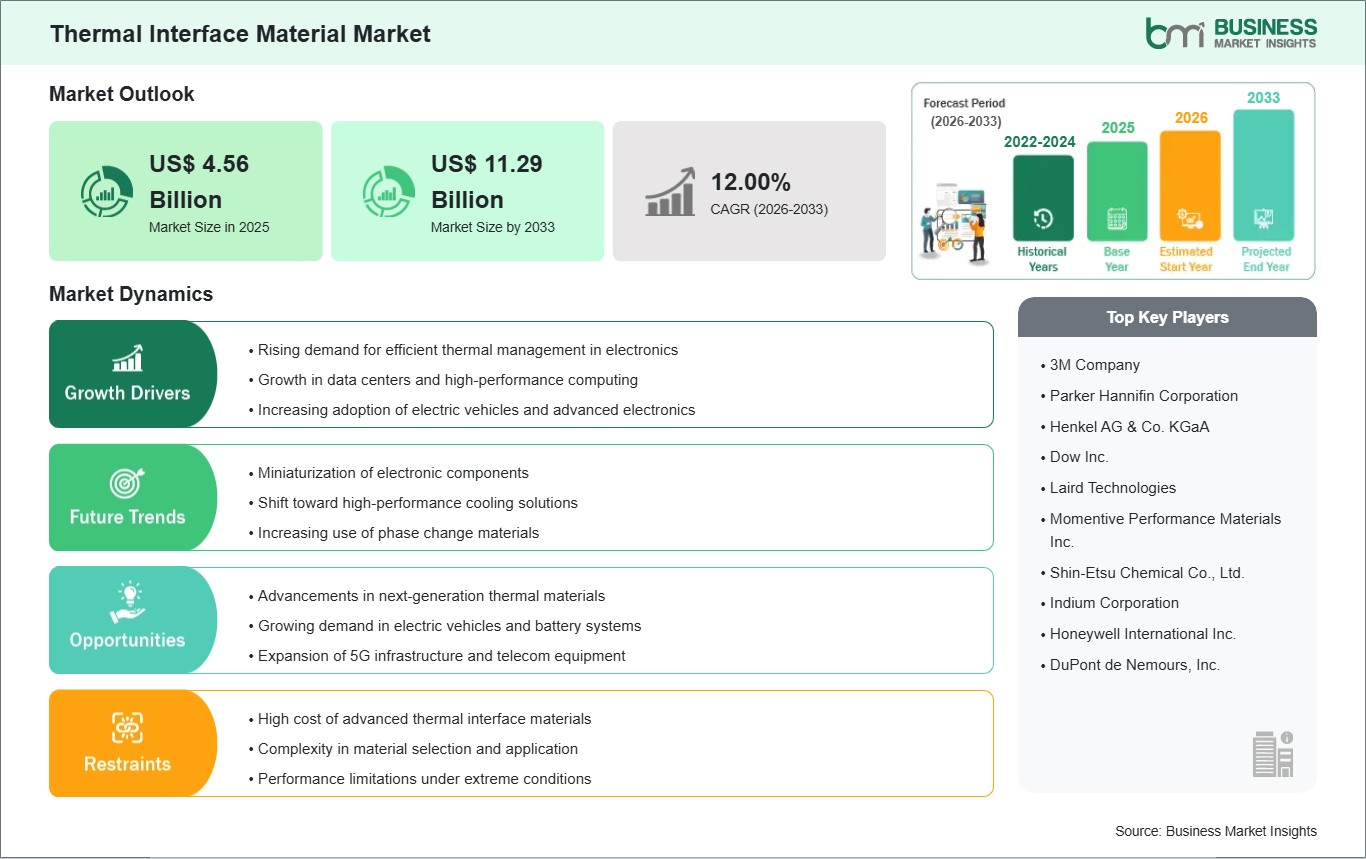
The market for thermal interface materials is growing significantly with increasing demand for the efficient dissipation of heat in electronic devices. These materials are the key to the optimal performance of systems that generate a considerable amount of heat. The silicone materials segment is the largest in the market due to the flexibility and thermal stability of the materials, and the gap fillers segment is the largest in the types segment due to the effectiveness of the materials in the efficient dissipation of heat by filling the gaps present in the compact electronic devices.
The computers and data centers segment is still the largest application area, with this trend continuing owing to the rapid expansion of digital infrastructure and rising data processing needs. This market is also benefiting from advances in material technology and rising use in automotive and telecommunications markets, in spite of facing challenges such as high material costs and performance issues, with opportunities in next-generation materials and in electric vehicles driving innovation in this field, with a steady outlook in this market owing to advances in technology and rising need for high-performance solutions.
Segment Analysis
Thermal Interface Material Market Segmentation
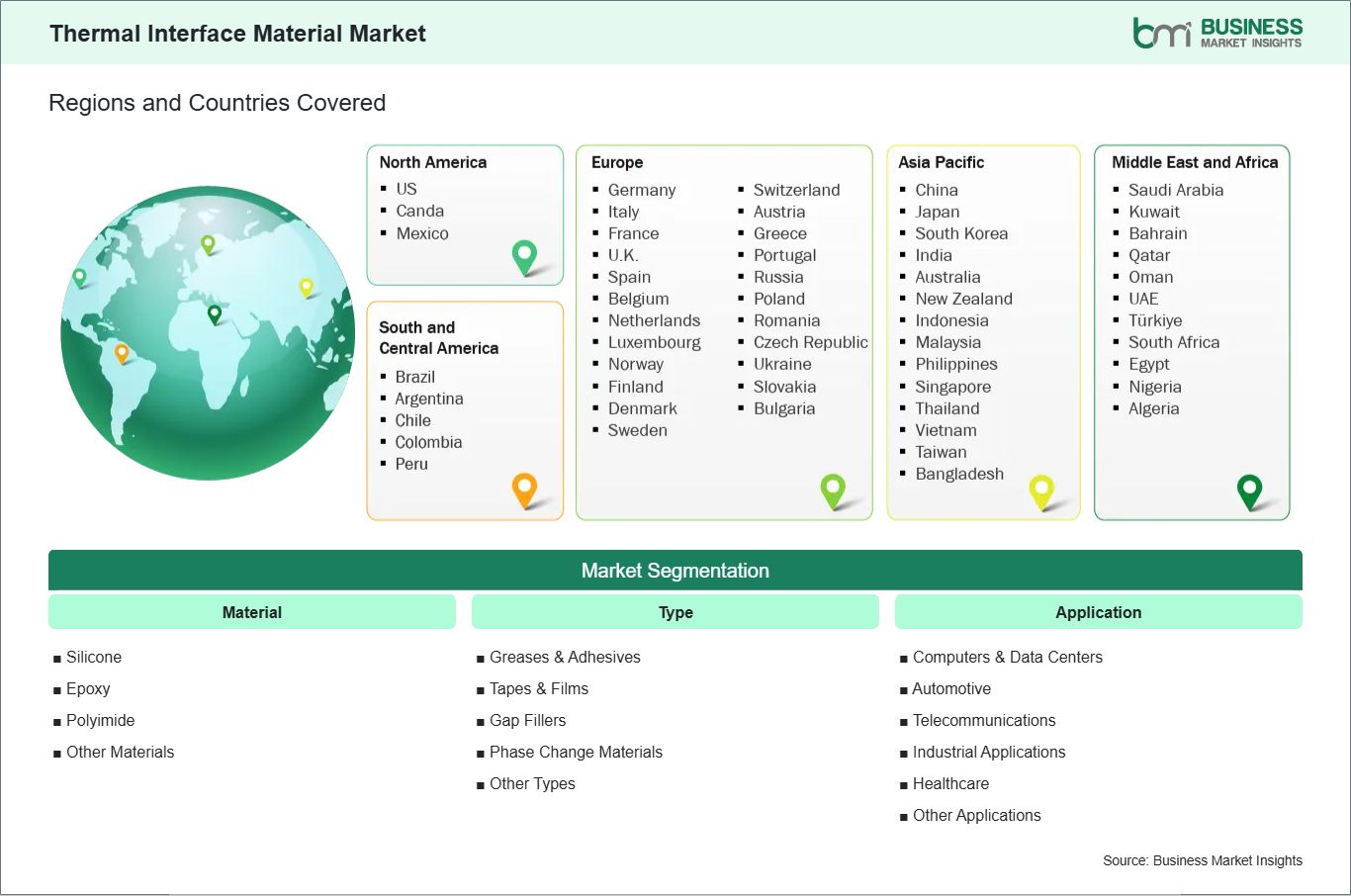
Key segments that contributed to the derivation of the Thermal Interface Material market analysis are material, type, and application.
- By material, the thermal interface material market is segmented into Silicone, Epoxy, Polyimide, and Other Materials. The Silicone segment dominated the market in 2025.
- By type, the thermal interface material market is segmented into Greases & Adhesives, Tapes & Films, Gap Fillers, Phase Change Materials, and Other Types. The Gap Fillers segment dominated the market in 2025.
- By application, the thermal interface material market is segmented into Computers & Data Centers, Automotive, Telecommunications, Industrial Applications, Healthcare, and Other Applications. The Computers & Data Centers segment dominated the market in 2025.
Market Forces
Thermal Interface Material Market Drivers and Opportunities
Rising demand for efficient thermal management in electronics
The increasing need for effective thermal management in electronics is a major factor that contributes to the growth of the thermal interface material market, mainly due to the rapid advancements in the field of electronics and the increasing power density of electronic devices. Modern electronic devices such as processors, GPUs, and power modules produce a considerable amount of heat during operation, and the effective management of the heat generated is essential for the performance and longevity of the devices. Thermal interface materials find a wide range of applications in the management of heat dissipation by enhancing the interface between the heat source and the heat sinks.
Furthermore, the increasing need for the effective management of heat dissipation in various industrial applications, such as consumer electronics, the automotive industry, and telecommunications, is a major factor that contributes to the growth of the thermal interface material market. The increasing need for the effective management of heat dissipation in the aforementioned applications is mainly due to the increasing need for the effective management of heat dissipation in the aforementioned applications and the increasing need for the effective management of the heat dissipation process in the aforementioned applications.
Advancements in next-generation thermal materials
Advancements in next-generation thermal materials present a significant opportunity for the thermal interface material market, as industries seek improved solutions for heat management in increasingly complex electronic systems. Innovations in material science are leading to the development of high-performance thermal interface materials with superior conductivity, durability, and adaptability. These advanced materials are designed to address the limitations of traditional solutions, offering enhanced performance in demanding applications such as high-power electronics and electric vehicles.
Furthermore, research and development efforts are focused on creating materials that are lightweight, environmentally friendly, and capable of operating under extreme conditions. The integration of nanotechnology and advanced composites is enabling the production of materials with improved thermal efficiency and mechanical properties. As industries such as automotive, telecommunications, and industrial manufacturing continue to adopt advanced technologies, the demand for innovative thermal interface materials is expected to increase. This creates opportunities for manufacturers to differentiate their offerings and expand their presence in high-growth segments of the market.
Size and Share Analysis
Thermal Interface Material Market Size and Share Analysis
The global Thermal Interface Material market is experiencing steady growth, with market size and share analysis reflecting evolving treatment preferences and competitive dynamics among key players. The report evaluates important subsegments categorized within material, type, and application highlighting their respective contributions to overall market performance.
By material, the Silicone subsegment dominated the market in 2025 due to its excellent thermal conductivity, flexibility, and stability across wide temperature ranges, making it highly suitable for electronic cooling applications where reliability and consistent heat dissipation are critical.
By type, the Gap Fillers subsegment dominated the market in 2025 due to their superior ability to fill air gaps between components, ensuring efficient heat transfer and improved performance in compact electronic assemblies and high-power devices requiring effective thermal management solutions.
By application, the Computers & Data Centers subsegment dominated the market in 2025 due to increasing data processing demands, rising server densities, and the need for efficient cooling solutions to maintain system reliability and performance in high-heat-generating environments.
Report Coverage
Thermal Interface Material Market Report Coverage and Deliverables
The "Thermal Interface Material Market Size and Forecast (2022 - 2033)" report provides a detailed analysis of the market covering below areas:
- Thermal Interface Material market size and forecast at the regional and country levels for segments covered under the scope
- Thermal Interface Material market trends, as well as drivers, restraints, and opportunities
- Thermal Interface Material market analysis covering key trends, regional framework, major players, regulations, and recent developments
- Industry landscape and competition analysis covering market concentration, heat map analysis, prominent players, and recent developments for the Thermal Interface Material market
- Detailed company profiles, including SWOT analysis
Geographic Insights
Thermal Interface Material Market Geographic Insights
The geographical scope of the Thermal Interface Material market report is divided into: North America, Asia Pacific, Europe, Middle East & Africa, and South & Central America. North America held the largest share in 2025.
North America dominates the thermal interface material market due to its strong presence in advanced electronics manufacturing and data center infrastructure. The region is home to major technology companies and semiconductor manufacturers, which drive significant demand for thermal management solutions. Increasing investments in cloud computing, artificial intelligence, and high-performance computing are further supporting market growth.
Additionally, the growing adoption of electric vehicles and advanced automotive technologies in North America is contributing to increased demand for thermal interface materials. Regulatory standards and focus on energy efficiency are encouraging the use of high-performance cooling solutions across industries. The presence of key market players and continuous technological innovation are strengthening the region`s leadership position. With ongoing advancements in electronics and increasing demand for efficient heat management, North America is expected to maintain its dominance in the thermal interface material market.
Industry Activity
Recent Developments
The Thermal Interface Material market is evaluated by gathering qualitative and quantitative data post primary and secondary research, which includes important corporate publications, association data, and databases. A few of the key developments in the Thermal Interface Material market are:
- In October 2024, Dow, announced that it entered into a strategic partnership with Carbice to develop next-generation thermal interface materials combining silicone and carbon nanotube (CNT) technologies for high-performance electronics and e-mobility applications.
- In February 2024, Henkel, announced that its Bergquist Hi Flow THF 5000UT phase-change thermal interface material received recognition in the Lightwave Innovation Reviews for its high-performance heat dissipation capabilities in semiconductors and data center applications.
- In 2025, Indium Corporation, announced that it would showcase a range of advanced thermal interface materials—including sintered solder TIMs, liquid metal TIMs, and phase-change materials—targeting high-performance computing (HPC) applications at industry events.
Trust & Transparency
Research Methodology
The market analysis combines proprietary research with secondary data from government agencies, company disclosures, regulatory filings, industry databases and expert interviews. Market estimates are validated through data triangulation, cross-market benchmarking and analyst
review.
View Full Research Methodology
Key Sources Referred:
American Chemistry Council (ACC)European Chemical Industry Council (Cefic)International Council of Chemical Associations (ICCA)ASTM International - Committee on Thermal Insulation MaterialsInternational Organization for Standardization (ISO)North American Insulation Manufacturers Association (NAIMA)European Industrial Insulation Foundation (EiiF)Indian Thermal Insulation Manufacturers Association (ITIMA)Company WebsitesCompany Annual ReportsCompany Investor Presentations