Market Summary
Executive Summary and Global Market Analysis
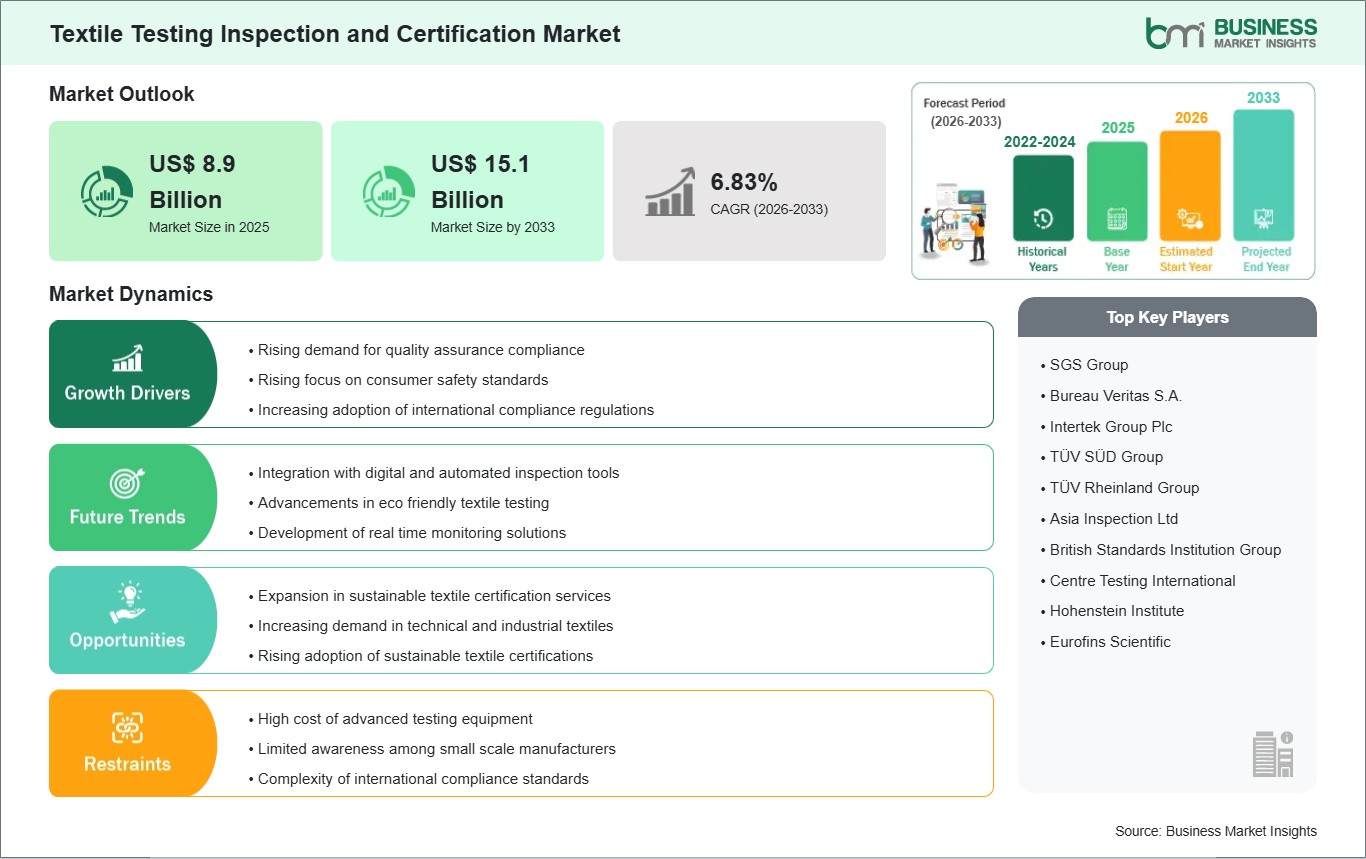
The textile testing, inspection, and certification market is experiencing steady evolution driven by tightening regulatory frameworks, rising consumer awareness, and the growing emphasis on product transparency across apparel and technical textiles. Market participants are increasingly focusing on end-to-end quality assurance solutions that integrate laboratory testing with digital inspection tools and compliance certification services. The expansion of fast fashion and e-commerce has intensified the need for rapid testing cycles and scalable inspection models, pushing providers to adopt automation, AI-based defect detection, and remote auditing capabilities.
Additionally, sustainability considerations such as eco-labeling, chemical compliance, and traceability standards are reshaping service portfolios, compelling TIC companies to align with global environmental and social governance benchmarks. Strategic partnerships between brands, manufacturers, and certification bodies are becoming more prevalent to ensure consistent quality across complex supply chains. Competitive dynamics are marked by consolidation, with leading firms enhancing geographic reach and technical expertise through acquisitions.
Emerging segments such as smart textiles and performance fabrics are also creating demand for specialized testing protocols, thereby diversifying revenue streams and reinforcing the market’s role as a critical enabler of trust, safety, and compliance in the textile industry.
Segment Analysis
Textile Testing Inspection and Certification Market Segmentation
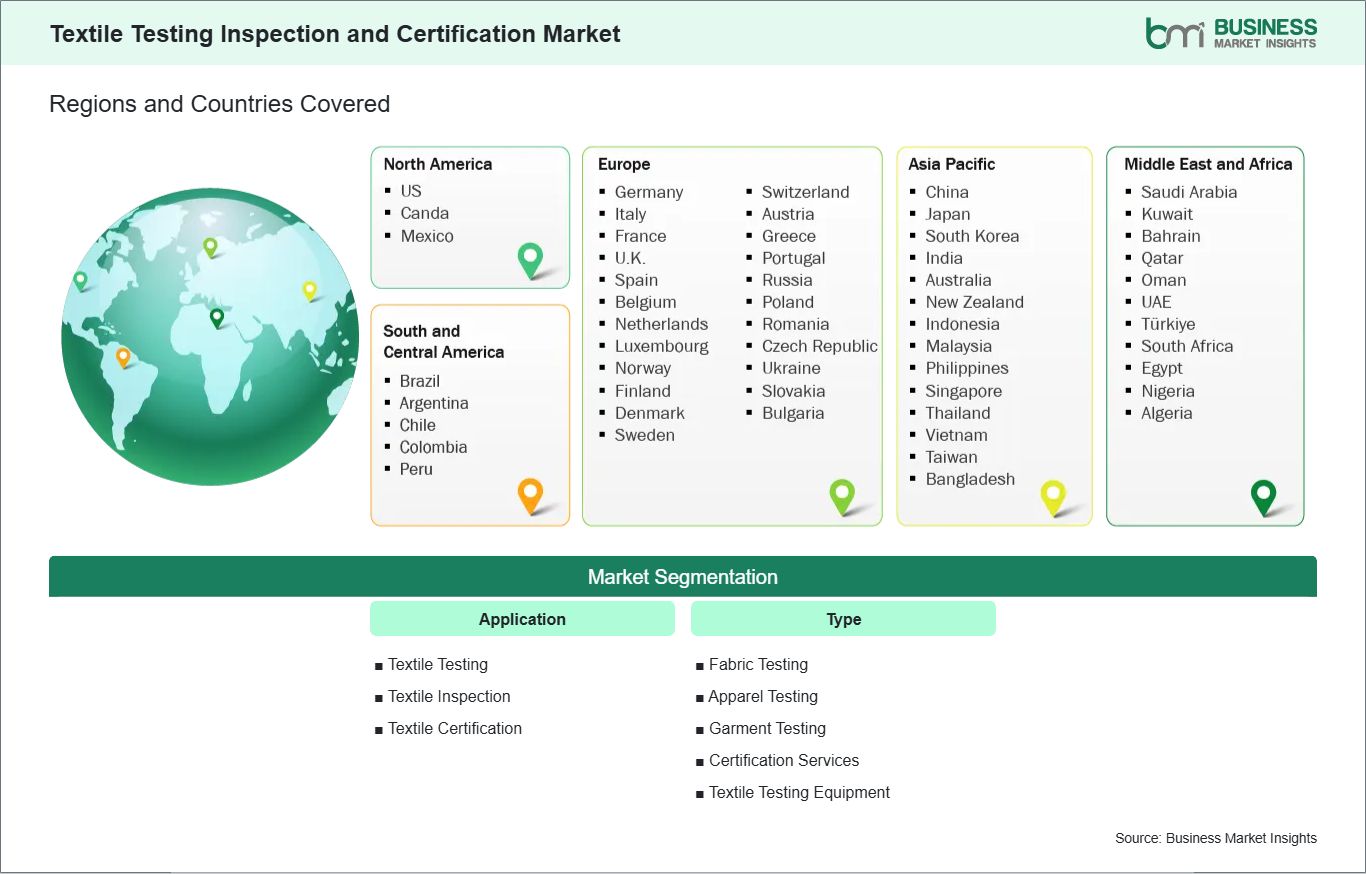
Key segments that contributed to the derivation of the textile testing, inspection and certification market analysis is application.
- Application, the textile testing inspection and certification market is segmented into textile testing, textile inspection, and textile certification. The textile testing segment dominated the market in 2025.
- In terms of Type, Textile TIC Market has been segmented into Fabric Testing, Apparel Testing, Garment Testing, Certification Services, Textile Testing Equipment
Market Forces
Textile Testing Inspection and Certification Market Drivers and Opportunities
Rising demand for quality assurance compliance
The demand for quality assurance in the textile supply chain is currently driving growth in the worldwide Textile Testing, Inspection and Certification market. To ensure product safety and durability, manufacturers and brands worldwide are implementing strict testing protocols, which also help them meet regulatory requirements. Third-party inspection and certification services have experienced growth because consumers are becoming more aware of textile quality. Companies develop their testing capabilities through investments in advanced testing laboratories and digital inspection tools, and automated processes, which enable them to operate at high volumes with consistent results.
The textile industry expansion has resulted in more demanding compliance requirements, which now include safety tests, flammability tests and performance assessments. Certified products have become the main focus for global retailers and wholesalers, which has led manufacturers to implement comprehensive testing methods throughout their manufacturing processes. Businesses can achieve more reliable product quality because their standardization and quality verification procedures reduce product returns and recalls and enhance their brand trustworthiness in competitive markets. Businesses can complete testing tasks more efficiently because testing equipment innovations enable precise fiber analysis and automatic defect identification and provide immediate test data. The operational efficiency of manufacturers improves through these innovations, while they help manufacturers achieve compliance with international standards, which are becoming more demanding. The combination of regulatory pressures, technological advancements, and consumer expectations drives the global quality assurance market for textile testing and certification process to maintain ongoing growth.
Expansion in sustainable textile certification services
Sustainable textile certification service providers around the world are experiencing rapid growth due to increased awareness of environmental issues and ethical sourcing practices. As a result, more textile producers and textile brands are seeking out certifications that will serve as proof of their sustainable production practices, material sourcing and lifecycle impacts. This trend is driven by the growing market for eco-friendly textiles and the desire for transparency in sustainability claims. Therefore, there are significant opportunities for third-party certification providers as a result of this increased demand for sustainable certification. As brands work to demonstrate their commitment to responsible production, global adoption of sustainable certifications, including ecologically friendly labeling and green compliance standards, is expected to increase. The services offered by sustainable certification companies include chemical footprint assessments, recycled material validations, and evaluations of environmental impact. Companies that include these types of certifications as part of their operations will have increased brand reputation, differentiation in the marketplace, and consumer trust, which will increase demand for specialized inspection and verification services. Technological advances are also influencing this market, as companies utilize digital tracking and data analysis to improve the accuracy and efficiency of sustainability assessments. Blockchain-enabled traceability and automated reporting applications are assisting textile producers in providing purchasers with verified sustainability data, which will further speed up the adoption of certification services. Due to a combination of consumer pressure, regulatory support and technological innovation, sustainable textile certification will continue to be an important driver of growth.
Size and Share Analysis
Textile Testing Inspection and Certification Market Size and Share Analysis
The textile testing, inspection and certification (TIC) market demonstrates steady growth, with size and share analysis highlighting evolving trends and competitive dynamics among key players. The report examines subsegments categorized within application, offering insights into their contribution to overall market performance.
By Application, the textile testing subsegment dominated the market in 2025, driven by increasing demand for quality assurance, regulatory compliance, and performance validation across textile manufacturing processes.
By Type, the Fabric Testing subsegment dominated the textile TIC market in 2025, driven by the growing need for early-stage quality assurance, compliance with international standards, and defect minimization across textile production processes.
Report Coverage
Textile Testing Inspection and Certification Market Report Coverage and Deliverables
The "Textile Testing Inspection and Certification Market Size and Forecast (2022 - 2033)" report provides a detailed analysis of the market covering below areas:
- Textile Testing Inspection and Certification Market size and forecast at global, regional, and country levels for all the key market segments covered under the scope
- Textile Testing Inspection and Certification Market trends, as well as drivers, restraints, and opportunities
- Textile Testing Inspection and Certification Market analysis covering key trends, global and regional framework, major players, regulations, and recent developments
- Industry landscape and competition analysis covering market concentration, heat map analysis, prominent players, and recent developments for the Textile Testing Inspection and Certification Market
- Detailed company profiles, including SWOT analysis
Geographic Insights
Textile Testing Inspection and Certification Market Geographic Insights
The geographical scope of the Textile Testing Inspection and Certification Market report is divided into North America, Asia Pacific, Europe, Middle East & Africa, and South & Central America. North America held the largest share in 2025.
The North American textile testing, inspection, and certification (TIC) market leads globally. This is due to strict regulations, strong consumer protection standards, and a focus on validating performance in apparel, industrial, and technical textiles. The region emphasizes compliance with chemical safety standards, accurate labeling, and product durability. This pushes brands and manufacturers to work with TIC providers for quality assurance and risk management. With developed infrastructure and established laboratories, testing cycles can be completed quickly. This supports both local production and international imports.
In the Asia-Pacific region, demand comes from major textile manufacturing countries like China, India, Bangladesh, and Vietnam. Here, inspection and certification services mainly focus on export needs. Growing awareness of sustainable production and the need to meet international standards is driving investment in modern testing facilities.
Europe prioritizes sustainability, circular economy efforts, and environmental regulations. This leads to specialized testing for eco-labels, restricted chemicals, and traceability. The Middle East and Africa are gradually adopting international standards to support textile exports and attract foreign investment. This creates chances for TIC providers in developing regulatory areas.
South and Central America are emerging markets where textile manufacturers increasingly meet global quality standards. This helps them stay competitive in trade. Regional trade agreements and local compliance requirements affect certification services. This makes tailored testing solutions vital for cross-border textile operations.
Industry Activity
Recent Developments
The Textile Testing Inspection and Certification Market is evaluated by gathering qualitative and quantitative data post primary and secondary research, which includes important corporate publications, association data, and databases. A few of the key developments in the spatial light Modulator market are:
- In June 2025, TUV SUD announced that it expanded its certification services under the Global Recycled Standard (GRS) and Recycled Claim Standard (RCS) to include recognized certification body status in Bangladesh, India and Vietnam significantly enhancing its global textile certification reach and combining audits with chemical analyses for recycled content verification.
- In March 2025, Kaixin Certification announced that it expanded its global presence by obtaining a global scope extension from Textile Exchange, enabling the company to provide internationally recognized sustainability audit and certification services to global brands and manufacturers worldwide.
Trust & Transparency
Research Methodology
The market analysis combines proprietary research with secondary data from government agencies, company disclosures, regulatory filings, industry databases and expert interviews. Market estimates are validated through data triangulation, cross-market benchmarking and analyst
review.
View Full Research Methodology
Key Sources Referred:
International Electrotechnical Commission Institute of Electrical and Electronics Engineers International Organization for Standardization Bureau of Indian Standards Central Electricity Authority Ministry of Power Indian Electrical and Electronics Manufacturers' Association European Committee for Electrotechnical Standardization VDE Association for Electrical Electronic & Information Technologies Company Websites Company Annual Reports Company Investor Presentation