Market Summary
Executive Summary and Global Market Analysis
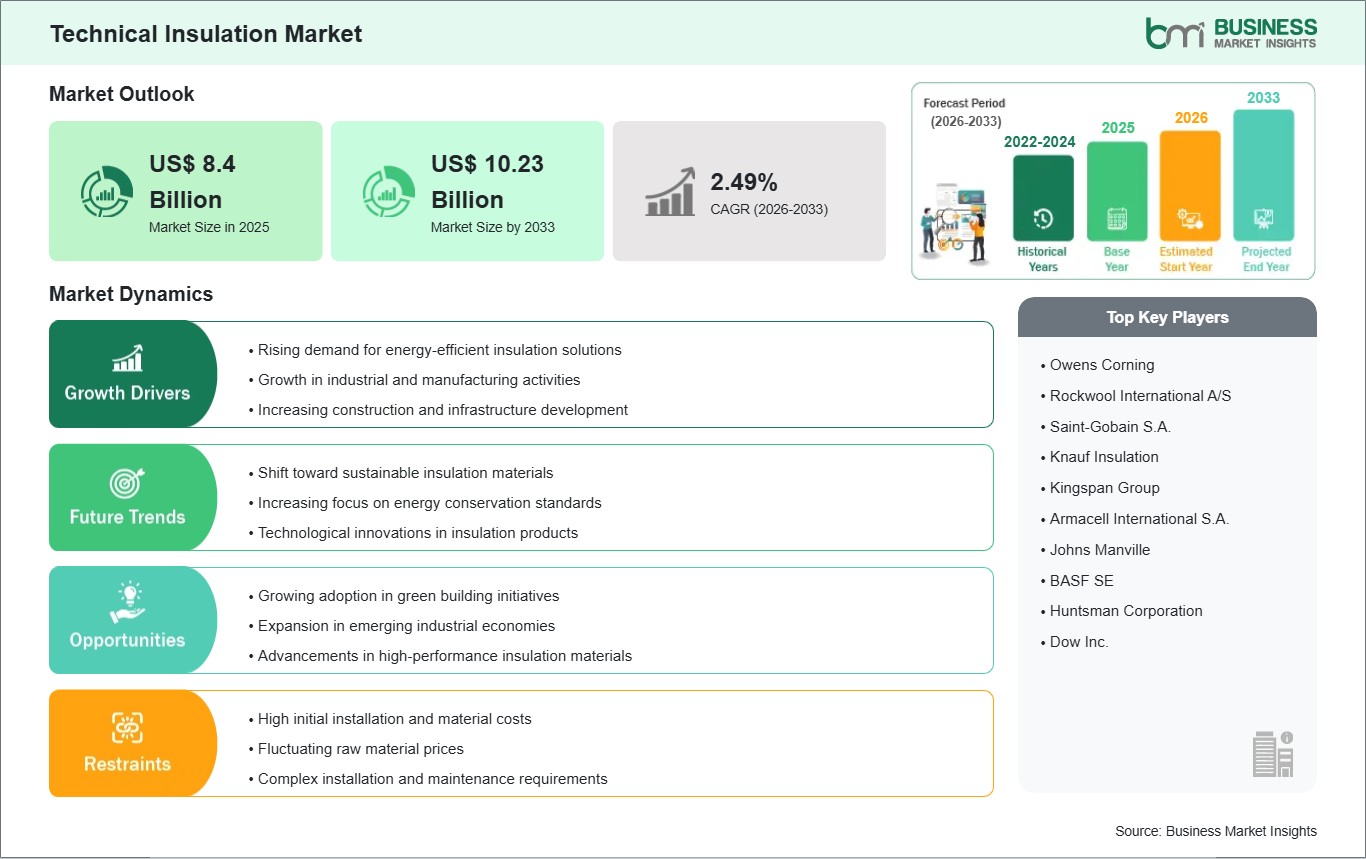
The technical insulation market is experiencing steady growth driven by increasing demand for energy-efficient solutions across industrial and commercial sectors. These materials are widely used to reduce heat loss, improve thermal performance, and enhance energy efficiency in applications such as pipelines, HVAC systems, and industrial equipment. Hot insulation dominates the type segment due to its extensive use in high-temperature industrial processes, while HVAC leads the application segment driven by rising demand for efficient heating and cooling systems globally.
The industrial and OEM segment continues to be the largest end user segment owing to its need to use insulation materials to ensure operational efficiency. Even though the industry faces challenges such as high installation costs and fluctuations in prices of materials, the market continues to grow owing to robust support from regulations and increased awareness about energy saving. Moreover, increased investment in infrastructure development and green buildings has also been a positive growth factor. Technological improvements in insulation materials have enhanced their efficiency, making them more attractive to end users.
Segment Analysis
Technical Insulation Market Segmentation
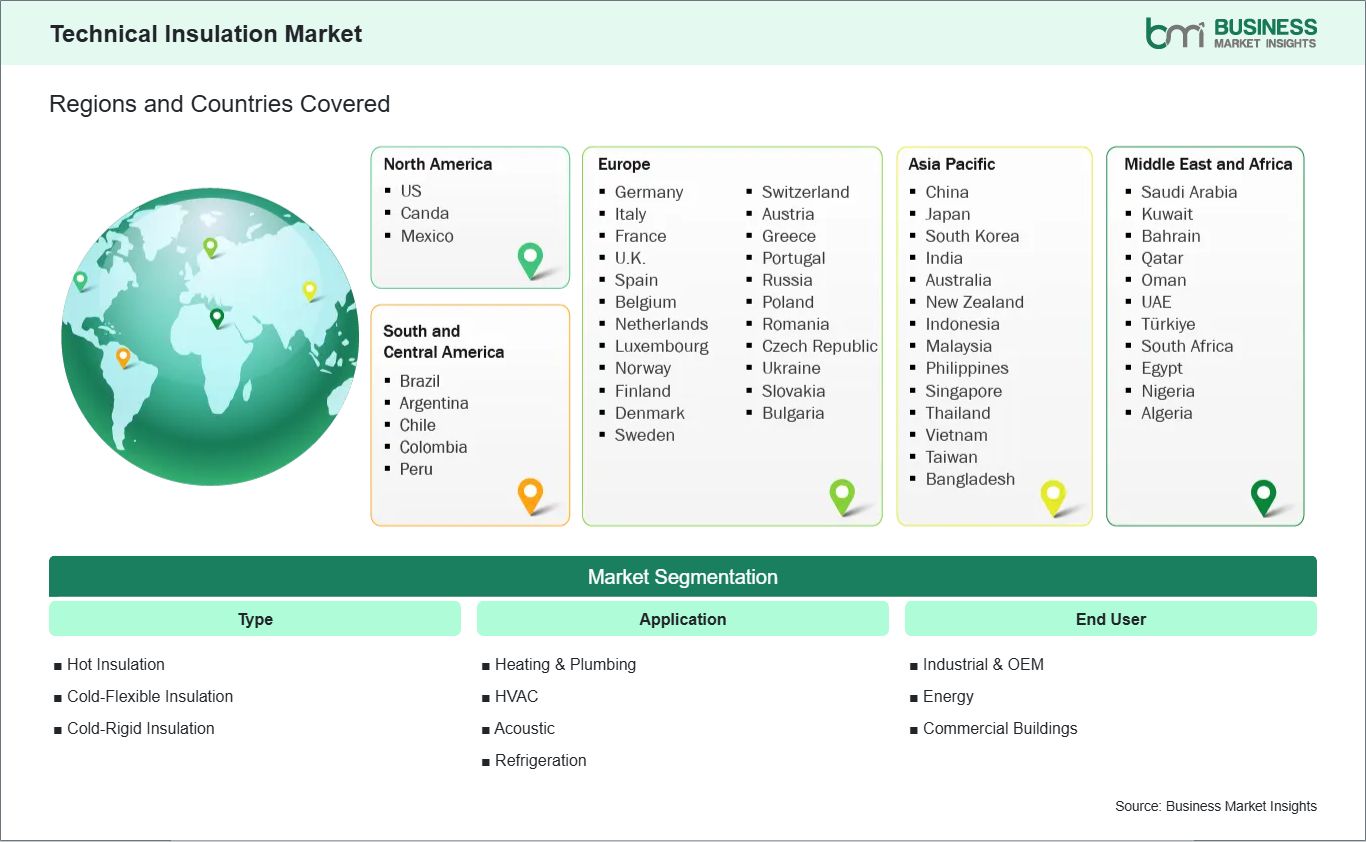
Key segments that contributed to the derivation of the Technical Insulation market analysis are type, application, and end user.
- By type, the technical insulation market is segmented into Hot Insulation, Cold-Flexible Insulation, and Cold-Rigid Insulation. The Hot Insulation segment dominated the market in 2025.
- By application, the technical insulation market is segmented into Heating & Plumbing, HVAC, Acoustic, and Refrigeration. The HVAC segment dominated the market in 2025.
- By end user, the technical insulation market is segmented into Industrial & OEM, Energy, and Commercial Buildings. The Industrial & OEM segment dominated the market in 2025.
Market Forces
Technical Insulation Market Drivers and Opportunities
Rising demand for energy-efficient insulation solutions
The increasing need for energy-efficient insulation products is a major factor for the growth of the technical insulation market. Industries and sectors within the building industry are increasingly focusing on the reduction of energy consumption and increasing thermal efficiency to meet the needs of sustainable development and regulatory compliance. Technical insulation products have a major influence in reducing heat loss or gain in various applications and increasing energy efficiency in the process.
Governments and regulatory bodies are implementing strict energy efficiency standards and building codes, encouraging the adoption of advanced insulation materials. This trend is particularly evident in developed regions where energy conservation policies are well established. In addition, rising energy costs are prompting industries and commercial facilities to invest in insulation solutions that improve operational efficiency and reduce long-term expenses. As awareness regarding environmental impact and energy savings continues to grow, the demand for high-performance technical insulation materials is expected to increase steadily across industrial and commercial applications worldwide.
Growing adoption in green building initiatives
The growing adoption of green building initiatives presents significant opportunities for the technical insulation market. Increasing awareness of environmental sustainability and the need to reduce carbon emissions are driving the demand for eco-friendly construction materials. Technical insulation plays a crucial role in improving building energy efficiency by reducing heat transfer, thereby lowering energy consumption and supporting sustainable development goals in residential and commercial construction projects worldwide.
Green building certifications and standards are encouraging the use of advanced insulation materials that offer superior thermal performance and environmental benefits. Builders and developers are increasingly incorporating insulation solutions that contribute to energy savings and enhance indoor comfort. In addition, advancements in material technology are enabling the development of sustainable insulation products with improved durability and reduced environmental impact. As global construction activities continue to rise and sustainability becomes a priority, the adoption of technical insulation in green building projects is expected to expand, creating strong growth opportunities for market participants.
Size and Share Analysis
Technical Insulation Market Size and Share Analysis
The global Technical Insulation market is experiencing steady growth, with market size and share analysis reflecting evolving treatment preferences and competitive dynamics among key players. The report evaluates important subsegments categorized within type, application, and end user, highlighting their respective contributions to overall market performance.
By type, the Hot Insulation subsegment dominated the market in 2025 due to its widespread use in high-temperature industrial processes, including power generation and manufacturing, where efficient heat retention, energy savings, and operational safety are critical for maintaining system efficiency and reducing thermal losses.
By application, the HVAC subsegment dominated the market in 2025 due to increasing demand for energy-efficient heating and cooling systems, rising construction activities, and strict building regulations promoting insulation solutions that enhance thermal performance and reduce energy consumption in residential and commercial buildings.
By end user, the Industrial & OEM subsegment dominated the market in 2025 due to extensive use of insulation materials in manufacturing, processing plants, and equipment, where thermal management, safety compliance, and energy efficiency are essential for optimizing performance and minimizing operational costs.
Report Coverage
Technical Insulation Market Report Coverage and Deliverables
The "Technical Insulation Market Size and Forecast (2022 - 2033)" report provides a detailed analysis of the market covering below areas:
- Technical Insulation market size and forecast at the regional and country levels for segments covered under the scope
- Technical Insulation market trends, as well as drivers, restraints, and opportunities
- Technical Insulation market analysis covering key trends, regional framework, major players, regulations, and recent developments
- Industry landscape and competition analysis covering market concentration, heat map analysis, prominent players, and recent developments for the Technical Insulation market
- Detailed company profiles, including SWOT analysis
Geographic Insights
Technical Insulation Market Geographic Insights
The geographical scope of the Technical Insulation market report is divided into: North America, Asia Pacific, Europe, Middle East & Africa, and South & Central America. North America held the largest share in 2025.
North America dominates the technical insulation market due to strong demand from industrial, commercial, and energy sectors. The region benefits from well-established infrastructure, advanced manufacturing capabilities, and strict regulatory standards focused on energy efficiency and environmental sustainability. Industries such as oil and gas, power generation, and construction are major consumers of technical insulation, driving consistent demand across various applications and supporting overall market growth in the region.
Regulatory frameworks promoting energy conservation and emission reduction are encouraging the adoption of high-performance insulation materials. Additionally, increasing investments in building renovation and modernization projects are contributing to market expansion. The presence of leading manufacturers and continuous advancements in insulation technologies further strengthen the market position. Growing emphasis on sustainable construction practices and energy-efficient systems is also driving demand. Overall, North America maintains its dominance due to strong industrial base, regulatory support, and increasing adoption of advanced insulation solutions across key sectors.
Industry Activity
Recent Developments
The Technical Insulation market is evaluated by gathering qualitative and quantitative data post primary and secondary research, which includes important corporate publications, association data, and databases. A few of the key developments in the Technical Insulation market are:
- In November 2025, Owens Corning highlighted ongoing investments in insulation solutions for high-growth applications such as data centers, focusing on energy-efficient materials to support expanding digital infrastructure.
- In 2025, Saint-Gobain and Rockwool International were recognized for advancing sustainable insulation technologies and expanding their global footprint through innovation and capacity growth initiatives in HVAC and technical insulation segments.
- In 2025, Armacell, Kingspan Group, and Johns Manville strengthened their market position through strategic agreements, joint ventures, and expansion activities aimed at enhancing advanced insulation solutions, particularly for industrial and data center applications.
Trust & Transparency
Research Methodology
The market analysis combines proprietary research with secondary data from government agencies, company disclosures, regulatory filings, industry databases and expert interviews. Market estimates are validated through data triangulation, cross-market benchmarking and analyst
review.
View Full Research Methodology
Key Sources Referred:
American Chemistry Council (ACC) European Chemical Industry Council (Cefic) International Council of Chemical Associations (ICCA) ASTM International - Committee on Insulation Materials International Organization for Standardization (ISO) North American Insulation Manufacturers Association (NAIMA) European Industrial Insulation Foundation (EiiF) Company Websites Company Annual Reports Company Investor Presentations