Technical Enzymes Market Outlook (2022-2033)

Historic Data: 2022-2024   |   Base Year: 2025   |   Forecast Period: 2026-2033
Report Content: Market Scope, Market Segmentation, Market Dynamics, and Competitive Analysis

Report Coverage:
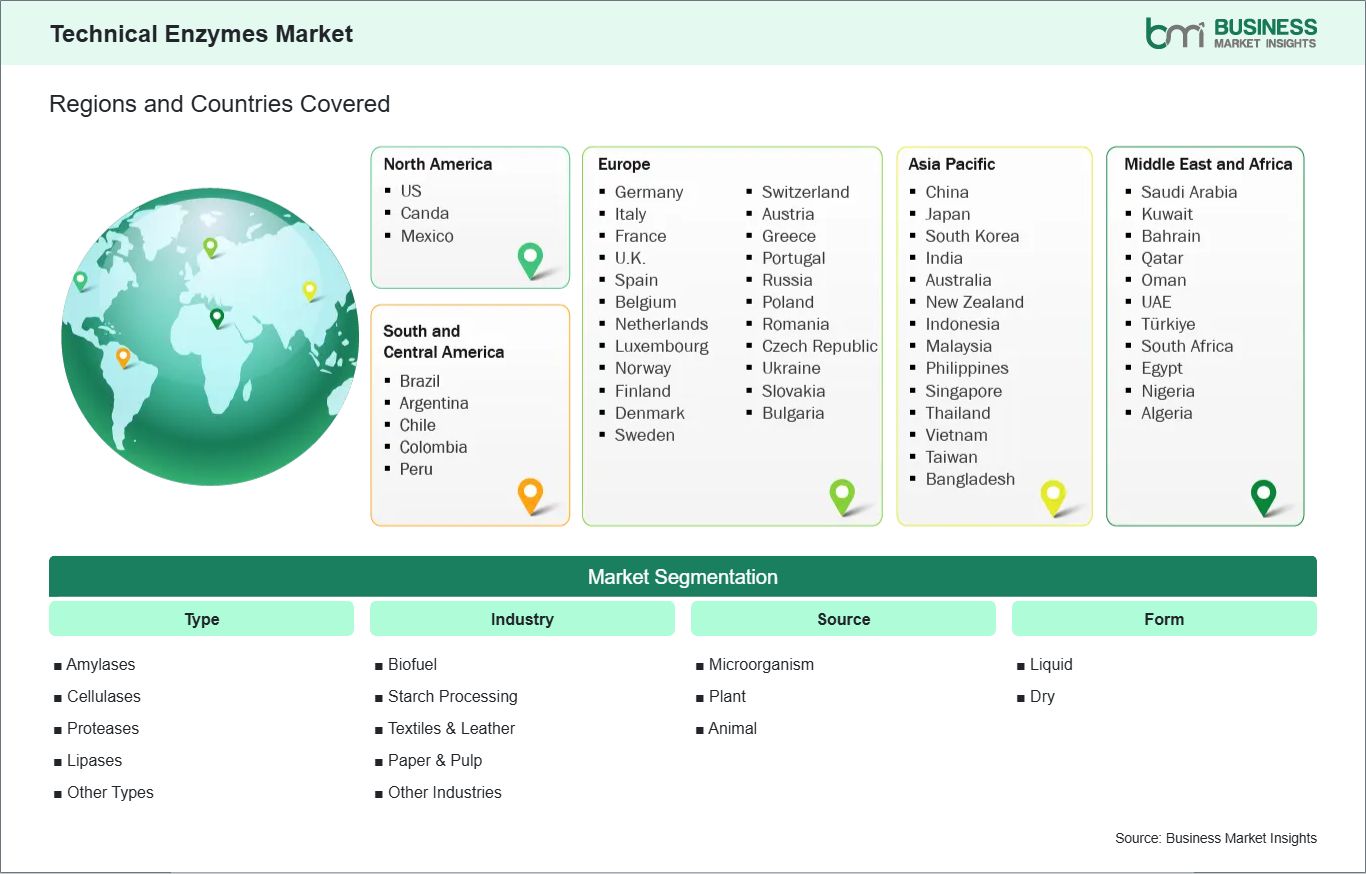
  • Type (Amylases, Cellulases, Proteases, Lipases, Other Types)
  • Industry (Biofuel, Starch Processing, Textiles & Leather, Paper & Pulp, Other Industries)
  • Source (Microorganism, Plant, Animal)
  • Form (Liquid, Dry)

No. of Pages: 428
Report Code: BMIPUB00034488
Category: Chemicals and Materials
Technical Enzymes Market

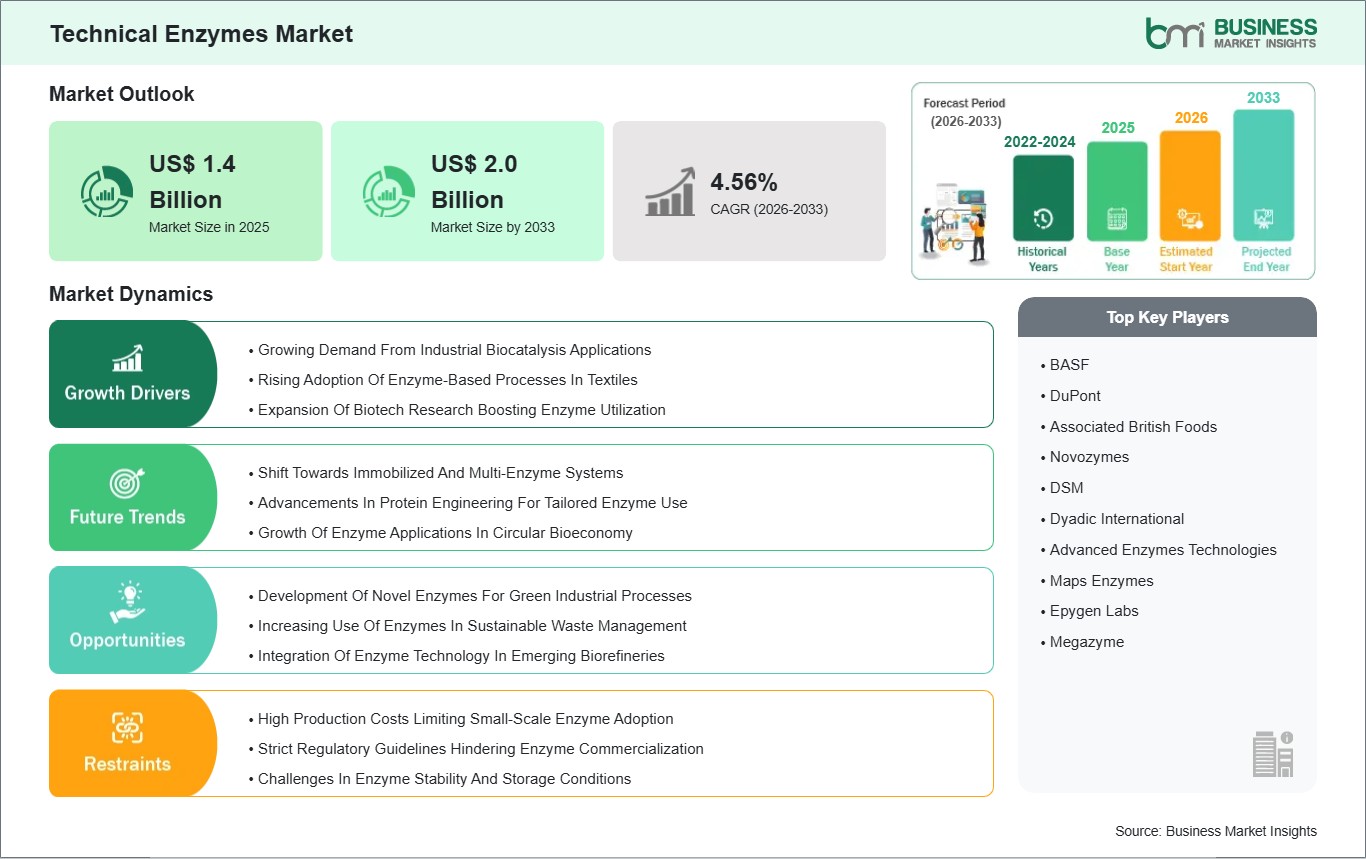
The Technical Enzymes Market size is expected to reach US$ 2. billion by 2033 from US$ 1.4 billion in 2025. The market is estimated to record a CAGR of 4.56% from 2026 to 2033.

Executive Summary and Global Market Analysis:

The global technical enzymes market is experiencing rapid growth because more industries are adopting enzymatic solutions, which improve process efficiency and product performance and create less environmental damage. Technical enzymes function as biological catalysts, that are used by industrial biotechnology, pharmaceutical, food processing, textile, paper and pulp, biofuel, detergent and waste management sectors to speed up or enable chemical reactions. The process optimization capabilities of these systems together with their energy efficiency and chemical reduction benefits have become fundamental elements of contemporary manufacturing operations and eco-friendly production processes. Biocatalysis adoption in industrial settings drives market growth because enzymes serve as chemical catalysts, which provide specific benefits, require less energy and produce fewer unwanted byproducts.

The textile industry uses cellulases and amylases as enzymes to perform bio-polishing and desizing, which improves fabric quality while decreasing water and energy consumption. The use of xylanase and cellulolytic enzymes in pulp and paper manufacturing enables businesses to decrease their dependence on chlorine-based bleaching methods, which helps create environmentally friendly production methods. The biofuel industry uses cellulases and hemicellulases as enzymes to improve biomass conversion into fermentable sugars, which provides an environmentally friendly substitute for fossil fuels. Sustainability practices and circular economy principles are now driving businesses to operate their activities.

Current business operations face mounting pressure from regulatory obligations and consumer demands, which require companies to minimize waste production and greenhouse gas emissions. Technical enzymes help organizations achieve these objectives by enabling processes that produce less pollution and emit fewer greenhouse gases and require reduced resource consumption. Specialized enzymes in wastewater treatment function to decompose organic pollutants, which results in decreased chemical consumption and enhanced wastewater treatment results.

Market conditions show strong positive movement, yet must overcome various obstacles. The high production costs of enzyme products, which need advanced fermentation and purification technologies, create a barrier for cost-sensitive market segments. The technical limitations of enzyme products stem from their need for specific storage and handling methods used to maintain their stability and shelf life. The development process of products that use enzymes in the food and pharmaceutical industries requires additional time because of the need to meet regulatory requirements, which result in increased work demands. The field of enzyme engineering advances through innovative research efforts that optimize processes and establish partnerships between research institutions and industries. Technical enzymes have become essential tools for businesses that aim to produce sustainably according to global sustainability standards.

Technical Enzymes Market - Strategic Insights:

global-market-strategic-framework
Get more information on this report

Technical Enzymes Market Segmentation Analysis:

Key segments that contributed to the derivation of the technical enzymes market analysis are type, industry, source, and form.

  • By type, the technical enzymes market is segmented into amylases, cellulases, proteases, lipases, other types. The proteases segment dominated the market in 2025.
  • Based on industry, the technical enzymes market is categorized into biofuel, starch processing, textiles & leather, paper & pulp, other industries. The biofuel segment dominated the market in 2025.
  • On the basis of source, the technical enzymes market is categorized into microorganism, plant, animal. The microorganism segment dominated the market in 2025.
  • In terms of form, the technical enzymes market is categorized into liquid, dry. The liquid segment dominated the market in 2025.

Technical Enzymes Market Drivers and Opportunities:

Growing Demand From Industrial Biocatalysis Applications

The global technical enzymes market is being significantly propelled by rising demand from industrial biocatalysis, where enzymes serve as catalysts to accelerate chemical reactions in environmentally benign ways. Industries such as fine chemicals, pharmaceuticals, pulp and paper, textiles, and food processing are increasingly replacing harsh chemical catalysts with enzyme‑based solutions that deliver improved selectivity and reduced energy consumption. Industrial biocatalysis enhances process efficiency, minimizes by‑product formation, and supports sustainability goals, factors that have elevated the role of technical enzymes in modern manufacturing workflows across regions.

In textiles, for example, enzymes like amylases and cellulases are widely used to remove starch size, facilitate fabric finishing, and enable bio‑polishing, resulting in better aesthetics and reduced water and energy use compared with conventional methods. Similarly, in the pulp and paper sector, technical enzymes such as xylanases help reduce the reliance on chlorine‑based bleaching, aligning with global trends to lower environmental impact. These biocatalytic solutions are gaining traction in Europe and North America, where stringent environmental regulations push manufacturers toward greener alternatives.

Biopharmaceutical production also relies heavily on enzyme catalysts to streamline synthesis and purification of active pharmaceutical ingredients (APIs), particularly in complex biologics manufacturing. Enzyme engineers are now working globally to tailor catalytic properties for specific industrial applications, optimizing reaction conditions and improving yields. As industries continue seeking cost‑effective, high‑performance, and sustainable production methods, technical enzymes for industrial biocatalysis are becoming an essential tool across manufacturing sectors worldwide.

Development Of Novel Enzymes For Green Industrial Processes

The technical enzymes market is also witnessing significant growth fueled by the development of novel enzyme formulations tailored for green industrial processes. As global industries embrace sustainability, researchers and manufacturers are investing in enzyme innovation that enables processes with lower energy requirements, reduced chemical waste, and enhanced biodegradability. These next‑generation enzymes — such as engineered proteases, lipases, and oxidoreductases — are designed for robust performance under challenging industrial conditions, expanding their applicability in sectors ranging from biofuels and bioplastics to wastewater treatment.

In the biofuel industry, enzymes like cellulases and hemicellulases are instrumental in converting lignocellulosic biomass into fermentable sugars, supporting the production of second‑generation bioethanol and other renewable fuels. Through protein engineering and directed evolution techniques, scientists are enhancing enzyme stability and activity under high temperatures and varying pH levels, driving down processing costs and expanding feedstock compatibility. These advancements are critical in Asia Pacific and Latin America, where abundant biomass resources encourage sustainable biofuel production as part of national energy strategies.

Moreover, wastewater and industrial effluent treatment increasingly leverage novel enzymatic solutions to degrade recalcitrant organic pollutants and reduce chemical oxygen demand without harmful by‑products. In Europe, where environmental regulations are stringent, enzyme‑based treatment systems are being integrated into municipal and industrial facilities to meet water quality standards while reducing energy consumption. As industries worldwide pursue greener processes and circular economy principles, the development of innovative enzyme technologies remains a strategic priority, unlocking new applications and strengthening market growth globally.

Technical Enzymes Market Size and Share Analysis:

The technical enzymes market demonstrates steady growth, with size and share analysis highlighting evolving trends and competitive dynamics among key players. The report examines subsegments categorized within type, industry, source, and form, offering insights into their contribution to overall market performance.

By type, the proteases subsegment dominated the market in 2025, driven by its extensive application across detergents, biofuels, and industrial processes requiring protein degradation.

Based on industry, the biofuel subsegment dominated the market in 2025, driven by high usage of enzymes to improve efficiency and yield in bioethanol and biodiesel production.

In terms of source, the microorganism subsegment dominated the market in 2025, driven by the cost‑effectiveness, high activity, and ease of production of microbial enzymes compared to plant or animal sources.

On the basis of form, the liquid subsegment dominated the market in 2025, driven by better stability, ease of dosing, and higher enzymatic activity in many industrial formulations.

Technical Enzymes Market Report Highlights:

Report Attribute Details
Market size in 2025 US$ 1.4 Billion
Market Size by 2033 US$ 2.0 Billion
Global CAGR (2026 - 2033)4.56%
Historical Data 2022-2024
Forecast period 2026-2033
Segments Covered By Type
  • Amylases
  • Cellulases
  • Proteases
  • Lipases
  • Other Types
By Industry
  • Biofuel
  • Starch Processing
  • Textiles & Leather
  • Paper & Pulp
  • Other Industries
By Source
  • Microorganism
  • Plant
  • Animal
By Form
  • Liquid
  • Dry
Regions and Countries Covered
North America US, Canada, Mexico
Europe Belgium, Austria, Finland, Denmark, Greece, Poland, Romania, Russia, Ukraine, Czech Republic, Slovakia, Bulgaria, Italy, Luxembourg, Germany, Switzerland, France, Netherlands, Norway, Portugal, Spain, Sweden, United Kingdom
Asia-Pacific Australia, China, India, Japan, South Korea, Indonesia, Malaysia, Philippines, Singapore, Thailand, Vietnam, Bangladesh, New Zealand, Taiwan
South and Central America Brazil, Argentina, Peru, Chile, Colombia
Middle East and Africa Bahrain, Kuwait, Oman, Qatar, Saudi Arabia, United Arab Emirates, Turkiye, South Africa, Egypt, Algeria, Nigeria
Market leaders and key company profiles
  • BASF
  • DuPont
  • Associated British Foods
  • Novozymes
  • DSM
  • Dyadic International
  • Advanced Enzymes Technologies
  • Maps Enzymes
  • Epygen Labs
  • Megazyme
Get more information on this report

Technical Enzymes Market Report Coverage and Deliverables:

The "Technical Enzymes Market Size and Forecast (2022 - 2033)" report provides a detailed analysis of the market covering below areas:

  • Technical Enzymes Market size and forecast at global, regional, and country levels for all the key market segments covered under the scope
  • Technical Enzymes Market trends, as well as drivers, restraints, and opportunities
  • Technical Enzymes Market analysis covering key trends, global and regional framework, major players, regulations, and recent developments
  • Industry landscape and competition analysis covering market concentration, heat map analysis, prominent players, and recent developments for the Technical Enzymes Market
  • Detailed company profiles, including SWOT analysis

Technical Enzymes Market Geographic Insights:

The geographical scope of the Technical Enzymes Market report is divided into North America, Asia Pacific, Europe, Middle East & Africa, and South & Central America. North America held the largest share in 2025.

The advanced industrial infrastructure and strong biotechnology ecosystem of North America together with its early enzyme-based solution adoption in multiple sectors make it the leading market for technical enzymes worldwide. The United States and Canada lead the field of enzyme research and development by creating new industrial biocatalysis, biofuels, food processing, paper and pulp and wastewater treatment solutions. Enzyme-based solutions, which include cellulases, proteases and amylases help regional companies to boost their operational effectiveness while decreasing chemical usage and making their production systems more environmentally friendly.

The Asia Pacific region experiences rapid industrial growth, which drives the development of its food and beverage sector and its biofuel market. Local startups and multinational companies work together to accelerate the implementation of enzyme solutions that China, India and Japan develop for textiles and starch processing and dairy and pharmaceutical manufacturing.

The European market maintains its strong position because of strict environmental rules and sustainability requirements, driving the adoption of green enzymes in pulp and paper and bioethanol and detergent production. Research institutions and industrial partners in Germany, France and the UK collaborate to create advanced enzyme solutions that improve process efficiency while reducing environmental impact. The Gulf Cooperation Council (GCC) nations show increasing use of enzymes for wastewater treatment, biofuel production, and food processing because their industrial growth and renewable energy initiatives create demand for these solutions.

Enzyme products are being adopted in South and Central American markets, which show gradual expansion. Brazil, Argentina and Mexico lead enzyme usage for sugarcane bioethanol production, starch modification and industrial fermentation. The regional growth process depends on rising demand for environmentally sustainable energy-efficient production methods, which also reduce operational costs.

Global enzyme usage increases because industries collaborate and governments support biotechnology research, while people become more aware of environmental damage. North America maintains its market leadership through established industrial networks, research development resources and its early acceptance of new enzyme products.

global-market-geography
Get more information on this report

Technical Enzymes Market Research Report Guidance:

  • The report includes qualitative and quantitative data in the Technical Enzymes Market across type, industry, source, form and geography.
  • The report starts with the key takeaways (chapter 2), highlighting key trends and outlook of the Technical Enzymes Market.
  • Chapter 3 focuses on the research methodology of the study.
  • Chapter 4 includes ecosystem analysis.
  • Chapter 5 highlights the major industry dynamics in the Technical Enzymes Market, including factors that are driving the market, prevailing deterrents, potential opportunities, as well as future trends. Impact analysis of these drivers and restraints is also covered in this section.
  • Chapter 6 discusses the Technical Enzymes Market scenario, in terms of historical market revenues, and forecast till the year 2033.
  • Chapters 7 to 11 cover Technical Enzymes Market segments by type, industry, source, form and geography across North America, Asia Pacific, Europe, Middle East & Africa, and South & Central America. They cover the market revenue forecast and factors driving the market.
  • Chapter 12 describes the competitive analysis along with the heat map analysis for the key players operating in the market.
  • Chapter 13 describes the industry landscape analysis. It provides detailed descriptions of business activities such as market initiatives, new developments, mergers, and joint ventures globally, along with a competitive landscape.
  • Chapter 14 provides detailed profiles of the major companies operating in the Technical Enzymes Market. Companies have been profiled on the basis of their key facts, business descriptions, products, financial overview, SWOT analysis, and key developments.
  • Chapter 15, i.e., the appendix, is inclusive of a brief overview of the company, a list of abbreviations, and a disclaimer.

Technical Enzymes Market News and Key Development:

The Technical Enzymes Market is evaluated by gathering qualitative and quantitative data post primary and secondary research, which includes important corporate publications, association data, and databases. A few of the key developments in the technical enzymes market are:

  • In November 2023, Novozymes A/S announced that it launched Quara® LowP, an innovative enzymatic solution designed for renewable diesel and sustainable aviation fuel (SAF) feedstock pre‑treatment, enabling producers to process mixed lipid feedstocks more efficiently, reduce operating costs, and lower environmental impact.
  • In February 2025, dsm‑firmenich announced that it agreed to sell its stake in the Feed Enzymes Alliance to its partner Novonesis, which will consolidate enzyme production and distribution under Novonesis’s broader biosolutions portfolio, enhancing their global industrial enzyme footprint.

Key Sources Referred:

  • World Health Organization (WHO)
  • Organisation for Economic Cooperation and Development (OECD)
  • The World Bank Group
  • Worldometer
  • The Lancet
  • International Bar Association
  • International Trade Administration
The List of Companies - Technical Enzymes Market
  • BASF
  • DuPont
  • Associated British Foods
  • Novozymes
  • DSM
  • Dyadic International
  • Advanced Enzymes Technologies
  • Maps Enzymes
  • Epygen Labs
  • Megazyme
Frequently Asked Questions
How big is the Technical Enzymes Market?

The Technical Enzymes Market is valued at US$ 1.4 Billion in 2025, it is projected to reach US$ 2.0 Billion by 2033.

What is the CAGR for Technical Enzymes Market by (2026 - 2033)?

As per our report Technical Enzymes Market, the market size is valued at US$ 1.4 Billion in 2025, projecting it to reach US$ 2.0 Billion by 2033. This translates to a CAGR of approximately 4.56% during the forecast period.

What segments are covered in this report?

The Technical Enzymes Market report typically cover these key segments-

  • Type (Amylases, Cellulases, Proteases, Lipases, Other Types)
  • Industry (Biofuel, Starch Processing, Textiles & Leather, Paper & Pulp, Other Industries)
  • Source (Microorganism, Plant, Animal)
  • Form (Liquid, Dry)

What is the historic period, base year, and forecast period taken for Technical Enzymes Market?

The historic period, base year, and forecast period can vary slightly depending on the specific market research report. However, for the Technical Enzymes Market report:

  • Historic Period : 2022-2024
  • Base Year : 2025
  • Forecast Period : 2026-2033
  • Who are the major players in Technical Enzymes Market?

    The Technical Enzymes Market is populated by several key players, each contributing to its growth and innovation. Some of the major players include:

  • BASF
  • DuPont
  • Associated British Foods
  • Novozymes
  • DSM
  • Dyadic International
  • Advanced Enzymes Technologies
  • Maps Enzymes
  • Epygen Labs
  • Megazyme
  • Who should buy this report?

    The Technical Enzymes Market report is valuable for diverse stakeholders, including:

    • Investors: Provides insights for investment decisions pertaining to market growth, companies, or industry insights. Helps assess market attractiveness and potential returns.
    • Industry Players: Offers competitive intelligence, market sizing, and trend analysis to inform strategic planning, product development, and sales strategies.
    • Suppliers and Manufacturers: Helps understand market demand for components, materials, and services related to concerned industry.
    • Researchers and Consultants: Provides data and analysis for academic research, consulting projects, and market studies.
    • Financial Institutions: Helps assess risks and opportunities associated with financing or investing in the concerned market.

    Essentially, anyone involved in or considering involvement in the Technical Enzymes Market value chain can benefit from the information contained in a comprehensive market report.

    Available Report Formats

    pdf-format excel-format pptx-format
    Buy Now
    Sales Assistance
    +1 646 791 7070 (US & UK)
    Customization Form

    Please tell us your area of interest
    (Market Segments/ Regions and Countries/ Companies)