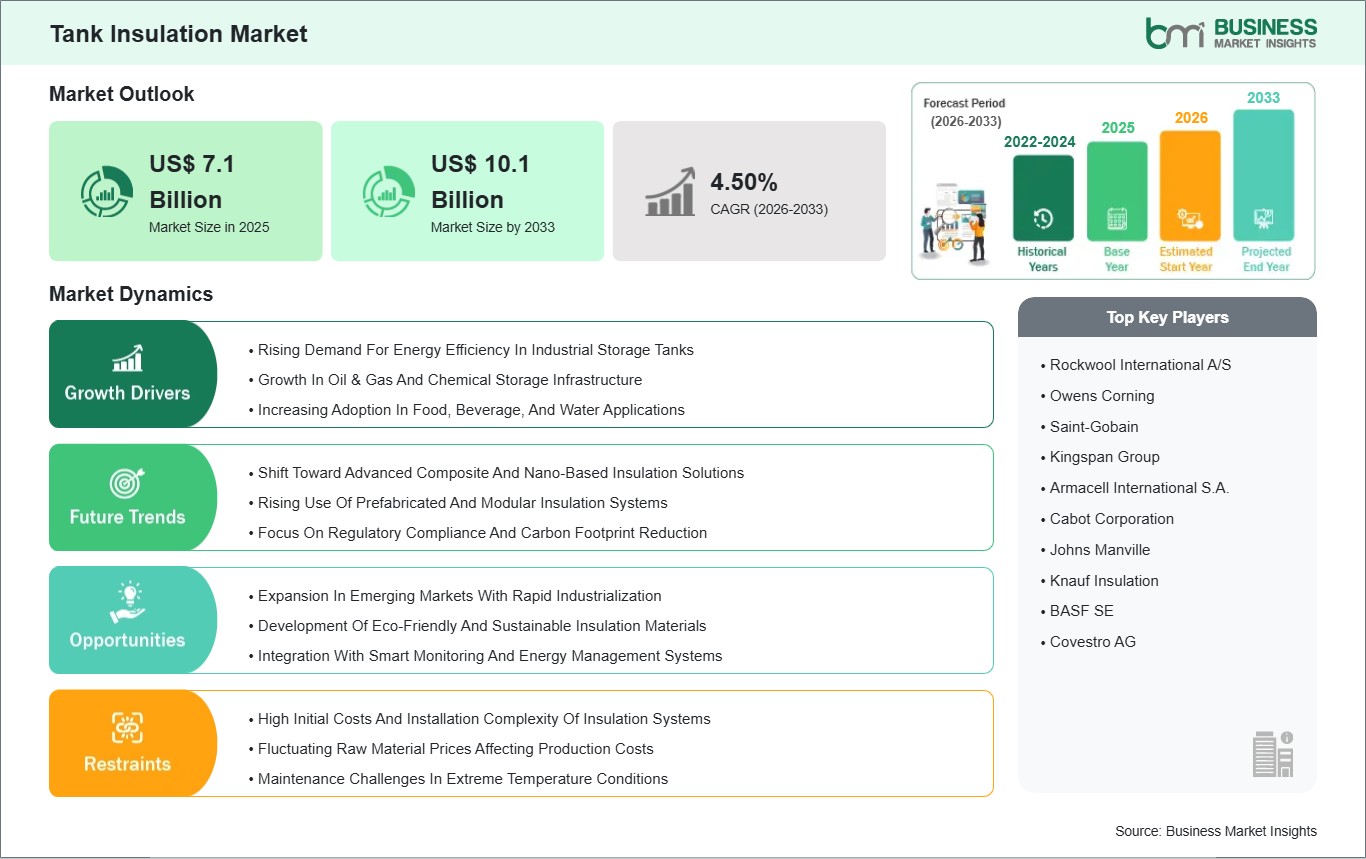
The Tank Insulation Market size is expected to reach US$ 10.1 billion by 2033 from US$ 7.1 billion in 2025. The market is estimated to record a CAGR of 4.50% from 2026 to 2033.
The global tank insulation market functions as an essential component for industrial operations, commercial activities and residential buildings because it helps save energy while controlling temperatures and increasing safety and decreasing tank operating expenses, which are used to hold liquids and gases. Tank insulation systems are applied to storage tanks in industries like oil & gas, petrochemical, chemical processing, water treatment, food & beverage, and pharmaceuticals, where maintaining specific temperatures is essential for process integrity, product quality, and safety compliance. The systems use various materials, which include fiberglass, mineral wool, cellular glass, polyurethane foam and elastomeric materials, and they choose materials based on the required thermal resistance, environmental conditions and operational requirements.
Energy efficiency and sustainability have emerged as primary market drivers because organizations increasingly prioritize these two aspects. All industries must decrease their energy consumption and carbon emissions according to growing global demands, and tank insulation optimization provides an effective method to decrease heat loss while enhancing process efficiency for tanks that store both high-temperature fluids and cryogenic gases. Thermal insulation systems in oil and gas storage terminals maintain product temperatures while stopping evaporation losses, which leads to decreased operational expenses and better regulatory compliance. Tank insulation delivers temperature management for water treatment facilities and industrial processes, which is vital to the biological and chemical reaction processes. Industrial infrastructure development in emerging economies serves as one of the main factors driving industrial growth, which results in increased capacity for petrochemical operations, terminal operations and storage facility operations. The requirement for advanced insulation solutions that provide extreme temperature resistance and environmental protection increases as tank sizes grow and systems become more advanced.
The market contains various limitations that restrict its growth. Project costs and schedules will be impacted by advanced insulation material costs, which vary because of two factors: raw material price changes and supply chain interruptions. Existing facilities need insulation installation and maintenance, which requires extensive manpower and technical skills to execute, especially for large buildings that need specific insulation solutions. Cost-sensitive applications and locations without specialized installation skills face challenges because of these factors.

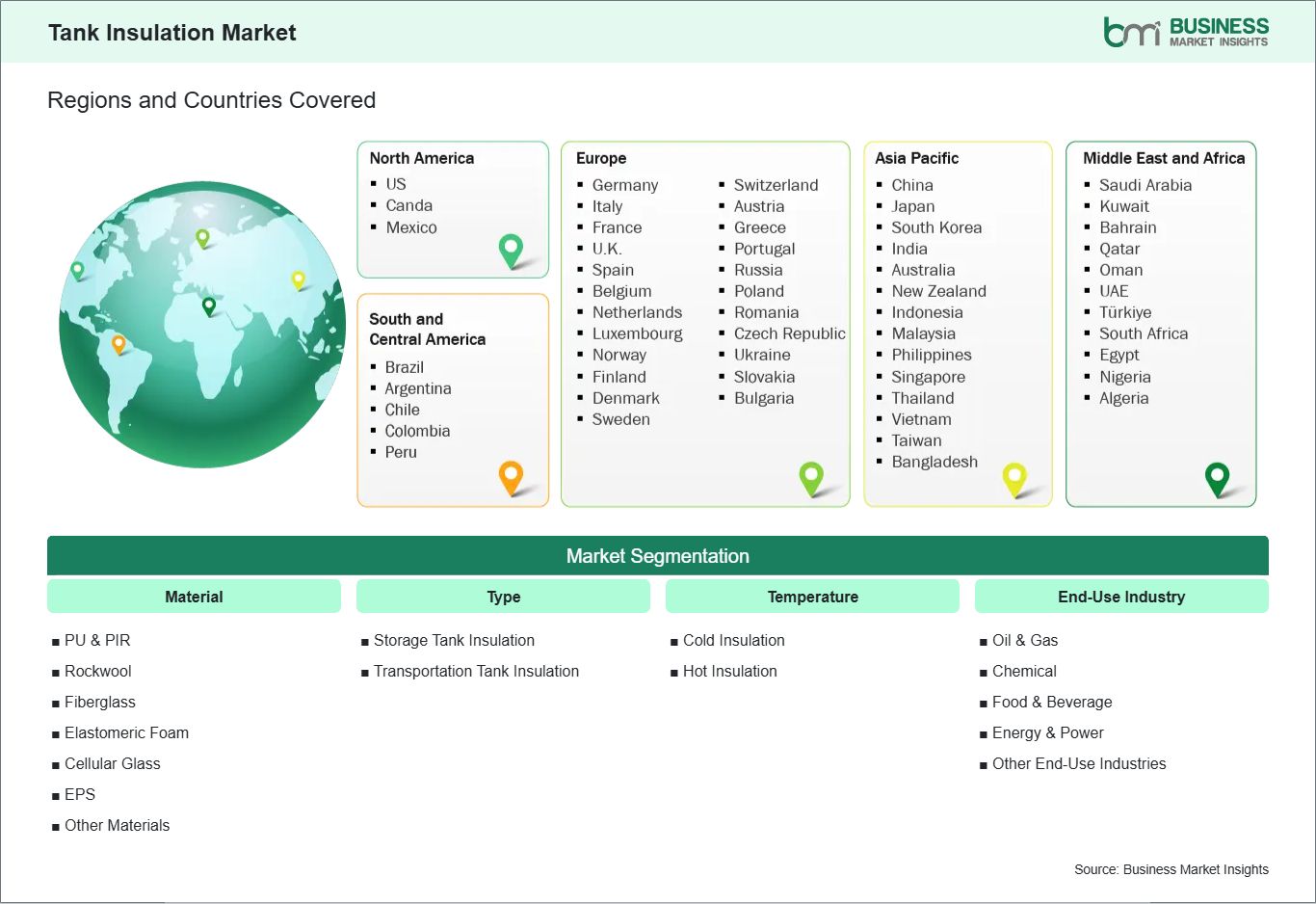
Key segments that contributed to the derivation of the tank insulation market analysis are material, type, temperature, and end‑use industry.
The global tank insulation market is increasingly driven by rising demand for energy efficiency in industrial storage tanks across multiple sectors, including oil & gas, chemical processing, power generation, and food & beverage. Industrial operations depend on insulated tanks because these tanks protect their stored materials from temperature changes, which lead to heat loss and higher energy costs. In refineries and petrochemical complexes, where large volumes of liquids must be heat‑managed 24/7, insulation helps reduce fuel consumption and improve process efficiency. This focus on operational cost savings and energy optimization has moved tank insulation from a "nice-to-have" to an essential component of sustainable industrial infrastructure.
The trend receives reinforcement from corporate sustainability commitments and energy policies, which European and North American countries enact. The regulatory frameworks in many mature markets now require facility owners to install advanced insulation systems or retrofit existing tanks because these systems deliver energy savings that meet environmental compliance standards. Insulation systems help facilities achieve efficiency targets while demonstrating lower carbon emissions, which supports their decarbonization efforts.
Across industries, insurers and safety regulators increasingly encourage or mandate insulation to prevent thermal shock, condensation, and surface temperature extremes that can compromise structural integrity or worker safety. This multi‑layered demand—financial, environmental, and safety‑driven—continues to propel investment in high‑performance insulation materials and engineered systems globally, underscoring energy efficiency as a core driver of market growth.
The tank insulation market is experiencing notable expansion in emerging markets characterized by rapid industrialization, infrastructural development, and rising manufacturing output. In Asia Pacific, countries such as China, India, Vietnam, and Indonesia are scaling up refinery capacity, petrochemical hubs, and heavy industry, all of which require temperature‑specific storage solutions. As these economies invest in new industrial parks and storage facilities to support domestic demand and global export chains, the adoption of tank insulation becomes integral to construction and operational planning. These regions are increasingly moving beyond basic insulation to advanced engineered systems tailored to climatic and process needs.
Similarly, in parts of Latin America and the Middle East, expanding energy, water treatment, and agro‑processing sectors are creating opportunities for insulation solutions. Brazil and Mexico, for instance, are investing in modern chemical and biofuel infrastructure where thermal insulation enhances energy conservation and process reliability. The Middle East`s ongoing diversification from pure hydrocarbon exportation into petrochemicals and industrial chemicals also demands robust insulation systems to ensure product quality across extreme temperature ranges.
Government initiatives that promote industrial modernization and energy efficiency, coupled with foreign direct investment in manufacturing zones, are accelerating infrastructure projects that include insulated tank installations. Local suppliers are increasingly partnering with global insulation material producers to deliver cost‑effective solutions, further embedding tank insulation into emerging markets’ industrial expansion strategies.

The tank insulation market demonstrates steady growth, with size and share analysis highlighting evolving trends and competitive dynamics among key players. The report examines subsegments categorized within material, type, temperature, and end‑use industry, offering insights into their contribution to overall market performance.
By material, the PU & PIR subsegment dominated the market in 2025, driven by its superior thermal insulation, lightweight nature, and energy‑saving properties in tank applications.
Based on type, the storage tank insulation subsegment dominated the market in 2025, driven by high demand from stationary tanks in industries like oil, gas, and chemicals.
In terms of temperature, the cold insulation subsegment dominated the market in 2025, driven by the need to maintain low temperatures in LNG, cryogenic, and refrigerated storage applications.
On the basis of end‑use industry, the oil & gas subsegment dominated the market in 2025, driven by extensive use of insulated tanks for storage and handling of crude oil, LNG, and other hydrocarbon products.
| Report Attribute | Details |
|---|---|
| Market size in 2025 | US$ 7.1 Billion |
| Market Size by 2033 | US$ 10.1 Billion |
| Global CAGR (2026 - 2033) | 4.50% |
| Historical Data | 2022-2024 |
| Forecast period | 2026-2033 |
| Segments Covered | By Material
|
|
Regions and Countries Covered
| |
| North America | US, Canada, Mexico |
| Europe | Belgium, Austria, Finland, Denmark, Greece, Poland, Romania, Russia, Ukraine, Czech Republic, Slovakia, Bulgaria, Italy, Luxembourg, Germany, Switzerland, France, Netherlands, Norway, Portugal, Spain, Sweden, United Kingdom |
| Asia-Pacific | Australia, China, India, Japan, South Korea, Indonesia, Malaysia, Philippines, Singapore, Thailand, Vietnam, Bangladesh, New Zealand, Taiwan |
| South and Central America | Brazil, Argentina, Peru, Chile, Colombia |
| Middle East and Africa | Bahrain, Kuwait, Oman, Qatar, Saudi Arabia, United Arab Emirates, Turkiye, South Africa, Egypt, Algeria, Nigeria |
| Market leaders and key company profiles |
|
The "Tank Insulation Market Size and Forecast (2022 - 2033)" report provides a detailed analysis of the market covering below areas:
The geographical scope of the Tank Insulation Market report is divided into North America, Asia Pacific, Europe, Middle East & Africa, and South & Central America. North America held the largest share in 2025.
North America stands as the leading region in the Tank Insulation Market because of its developed industrial facilities, its strict energy efficiency standards and its various uses in oil and gas, chemical, water treatment and food and beverage sectors. Refineries, petrochemical plants and food processing facilities in the United States and Canada utilize advanced insulation solutions such as fiberglass and mineral wool, polyurethane foams and elastomeric materials to construct their large-scale storage tanks, which help them maintain temperature control and prevent heat loss and guarantee operational safety. The implementation of energy conservation initiatives combined with emissions reduction programs creates a need for high-performance insulation systems, which will be used in both new tank installations and retrofitted tank projects.
The European market exists as a crucial area for thermal insulation, which chemical and industrial storage tanks employ in Germany, France and the UK because industrial modernization, environmental regulations and sustainable building practices create demand for this technology although material costs and complex installation requirements create occasional challenges.
The Asia Pacific region is experiencing fast development because industrial infrastructure develops through industrial growth in China, India and Southeast Asian nations. The adoption of tank insulation is driven by increasing demand for petrochemical storage facilities and rising energy awareness and investments in food and beverage and water treatment sectors, which require eco-friendly and cost-effective materials that work well in tropical climates.
The Middle Eastern and African market depends on oil and gas storage and processing facilities, which exist throughout the region but especially impact Saudi Arabia and UAE, and South Africa, where thermal insulation protects hydrocarbon assets under extreme temperature conditions.
The South and Central American market represents a developing market with Brazil, Argentina and Chile developing industrial storage and water treatment and energy systems, although their progress remains restricted because they lack sufficient funds and advanced materials.
The North American market maintains its lead in technology adoption and regulatory support, yet other regions start to identify tank insulation advantages, which drive energy efficiency and safety and operational benefits, thus expanding the worldwide market growth.

The Tank Insulation Market is evaluated by gathering qualitative and quantitative data post primary and secondary research, which includes important corporate publications, association data, and databases. A few of the key developments in the tank insulation market are:
The Tank Insulation Market is valued at US$ 7.1 Billion in 2025, it is projected to reach US$ 10.1 Billion by 2033.
As per our report Tank Insulation Market, the market size is valued at US$ 7.1 Billion in 2025, projecting it to reach US$ 10.1 Billion by 2033. This translates to a CAGR of approximately 4.50% during the forecast period.
The Tank Insulation Market report typically cover these key segments-
The historic period, base year, and forecast period can vary slightly depending on the specific market research report. However, for the Tank Insulation Market report:
The Tank Insulation Market is populated by several key players, each contributing to its growth and innovation. Some of the major players include:
The Tank Insulation Market report is valuable for diverse stakeholders, including:
Essentially, anyone involved in or considering involvement in the Tank Insulation Market value chain can benefit from the information contained in a comprehensive market report.
Please tell us your area of interest
(Market Segments/ Regions and Countries/ Companies)