Market Summary
Executive Summary and Global Market Analysis
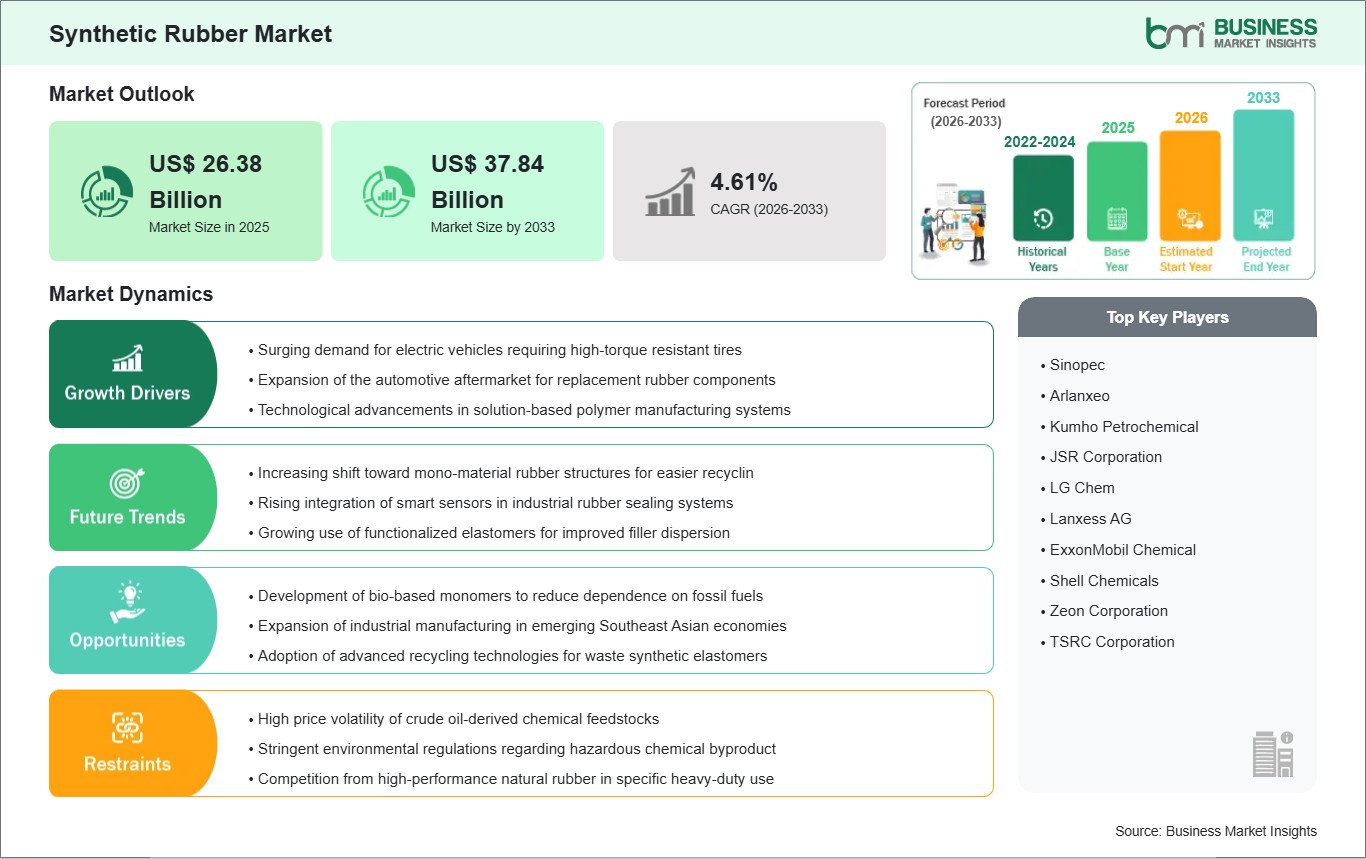
The synthetic rubber industry represents an important part of the industrial landscape of the world, contributing significantly to the development of modern transportation, construction, and consumer products. While considered a commodity industry in the past, today`s synthetic rubber industry is in a state of transition from a low-tech to a high-tech industry, driven by the need for performance and sustainability. Styrene-butadiene rubber and tire manufacturing industry dominate today`s synthetic rubber industry. Solution polymerization represents a trend toward precision engineering in material science, which enables the development of safer, more durable, and more energy-efficient synthetic rubbers than ever before.
Growth is currently robust, fueled by the rising production of electric vehicles and the expansion of industrial manufacturing in Asia-Pacific. However, the market must navigate challenges such as feedstock price volatility and increasing pressure to reduce the environmental impact of chemical manufacturing. The industry is responding through innovation in bio-based feedstocks and the development of circular economy models for rubber recycling. As major global players invest in advanced continuous polymerization and new polymer architectures, the synthetic rubber market is evolving from a heavy-industrial sector into a science-led industry that is central to the future of sustainable mobility and high-performance industrial design.
Segment Analysis
Synthetic Rubber Market Segmentation
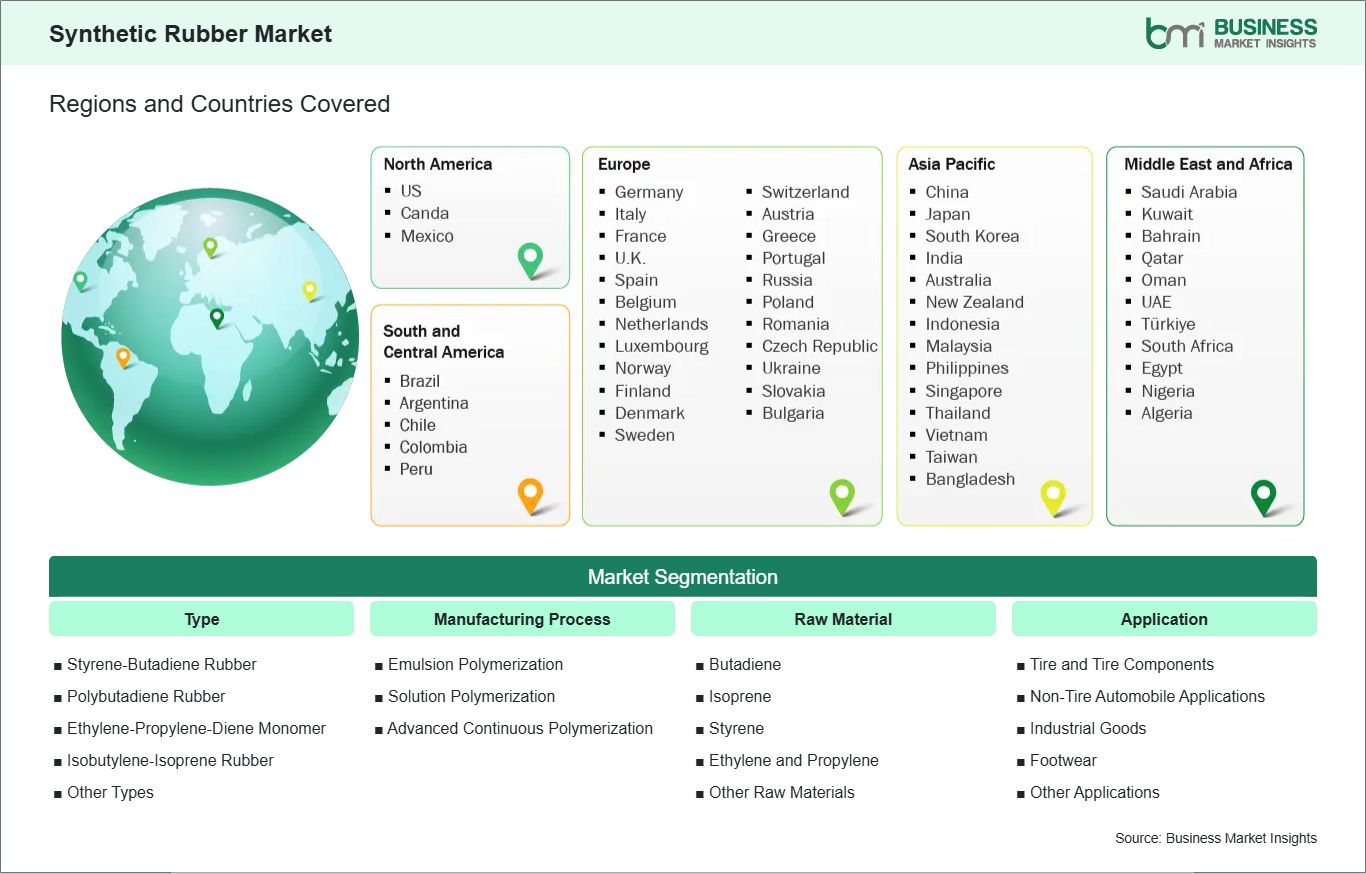
Key segments that contributed to the derivation of the Synthetic Rubber market analysis are type, manufacturing process, raw material, and application.
- By type, the synthetic rubber market is segmented into Styrene-Butadiene Rubber, Polybutadiene Rubber, Ethylene-Propylene-Diene Monomer, Isobutylene-Isoprene Rubber, and Others. The Styrene-Butadiene Rubber segment dominated the market in 2025.
- By manufacturing process, the synthetic rubber market is segmented into Emulsion Polymerization, Solution Polymerization, and Advanced Continuous Polymerization. The Solution Polymerization segment dominated the market in 2025.
- By raw material, the synthetic rubber market is segmented into Butadiene, Isoprene, Styrene, Ethylene and Propylene, and Others. The Butadiene segment dominated the market in 2025.
- By application, the synthetic rubber market is segmented into Tire and Tire Components, Non-Tire Automobile Applications, Industrial Goods, Footwear, and Other Applications. The Tire and Tire Components segment dominated the market in 2025.
Market Forces
Synthetic Rubber Market Drivers and Opportunities
Surging demand for electric vehicles requiring high-torque resistant tires
The major driver for the synthetic rubber market is the rapid transition towards electric mobility on a global scale, which demands specific technical specifications for tires that meet the requirements of electric vehicles. Electric vehicles are much heavier in weight compared to traditional internal combustion engine vehicles due to the presence of a battery pack in electric vehicles and provide instant torque to the wheels. This puts immense stress on the treads of the vehicle tires, resulting in increased wear and tear on the tires. Therefore, there is a high demand for specialized synthetic rubber materials such as solution styrene-butadiene rubber that provide superior resistance against wear and tear and ensure that the tires of electric vehicles remain in use for a long period of time.
Moreover, there exists a need to maximize range, which relies significantly on rolling resistance. Synthetic rubber makers are currently working on creating chemical blends that reduce energy loss when deformed. This extends the range of an electric vehicle. This need for a specific type of synthetic rubber, which has a low rolling resistance, is causing a paradigm shift from conventional rubber materials to more engineered materials. As government subsidies continue to increase the adoption rate of electric vehicles, synthetic rubber makers are witnessing a long-term shift in demand from conventional materials to more engineered materials
Development of bio-based monomers to reduce dependence on fossil fuels
A significant growth opportunity in the synthetic rubber market lies in the commercialization of bio-based raw materials, such as bio-butadiene and bio-isoprene. Historically, the synthetic rubber industry has been vulnerable to the price fluctuations of the petrochemical market, as its primary feedstocks are derived from crude oil and natural gas. By utilizing agricultural waste, sugar, or cellulosic biomass as feedstocks, manufacturers can create renewable monomers that have a significantly lower carbon footprint. This transition aligns with the broader corporate sustainability goals of major tire and automotive brands, many of which have pledged to use 100 percent sustainable materials in the coming decades.
The move toward green chemistry also provides a strategic hedge against geopolitical instability and the tightening of carbon emission regulations. Early adopters of bio-synthetic rubber technology are gaining a competitive advantage by offering products that appeal to eco-conscious consumers and institutional investors. As fermentation and catalytic conversion technologies scale up, the production costs of bio-based monomers are expected to become more competitive with traditional petrochemical routes. This evolution represents a fundamental change in the synthetic rubber value chain, moving the industry toward a regenerative model that decouples material production from finite fossil resources.
Size and Share Analysis
Synthetic Rubber Market Size and Share Analysis
The global Synthetic Rubber market is experiencing steady growth, with market size and share analysis reflecting evolving treatment preferences and competitive dynamics among key players. The report evaluates important subsegments categorized within type, manufacturing process, raw material, and application, highlighting their respective contributions to overall market performance.
By type, the Styrene-Butadiene Rubber subsegment dominated the market in 2025 because of its high abrasion resistance and cost-effectiveness compared to natural rubber, making it the essential choice for manufacturing durable treads in passenger car tires.
By manufacturing process, the Solution Polymerization subsegment dominated the market in 2025 as it allows for precise control over the polymer microstructure, resulting in high-performance rubbers that provide lower rolling resistance and better wet grip for modern green tires.
By raw material, the Butadiene subsegment dominated the market in 2025 because it serves as the primary building block for both styrene-butadiene and polybutadiene rubbers, which together account for the vast majority of global synthetic elastomer production.
By application, the Tire and Tire Components subsegment dominated the market in 2025 due to the continuous global demand for vehicle production and the massive replacement tire market, where synthetic rubber is the critical ingredient for achieving safety and fuel efficiency.
Report Coverage
Synthetic Rubber Market Report Coverage and Deliverables
The "Synthetic Rubber Market Size and Forecast (2022 - 2033)" report provides a detailed analysis of the market covering below areas:
- Synthetic Rubber market size and forecast at the regional and country levels for segments covered under the scope
- Synthetic Rubber market trends, as well as drivers, restraints, and opportunities
- Synthetic Rubber market analysis covering key trends, regional framework, major players, regulations, and recent developments
- Industry landscape and competition analysis covering market concentration, heat map analysis, prominent players, and recent developments for the Synthetic Rubber market
- Detailed company profiles, including SWOT analysis
Geographic Insights
Synthetic Rubber Market Geographic Insights
The geographical scope of the Synthetic Rubber market report is divided into: North America, Asia Pacific, Europe, Middle East & Africa, and South & Central America. North America held the largest share in 2025.
North America maintains a dominant position in the synthetic rubber market, a status supported by its world-class petrochemical infrastructure and a highly advanced automotive research sector. The region is home to several of the world largest chemical and tire manufacturers, who lead the way in the development of specialized elastomers for extreme environments. In the United States, the resurgence of domestic manufacturing and a strong emphasis on supply chain security have led to significant investments in new synthetic rubber facilities. This regional strength is further bolstered by a mature automotive aftermarket, where the high frequency of vehicle maintenance drives a consistent demand for replacement tires, hoses, and seals.
The dominance of North America is also a result of early and aggressive adoption of sustainability standards, which has fostered a leading market for high-performance green tires. The region advanced technological ecosystem allows for rapid prototyping and commercialization of new rubber formulations, such as those used in aerospace and medical applications. Furthermore, the availability of low-cost ethane and other feedstocks from regional shale gas production provides North American manufacturers with a competitive cost structure compared to other global regions. This combination of technical expertise, favorable raw material access, and a massive domestic consumer base ensures that North America remains the primary engine of value and innovation for the global synthetic rubber industry.
Industry Activity
Recent Developments
The Synthetic Rubber market is evaluated by gathering qualitative and quantitative data post primary and secondary research, which includes important corporate publications, association data, and databases. A few of the key developments in the Synthetic Rubber market are:
- In November 2025, Arlanxeo announced that it had expanded its synthetic rubber production capacity in Saudi Arabia, focusing on butadiene rubber (BR) and styrene-butadiene rubber (SBR) to serve global tire manufacturers.
- In July 2024, Kumho Petrochemical announced that it had launched eco-friendly synthetic rubber grades with reduced carbon footprint, targeting high-performance tires and industrial applications.
- In March 2023, LG Chem announced that it had upgraded its synthetic rubber facilities in South Korea to improve efficiency and reduce emissions, reinforcing its ESG roadmap.
Trust & Transparency
Research Methodology
The market analysis combines proprietary research with secondary data from government agencies, company disclosures, regulatory filings, industry databases and expert interviews. Market estimates are validated through data triangulation, cross-market benchmarking and analyst
review.
View Full Research Methodology
Key Sources Referred:
Society of Plastics Engineers (SPE) American Chemistry Council (ACC) International Institute of Synthetic Rubber Producers (IISRP) Plastics Industry Association (PLASTICS) ASTM International International Organization for Standardization (ISO) European Chemical Industry Council (Cefic) China Petroleum and Chemical Industry Federation (CPCIF) Company Websites Company Annual Reports Company Investor Presentations