Market Summary
Executive Summary and Global Market Analysis
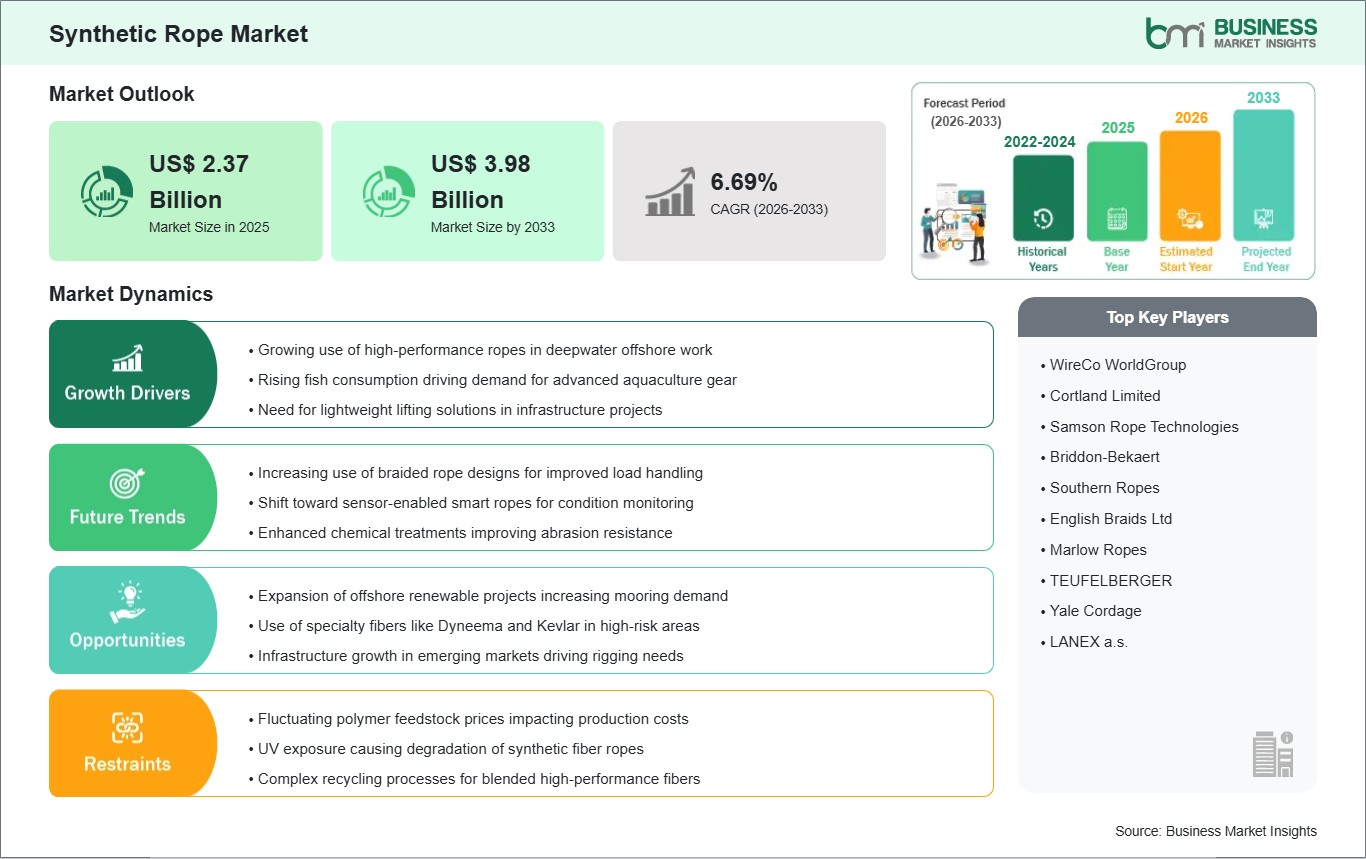
The synthetic rope market acts as an important segment in the overall industry for sectors that need high-strength, lightweight, and durable tension products. Synthetic ropes are made from modern polymers to give better properties compared to traditional ropes made from natural fibers or steel wire. At the moment, the market for synthetic ropes is dominated by polypropylene and the marine and fishing industry, which cover the biggest percentage in global market consumption. The move towards specialty fibers and braided ropes is an important characteristic of the modern market, as industries in deepwater and construction operations are trying to achieve maximum safety and strength while at the same time trying to reduce weight and maintenance associated with traditional ropes.
The current market environment is dominated by a two-pronged approach of performance and environmental responsibility. Even though the oil and gas industry continues to be a key end-user segment, offshore renewables and infrastructure projects are helping to drive additional demand. While challenges such as fluctuating raw materials costs and the complexity of recycling high-performance polymers persist, responses such as increased research into circular economy approaches and bio-based coatings are helping to address these. Looking ahead, there are likely to be more technology innovations, such as real-time monitoring sensors, which will enable synthetic ropes to play a more intelligent role in ensuring safety and longevity.
Segment Analysis
Synthetic Rope Market Segmentation
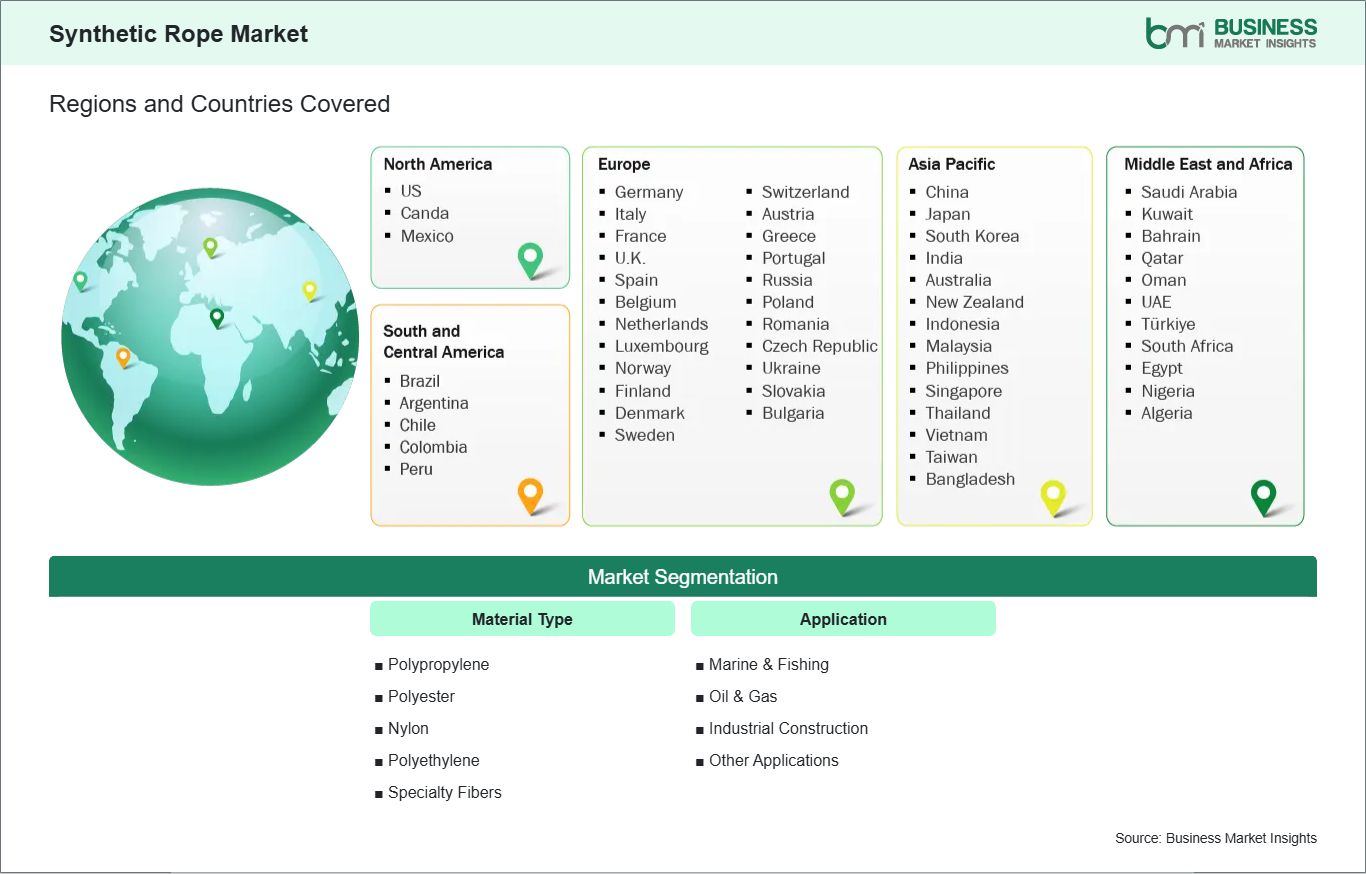
Key segments that contributed to the derivation of the Synthetic Rope market analysis are material type and application.
- By material type, the synthetic rope market is segmented into Polypropylene, Polyester, Nylon, Polyethylene, and Specialty Fibers. The Polypropylene segment dominated the market in 2025.
- By application, the synthetic rope market is segmented into Marine & Fishing, Oil & Gas, Industrial Construction, and Others. The Marine & Fishing segment dominated the market in 2025.
Market Forces
Synthetic Rope Market Drivers and Opportunities
Growing adoption of high-performance ropes for deepwater offshore operations
The synthetic rope market is significantly propelled by the increasing complexity of offshore energy exploration and production. As oil and gas activities move into deeper waters, traditional steel wire ropes become less viable due to their immense self-weight, which consumes a substantial portion of a crane or winch's lifting capacity. High-performance synthetic ropes, particularly those made from specialty fibers, provide a solution by offering a strength-to-weight ratio that is up to fifteen times greater than steel. This allows operators to reach greater depths and handle heavier loads with existing equipment, effectively optimizing operational efficiency and reducing fuel consumption during offshore deployment.
Additionally, synthetic ropes provide superior fatigue resistance and do not experience the internal corrosion associated with steel cables when exposed to saltwater environments therefore their durability decreases the amount of time a rope must be replaced resulting in decreased downtime during critical subsea installation operations. Safety is also an important factor in driving the shift toward synthetic ropes, as synthetic ropes do not store as much kinetic energy as steel ropes do, and therefore will not create as much force during an event of a snap of the synthetic rope. Demand for lightweight, high-load synthetic mooring and lifting products will continue to provide a significant portion of revenue growth to the industry due to the growth of offshore wind farm projects on a large scale.
Expansion of offshore renewable energy projects requiring mooring lines
The rapid global transition toward renewable energy, specifically offshore wind and floating solar platforms, represents a major growth frontier for synthetic rope manufacturers. Floating offshore wind farms require sophisticated mooring systems to maintain stability in turbulent sea conditions. Synthetic ropes are ideally suited for these applications because their elasticity allows them to absorb the dynamic loads caused by waves and wind more effectively than rigid chain or wire systems. This flexibility reduces the peak loads on the floating foundation and the seabed anchors, allowing for lighter and more cost-effective structural designs. Beyond wind energy, the emerging tidal and wave energy sectors also rely on specialized synthetic lines that can withstand constant cyclic loading and biological fouling.
Manufacturers are currently developing customized rope constructions with protective coatings that prevent marine growth from compromising the fiber integrity. As governments worldwide increase their offshore renewable energy targets to meet climate goals, the volume of synthetic rope required for these installations is projected to scale significantly. This opportunity allows rope producers to diversify their revenue streams away from traditional fossil fuel sectors and align their product portfolios with the global shift toward sustainable industrial practices.
Size and Share Analysis
Synthetic Rope Market Size and Share Analysis
The global Synthetic Rope market is experiencing steady growth, with market size and share analysis reflecting evolving treatment preferences and competitive dynamics among key players. The report evaluates important subsegments categorized within material type and application highlighting their respective contributions to overall market performance.
By material type, the Polypropylene subsegment dominated the market in 2025 because it offers the most cost-effective balance of high tensile strength and lightweight properties, and its natural buoyancy makes it the primary choice for general-purpose marine and utility applications.
By application, the Marine & Fishing subsegment dominated the market in 2025 due to the continuous demand for durable, corrosion-resistant ropes in commercial fishing, aquaculture, and vessel mooring operations, where synthetic materials have largely replaced traditional natural fibers and steel wires.
Report Coverage
Synthetic Rope Market Report Coverage and Deliverables
The "Synthetic Rope Market Size and Forecast (2022 - 2033)" report provides a detailed analysis of the market covering below areas:
- Synthetic Rope market size and forecast at the regional and country levels for segments covered under the scope
- Synthetic Rope market trends, as well as drivers, restraints, and opportunities
- Synthetic Rope market analysis covering key trends, regional framework, major players, regulations, and recent developments
- Industry landscape and competition analysis covering market concentration, heat map analysis, prominent players, and recent developments for the Synthetic Rope market
- Detailed company profiles, including SWOT analysis
Geographic Insights
Synthetic Rope Market Geographic Insights
The geographical scope of the Synthetic Rope market report is divided into: North America, Asia Pacific, Europe, Middle East & Africa, and South & Central America. North America held the largest share in 2025.
North America stands as the dominant region in the synthetic rope market, a position established by its extensive offshore energy infrastructure and a highly developed maritime sector. The region's leadership is anchored in the Gulf of Mexico, where deepwater oil and gas operations have pioneered the use of high-modulus synthetic ropes for mooring and subsea installations. Additionally, North America benefits from a robust manufacturing base and a high concentration of leading specialty fiber producers, which allows for the rapid development and domestic supply of advanced rope systems. The presence of stringent workplace safety regulations also encourages the adoption of synthetic alternatives over steel wire to reduce handling injuries and improve operational security in industrial settings.
The regional market is further supported by significant investments in naval defense and a mature recreational marine industry. In the United States and Canada, the modernization of port facilities and the expansion of the commercial fishing industry provide a steady stream of demand for high-durability synthetic lines. Furthermore, the growing focus on offshore wind development along the Atlantic coast is opening new avenues for large-scale mooring projects. With a strong emphasis on research and development and a consumer base that prioritizes technical certification and performance reliability, North America is well-positioned to maintain its primary influence over global market trends and innovation cycles.
Industry Activity
Recent Developments
The Synthetic Rope market is evaluated by gathering qualitative and quantitative data post primary and secondary research, which includes important corporate publications, association data, and databases. A few of the key developments in the Synthetic Rope market are:
- In October 2025, Bridon-Bekaert Ropes Group announced that it had expanded its synthetic rope production capacity in Europe, focusing on offshore energy and marine applications where lightweight, high-strength synthetic ropes are increasingly replacing steel wire ropes.
- In July 2024, Cortland Company announced that it had launched a new series of high-performance synthetic ropes made from HMPE (high-modulus polyethylene) fibers, designed for heavy lifting, towing, and renewable energy projects.
Trust & Transparency
Research Methodology
The market analysis combines proprietary research with secondary data from government agencies, company disclosures, regulatory filings, industry databases and expert interviews. Market estimates are validated through data triangulation, cross-market benchmarking and analyst
review.
View Full Research Methodology
Key Sources Referred:
Cordage Institute (CI) American Rope Manufacturers Association (ARMA) European Federation of Rope and Cordage Industries (EFRCI) International Organization for Standardization (ISO) ASTM International Society of Plastics Engineers (SPE) China Rope and Net Industry Association (CRNIA) Indian Rope Manufacturers Association (IRMA) Company Websites Company Annual Reports Company Investor Presentations