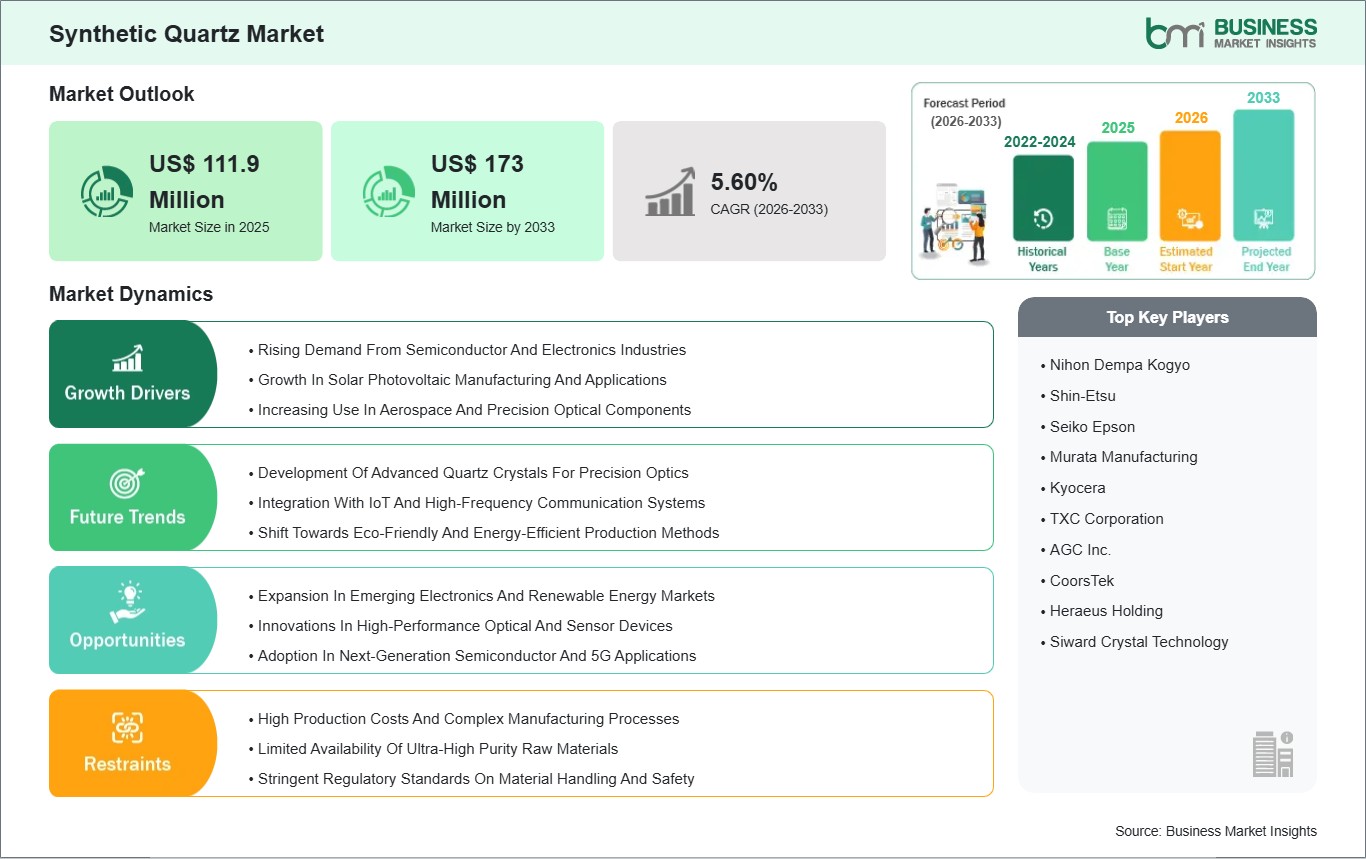
The Synthetic Quartz Market size is expected to reach US$ 173. million by 2033 from US$ 111.9 million in 2025. The market is estimated to record a CAGR of 5.60% from 2026 to 2033.
The global synthetic quartz market is expanding as industries increasingly rely on engineered quartz for high‑performance applications where purity, precision and consistency are essential. Synthetic quartz, which people also call engineered quartz or cultured quartz is produced through controlled manufacturing methods that create high purity silica crystals, which exhibit enhanced mechanical, thermal and optical characteristics. The unique properties of synthetic quartz make it essential for technology-dependent industries, which include electronics and semiconductors, optics and photonics, automotive and aerospace and specialty glass production. The material became popular for use in semiconductor wafer carriers optical lenses UV fused silica windows, and high frequency devices because of its ability to maintain dimensional stability and resist thermal shock and enable precise manufacturing. The advanced electronics manufacturing sector drives market growth because manufacturers need synthetic quartz for essential components, which they use in semiconductor fabrication equipment, fiber optic systems and high precision instruments. Manufacturers are increasingly using synthetic quartz to create dependable electronic devices because global consumers want faster, more efficient and smaller devices.
The growing demand for quartz materials with low thermal expansion and high purity from 5G networks and Internet of Things (IoT) devices and autonomous systems supports the requirement for materials that maintain stability and signal integrity in complex electronic assemblies. The rising use of synthetic quartz in both renewable energy systems and industrial processes serves as another major force driving its growth. The solar panel industry uses high-quality quartz materials to achieve precise results during cleaning and etching processes, while aerospace and defense industries use quartz materials to build optical and sensor systems that need to withstand extreme environmental conditions. The market encounters difficulties because production costs remain high and energy-intensive manufacturing methods drive up prices, which reduces competitiveness in various end-use markets.
The manufacturing process faces limitations because it depends on high-quality raw material availability and unpredictable supply chain disruptions. The development of modern synthesis methods, which include better hydrothermal growth techniques and energy-efficient processing methods has enabled researchers to create better products while reducing manufacturing costs. The development of next-generation quartz materials for new applications is being driven by strategic partnerships between materials scientists and end-use manufacturers who are making capacity investments. The synthetic quartz market is expected to grow steadily worldwide because industries want precision and reliability, and products need performance, which will increase demand for new technologies across different sectors.

Key segments that contributed to the derivation of the synthetic quartz market analysis are type and application.
The global synthetic quartz market is strongly driven by rising demand from semiconductor and electronics industries, where high-purity silica crystals are essential for advanced fabrication and precision components. In semiconductor manufacturing, synthetic quartz is widely used in wafer carriers, crucibles, reactors, and other processing equipment due to its exceptional purity and low thermal expansion. These properties help maintain process stability and prevent contamination during high-temperature cycles, which is critical for producing microchips with shrinking geometries and enhanced performance. Growing investments in chip fabrication facilities worldwide, particularly in North America, Asia Pacific, and Europe, are reinforcing demand for engineered quartz materials that meet stringent quality requirements.
In consumer electronics, synthetic quartz plays a vital role in optical lenses, display panels, and high-frequency components used in smartphones, wearables, and communication devices. Manufacturers are increasingly specifying synthetic quartz over natural alternatives because of its consistent quality and reproducibility, which directly affects device reliability and performance. As electronic devices continue to become more compact and powerful, the demand for materials like synthetic quartz that support miniaturization and high precision continues to expand.
Semiconductor and electronics manufacturers are also collaborating with quartz producers to co-develop application‑specific solutions. These collaborations help ensure that the material properties align with evolving industry needs, such as 5G communications, high-speed computing, and advanced sensor technologies. Through joint research and innovation, the synthetic quartz materials used in electronic applications are becoming more refined, enabling greater integration into next‑generation devices and bolstering market growth globally.
The growth of emerging electronics and renewable energy sectors provides advantages to the worldwide synthetic quartz industry. The demand for synthetic quartz materials increases in Asia Pacific, Latin America and specific Middle Eastern areas because of their industrial growth and rising consumer interest in modern electronic products. China India, and South Korea not only serve as major producers of consumer electronics but also dedicate substantial resources to develop their high precision manufacturing systems. The industry has adopted engineered quartz for use in optical devices, and high frequency components and sensor technology because of its expanding range of applications.
The renewable energy sector has started utilizing synthetic quartz for solar photovoltaic PV manufacturing and energy storage applications. Silicon wafers require quartz materials for their precision cleaning and etching processes and for their high temperature energy conversion equipment components. The global movement toward cleaner energy solutions has created a need for solar panel production facilities that develop in areas that have supportive policies and increasing energy requirements. The expansion of renewable energy installations creates a greater requirement for materials that enable efficient production operations.
Additionally, emerging technologies in energy systems — including advanced battery management and grid infrastructure — require materials with high thermal stability and durability. Synthetic quartz meets these demands, creating new opportunities for market penetration in renewable sectors. With governments and private enterprises pushing for sustainable energy solutions, the application of synthetic quartz in electronics and renewable energy is poised to expand, contributing to broader market growth and diversification on a global scale.

The synthetic quartz market demonstrates steady growth, with size and share analysis highlighting evolving trends and competitive dynamics among key players. The report examines subsegments categorized within type and application, offering insights into their contribution to overall market performance.
By type, the synthetic quartz crystal subsegment dominated the market in 2025, driven by its superior purity, stability, and performance required for precision electronic components.
In terms of application, the electronics & electrical subsegment dominated the market in 2025, driven by growing global demand for semiconductors, communication devices, and high-performance electronic components.
| Report Attribute | Details |
|---|---|
| Market size in 2025 | US$ 111.9 Million |
| Market Size by 2033 | US$ 173 Million |
| Global CAGR (2026 - 2033) | 5.60% |
| Historical Data | 2022-2024 |
| Forecast period | 2026-2033 |
| Segments Covered | By Type
|
|
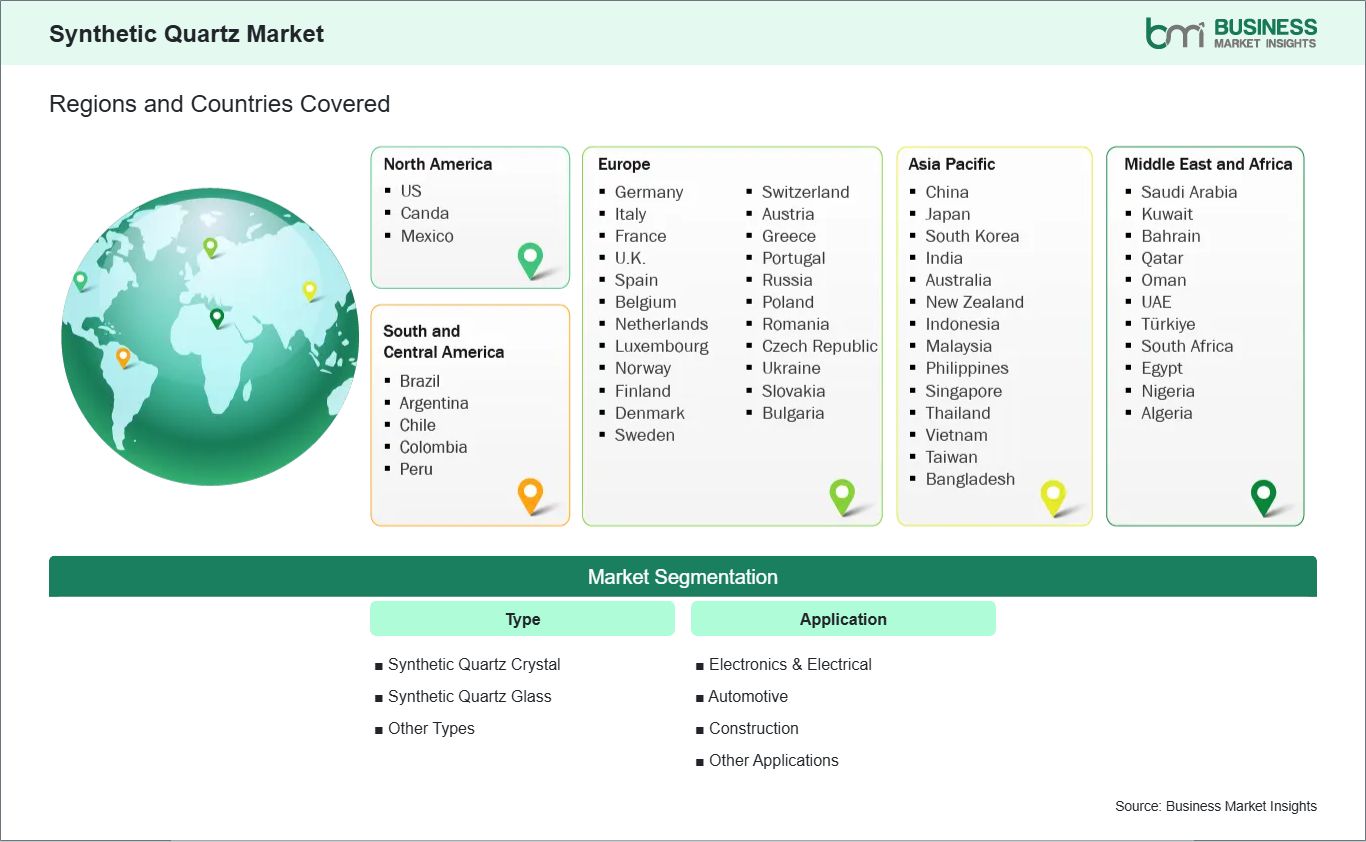
Regions and Countries Covered
| |
| North America | US, Canada, Mexico |
| Europe | Belgium, Austria, Finland, Denmark, Greece, Poland, Romania, Russia, Ukraine, Czech Republic, Slovakia, Bulgaria, Italy, Luxembourg, Germany, Switzerland, France, Netherlands, Norway, Portugal, Spain, Sweden, United Kingdom |
| Asia-Pacific | Australia, China, India, Japan, South Korea, Indonesia, Malaysia, Philippines, Singapore, Thailand, Vietnam, Bangladesh, New Zealand, Taiwan |
| South and Central America | Brazil, Argentina, Peru, Chile, Colombia |
| Middle East and Africa | Bahrain, Kuwait, Oman, Qatar, Saudi Arabia, United Arab Emirates, Turkiye, South Africa, Egypt, Algeria, Nigeria |
| Market leaders and key company profiles |
|
The "Synthetic Quartz Market Size and Forecast (2022 - 2033)" report provides a detailed analysis of the market covering below areas:
The geographical scope of the Synthetic Quartz Market report is divided into North America, Asia Pacific, Europe, Middle East & Africa, and South & Central America. North America held the largest share in 2025.
North America maintains its leading position in synthetic quartz production because high-purity quartz supplies essential needs of its semiconductor, aerospace and electronics sectors, which use quartz for wafer production and optical equipment and high-frequency electronic devices. United States and Canadian territory contains multiple semiconductor research centers, which drive new developments in quartz production methods and their use in photonics, sensor systems and high-accuracy measurement devices. Aerospace and defense industries drive quartz demand because they use the mineral in navigation systems, satellite optical equipment and sensors, which need advanced thermal resistance and strength. Asia Pacific shows the highest market growth because China, Japan and South Korea and India increase their production capacity for electronics and solar photovoltaic systems. The region's rapid industrial growth together with its rising consumer electronics usage and its major renewable energy investments create a rising demand for synthetic quartz to manufacture wafer carriers, solar inspection equipment and high-precision optical systems. Europe's market exists through strict quality requirements and its established automotive, aerospace and industrial manufacturing industries and its active research partnerships, which develop future quartz materials. Germany France, and Italy have advanced engineering capabilities that produce precise optical systems that make them vital to the field. The Middle East and Africa experience moderate demand because new high-tech manufacturing facilities, oil and gas instrumentation needs and renewable energy projects that use quartz-based sensors and optical components drive demand while the region faces problems with insufficient local production capabilities and needs to depend on imported products. South and Central America brings value to the market through its specialized uses, which exist in three sectors electronics aerospace maintenance and industrial automation with Brazil and Mexico showing the most usage across the area. The global synthetic quartz market exists because North America leads the market while Asia Pacific shows growth, and Europe develops high-quality products through research, and the Middle East and Africa and Latin America provide new business opportunities that use synthetic quartz in numerous industries from electronics to renewable energy to precision optics.

The Synthetic Quartz Market is evaluated by gathering qualitative and quantitative data post primary and secondary research, which includes important corporate publications, association data, and databases. A few of the key developments in the synthetic quartz market are:
The Synthetic Quartz Market is valued at US$ 111.9 Million in 2025, it is projected to reach US$ 173 Million by 2033.
As per our report Synthetic Quartz Market, the market size is valued at US$ 111.9 Million in 2025, projecting it to reach US$ 173 Million by 2033. This translates to a CAGR of approximately 5.60% during the forecast period.
The Synthetic Quartz Market report typically cover these key segments-
The historic period, base year, and forecast period can vary slightly depending on the specific market research report. However, for the Synthetic Quartz Market report:
The Synthetic Quartz Market is populated by several key players, each contributing to its growth and innovation. Some of the major players include:
The Synthetic Quartz Market report is valuable for diverse stakeholders, including:
Essentially, anyone involved in or considering involvement in the Synthetic Quartz Market value chain can benefit from the information contained in a comprehensive market report.
Please tell us your area of interest
(Market Segments/ Regions and Countries/ Companies)