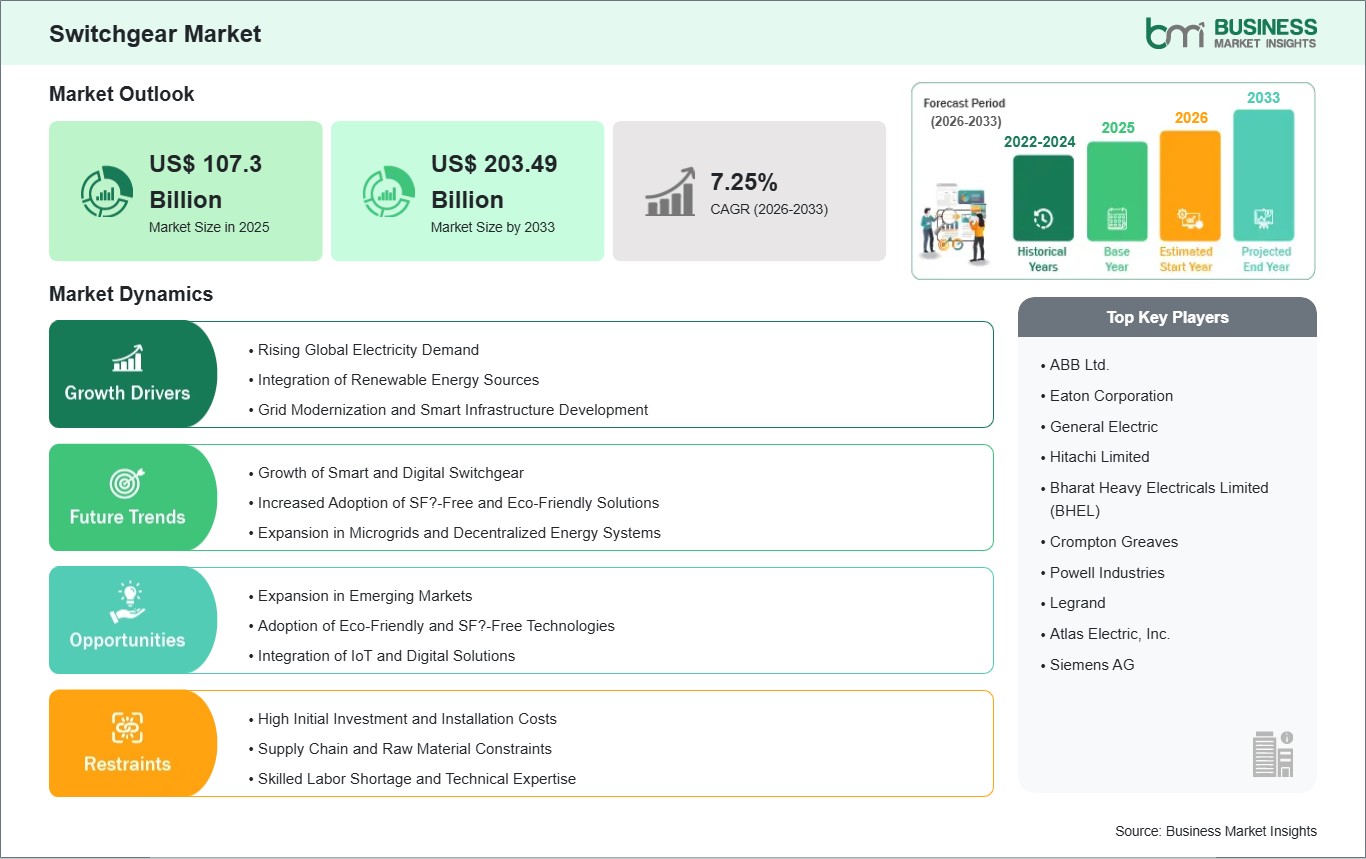
The switchgear market size is expected to reach US$ 203.49 billion by 2033 from US$ 107.30 billion in 2025. The market is estimated to record a CAGR of 7.25% from 2026 to 2033.
Switchgear refers to electrical equipment used to control, protect, isolate, and monitor electrical circuits and equipment, ensuring safe and reliable power distribution in electrical systems. It includes components such as circuit breakers, disconnect switches, relays, fuses, and busbars that enable fault interruption, overload protection, and electrical isolation to prevent damage and enhance safety. Switchgear delivers benefits like improved operational efficiency, enhanced system protection, minimized downtime during faults, and support for grid stability and automation. It finds applications across power generation, transmission and distribution networks, industrial facilities, commercial buildings, and residential infrastructure, as well as in data centers, renewable energy plants, and transportation electrification projects.
The switchgear market continues to expand due to several key drivers: the rising global demand for electricity, driven by population growth, industrialization, urbanization, and expanding infrastructure; the integration of renewable energy sources requiring upgraded grid management; and grid modernization efforts, including smart grids and EV charging infrastructure that demand advanced protection and control devices. Regulatory and safety standards also push utilities and industries toward modern switchgear solutions with better reliability and efficiency, while the adoption of digital monitoring and predictive maintenance adds value for end users.

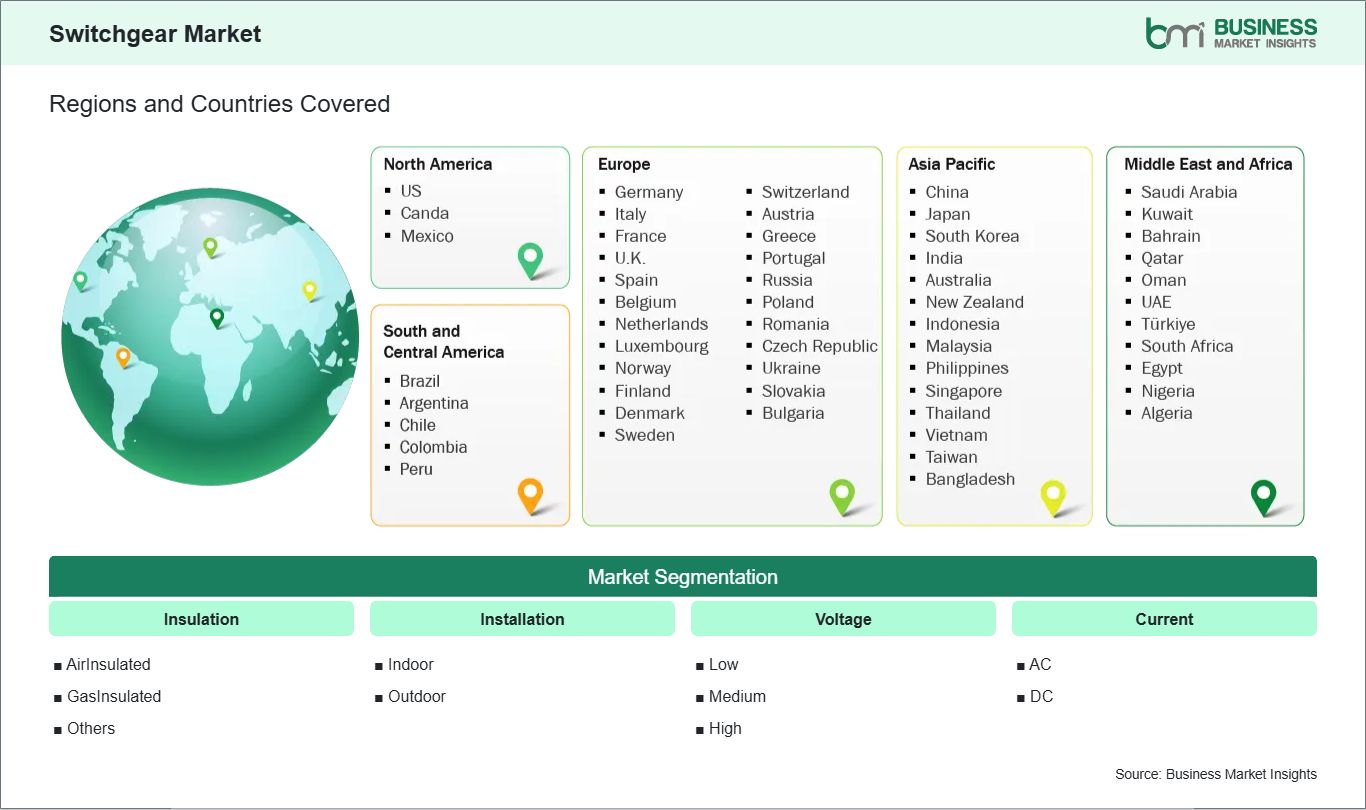
Key segments that contributed to the derivation of the switchgear market analysis are Insulation, Installation, Voltage, Current and end user.
Increasing population, rapid urbanization, and industrialization are driving a surge in electricity consumption worldwide. As countries expand infrastructure, factories, commercial spaces, and residential areas, the demand for reliable power distribution systems grows. Switchgear plays a crucial role in ensuring safe, efficient, and continuous electricity supply, protecting grids from faults, overloads, and short circuits. Utilities and industrial sectors are investing in modern switchgear solutions to prevent downtime, enhance operational efficiency, and support expanding power networks. This rising electricity requirement across emerging and developed markets acts as a primary growth driver, compelling manufacturers to innovate and scale production to meet diverse voltage, current, and environmental requirements globally.
Environmental regulations targeting greenhouse gas emissions have increased demand for sustainable switchgear. SF₆ gas, traditionally used for Insulation, is a potent greenhouse gas, prompting manufacturers to develop eco-friendly alternatives such as vacuum or solid-insulated switchgear. This creates opportunities for companies to innovate and differentiate their product offerings while meeting global sustainability targets. Adoption of such green technologies is particularly strong in Europe, North America, and Asia, driven by both regulatory compliance and corporate sustainability goals. The growing focus on reducing environmental impact while maintaining grid reliability positions eco-friendly switchgear as a high-potential segment, attracting investments and partnerships for research, production, and deployment worldwide.
By Insulation, the market is segmented into Air-Insulated, Gas-Insulated, and Others. The Air-Insulated segment dominated the market in 2024. The Air-Insulated Switchgear segment uses air as the primary insulating medium, offering cost-effective, reliable solutions for medium- and high-voltage applications. Widely deployed in power transmission and distribution, AIS provides easy maintenance, compact design, and adaptability, supporting grid reliability and industrial electrification projects.
By Installation, the market is segmented into Indoor, Outdoor. The Indoor segment held the largest share of the market in 2024. The Indoor Switchgear segment includes equipment installed within buildings or enclosed facilities, protecting electrical systems from environmental factors. Ideal for commercial, industrial, and utility applications, it offers enhanced safety, compact design, controlled conditions, and easy maintenance, supporting reliable power distribution in confined or urban spaces.
By Voltage, the market is segmented into Low, Medium, and High. The High segment held the largest share of the market in 2024. The High Voltage Switchgear segment handles voltages above 36 kV, enabling efficient transmission and distribution of electricity over long distances. Essential for utilities, power plants, and large industrial networks, it ensures system protection, reliability, fault isolation, and supports integration of renewable energy and smart grid infrastructure.
By Current, the market is segmented into AC, DC. The Indoor segment held the largest share of the market in 2024. The AC segment manages the distribution and protection of alternating current in electrical networks. Widely used in industrial, commercial, and utility systems, AC switchgear ensures safety, fault isolation, efficient power flow, and supports reliable operation in both low- and high-voltage applications.
By End User, the market is segmented into Transmission & Distribution Utilities, Industrial, Commercial & Residential, Water & Wastewater, Data Center, and Others. The Transmission & Distribution Utilities segment held the largest share of the market in 2024. The Transmission & Distribution Utilities segment includes power companies responsible for transmitting and distributing electricity to end users. They rely on switchgear for grid protection, fault management, and system reliability, ensuring efficient power flow, minimizing downtime, and supporting modernization and renewable energy integration.

| Report Attribute | Details |
|---|---|
| Market size in 2025 | US$ 107.3 Billion |
| Market Size by 2033 | US$ 203.49 Billion |
| Global CAGR (2026 - 2033) | 7.25% |
| Historical Data | 2022-2024 |
| Forecast period | 2026-2033 |
| Segments Covered | By Insulation
|
|
Regions and Countries Covered
| |
| North America | US, Canada, Mexico |
| Europe | Belgium, Austria, Finland, Denmark, Greece, Poland, Romania, Russia, Ukraine, Czech Republic, Slovakia, Bulgaria, Italy, Luxembourg, Germany, Switzerland, France, Netherlands, Norway, Portugal, Spain, Sweden, United Kingdom |
| Asia-Pacific | Australia, China, India, Japan, South Korea, Indonesia, Malaysia, Philippines, Singapore, Thailand, Vietnam, Bangladesh, New Zealand, Taiwan |
| South and Central America | Brazil, Argentina, Peru, Chile, Colombia |
| Middle East and Africa | Bahrain, Kuwait, Oman, Qatar, Saudi Arabia, United Arab Emirates, Turkiye, South Africa, Egypt, Algeria, Nigeria |
| Market leaders and key company profiles |
|
The Switchgear Market Size and Forecast (2022–2033) report provides a detailed analysis of the market covering below areas:
The geographical scope of the Switchgear market report is divided into five regions: North America, Asia Pacific, Europe, Middle East &; Africa, and South & Central America. The IoT sensor market in Asia Pacific is expected to grow significantly during the forecast period.
The Asia-Pacific Switchgear market is segmented into China, Japan, South Korea, India, Australia, New Zealand, Indonesia, Malaysia, the Philippines, Singapore, Thailand, Vietnam, Taiwan, Bangladesh, and the Rest of Asia. The Asia-Pacific Switchgear market is experiencing robust growth, driven by rapid urbanization, expanding industrialization, rising electricity demand, large-scale infrastructure development, renewable energy integration, grid modernization initiatives, and strong government investments in transmission and distribution networks across emerging economies such as China, India, and Southeast Asia.
Additionally, increasing adoption of smart grids, electrification of transportation, growing data center investments, and supportive regulatory policies promoting energy efficiency and sustainable power infrastructure are further accelerating switchgear demand across the Asia-Pacific region.

The switchgear market is evaluated by gathering qualitative and quantitative data post primary and secondary research, which includes important corporate publications, association data, and databases. A few of the key developments in the Switchgear market are:
The Switchgear Market is valued at US$ 107.3 Billion in 2025, it is projected to reach US$ 203.49 Billion by 2033.
As per our report Switchgear Market, the market size is valued at US$ 107.3 Billion in 2025, projecting it to reach US$ 203.49 Billion by 2033. This translates to a CAGR of approximately 7.25% during the forecast period.
The Switchgear Market report typically cover these key segments-
The historic period, base year, and forecast period can vary slightly depending on the specific market research report. However, for the Switchgear Market report:
The Switchgear Market is populated by several key players, each contributing to its growth and innovation. Some of the major players include:
The Switchgear Market report is valuable for diverse stakeholders, including:
Essentially, anyone involved in or considering involvement in the Switchgear Market value chain can benefit from the information contained in a comprehensive market report.
Please tell us your area of interest
(Market Segments/ Regions and Countries/ Companies)