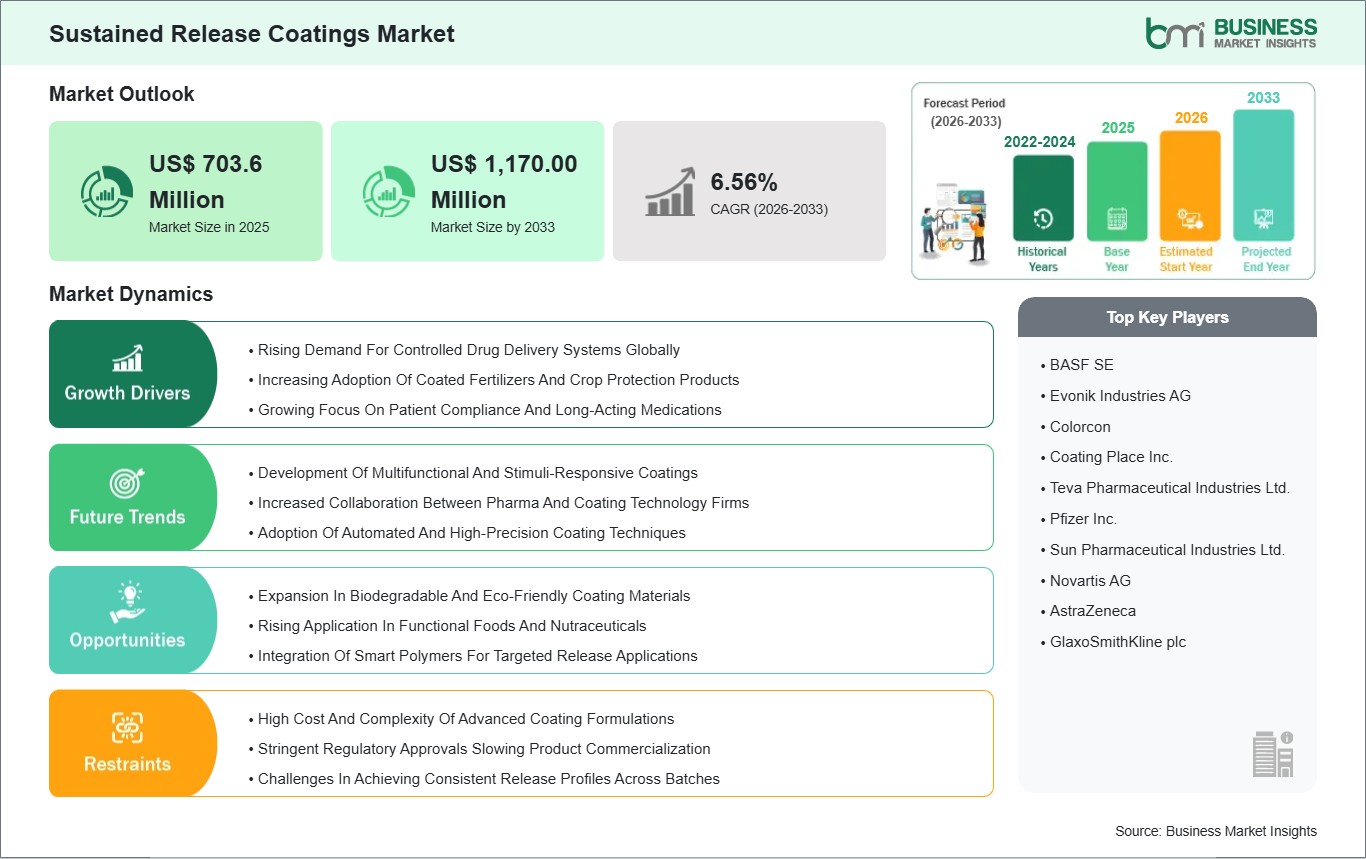
The Sustained Release Coatings Market size is expected to reach US$ 1,170. million by 2033 from US$ 703.6 million in 2025. The market is estimated to record a CAGR of 6.56% from 2026 to 2033.
The global market for sustained release coatings has begun to develop strong momentum because various industries now prefer to use controlled delivery systems, which deliver precise doses to their products in the fields of pharmaceuticals, agriculture, food production and specialty chemical applications. Sustained release coatings consist of polymer materials that producers use to create protective coatings that control active ingredient discharge over long periods to achieve better operational results while decreasing the number of required doses, which enables users to take their medication more easily. These coatings enable manufacturers of oral solid dosage forms, which include tablets and capsules to create precise drug release patterns that match specific therapeutic requirements. The controlled release technology helps various industries, including pharmaceuticals, fertilizers, seeds, and food additives, to enhance their product performance while reducing environmental waste. The global use of these coating systems continues to expand because organizations now require their products to achieve greater operational efficiency and better performance while providing greater benefits to their end users.
The market experiences growth because consumers increasingly seek sophisticated drug delivery systems, which help them treat chronic illnesses that need ongoing medication. The application of sustained release coatings helps sustain constant drug levels in the bloodstream, which results in fewer necessary medication doses and better health results for patients. The functional capabilities of these coatings have expanded through polymer science advances, which introduced biodegradable and bio-based coating materials to different industrial sectors. The agricultural sector now utilizes coated fertilizers and seeds to boost nutrient absorption while decreasing environmental runoff, which helps achieve worldwide sustainability objectives. The market has specific limitations that stem from difficulties found in creating and producing products. The process needs exact management of all three elements coating thickness, coating composition and coating application methods because these elements determine the release pattern. The development process takes longer because regulatory authorities examine pharmaceutical products that use new coating materials. Ongoing research together with cross-industry partnerships leads to new innovations that develop advanced multifunctional coatings that possess better performance capabilities.
The global demand for next-generation products will maintain sustained release coatings as an essential element of product development in all industries that require efficient sustainable delivery systems that perform at high standards.

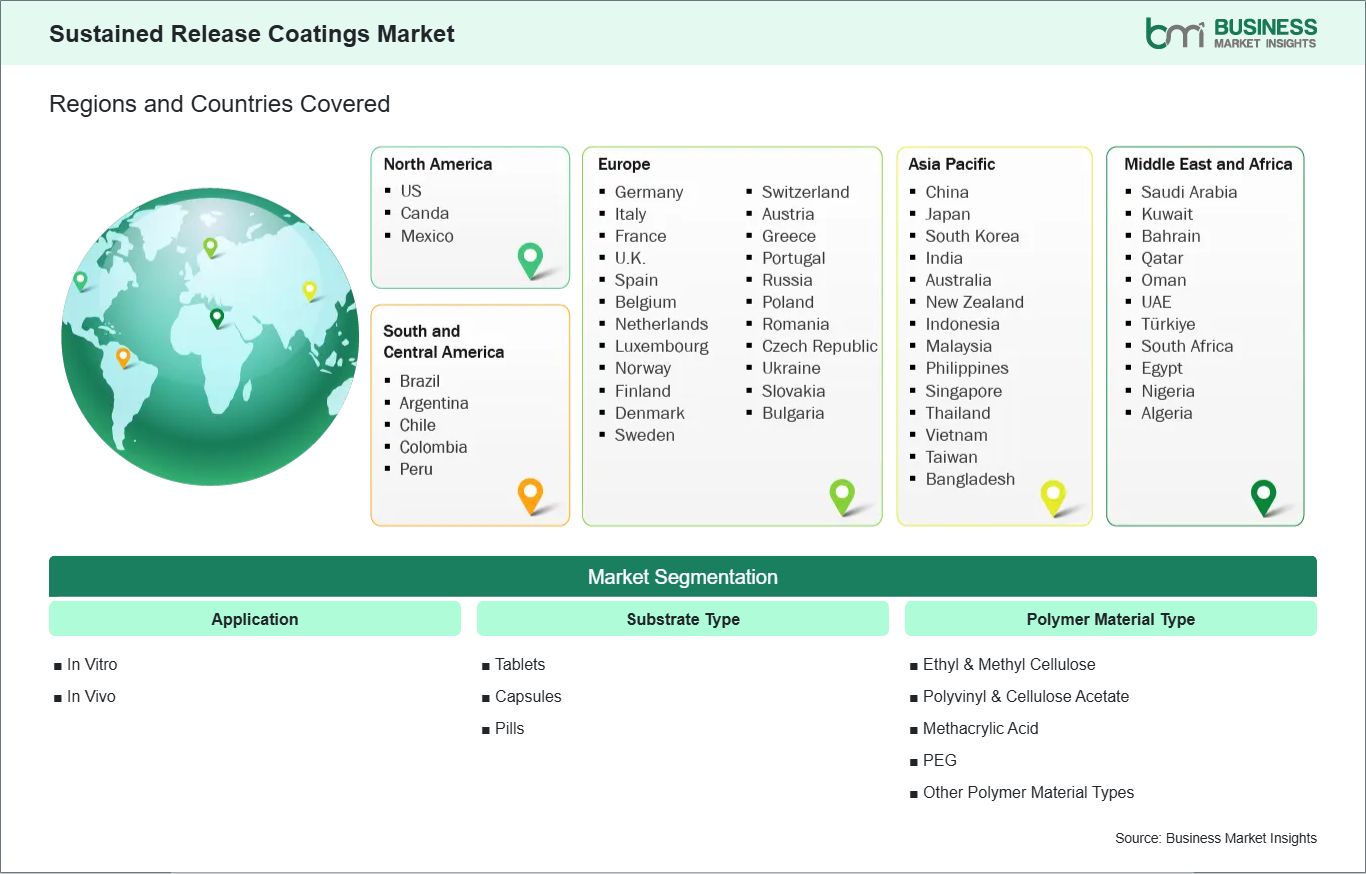
Key segments that contributed to the derivation of the sustained release coatings market analysis are application, substrate type, and polymer material type.
The global demand for controlled drug delivery systems has surged as healthcare providers and pharmaceutical companies seek solutions that improve patient compliance and optimize therapeutic outcomes. Sustained release coatings play a pivotal role in this trend by enabling precise modulation of drug release profiles over extended periods. In North America, the high prevalence of chronic diseases such as diabetes, cardiovascular disorders, and neurological conditions has accelerated the adoption of tablets and capsules with advanced polymer coatings. These coatings maintain stable plasma concentrations, reduce dosing frequency, and improve overall patient adherence, making them a critical tool for long-term treatment regimens.
Pharmaceutical R&D in Europe and Asia Pacific is increasingly focused on modifying drug release kinetics through innovative coating technologies. Countries like Germany, Japan, and India are leveraging polymer-based coatings to improve solubility, protect sensitive compounds, and reduce gastrointestinal side effects. Contract development and manufacturing organizations (CDMOs) are also integrating high-precision coating equipment to ensure batch-to-batch consistency, addressing a key challenge in large-scale production.
Additionally, sustained release coatings are being applied in combination products such as orally disintegrating tablets and implantable devices, where consistent drug delivery is essential. Regulatory agencies are encouraging the adoption of these technologies by emphasizing patient-centric formulations, which has further boosted investments in formulation innovation. As a result, sustained release coatings are increasingly viewed as a strategic differentiator for pharmaceutical products globally, with adoption spreading across therapeutic areas and delivery formats.
The shift toward biodegradable and eco-friendly coating materials is redefining the global sustained release coatings market. Manufacturers are developing polymer coatings derived from natural sources, such as cellulose derivatives, starch, and polylactic acid, to meet growing environmental regulations and sustainability demands. North America leads this transformation, with pharmaceutical and agricultural industries prioritizing materials that reduce ecological impact without compromising functional performance. Coated fertilizers and slow-release pesticides exemplify the dual benefit of enhanced efficiency and minimized environmental runoff, supporting both productivity and sustainability goals.
In Asia Pacific, rising environmental awareness and stricter regulations on chemical usage are driving the adoption of biodegradable coatings in pharmaceuticals, nutraceuticals, and agricultural products. Companies in Japan, China, and India are investing in bio-based polymers that offer controlled release properties while being fully degradable, aligning with global sustainability initiatives. These coatings are increasingly replacing conventional synthetic polymers in applications where residual accumulation can pose environmental concerns.
Europe is also witnessing innovation in multifunctional eco-friendly coatings that combine controlled release with additional benefits such as moisture resistance, taste masking, or UV protection. Research collaborations between universities and industry players are accelerating material development and testing, enabling faster commercialization. As global end-users continue to prioritize environmental responsibility, biodegradable and sustainable coatings are emerging as a significant growth segment, with potential to transform both pharmaceutical and agricultural applications worldwide.

The sustained release coatings market demonstrates steady growth, with size and share analysis highlighting evolving trends and competitive dynamics among key players. The report examines subsegments categorized within application, substrate type, and polymer material type, offering insights into their contribution to overall market performance.
By application, the in vitro subsegment dominated the market in 2025, driven by its critical role in drug formulation testing, quality control, and cost-effective evaluation of release profiles.
Based on substrate type, the tablets subsegment dominated the market in 2025, driven by their widespread use, ease of manufacturing, and suitability for controlled drug delivery systems.
On the basis of polymer material type, the ethyl & methyl cellulose subsegment dominated the market in 2025, driven by its excellent film-forming ability and effectiveness in controlling drug release rates in pharmaceutical coatings.
| Report Attribute | Details |
|---|---|
| Market size in 2025 | US$ 703.6 Million |
| Market Size by 2033 | US$ 1,170.00 Million |
| Global CAGR (2026 - 2033) | 6.56% |
| Historical Data | 2022-2024 |
| Forecast period | 2026-2033 |
| Segments Covered | By Application
|
|
Regions and Countries Covered
| |
| North America | US, Canada, Mexico |
| Europe | Belgium, Austria, Finland, Denmark, Greece, Poland, Romania, Russia, Ukraine, Czech Republic, Slovakia, Bulgaria, Italy, Luxembourg, Germany, Switzerland, France, Netherlands, Norway, Portugal, Spain, Sweden, United Kingdom |
| Asia-Pacific | Australia, China, India, Japan, South Korea, Indonesia, Malaysia, Philippines, Singapore, Thailand, Vietnam, Bangladesh, New Zealand, Taiwan |
| South and Central America | Brazil, Argentina, Peru, Chile, Colombia |
| Middle East and Africa | Bahrain, Kuwait, Oman, Qatar, Saudi Arabia, United Arab Emirates, Turkiye, South Africa, Egypt, Algeria, Nigeria |
| Market leaders and key company profiles |
|
The "Sustained Release Coatings Market Size and Forecast (2022 - 2033)" report provides a detailed analysis of the market covering below areas:
The geographical scope of the Sustained Release Coatings Market report is divided into North America, Asia Pacific, Europe, Middle East & Africa, and South & Central America. North America held the largest share in 2025.
The global market for sustained release coatings is primarily controlled by North America because its pharmaceutical and biotechnology industries are advanced while its businesses widely use controlled drug delivery systems, and its research and development facilities operate at a high level. The region needs extensive sustained release coating applications for its oral solid dosage forms, injectables and implantable devices because patients with chronic diseases require long-acting medications. Research institutions, leading pharmaceutical companies, contract manufacturing organizations and specialized polymer coating manufacturers work together to create new products which include biodegradable, pH-responsive and multifunctional coatings that enhance drug delivery and boost treatment success. North America markets sustained release coatings for agricultural purposes because the region needs coated fertilizers and seeds to improve nutrient efficiency and decrease environmental damage while fulfilling sustainability goals.
The Asia Pacific region is developing into a fast-growing area because of its improved healthcare systems, increased pharmaceutical production capacity and better understanding of modern drug delivery methods. China, India and Japan are increasing their investments in coating technologies which serve different needs of agricultural applications and medical field needs by improving therapeutic outcomes and patient adherence through their use of precision agriculture technologies and sustainable agricultural practices.
The European economy grows at a moderate pace because its established pharmaceutical industry operates under strict regulatory requirements while developing new drug technologies. The companies from Germany Switzerland, and the United Kingdom use sustained release coatings to improve their complex dosage systems because these coatings help their products work better while decreasing the number of needed doses.
The Middle East and Africa market currently exists at a smaller size, which experiences continuous growth because urban healthcare centers and modern pharmaceutical manufacturing facilities receive increasing investment. The market development receives support from initiatives that establish local production facilities for controlled-release medicines and improve agricultural efficiency.
South American and Central American countries begin to adopt sustained release coatings for use in pharmaceutical products and crop protection products because governments and private companies work to expand healthcare access and boost agricultural productivity.
The rising understanding of patient compliance advantages and environmental benefits from coated fertilizers drives Brazil and Mexico to lead the regional adoption of these products.

The Sustained Release Coatings Market is evaluated by gathering qualitative and quantitative data post primary and secondary research, which includes important corporate publications, association data, and databases. A few of the key developments in the sustained release coatings market are:
The Sustained Release Coatings Market is valued at US$ 703.6 Million in 2025, it is projected to reach US$ 1,170.00 Million by 2033.
As per our report Sustained Release Coatings Market, the market size is valued at US$ 703.6 Million in 2025, projecting it to reach US$ 1,170.00 Million by 2033. This translates to a CAGR of approximately 6.56% during the forecast period.
The Sustained Release Coatings Market report typically cover these key segments-
The historic period, base year, and forecast period can vary slightly depending on the specific market research report. However, for the Sustained Release Coatings Market report:
The Sustained Release Coatings Market is populated by several key players, each contributing to its growth and innovation. Some of the major players include:
The Sustained Release Coatings Market report is valuable for diverse stakeholders, including:
Essentially, anyone involved in or considering involvement in the Sustained Release Coatings Market value chain can benefit from the information contained in a comprehensive market report.
Please tell us your area of interest
(Market Segments/ Regions and Countries/ Companies)