Market Summary
Executive Summary and Global Market Analysis
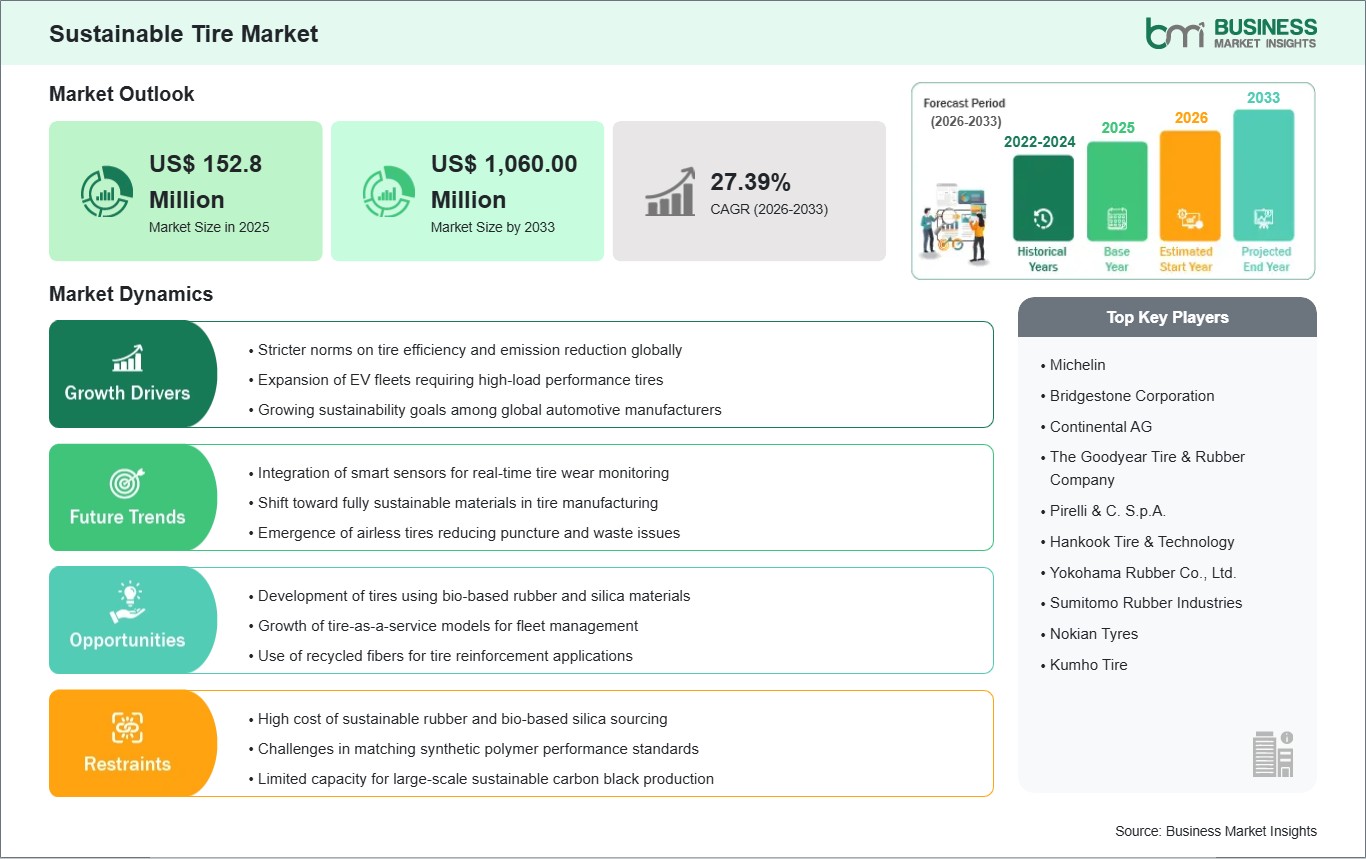
The sustainable tire market is in a stage of structural change with the global automotive industry shifting towards a completely carbon-neutral future. The sustainable tire market is characterized by the replacement of traditional petroleum-based materials with renewable, recycled, and bio-based materials without affecting the tire's performance and safety characteristics. The sustainable tire market is dominated by radial tires and passenger cars, where the need for fuel efficiency and reduced road noise is a major problem. Advances in the field of material science have allowed tire manufacturers to produce tires that not only provide better rolling resistance and longer tire life but also minimize the environmental footprint of a vehicle during its useful life.
Growth in this sector is driven by a combination of stringent international regulations and a fundamental shift in consumer behavior toward green mobility. While the market faces challenges related to the higher cost of sustainable feedstocks and the need for specialized manufacturing equipment, the long-term outlook is highly positive. Major industry players are committing to ambitious goals, such as producing tires made from 100 percent sustainable materials within the next few decades. As electric vehicle adoption continues to rise, the need for specialized sustainable tires that can handle higher torque and weight will further accelerate market expansion. The future of the industry lies in the successful integration of circular economy principles, from raw material sourcing to advanced tire recycling technologies.
Segment Analysis
Sustainable Tire Market Segmentation
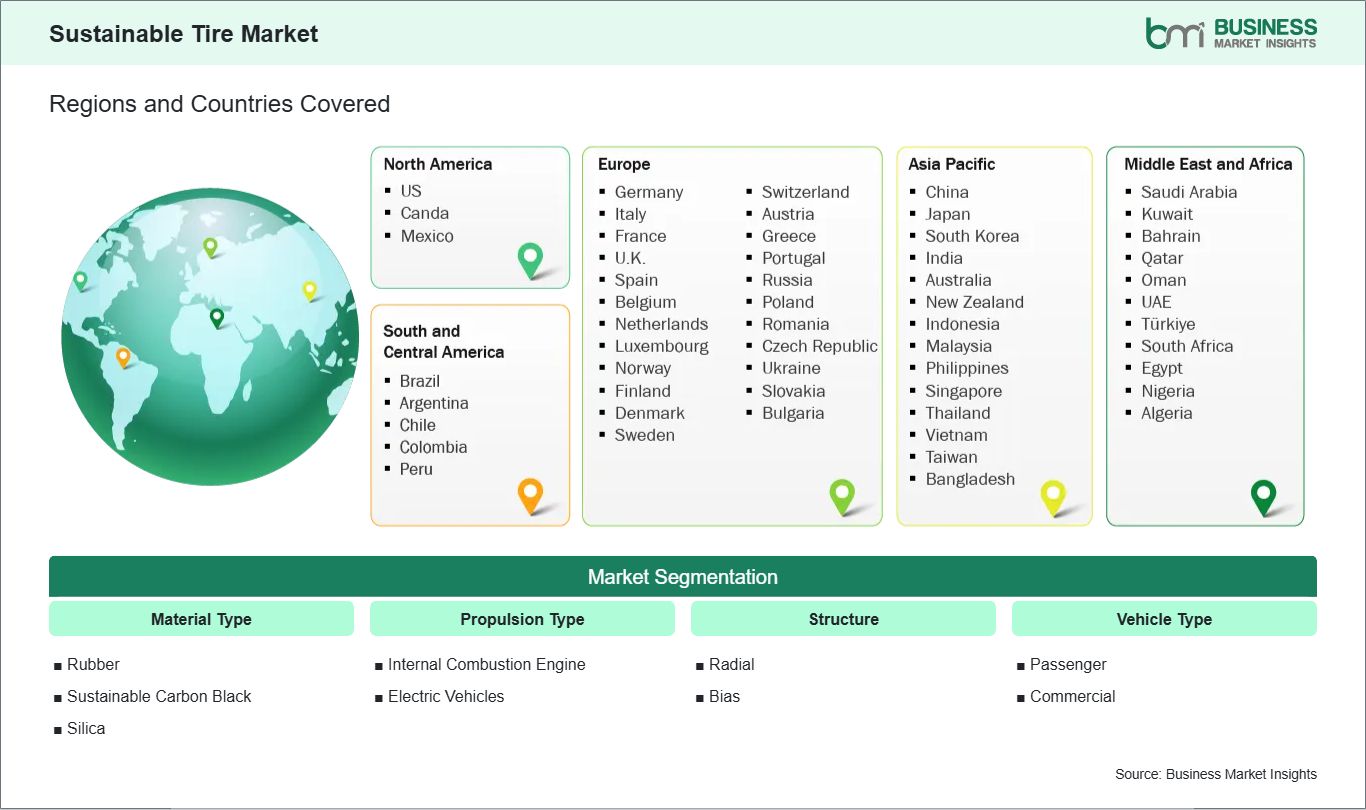
Key segments that contributed to the derivation of the Sustainable Tire market analysis are material type, propulsion type, structure, and vehicle type.
- By material type, the sustainable tire market is segmented into Rubber, Sustainable Carbon Black, and Silica. The Rubber segment dominated the market in 2025.
- By propulsion type, the sustainable tire market is segmented into Internal Combustion Engine and Electric Vehicles. The Internal Combustion Engine segment dominated the market in 2025.
- By structure, the sustainable tire market is segmented into Radial and Bias. The Radial segment dominated the market in 2025.
- By vehicle type, the sustainable tire market is segmented into Passenger and Commercial. The Passenger segment dominated the market in 2025.
Market Forces
Sustainable Tire Market Drivers and Opportunities
Stricter government regulations regarding tire rolling resistance and emissions
The primary catalyst for the sustainable tire market is the introduction of rigorous environmental standards aimed at reducing the carbon footprint of the transportation sector. Many regions have implemented mandatory tire labeling systems that rate products based on fuel efficiency, wet grip, and external noise. These regulations force manufacturers to innovate by incorporating advanced materials like highly dispersible silica and bio-based oils that lower rolling resistance. By reducing the energy required to move the vehicle, these sustainable tires directly lower fuel consumption for traditional engines and extend the battery range for electric models, helping automakers meet overall fleet emission targets.
Besides getting things done in a better way, new rules are also pointing towards reducing the environmental harm caused by the shedding of tire particles and the disposal of tires at the end of their lifecycle. Lawmakers are putting their sights on the circular economy and proposing incentives for the use of reclaimed rubber and sustainable fillers, which could be disposed of easily once the tire has ended its lifecycle. This regulatory thump has transformed eco-friendly tires from being a niche and luxury product to a fundamental part of mainstream automobile manufacturing. Those companies that do not align their production with these eco-standards will be exposed to, among others, high penalties and a possible lockout from major international markets where green procurement policies are becoming common.
Development of tires using dandelion-derived rubber and rice husk silica
A significant growth opportunity in the market is the commercialization of alternative raw materials that reduce the industry dependency on traditional hevea rubber and petroleum-based fillers. For example, the extraction of rubber from the roots of Russian dandelions offers a sustainable and locally sourced alternative that does not contribute to tropical deforestation. Similarly, silica produced from rice husk ash—an agricultural byproduct—provides a high-performance reinforcing filler that enhances wet traction and fuel efficiency. These bio-based innovations allow tire makers to diversify their supply chains and reduce their vulnerability to the price volatility of conventional commodities.
This shift toward agricultural byproducts not only improves the environmental profile of the tire but also supports rural economies by creating new value streams for waste products. As the technology for processing these materials matures, the production costs are expected to decrease, making sustainable tires more price-competitive with traditional options. Brands that successfully integrate these bio-derived materials can market their products to environmentally conscious consumers who prioritize transparency and ethical sourcing. This opportunity extends beyond passenger cars to heavy-duty commercial segments, where the durability and heat resistance of these new compounds are currently undergoing rigorous field testing.
Size and Share Analysis
Sustainable Tire Market Size and Share Analysis
The global Sustainable Tire market is experiencing steady growth, with market size and share analysis reflecting evolving treatment preferences and competitive dynamics among key players. The report evaluates important subsegments categorized material type, propulsion type, structure, and vehicle type, highlighting their respective contributions to overall market performance.
By material type, the Rubber subsegment dominated the market in 2025 because natural and reclaimed rubber serve as the primary foundational components for tire treads and sidewalls, offering the essential elasticity and durability required for safe road performance.
By propulsion type, the Internal Combustion Engine subsegment dominated the market in 2025 due to the massive global existing fleet of traditional vehicles and the widespread availability of fuel-efficient green tires designed to reduce carbon emissions for standard gasoline and diesel engines.
By structure, the Radial subsegment dominated the market in 2025 as its flexible sidewalls and tough tread belts provide superior fuel economy, longer tread life, and better heat dissipation, making it the industry standard for modern automotive efficiency.
By vehicle type, the Passenger subsegment dominated the market in 2025 because of the high volume of individual car ownership worldwide and the strong consumer demand for eco-friendly tires that improve mileage and reduce the total cost of vehicle operation.
Report Coverage
Sustainable Tire Market Report Coverage and Deliverables
The "Sustainable Tire Market Market Size and Forecast (2022 - 2033)" report provides a detailed analysis of the market covering below areas:
- Sustainable Tire Market market size and forecast at the regional and country levels for segments covered under the scope
- Sustainable Tire Market market trends, as well as drivers, restraints, and opportunities
- Sustainable Tire Market market analysis covering key trends, regional framework, major players, regulations, and recent developments
- Industry landscape and competition analysis covering market concentration, heat map analysis, prominent players, and recent developments for the Sustainable Tire Market market
- Detailed company profiles, including SWOT analysis
Geographic Insights
Sustainable Tire Market Geographic Insights
The geographical scope of the Sustainable Tire market report is divided into: North America, Asia Pacific, Europe, Middle East & Africa, and South & Central America. North America held the largest share in 2025.
North America leads the sustainable tire market, a position rooted in its advanced automotive research ecosystem and a high consumer demand for high-performance, fuel-efficient products. The region dominance is particularly strong in the United States, where strict fuel economy standards and corporate average fuel economy (CAFE) requirements have pushed tire manufacturers to prioritize low-rolling-resistance technologies.
Additionally, the presence of major global tire headquarters and dedicated R&D centers in the region has fostered the development of cutting-edge sustainable materials, such as soybean oil-based rubber and recycled polyester cords. The North American market also benefits from a robust logistics and transportation sector that is increasingly adopting green tires to lower fleet operational costs and meet corporate sustainability mandates.
The leadership of North America is further supported by significant government incentives for electric vehicle adoption and domestic manufacturing of green technologies. The region's consumers are among the most willing to adopt premium, eco-labeled products, providing a steady market for the latest sustainable tire innovations. Furthermore, the well-established tire recycling infrastructure in Canada and the U.S. supports a growing market for retreaded and reclaimed rubber products, particularly in the commercial vehicle segment. While other regions are expanding their sustainable manufacturing capacity, North America`s combination of technological leadership, supportive regulatory frameworks, and a mature aftermarket for premium tires ensures it remains the primary driver of market value and innovation.
Industry Activity
Recent Developments
The Sustainable Tire market is evaluated by gathering qualitative and quantitative data post primary and secondary research, which includes important corporate publications, association data, and databases. A few of the key developments in the Sustainable Tire market are:
- In June 2025, Continental AG announced that it had increased the share of renewable and recycled materials in its tire production, reinforcing its commitment to sustainability and reducing reliance on fossil-based inputs.
- In June 2025, Pirelli announced that it had published its 2024 Sustainability Report, detailing progress on sustainable tire development, carbon reduction targets, and expanded use of bio-based and recycled materials in its product portfolio.
Trust & Transparency
Research Methodology
The market analysis combines proprietary research with secondary data from government agencies, company disclosures, regulatory filings, industry databases and expert interviews. Market estimates are validated through data triangulation, cross-market benchmarking and analyst
review.
View Full Research Methodology
Key Sources Referred:
WPO (World Packaging Organization) SPC (Sustainable Packaging Coalition) FPA (Flexible Packaging Association) PMMI (The Association for Packaging and Processing Technologies) FEFCO (European Federation of Corrugated Board Manufacturers) AIPIA (Active & Intelligent Packaging Industry Association) IAPRI (International Association of Packaging Research Institutes) APR (Association of Plastic Recyclers) GPI (Glass Packaging Institute) Company Websites Company Annual Reports Company Investor Presentations